Merged DDWFTTW in a “Real” Wind

Status
Not open for further replies.
For anyone who did not bother to really read this post of ppg's it really is worth a look. It displays a level of ignorance about basic physics that really is extraordinary. As I have said before I think some folks give ppg more credit than Humber because he hides his nonsense in prose so it doesn't jump out at you in the same way

100% correct. I am always completely amazed when people claim he has the ability to do basic physics or math. The claim seems to be that he can do basic physics - except for his astonishingly blatant errors. I'm pretty sure my physics professors would have described that as not being able to do physics.
 
100% correct. I am always completely amazed when people claim he has the ability to do basic physics or math. The claim seems to be that he can do basic physics - except for his astonishingly blatant errors. I'm pretty sure my physics professors would have described that as not being able to do physics.

Then you can correct the above post, can't you?
The prop will be producing static thrust so an efficiency of around 10% can be expected.
Propcalc say similar props to the GWS Slowfly are in that range, though 1N is very optimistic, though the 0.04N I calculated, is not and quite a practical value.

Cheap shaft encoders can be taken from a ball mouse or old printer. A "trivial" matter for you?
 
Last edited:
You no longer matter!

Then you will need to show why the I Ratant's cart does not work, and show one the beats the popcorn.
Trying to divorce yourself from yours and JB's claim about popcorn and bricks, shows how weak your arguments are.

Why in the world should I have to show why I Ratant's card doesn't work? I don't care about non-working carts.

I don't know what JBs argument is about popcorn and bricks but mine was that a brick (like I Ratant's cart) is a non-working DDWFTTW cart and has nothing to contribute about working DDWFTTW carts.

He was referring to a test that was already proposed and quite satisfactory.

I don't care what RPs test was. I made my own up. I also don't care about any of your tests.

And you dodged your errors in the amplifier again, and shun any tools that will tie you down to facts. The mighty cart can stand no scrutiny.

I didn't design the amp I just grabbed it off of a webpage so I don't care. I never cared or bothered to analyze it. It served its purpose-it showed you didn't have a clue about analyzing a simple circuit.

I don't think you are getting this-I don't care what you have to say any longer! It just doesn't matter! You don't count in my book.

WindGrins:)
 
Wow! Latching up you say, where have I heard that before?

Maybe you read about it in Wikipedia?

A system exhibiting positive feedback, in response to perturbation, acts to increase the magnitude of the perturbation. That is, A produces more of B which in turn produces more of A.[1] In contrast, a system that responds to a perturbation in a way that reduces its effect is said to exhibit negative feedback. These concepts were first recognized as broadly applicable by Norbert Wiener in his 1948 work on cybernetics.[2]
Positive feedback often leads to exponential divergences or the exponential growth of oscillations. Under positive feedback and a lack of stabilizing forces, systems will typically accelerate towards a non-linear region, which may stabilise the system or, conversely, destroy it. Positive feedback may end with the system 'latched' into a new stable state.

http://en.wikipedia.org/wiki/Positive_feedback


And your post is so full of wrong. I've seen that kind of wrong before.

A ddwfttw cart is sitting on the smooth ground outside in a 10mph tailwind. The park brake is on. Another identical cart is sitting on a very long treadmill running at 10mph in a still air room, it's park brake is on. You believe that there is a fundamental difference in the dynamics of the two carts when the park brakes are released.

Can you really believe that?

No. In the situation you describe there would be no fundamental difference, as I already mentioned. The difference will only be evident if the cart on the treadmill is held so that it is stationary in the inertial reference frame where the ground is stationary, while the tread moves under it, turning the wheels. When the thrust builds up so that the cart no longer needs to be held, it will be "latched" in accordance with the information in the Wiki article I referred you to. So go ahead and tell us how Wiki has it all wrong, and "latched" is only for crackpots.
 
100% correct. I am always completely amazed when people claim he has the ability to do basic physics or math. The claim seems to be that he can do basic physics - except for his astonishingly blatant errors. I'm pretty sure my physics professors would have described that as not being able to do physics.

Well, let's put it this way, he has more ability than humber. But that is not saying much. He attempts analysis that humber would never try, his much vaunted differential equation he has set up several times. Of course he will always make a mistake in setting it up. I think that in some of his analyses he does get the right answer, but then he looks at it after the fact and changes the sign in a line of it to make if come out "right". That is why it is so easy to take some of his posts, correct it, and show why it actually supports DDWFTTW.

Of course he was around when I led humber through the yes/no questions and since neither he nor humber can respond to those extremely simple questions all they can do is to deride them.

At times I thought humber and Harold might be like most of the pro Flat Earth debaters on the FES. They are people who are not really looking to be convinced, they merely want to argue with someone. They know they are wrong and argue for the pure enjoyment of debate. The H's seem to get genuinely angry when their egregious errors are pointed out to them.
 
Why in the world should I have to show why I Ratant's card doesn't work? I don't care about non-working carts.
Because you said it didn't, when I Ratant is not here to argue back.

I don't know what JBs argument is about popcorn and bricks but mine was that a brick (like I Ratant's cart) is a non-working DDWFTTW cart and has nothing to contribute about working DDWFTTW carts.
You adoption of the winged brick says you are a mountebank.

I didn't design the amp I just grabbed it off of a webpage so I don't care. I never cared or bothered to analyze it. It served its purpose-it showed you didn't have a clue about analyzing a simple circuit.
In other words another boast you can't support.

I don't think you are getting this-I don't care what you have to say any longer! It just doesn't matter! You don't count in my book.
WindGrins:)
Fey heart never wins the maiden.
 
Aah, Harold has dug up the old article that led them to make their claim of a "latched up" system. Yet they forgot about "step a", they never identified the perturbation that exists or why it only works in a direction directly opposing the motion of the treadmill. Or why it works on all treadmills tested so far. It seems strange to me that their claim of "vibrations" is the same regardless of make or model of treadmill.
 
humber, we know that I Ratant's cart never worked. He admitted it himself. The reason was also given here, but again you probably ignored that.

There is no more point in testing an admitted failure than there is in testing a brick. Most people know that a brick cannot go DDWFTTW without a strong arm throwing it. I Ratant said his cart cannot go DDWFTTW, so until it is improved enough there is no point in testing it.
 
Maybe you read about it in Wikipedia?


http://en.wikipedia.org/wiki/Positive_feedback


No. In the situation you describe there would be no fundamental difference, as I already mentioned. The difference will only be evident if the cart on the treadmill is held so that it is stationary in the inertial reference frame where the ground is stationary, while the tread moves under it, turning the wheels. When the thrust builds up so that the cart no longer needs to be held, it will be "latched" in accordance with the information in the Wiki article I referred you to. So go ahead and tell us how Wiki has it all wrong, and "latched" is only for crackpots.


Oh indeed, if latched is just a way of saying "has reached another equilibrium state" then that's fine. so let's look at that.

So in the system as you describe it the 'outside cart' could be towed to windspeed where it will become "latched", which is equivalent to holding the TM cart until it becomes stable, (assuming the TM cart is stable at 10 mph)
 
Last edited:
Aah, Harold has dug up the old article that led them to make their claim of a "latched up" system. Yet they forgot about "step a", they never identified the perturbation that exists or why it only works in a direction directly opposing the motion of the treadmill. Or why it works on all treadmills tested so far. It seems strange to me that their claim of "vibrations" is the same regardless of make or model of treadmill.

Perturbation in Physics is simply the effect of one thing on another; "the influence of mechanical action". That is certainly an apt description for the influence of the tread moving under the wheels of the cart. I said nothing at all about vibrations, although vibrations may well play a role in transferring energy to the cart. By the way, Shirley, my name is not Harold. If you want to be called Shirley from here on out, just continue to call me Harold.
 
No. In the situation you describe there would be no fundamental difference, as I already mentioned. The difference will only be evident if the cart on the treadmill is held so that it is stationary in the inertial reference frame where the ground is stationary, while the tread moves under it, turning the wheels. When the thrust builds up so that the cart no longer needs to be held, it will be "latched" in accordance with the information in the Wiki article I referred you to. So go ahead and tell us how Wiki has it all wrong, and "latched" is only for crackpots.

It only has to be held to get up to speed because the treadmill is so short that the cart will fall off the end before it's up to wind speed. With a long enough treadmill, it could start from 0 relative to the belt.
 
Oh indeed, if latched is just a way of saying "has reached another equilibrium state" then that's fine. so let's look at that.

So in the system as you describe it the 'outside cart' could be towed, to windspeed where it will become "latched", which is equivalent to holding the TM cart until it becomes stable, (assuming the TM cart is stable at 10 mph)

No. I have explained why the cart on the road in the tailwind cannot possibly become latched, as there is no positive feedback with the energy source, the wind. Weren't you paying attention?
 
He never did - and NALSA is just as aware of this as the rest of us.

You are always being the spokesman for "physics" yet we see no evidence from you that supports that position.
I have used Drela's numbers and your construction details to show the cart does not work as you claim. Where is your response?
 
It only has to be held to get up to speed because the treadmill is so short that the cart will fall off the end before it's up to wind speed. With a long enough treadmill, it could start from 0 relative to the belt.

So you say, but that has never been demonstrated and it cannot be assumed to be true. Holding the cart places it in the inertial frame where the ground is at rest, and the tread is a source of energy. If the cart moves back with the tread, it is in the inertial frame of the moving tread and the air resistance will not be enough to change that in the same manner as being held. Your argument is based upon an unproven assumption.
 
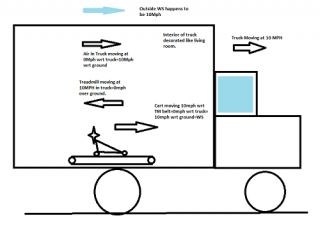
Here's a nice TM diagram

Here's a nice TM diagram.

I like this diagram because depending upon the view you pick, it has the cart moving on the TM at 10mph and over the ground at 10 mph, the tailwind on the TM is 0 but on the cart is 10mph and over the ground is 10mph and everything works out just fine! If you remove the truck and TM, and lower the cart to the ground, the situation is exactly the same as in the truck! It's a nice example of the equivalence of reference frames. For a viewer riding in the back of the truck, they would think they were in Spork's TM room. For a viewer on the ground, they would see the cart going over the ground at WS with a 10Mph Tailwind. Amazing how this works out! (Click on the lower diagram and you'll get a bigger image.) I haven't figured out how to do that yet in the post!

thum_488654de115e9647b7.png
[/url]

WindGrins:)

 
No assumption necessary

So you say, but that has never been demonstrated and it cannot be assumed to be true. Holding the cart places it in the inertial frame where the ground is at rest, and the tread is a source of energy. If the cart moves back with the tread, it is in the inertial frame of the moving tread and the air resistance will not be enough to change that in the same manner as being held. Your argument is based upon an unproven assumption.

Since the same carts were taken outside and were shown to self start and run past WS in the wind, it has been proven so its not an assumption.

WindGrins:)
 
Here's a nice TM diagram.

I like this diagram because depending upon the view you pick, it has the cart moving on the TM at 10mph and over the ground at 10 mph, the tailwind on the TM is 0 but on the cart is 10mph and over the ground is 10mph and everything works out just fine! If you remove the truck and TM, and lower the cart to the ground, the situation is exactly the same as in the truck! It's a nice example of the equivalence of reference frames. For a viewer riding in the back of the truck, they would think they were in Spork's TM room. For a viewer on the ground, they would see the cart going over the ground at WS with a 10Mph Tailwind. Amazing how this works out! (Click on the lower diagram and you'll get a bigger image.) I haven't figured out how to do that yet in the post!

[qimg]http://www.internationalskeptics.com/forums/imagehosting/thum_488654de115e9647b7.png[/qimg][/url]

WindGrins:)

[qimg]http://www.internationalskeptics.com/forums/imagehosting/thum_488654de115e9647b7.png[/qimg]

Put a parrot in a cage and do the same. If the parrot always fall off its perch at windspeed, call the press. That "Voodoo Van Test" raises guffaws from engineering students.
 
Last edited:
No. I have explained why the cart on the road in the tailwind cannot possibly become latched, as there is no positive feedback with the energy source, the wind. Weren't you paying attention?

Oh but there is, weren't you paying attention?
 
Status
Not open for further replies.

ISF - Join now!

Every member here is approved by hand. No bots, no spam, just people who care about evidence and honest debate.

Membership is free!

Create your free account

Back
Top Bottom