Merged DDWFTTW in a “Real” Wind

Status
Not open for further replies.
Wiki:
"Randi entered the international spotlight in 1972 when he publicly challenged the claims of Uri Geller. Randi accused Geller of being nothing more than a charlatan and a fraud who used standard magic tricks to accomplish his allegedly paranormal feats, and he supported his claims in the book The Truth About Uri Geller.[16][35]"

"James Randi challenges psychics and charlatans"
"James Randi challenges psychics and charlatans Life, the Universe, & Everything."

"James Randi Educational Foundation
27 May 2011 ... The JREF exposes charlatans and helps people defend ...
www.randi.org/ "
 
Last edited:
I'm not sure how you miss this!

As the cart passes the bike (which ensures it is faster than the wind on a string DDW) release the packing peanuts. Film the outcome from the drop point from the side so it is unambigous!
Why do that? Surely at some point the cart will overtake the bike.

It's not clear to me just where your density resides. Is it reading comprehension or fast skimming or blindness?:(

Yes, by definition, that's exactly what my sentence says. That was the point of the statement:

As the cart passes the bike (which ensures it is faster than the wind on a string DDW) release the packing peanuts. Film the outcome from the drop point from the side so it is unambigous!

It's just not clear to me how you cut and paste the exact sentence and see something completly different from what it says.

WindGrins:)
 
It's not clear to me just where your density resides. Is it reading comprehension or fast skimming or blindness?:(

Yes, by definition, that's exactly what my sentence says. That was the point of the statement:


It's just not clear to me how you cut and paste the exact sentence and see something completly different from what it says.

WindGrins:)

Because I proposed the test, that's why. You are offering a stale extemporization, which you somehow deem to be clever and original, yet is not consistent with your previous adjuration concerning popcorn and bricks.

If the cart is towed downwind to WS by a bike, and the cart can travel faster than the wind, it will soon catch up and pass the bike.
In other words, the less we have from you, the fewer the errors.
 
Last edited:
Humber to the Rescue!

I have clearly stated what is wrong with your irrational belief in the treadmill equivalency to a cart on a road with a tailwind.
Edited by LashL: 
Removed quote of moderated content.

No you Didn't! You may think you did but you didn't come close!

"I say there old Humber, they have me in a pickle. I can't run away without looking like a gutless chicken, and I can't answer Sporks questions without looking like an idiot! Would you please rush in with some distracting nonsense?

If you had any courage at all, you would gladly take the "question challenge" to prove your superiority. After all, no one is telling you how you have to answer the questions-just provide answers.

Your lack of response tells us pretty much how someone should calibrate you!


WindGrins:D
 
Last edited by a moderator:
What is your complaint?

Because I proposed the test, that's why. You are offering a stale extemporization, which you somehow deem to be clever and original, yet is not consistent with your previous adjuration concerning popcorn and bricks.

If the cart is towed downwind to WS by a bike, and the cart can travel faster than the wind, it will soon catch up and pass the bike.
Or do you have an apologist's lament to deny that one too?

In my example the bike has nothing to do with towing the cart. The cart is running along a fishing line for guidance. The bike just gets the peanuts to WS as the cart goes by to give them a fighting chance.

I never claimed there was ever anything clever about the setup. It's just a prescription for RP. In your test with the bike, how do you know the bike is at windspeed? Streamers won't tell you anything in your world?

But even it was the same test. Why are you complaining?

No Test is ever going to change your mind so why do you even care?

WindGrins
 
Last edited:
No you Didn't! You may think you did but you didn't come close!
Assumes that making you think is of benefit.
We have no mathematical analysis from you, save for psuedo-intellectual waffle about zero and infintesimals.
The amplifier you cut and pasted is flawed from DC bias. To achieve as modest 1V output from the 6V supply, the collector must be around 3V. The bias current is then 3mA. For the given beta of 100, the base current is 30uA. The base bias resistor is 200K, so V = IR = 30uA*200K =6V.
A tenuous design, that will see the bias point wander with transistor gain. The few that do not saturate, may show some output.

If the cart needs a guide wire, it must be because it unstable in the wind. Obviously, when tethered, the cart cannot follow changes in the wind direction, while the nominal downwind direction is determined by the guide wire. Sounds like an underhanded attempt to employ crosswinds and so emulate the bogus NALSA trials.
The wind should be such that the cart can run freely, and not so gusty that it gets blown away. I Ratant was willing to do that, so why not Spork and JB?


"I say there old Humber, they have me in a pickle. I can't run away without looking like a gutless chicken, and I can't answer Sporks questions without looking like an idiot! Would you please rush in with some distracting nonsense?
If you had any courage at all, you would gladly take the "question challenge" to prove your superiority. After all, no one is telling you how you have to answer the questions-just provide answers.
Your lack of response tells us pretty much how someone should calibrate you!
Yes, mother.
 
Last edited:
In my example the bike has nothing to do with towing the cart. The cart is running along a fishing line for guidance. The bike just gets the peanuts to WS as the cart goes by to give them a fighting chance.
You have denied the use of peanuts, and likened them to bricks, so why are you now championing them? A sub-conscious acceptance of their validity, perhaps?

I never claimed there was ever anything clever about the setup. It's just a prescription for RP. In your test with the bike, how do you know the bike is at windspeed? Streamers won't tell you anything in your world?
But even it was the same test. Why are you complaining?

But, in your world the streamer will be a reliable indicator. The streamer be the employed, rather than the peanuts you say are not.
To overcome that objection, tow the bike until there is no tension in the thread, meaning the cart is self-sustaining and release it.
A simple device such as a flexible rod, can be used to indicate that the tension is not present.

For a simple wind test, a device could monitor the prop shaft-speed. That could be a quadrature detector connected to a transmitter, and the result displayed on a laptop, EE Windgrins.
A simpler, and less expensive method, would be an acoustical device employing a small loudspeaker. When the perceived pitch is constant, the cart has achieved constant velocity, so obviating the whining about run length, while also indicating any erratic contact with the ground. It would be a simple matter to arrange for the primary pitch to be related to the prop's direction, and so tell of that too.
 
A Galilean transform is nothing more than a transform of velocities; it does not transform a cart that is running on a treadmill into a cart running on a road, nor does it have any magical effect on the physical laws that explain the cart on the treadmill. If I observe a cart on a treadmill from a FOR where the ground is stationary, I see a cart that is powered by the moving tread. If I now move at the speed of the tread, so that the tread appears to me to be stationary, and I once again observe the cart on the treadmill, it is still a cart on a treadmill that is powered by the moving tread. The observer does not change reality, he can only change how he views reality. The observer in the second case may think, incorrectly, that since he sees the tread as stationary and he feels a wind due to his own motion, the cart is being powered by wind. But he would only be fooling himself! Once he realizes that the wind he feels is due to his own motion and if he stops moving, the wind stops but the cart doesn’t stop, he uses some common sense and deductive reasoning to conclude the cart is powered by the tread and not in any way by wind.

What you are trying to do with the claim of equivalency is dumb down the observer to the point where he can’t tell the difference and can’t know what is going on, so you can claim what you want. That tactic may work for some dumb and gullible people, but it won’t work with anyone with a fairly well functioning brain!


The difference between the cart on the treadmill and a cart on a road in the wind can be stated mathematically, as the cart’s velocity is related to the difference in velocity between the cart and the energetic medium that is powering it. In the case of the wind-powered cart on a road, this can be stated as the difference between cart velocity Vc and wind velocity, Vw so energy available to the cart functionally related to (Vc – Vw) and as VC approaches Vw the energy approaches zero. That is a case of negative feedback, as the faster the cart runs, the less energy it has available from the wind, until at wind speed it has no wind energy at all and can only slow down.

In the case of the tread-powered cart the energy available to the cart is also related to the difference in velocity between the cart Vc and the tread velocity Vt but there is one important difference! The tread is moving in the opposite direction the cart is moving, and velocity is a vector quantity. If we take the velocity of the cart as positive, then the velocity of the tread must be taken as negative. The difference then, and the energy available to the cart is functionally related to ( Vc – ( -Vt) ) and this will always be a positive quantity. In fact, the faster the cart runs on the treadmill, the more energy is available to it. That is a case of positive feedback.

The only possible way you can try to claim there is an equivalency here is to claim the existence of ground energy, something you carteers have already tried with no success. It is time you quit trying to play off the treadmill as an example of a DDWFTTW wind cart, because it is no such thing!

This post is a perfect illustration of failure to comprehend that there is no such thing as absolute motion. It's a stubbornly wrong geocentric treatise which merely proclaims that the earth does not move, therefore a treadmill in still air is not equivalent to a road in a wind. The highlighted paragraph encapsulates the failure to comprehend: "Yeah, you and every physicist in the world can say all motion is relative, but you can't fool me; I know you're just pretending and it really isn't".

There is no purpose in arguing further on this point with someone who will not open a physics book (or read a posted link) to discover that they are absolutely wrong about this.
 
Give it a rest. I didn't ask you since no test works for you!

You have denied the use of peanuts, and likened them to bricks, so why are you now championing them? A sub-conscious acceptance of their validity, perhaps?

Humber, you are slow. I never compared packing peanuts to bricks. That was your silly idea. My brick was the analogy of any non-DDWFTTW cart. You are off in the weeds again.
I'm perfectly fine with the idea that any DDWFTTW cart will outrun packing peanuts. I've said so from the start. I'm very comfortable with this. And no, I Ratant has not built a working DDWFTTW cart yet. When he does, I'm comfortable that it can outrun them also. But until then, no need to talk about his cart.


But, in your world the streamer will be a reliable indicator. The streamer be the employed, rather than the peanuts you say are not.
To overcome that objection, tow the bike until there is no tension in the thread, meaning the cart is self-sustaining and release it.
A simple device such as a flexible rod, can be used to indicate that the tension is not present.

You seem to not have a clue about how I proposed the test for RP. The carts self start. They don't need to be towed.

For a simple wind test, a device could monitor the prop shaft-speed. That could be a quadrature detector connected to a transmitter, and the result displayed on a laptop, EE Windgrins.
A simpler, and less expensive method, would be an acoustical device employing a small loudspeaker. When the perceived pitch is constant, the cart has achieved constant velocity, so obviating the whining about run length, while also indicating any erratic contact with the ground. It would be a simple matter to arrange for the primary pitch to be related to the prop's direction, and so tell of that too.

You are more than welcome to do all the tests you want any way you want to. Stop bothering me about my test for RP and feel free to perform any tests you create. Instrument them up to your heart's content. I don't care!

WindGrins:)
 
Last edited:
The cart will not work in a vacuum because it uses the air as the medium it works on to move on the tread. That is the only reason it would not work in a vacuum! It still gets its energy from the tread, and that energy is a function of Vc - (-Vt), which is undeniably true.
When the treadmill starts up, the cart's inertia means it initially won't move, so Vc-(-Vt) will be at a maximum. In other words, the drag on the cart from the treadmill will be at a maximum. Gradually the cart will be dragged backwards and Vc-(-Vt) will decline until eventually the cart is travelling backwards at the same speed as the treadmill. So far, so what? That is exactly equivalent to a cart initially accelerated on a road (in a vacuum) to the equal and opposite velocity that the treadmill has in the first example. It will slow down and stop, relative to the medium it's in contact with. Nothing earthshaking so far.

Now instead of using a propeller spinning in the air for propulsion, a cart could be made with a set of wheels working on railings alongside the treadmill, and it should still be able to move up the tread. There are other methods that can be used as well, none of them employing a propeller and all of them would work in a vacuum as the source of energy is the tread, not the air.
You mean, a cart could be constructed which uses the relative motion of two media to power its own movement relative to those media? Who'd ever have thought such a thing was possible? Oh, yeah - everyone.
 
Jack by the Hedge, you have hit on the H's problem. I have called them Flat Earther's on Talk Rat since that is the only universe I know of where the physics might support their claims. The Flat Earth is the only one that I know of where there is absolute motion. It is too bad that Harold and my time schedules seem to be different. I would have liked to engage him a bit in debate. But I see my points have all been covered.

Thanks all.

ETA: This was a response to an earlier post of Jack's where he highlighted some of Harold's nonsense.
 
Last edited:
You mean, a cart could be constructed which uses the relative motion of two media to power its own movement relative to those media? Who'd ever have thought such a thing was possible? Oh, yeah - everyone.

Goodness me who would have thought it. Here's an idea, if you can use the speed difference between two media to power the cart then you could substitute a propeller for the second wheel and the air for the second medium. The principal would be exactly the same.
 
For anyone who did not bother to really read this post of ppg's it really is worth a look. It displays a level of ignorance about basic physics that really is extraordinary. As I have said before I think some folks give ppg more credit than Humber because he hides his nonsense in prose so it doesn't jump out at you in the same way; they definitely should read this post.

He is saying very clearly that Einstein and every other physicist since Galileo was wrong.

A Galilean transform is nothing more than a transform of velocities; it does not transform a cart that is running on a treadmill into a cart running on a road, nor does it have any magical effect on the physical laws that explain the cart on the treadmill. If I observe a cart on a treadmill from a FOR where the ground is stationary, I see a cart that is powered by the moving tread. If I now move at the speed of the tread, so that the tread appears to me to be stationary, and I once again observe the cart on the treadmill, it is still a cart on a treadmill that is powered by the moving tread. The observer does not change reality, he can only change how he views reality.

Hmmm, this seems familiar. I always thought all FOR's are equally "real". The reality he is speaking of must be the magic one true reference frame.

The observer in the second case may think, incorrectly, that since he sees the tread as stationary and he feels a wind due to his own motion, the cart is being powered by wind. But he would only be fooling himself! Once he realizes that the wind he feels is due to his own motion and if he stops moving, the wind stops but the cart doesn’t stop, he uses some common sense and deductive reasoning to conclude the cart is powered by the tread and not in any way by wind.

I wonder ppg, could give us a few more examples of the application of this sort of deductive reasoning? How far does it extend? I have heard about jumping up and down on aircraft carriers to tell if the wind is really blowing but I am not sure how exactly it works. Are there any jumping tests that can help us determine if our universe is in motion relative to some larger universe?
 
Last edited:
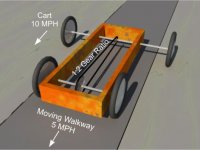
Heh, I see ppg used the example of this with the gearing reversed:

attachment.php
 

Attachments

  • Walkway Cart.jpg
    Walkway Cart.jpg
    18.9 KB · Views: 38
If you had super sensitive instruments, and knew your latitude, humber's jump test just might work. Of course you would have to be able to jump up and down and land on the same spot within a thousandth of an inch or even less. But that is due to the fact that the Earth is rotating and therefore its surface is not a true basis for an inertial frame of reference. It is of course for most practical uses, but there are some times that you must take rotation into account.
 
Humber, you are slow. I never compared packing peanuts to bricks. That was your silly idea. My brick was the analogy of any non-DDWFTTW cart. You are off in the weeds again.
I'm perfectly fine with the idea that any DDWFTTW cart will outrun packing peanuts. I've said so from the start. I'm very comfortable with this. And no, I Ratant has not built a working DDWFTTW cart yet. When he does, I'm comfortable that it can outrun them also. But until then, no need to talk about his cart.
Then you will need to show why the I Ratant's cart does not work, and show one the beats the popcorn.
Trying to divorce yourself from yours and JB's claim about popcorn and bricks, shows how weak your arguments are.

You seem to not have a clue about how I proposed the test for RP. The carts self start. They don't need to be towed.
He was referring to a test that was already proposed and quite satisfactory.

You are more than welcome to do all the tests you want any way you want to. Stop bothering me about my test for RP and feel free to perform any tests you create. Instrument them up to your heart's content. I don't care!
WindGrins:)
And you dodged your errors in the amplifier again, and shun any tools that will tie you down to facts. The mighty cart can stand no scrutiny.
 
If you had super sensitive instruments, and knew your latitude, humber's jump test just might work. Of course you would have to be able to jump up and down and land on the same spot within a thousandth of an inch or even less. But that is due to the fact that the Earth is rotating and therefore its surface is not a true basis for an inertial frame of reference. It is of course for most practical uses, but there are some times that you must take rotation into account.

But in this case the test would not be confined to the reference frames in question. You would need to communicate with a super observer. PPG needs to build a house on a large TM.
 
I never claimed there was ever anything clever about the setup. It's just a prescription for RP. In your test with the bike, how do you know the bike is at windspeed? Streamers won't tell you anything in your world?

But even it was the same test. Why are you complaining?

Despite humber's whining that we will never do his tests, he has never described a test in anywhere near enough detail to satisfy him. It upsets him when someone does describe a test carefully enough that it can be done as described and the results can prove him wrong. The most critical component of the humber-test is the built in "out".

You are more than welcome to do all the tests you want any way you want to.

humber does not do tests - no matter how simple. He just throws tantrums when others won't do tests for him.
 
More math free bile from the Carteers:

Drela:
Although the behavior of the cart in the video does seem surprising, there's nothing about it which violates physical laws. It's quite real. What makes it work is some fundamental thrust/power relations for a propeller.

Let's assume the simplest case where the cart is traveling at the speed of the wind. In this case, the propeller sees zero net airspeed, same as a helicopter rotor in hover. The shaft power needed to drive a hovering rotor (i.e. the propeller) is

P = sqrt[ T^3 / (2 rho pi) ] / (eta_h R)

T = thrust
rho = air density
pi = 3.14159
eta_h = hover figure of merit = hover efficiency ( = 0.8 typically)
R = rotor radius

If the cart is traveling at some ground speed V, there must be a "braking" force on the wheels in order for them to generate the power needed by the prop. This force is simply

F = P / V

and if the prop is big enough (R is sufficiently big), this braking force F can easily be far smaller than the thrust T produced by the prop, so the cart can accelerate.

Let's consider some reasonable numbers:

V = 5 m/s = 11 mph (looks like the speed of the cart)
T = 1 N (102 grams)
R = 0.4 m
eta_h = 0.5 (assume crummy prop to be conservative)
rho = 1.2 kg/m^3

This gives the following prop shaft power.

P = 1.8W

The power-generating force on the wheels is

F = P/V = 1.8 W / 5 m/s = 0.36 N

So there's a net forward thrust on the cart equal to

T_net = T - F = 1.0N - 0.36N = 0.64 N = 65 gram = 2.3 oz

This excess thrust can go into overcoming friction, or accelerating the cart.
In practice, the cart will continue to accelerate until the excess thrust T_net is balanced by air drag and rolling resistance.

cart = 0.16kg
a = .65/.16kg
4ms-2
Not in evidence, but a constant speed of about 0.1ms, wrt the ground.
---------------------------
Make recently published some cart construction details.
The prop is a GWS RD-1575 Slowfly (15"x7.5"), 29gr
But, there is no data, and many hobbyists are skeptical about GWS' optimistic claims, but I could find no data one way or the other.

The remaining data is:
Wheel radius = .0425mm
Gearing:
13T wheel
16T prop
= 0.81

Belt Speed = 5m/s
Wheel rate =
5/2pi*r =
1123 rpm
~ 117 radians/sec

Prop rate = wheel rate*gearing
912rpm
~ 95radians/sec

Taking Drela's numbers in lieu of the prop data:

T = P/w
= 1.8/95
= .019N-m

Wheel shaft torque:
= .019*0.81=
.015N-m

Wheel drag:
F = T/r
.015/.042 =
0.35N

Prop power = 5m/s*1N = 5W
Belt power = 0.35*5m/s = 1.75W

That is over-unity.

The obvious error is thinking that the cart moves at the belt speed of 5m/s.
Given the 0.1m/s seen
Prop Power = 0.1*1N = 0.1W
Belt power = 0.35*5m/s = 1.75W
Easily ahead ,the cart largely sits there wasting belt power. The latch keeps it there.
 
Last edited:
Status
Not open for further replies.

ISF - Join now!

Every member here is approved by hand. No bots, no spam, just people who care about evidence and honest debate.

Membership is free!

Create your free account

Back
Top Bottom