
Merged DDWFTTW in a “Real” Wind

Status
Not open for further replies.
....I won't do his pointless and poorly defined tests for him.

You refused because they would show your TM to be a trinket, but now I don't need you.

Wrong. You claimed that every prop would behave as you claimed with "NO EXCEPTIONS". Not only did he find an exception, but it's a very common case.
No, it is not. A propeller is as much governed by the characteristics of the engine, as anything else. To achieve high efficiency, the aerodynamic load must match the engine's power profile. It is control of the engine that maintains the constant horsepower in that particular case.

WRONG! Read the title of your graph. It does not refer to A propeller. It refers to an infinite set of propellers - a different one for every single point on the graph. It is a graph of the maximum possible thrust for ANY 8' propeller at each given speed. The prop they use at 50 mph would be largely stalled at 0 mph.

You won't work around your constant net force problem that way, nor with arguments around the variable pitch. I have anticipated all your ruses,

[latex] T (\omega, V) = 1/2.p.V^2 \frac {\pi}{4}D^2 \frac {Ct (J, Re)}{J^2}<br />

<br /> J = advance ratio<br />

<br /> T = Thrust<br />

<br /> V = air speed<br />

<br /> \omega = angular velocity<br />

<br /> Re = Reynolds number<br />

<br /> Ct = thrust coefficient<br />

<br /> D = diameter<br />
[/latex]


You're absolutely wrong about the general case, and your remarks referred to every single prop with "no exception". You're lies remain on these pages in black and white for all to see.

Puerile. You are holding ppg to one statement? Do you think profpangloss was saying that would apply to prop made of wire mesh?
The general case is like this:
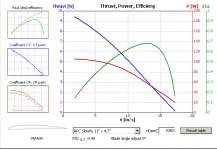
attachment.php
 

Attachments

  • propcalc_spork.png
    propcalc_spork.png
    14.6 KB · Views: 38
Dust disperses and becomes invisible really quickly jb.

So? -- who gives a crap what the dust that has become "invisible" does -- it's the visible dust that is the "visible opponent" you claim never existed.

It also settles to ground rapidly, unlike foam popcorn or smoke.

Once again -- So? Who gives a crap about the dust that has settled to the ground "rapidly", it's the dust that *hasn't* settled that is the "visible opponent" that you claim never existed.

Also, the particles are so small it would seem to me the wind could blow through them.

Yeah -- that's why we see large objects regularly blowing in the wind -- the wind "blows through" the small ones. :rolleyes:

Unlike the foam popcorn, they don't have enough mass to be accelerated that close to wind speed.

Yeah, that's why we see heavy objects regularly blown with the wind -- the light ones simply don't have enough mass to get there. :rolleyes:

Do you even read the stupid stuff you write?

I tried doing a g-search on dust in the wind back when this video was first posted. I couldn't find anything definitive.

Surely you found something though when you did a g-search on the speed of popcorn in the wind. I mean you wouldn't just be making crap up about it would you?

JB
 
@jb: I notice you skipped over Humber's point that I've asked twice about wrt no dust seen blowing past the CV when it was going below ws. How do you explain that one? Was it in a dust-free zone or what??
 
@jb: I notice you skipped over Humber's point that I've asked twice about wrt no dust seen blowing past the CV when it was going below ws. How do you explain that one? Was it in a dust-free zone or what??

Ask your own questions and I might answer them. I skip most of humber's crap and I skip most of you talking about humbers crap.

JB
 
So what would you say if a video was posted showing the same cart going up a treadmill? :)
I would be curious as to whether the treadmill velocity was the same as the wind velocity in the outdoors. AFIK, no such video exists, so your question is not much different from, "What would you say if you saw a photograph where the shy is pink with yellow stripes?
And what about Humber's observation that we see no dust blowing past the CV when it was below ws??

I haven't seen the video recently, so it's not clear to me whether humber is saying there is no airborne dust, or that there is airborne dust and the cart isn't passing it, or whether humber is just making stuff up. Given humber's history, number three seems to be the most likely. Also, I would ask how he knows the cart is slower than wind speed.
 
I accept nothing from either you or Spork! I only accept mathematics and logic that can be shown, from basic principles, to work.
You accepted all without question, until is was questioned, Tobermoryphil.

tobermoryphil said:
Firstly, if we want 222 N thrust from the prop, Javaprop (4.85 m dia., 0.3 spinner, 120 rpm, 8.046 airspeed, MH116 airfoil) requires an input of 2160 W . This results in 222.34 N thrust, with the prop being 82.82% efficient.
Now we need to obtain 2160 W power via the wheels. We assume 93% transmission efficiency, so we are in fact looking for 2322.5 W. Over 12.516 m, this equates to a 185.5 N retarding force.

All taken directly from me, so you may expect that I know what the game is. There will be a general case to follow, but for now...

Thrust = Power/Velocity
V = 8.046m/s
Thrust = 220N
Power = 8.046*220N = 1792W
n=.83
Power_Shaft = 2159W

Prop Torque = Power/w
w= 12.566 rad/sec.(120rpm)
=2159W/12.566
= 171.81N-m

Wheel Power:
Gear ratio =2.8:1
Wheel shaft torque = Prop Torque/2.8 =
171.81N-m/2.8 =
61.17N-m

Transmission:
n= 0.93
T = 61.17/0.93 = 65.77N-m

Wheel radius = .3552
F = T/r
=65.77/.3552
185N

Wheel Power = T*w
= 65.77*35.185 = 2314W

That is greater than the air power at the prop.

Tobermoryphil said:
Now add in the CALCULATED rolling resistance, as noted previously, of 15.91 N, and the air drag, 17.5 N for a very realistic Cd of 0.25, and we get 218.91N.
Prop thrust is 222.34 N.

Provide data for that. Ask Spork for all the data. Guessing is not good enough. Finger calibration suspect. The Frr is too low to support the load, and the cart will slide.

Tobermoryphil said:
We therefore have 3.43 N left over for acceleration. Not a lot, admittedly, but the cart is already running at 2.8 times wind speed, very near to its theoretical steady state maximum. If the Cd is only 0.2, which I believe it is, we get a further 3.5 N.

Then you are short, and also of the recorded net force:
32N - 3.43N - 3.5N = -25N

Back to power.

Wheel Power = 2314W
All of the power has been spent at the prop in generating the thrust, and in the transmission losses. Correct?

Now you need to supply ( using your unrealistic figures):

Aero drag Power = 17.5**12.51m/s = 219W (wheel)
Wheel Frr power = 15.91N*12.51m/s = 199W

There is a net power loss of
219 + 199 = 418W

No power = no KE = no +acceleration, but slowing.

Add the necessary power to the wheel to cover the drag losses.
Wheel power =
2314W + 418W
= 2732W

T = P/w
2732W/ 35.185 rad-sec
=77.64N-m

Wheel drag:
F =T/r
77.64N-m/.3552m
218N

Net force = 220N - 218N - 3.43N - 3.5N = - 4.93N

There are still the internal tyre losses to add to that. A physical fact.

The drag figures are too low. Cd = 0.2 now?
Frr disappearing until the BB is like an ice cart?
http://www.engineeringtoolbox.com/drag-coefficient-d_627.html

Power consumed by prop, transmission and drag = 2732W
Power generated = 2732W
Net force = -4.93N

Still no power to add KE to the cart so no acceleration is possible, and will never be no matter how you change the numbers.
 
I haven't seen the video recently, so it's not clear to me whether humber is saying there is no airborne dust, or that there is airborne dust and the cart isn't passing it, or whether humber is just making stuff up. Given humber's history, number three seems to be the most likely. Also, I would ask how he knows the cart is slower than wind speed.

If the question is simply "why little or no dust visible downwind of the truck when the truck is below windspeed", that's pretty simple to anyone who has ever driven dusty roads: speed creates a swirling wake and the swirling wake picks up most of the dust. The wind was about 12-14 at that time and when I sped up to pass in front of the BUFC I was up to around 50 - 60 mph (over the ground).

Below windspeed, the highest relative velocity would have been with the truck sitting still (a wake of 12-14mph). Not much dust kicked up in a 12-14mph wake, clearly. As the vehicle speed up, this wake would have been reduced (lessening any tendency to pick up dust) until at wind speed there would have been no wake at all (and thus very little dust). At full speed the truck would have had a 40-45mph wake and thus exponentially more dust.

What, is there some Humspiracy now related to dust?

JB
 
While true, so what?
You said it was not Javaprop data, so that there could be a switch to Propsim, and Spork could say to NALSA we had it all wrong.
That's why.
And it means you were not perspicacious enough to realise ratios are unit independent, so put your foot in it.

wtf are you talking about? I was merely presenting the evidence that the data you keep presenting as "from Javaprop" was not, in fact, from Javaprop.
Yes it was, and I did not produce that data. Spork did.

Your second attempt at two designs resulted in precisely the same power to thrust ratio, despite the changes to the shape, and other parameters, because they fall outside the range of viability.

Now you are just tossing red herrings for obfuscation apparently.
Frying fish.

The only method that relates to an "ideal transducer" is the method your hero(s) hyevpranglostoph uses.

Wrong again. P = V*T represents the ideal transducer used in the submission. The 3-headed gargoyle you are attempting to make, argued that thrust is generated by the delta v method.

Would you please post the method you used to calculate the true wind speeds and direction, so that they are a matter of record? If not, why not?
 
Last edited:
I would be curious as to whether the treadmill velocity was the same as the wind velocity in the outdoors. AFIK, no such video exists, so your question is not much different from, "What would you say if you saw a photograph where the shy is pink with yellow stripes?

Hyperbole much? No, there is no such video yet. I'm just hoping to get I Ratant to make one by obtaining some commitment from the carteers as to what such a video would demonstrate.

I haven't seen the video recently, so it's not clear to me whether humber is saying there is no airborne dust, or that there is airborne dust and the cart isn't passing it, or whether humber is just making stuff up. Given humber's history, number three seems to be the most likely. Also, I would ask how he knows the cart is slower than wind speed.

Drewid posted the video on the preceding page. Take a peek. Humber is clearly asking why we don't see any dust kicked up by the truck following the BB blowing past it. It being the truck, from where the filming is being done. That dust would be much closer to the camera and thus clearly visible. So, when the truck=Chase Vehicle-is going below ws for the first 15 seconds or so, why don't we see the dust it obviously kicks up blowing past it on both sides??

Also, watching this video again just now, it sure looks to me like the dust from the truck when it circles in front of BB goes off at an angle to it, and that they are not going in the same exact direction. Big surprise that, given the way you folks argue the charts show so little variation in wind direction. :rolleyes:

@jb: So the swirling picks up most of the dust? Wouldn't it have to catch literally all of it that from such a close range we wouldn't see any blowing past it so close to the camera?? We can see the dust that passes by the cart from some 50 feet away.
 
Last edited:
If the question is simply "why little or no dust visible downwind of the truck when the truck is below windspeed", that's pretty simple to anyone who has ever driven dusty roads: speed creates a swirling wake and the swirling wake picks up most of the dust. The wind was about 12-14 at that time and when I sped up to pass in front of the BUFC I was up to around 50 - 60 mph (over the ground).

Below windspeed, the highest relative velocity would have been with the truck sitting still (a wake of 12-14mph). Not much dust kicked up in a 12-14mph wake, clearly. As the vehicle speed up, this wake would have been reduced (lessening any tendency to pick up dust) until at wind speed there would have been no wake at all (and thus very little dust). At full speed the truck would have had a 40-45mph wake and thus exponentially more dust.

And at 1:26, short before WS, you actually do see a little dust flying past the wind-vane. Obviously you can see that little dust better against the blue sky, than against the ground of the same color.

http://www.youtube.com/watch?v=5CcgmpBGSCI&feature=player_detailpage#t=87s

What, is there some Humspiracy now related to dust?
Seems the "not enough dust" argument is obligatory in all crackpot conspiracy theories.

lm-footpad-as11-40-5926hr.jpg
 
Ask your own questions and I might answer them. I skip most of humber's crap and I skip most of you talking about humbers crap.

JB

As RP says, the dust is blown in any direction other than ddw.
You can skip what you like, but the crap pile will just be larger when you step in it.
 
If the question is simply "why little or no dust visible downwind of the truck when the truck is below windspeed", that's pretty simple to anyone who has ever driven dusty roads: speed creates a swirling wake and the swirling wake picks up most of the dust. The wind was about 12-14 at that time and when I sped up to pass in front of the BUFC I was up to around 50 - 60 mph (over the ground).
And? The mass of the dust is greater than that of the air, and so is the drag. Dust particles are like boulders to air molecules and will spin and so take up energy as angular momentum, so their linear velocity slows.
They also shed energy as turbulence that detaches from the surface.
Complicated process.

Below windspeed, the highest relative velocity would have been with the truck sitting still (a wake of 12-14mph). Not much dust kicked up in a 12-14mph wake, clearly. As the vehicle speed up, this wake would have been reduced (lessening any tendency to pick up dust) until at wind speed there would have been no wake at all (and thus very little dust). At full speed the truck would have had a 40-45mph wake and thus exponentially more dust.
Oh, tyres don't accelerate dust? "anyone who has followed a truck or passing car in the desert, knows what can happen to the windscreen"

What, is there some Humspiracy now related to dust?
Well maybe pon-pons from Staples masquerading as test instruments, get caught in the turbulence, and don't indicate very much at all.
 
And at 1:26, short before WS, you actually do see a little dust flying past the wind-vane. Obviously you can see that little dust better against the blue sky, than against the ground of the same color.

http://www.youtube.com/watch?v=5CcgmpBGSCI&feature=player_detailpage#t=87s


Seems the "not enough dust" argument is obligatory in all crackpot conspiracy theories.

[qimg]http://pseudoastro.files.wordpress.com/2009/07/lm-footpad-as11-40-5926hr.jpg?w=288&h=291[/qimg]

Seems like a really good reason not to put a windvane on the cart.
Plenty of room for error and playing with the numbers. A vane on the cart would be direct measurement of the wind relative to the cart, and so no need to bother with the true wind calculation, if the cart follows the true wind.
 
RP-Have some perspective!

Hyperbole much? No, there is no such video yet. I'm just hoping to get I Ratant to make one by obtaining some commitment from the carteers as to what such a video would demonstrate.


Drewid posted the video on the preceding page. Take a peek. Humber is clearly asking why we don't see any dust kicked up by the truck following the BB blowing past it. It being the truck, from where the filming is being done. That dust would be much closer to the camera and thus clearly visible. So, when the truck=Chase Vehicle-is going below ws for the first 15 seconds or so, why don't we see the dust it obviously kicks up blowing past it on both sides??

Also, watching this video again just now, it sure looks to me like the dust from the truck when it circles in front of BB goes off at an angle to it, and that they are not going in the same exact direction. Big surprise that, given the way you folks argue the charts show so little variation in wind direction. :rolleyes:

@jb: So the swirling picks up most of the dust? Wouldn't it have to catch literally all of it that from such a close range we wouldn't see any blowing past it so close to the camera?? We can see the dust that passes by the cart from some 50 feet away.

RP,

I'm a bit surprised at this.

If I Ratant makes some changes and his cart can go up the treadmill, then I'll be the first one to say that he has achieved a DDWFTTW cart. In fact, the TM should be the test to validate that the cart is a DDWFTTW cart. If it can't hold steady on the TM at a reasonable speed, It should not be tested in winds below that speed. It is only the idiots, who after lengthy study, don't get the TM. Notice that the carts do not exceed windspeed immediately, they take a bit of time to get to WS. The small carts do it much faster than the BB. Once the carts have a bit of time to accelerate, then put in the peanuts. Any DDWFTTW cart that is under control should outrun them. No one in this game should be afraid of any contest for a DDWFTTW cart with packing peanuts! Since he is an RC guy and if he can make his cart work, he should be able to make a good video! I welcome it.

With regards to the dust, Surely you are not suggesting a video conspiracy! It was only noticed after the fact and much argument that the cart outran the dust and with no contest. No matter how neutral one wants to be, there is a limit. This one is really reaching for straws unless you want to accuse the team of massive and expensive video doctoring and fraud. Then there is the issue that they would have to have NALSA in on the fraud with a 2.8X record (not a trivial margin). I'm hoping only Humber is this big of a jerk!

Regards,

WindGrins:)
 
You said it was not Javaprop data, so that there could be a switch to Propsim, and Spork could say to NALSA we had it all wrong.
That's why.
Wrong, I said it was not javaprop data, for the simple reason that it was not javaprop data.


And it means you were not perspicacious enough to realise ratios are unit independent, so put your foot in it.

Actually, it means that Prop. Designer wanted the chord data in meters, so I converted it for that program, Javaprop works regardless of units, so what?


Yes it was, and I did not produce that data. Spork did.

No, it wasn't, as I proved. And I know that spork provided that data.

Your second attempt at two designs resulted in precisely the same power to thrust ratio, despite the changes to the shape, and other parameters, because they fall outside the range of viability.

No, it's because Javaprop is optimized for small, fast turning props, While Prop. designer is optimized for large, slow turning props.


Wrong again. P = V*T represents the ideal transducer used in the submission. The 3-headed gargoyle you are attempting to make, argued that thrust is generated by the delta v method.
In which case, you are clueless.


Would you please post the method you used to calculate the true wind speeds and direction, so that they are a matter of record? If not, why not?

I will when you make any specific claims about any errors.
 
Last edited:
So? -- who gives a crap what the dust that has become "invisible" does -- it's the visible dust that is the "visible opponent" you claim never existed.
You have often championed smoke as an indicator, and it's at work right now.

Once again -- So? Who gives a crap about the dust that has settled to the ground "rapidly", it's the dust that *hasn't* settled that is the "visible opponent" that you claim never existed.
You claimed the dust as an indicator. Remember? How long does that particular dust take to settle?


Yeah -- that's why we see large objects regularly blowing in the wind -- the wind "blows through" the small ones. :rolleyes:
And the cart has a lower Cd than a sphere or bird?
Dust has a large Cd.

Yeah, that's why we see heavy objects regularly blown with the wind -- the light ones simply don't have enough mass to get there. :rolleyes:
You are on record as saying all objects will get to WS, but at a rate according to mass, because F=ma, and the objects see no opposing force downwind. Oh, yes you did.


Surely you found something though when you did a g-search on the speed of popcorn in the wind. I mean you wouldn't just be making crap up about it would you?
JB
It beat the cart, no matter what that is.
 
Wrong, I said it was not javaprop data, for the simple reason that it was not javaprop data.
Oh, is that right? There are totally different means of deriving a maximally efficient prop?

Actually, it means that Prop. Designer wanted the chord data in meters, so I converted it for that program, Javaprop works regardless of units, so what?
You said it was not Javaprop data because it was not metric.

No, it wasn't, as I proved. And I know that spork provided that data.
No matter, the numbers are there, aren't they? Power rpm and torque.
do you have a mathematical reason for any difference to the fundamental facts of propellers?

No, it's because Javaprop is optimized for small, fast turning props, While Prop. designer is optimized for large, slow turning props.
Total nonsense, and Spork produced the diagrams posted and at FTW .org using Javaprop.
When was Prop Designer first mentioned?
or this one?
http://personal.osi.hu/fuzesisz/strc_eng/index.htm

In which case, you are clueless.
The numbers are illogical.

I will when you make any specific claims about any errors.
Yes....but you will not be able to recant the errors after the fact. So shy to nail your claim to the door.
 
Last edited:
RP,

I'm a bit surprised at this.

If I Ratant makes some changes and his cart can go up the treadmill, then I'll be the first one to say that he has achieved a DDWFTTW cart. In fact, the TM should be the test to validate that the cart is a DDWFTTW cart. If it can't hold steady on the TM at a reasonable speed, It should not be tested in winds below that speed. It is only the idiots, who after lengthy study, don't get the TM. Notice that the carts do not exceed windspeed immediately, they take a bit of time to get to WS. The small carts do it much faster than the BB. Once the carts have a bit of time to accelerate, then put in the peanuts. Any DDWFTTW cart that is under control should outrun them. No one in this game should be afraid of any contest for a DDWFTTW cart with packing peanuts! Since he is an RC guy and if he can make his cart work, he should be able to make a good video! I welcome it.

With regards to the dust, Surely you are not suggesting a video conspiracy! It was only noticed after the fact and much argument that the cart outran the dust and with no contest. No matter how neutral one wants to be, there is a limit. This one is really reaching for straws unless you want to accuse the team of massive and expensive video doctoring and fraud. Then there is the issue that they would have to have NALSA in on the fraud with a 2.8X record (not a trivial margin). I'm hoping only Humber is this big of a jerk!

Regards,

WindGrins:)

The TM says nothing about a cart in the wind, and that will be demonstrated. The dust is more about the previous "evidence" and the patently changing wind. And the record is not held if the wind is not 10mph, and it isn't.
It also goes to the lack of knowledge of fluid dynamics, when the arguments are nonsense and show so little depth of understanding. Simple minded this is faster than that.
 
Last edited:
Status
Not open for further replies.

ISF - Join now!

Every member here is approved by hand. No bots, no spam, just people who care about evidence and honest debate.

Membership is free!

Create your free account

Back
Top Bottom