... signifying nothing.That snips it.

You are using an out of date browser. It may not display this or other websites correctly.
You should upgrade or use an alternative browser.
Merged DDWFTTW in a “Real” Wind
- Thread starter ynot
- Start date
- Status
- Not open for further replies.
I can still read!
Since the graph listed has the title:
Thrust at constant HP v. MPH.
and the text immediately above it states:
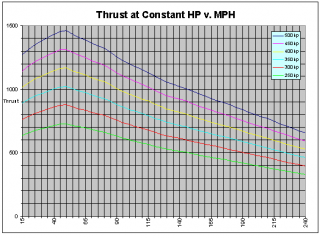
Figure 2 shows a plot of the thrust generated by a particular (variable pitch) propeller as a function of the airspeed (15 through 240 MPH) and power applied to it (250 through 500 HP).
That the author intended it to mean exactly what I said which was:
propellers do increase thrust as they near their design point as opposed to monotonically decreasing as PPG stated.
You two also can't seem to decide if they have their maximum thrust or as you say around 10% of their thrust at 0 WS.
PS. The graph mentioned nothing about "planes in flight" but can you tell us what the difference is for a plane in flight vs a propeller moving on a cart?
My contention, which an astute one would notice, is that in the regime in which we are interested, this particular graph shows a clearly increasing thrust with an increase in windspeed, directly contradicting PPG's assertion.
PS, I thought this was PPG's argument. Are you his answer man, now?
WindGrins
You have shown a power curve for a plane in flight.
Since the graph listed has the title:
Thrust at constant HP v. MPH.
and the text immediately above it states:
Figure 2 shows a plot of the thrust generated by a particular (variable pitch) propeller as a function of the airspeed (15 through 240 MPH) and power applied to it (250 through 500 HP).
That the author intended it to mean exactly what I said which was:
propellers do increase thrust as they near their design point as opposed to monotonically decreasing as PPG stated.
You two also can't seem to decide if they have their maximum thrust or as you say around 10% of their thrust at 0 WS.
PS. The graph mentioned nothing about "planes in flight" but can you tell us what the difference is for a plane in flight vs a propeller moving on a cart?
My contention, which an astute one would notice, is that in the regime in which we are interested, this particular graph shows a clearly increasing thrust with an increase in windspeed, directly contradicting PPG's assertion.
PS, I thought this was PPG's argument. Are you his answer man, now?
WindGrins
Subduction Zone
Muse

- Joined
- Dec 23, 2008
- Messages
- 999
QED,
Once again, I never claimed spork is the only one who knows how to build a DDWFTTW cart. I told you of several others that did. spork never even claimed to be the first. But if you want to learn how to build an airplane you do not ask the gardener. You ask people who have successfully built and flown airplanes. I Ratant did not do this. In fact he came in with an attitude of "this is what you are doing wrong" without even understanding the subject. Small wonder that his cart did not work

You are still dodging the question of how the BUFC outran a cloud of dust that was obviously faster than the speed of the wind.
Tortured Logic Redux!
You seem to be missing the obvious: Neither my brick nor I Ratant's cart is a workable DDWFTTW vehicle. The only inference that can be drawn from this logically is that there are multiple ways that one can build a non-workable DDWFTTW vehicle. And in general, they have little to tell about workable ones.
And what is it that you believe I owe PPG an apology for-
Stating that he directly contradicts his own posts or that his arguments to this point are either totally incorrect or lack any semblance of sense or substance?
It's nice to see you have such sensitivities!
WindGrins
It means the cart did not go faster than the peanuts, let alone the wind.
Your explanation is that I Ratant was not engaged in building a ddwfftw cart, which means he was testing the peanuts?
And you owe profpangloss an apology.
You seem to be missing the obvious: Neither my brick nor I Ratant's cart is a workable DDWFTTW vehicle. The only inference that can be drawn from this logically is that there are multiple ways that one can build a non-workable DDWFTTW vehicle. And in general, they have little to tell about workable ones.
And what is it that you believe I owe PPG an apology for-
Stating that he directly contradicts his own posts or that his arguments to this point are either totally incorrect or lack any semblance of sense or substance?
It's nice to see you have such sensitivities!
WindGrins
That is the sole purpose of his blunt refusal; now the only question is what he gains from it.
Well, It's clearly not about the cart.
Seems like you should do a little work if you want the results!
You know you guys tell a great story. I'm now of the opinion that Spork and JB no longer need to prove they can build a cart that can work since they have done just that.
Why don't you build one of Spork's carts per his build instructions. Show that it can run up a treadmill, then you can videotape it running slower than the peanuts in an equivalent wind as the treadmill.
Since the others have put a lot of sweat, time, and effort in, why don't you do some work if you want to see this experiment. Most of us are completely satisfied with what has been demonstrated. Only you and Humber keep wanting others to do all the work!
I would say, now is a time for a change. Let's see if you can convince us!
WindGrins
What does "seemed to work just fine" mean? That they ran on a treadmill? How many of them, including the cart(s) Spork built, were subject to the popcorn test? I would venture to say none, as I have not seen any video evidence of same. That is a very simple test. Why wouldn't Spork do it and video it? What if the same cart that was whipped badly by the popcorn can run on a treadmill? What would that do to your treadmill evidence?
You know you guys tell a great story. I'm now of the opinion that Spork and JB no longer need to prove they can build a cart that can work since they have done just that.
Why don't you build one of Spork's carts per his build instructions. Show that it can run up a treadmill, then you can videotape it running slower than the peanuts in an equivalent wind as the treadmill.
Since the others have put a lot of sweat, time, and effort in, why don't you do some work if you want to see this experiment. Most of us are completely satisfied with what has been demonstrated. Only you and Humber keep wanting others to do all the work!
I would say, now is a time for a change. Let's see if you can convince us!
WindGrins
Subduction Zone
Muse
- Joined
- Dec 23, 2008
- Messages
- 999
Windgrins, humber does not do experiments. When we were debating streamers long ago he would not go to the trouble to cut a streamer out of a plastic grocery bag, which is what I did. He tried to use his "logic" to win the debate. It did not match the experimental data.
He believed then, and probably still believes now, that streamers had some sort of hysteresis. My tests showed that it was negligible at best. For some reason he thinks that a heavier vane will react faster than a lighter streamer. Why? I don't know. You will have to ask him.
Humber has more time invested in this than just about anyone else on the planet; 8 million words don't type themselves you know!Since the others have put a lot of sweat, time, and effort in, why don't you do some work if you want to see this experiment. Most of us are completely satisfied with what has been demonstrated. Only you and Humber keep wanting others to do all the work!
I would say, now is a time for a change. Let's see if you can convince us!

The logical thing to do would have been to build a cart as per the on-line instructions and test it; total cost of what, $50 and a few hours? Maybe $200 altogether, instead of investing 1500 hours denying reality?
Again, one has to wonder what humber gets out of his investment.
profpangloss
Critical Thinker
- Joined
- May 1, 2011
- Messages
- 391
Figure 2 shows a plot of the thrust generated by a particular (variable pitch) propeller as a function of the airspeed (15 through 240 MPH) and power applied to it (250 through 500 HP).
That the author intended it to mean exactly what I said which was:
propellers do increase thrust as they near their design point as opposed to monotonically decreasing as PPG stated.
You two also can't seem to decide if they have their maximum thrust or as you say around 10% of their thrust at 0 WS.
PS. The graph mentioned nothing about "planes in flight" but can you tell us what the difference is for a plane in flight vs a propeller moving on a cart?
My contention, which an astute one would notice, is that in the regime in which we are interested, this particular graph shows a clearly increasing thrust with an increase in windspeed, directly contradicting PPG's assertion.
PS, I thought this was PPG's argument. Are you his answer man, now?
WindGrins
How long did you need to search in order to find that humped graph? As Humber has already noted, that is for a particular propeller and with constant H-P. All you have shown is that a particular propeller can be designed to produce a graph that deviates from the norm under certain conditions. You won’t win any arguments using such desperate measures! But even in that somewhat unorthodox case, the general trend is to decreasing thrust with increasing airspeed. Also, notice that the size of the hump gets less and less as the Power decreases. It is flattening out quite a bit within the range that was used. I wonder how it would look at the power range of the cart ( 1 or 2 H-P)? Interpolation indicates to me the hump may not even be present.
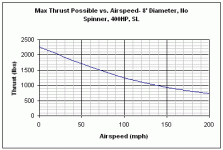
But here is a more standard graph which shows what I was referring to, the decrease in maximum thrust with airspeed, which is the normal case. This is the general case, as opposed to the particular case you presented. The general case is what I based my remarks on.
Attachments
Time for a change!
Yes, but this was PPG's requests for more tests! It has become very clear that there are doers and then there are talkers. The talkers seem to want the doers to do all the work while they badmouth the efforts.
Do you feel that it would be nice for a change for the talkers to actually do something to show they are correct. So far in 188 pages of this forum alone, they have not produced a single reason why this can't work. I Ratant came the closest to demonstrating something but since he couldn't duplicate the treadmill results due to an ineffective cart, his efforts came to naught-but he did actually did do something!
It's easy to stand on the sidelines and take infinite pot shots, not respond to cogent argument, and refuse to admit they ever error while doing absolutely nothing to demonstrate their ideas. I'm ready to let them put their efforts where their mouth is.
Regards
WindGrins
Windgrins, humber does not do experiments. When we were debating streamers long ago he would not go to the trouble to cut a streamer out of a plastic grocery bag, which is what I did. He tried to use his "logic" to win the debate. It did not match the experimental data.
He believed then, and probably still believes now, that streamers had some sort of hysteresis. My tests showed that it was negligible at best. For some reason he thinks that a heavier vane will react faster than a lighter streamer. Why? I don't know. You will have to ask him.
Yes, but this was PPG's requests for more tests! It has become very clear that there are doers and then there are talkers. The talkers seem to want the doers to do all the work while they badmouth the efforts.
Do you feel that it would be nice for a change for the talkers to actually do something to show they are correct. So far in 188 pages of this forum alone, they have not produced a single reason why this can't work. I Ratant came the closest to demonstrating something but since he couldn't duplicate the treadmill results due to an ineffective cart, his efforts came to naught-but he did actually did do something!
It's easy to stand on the sidelines and take infinite pot shots, not respond to cogent argument, and refuse to admit they ever error while doing absolutely nothing to demonstrate their ideas. I'm ready to let them put their efforts where their mouth is.
Regards
WindGrins
tobermoryphil
Thinker
- Joined
- Apr 23, 2011
- Messages
- 172
PPG: is anyone seriously disagreeing that prop thrust generally decreases with increase in velocity? in which case, your point is?
Last edited:
I'm happy to take this as a change in your statement.
It took me about 30 seconds. The one I showed is for a controllable pitch prop (like the BB) and your graph is for a fixed pitch prop (not the "general case").
However, pick either graph and your story still switches from a prop in still air produces no thrust vs that is its maximum thrust. You never acknowledged this radical reversal or told anyone you had it wrong!
Now, If you would like to state that your original contention that props in still air produce no thrust and that you were wrong about this, that props in still air indeed do produce substantial thrust, then we can go forward.
The only downside for you is that you will have to admit that the cart at WS can produce substantial thrust which was all that was stated by the carteers.
I'm happy to take this as a change in your statement. A simple admission of error. Is this what you are saying?
Regards,
WindGrins
How long did you need to search in order to find that humped graph? As Humber has already noted, that is for a particular propeller and with constant H-P. All you have shown is that a particular propeller can be designed to produce a graph that deviates from the norm under certain conditions. You won’t win any arguments using such desperate measures! But even in that somewhat unorthodox case, the general trend is to decreasing thrust with increasing airspeed. Also, notice that the size of the hump gets less and less as the Power decreases. It is flattening out quite a bit within the range that was used. I wonder how it would look at the power range of the cart ( 1 or 2 H-P)? Interpolation indicates to me the hump may not even be present.
But here is a more standard graph which shows what I was referring to, the decrease in maximum thrust with airspeed, which is the normal case. This is the general case, as opposed to the particular case you presented. The general case is what I based my remarks on.
[qimg]http://www.internationalskeptics.com/forums/attachment.php?attachmentid=22313&stc=1&d=1306179958[/qimg]
It took me about 30 seconds. The one I showed is for a controllable pitch prop (like the BB) and your graph is for a fixed pitch prop (not the "general case").
However, pick either graph and your story still switches from a prop in still air produces no thrust vs that is its maximum thrust. You never acknowledged this radical reversal or told anyone you had it wrong!
Now, If you would like to state that your original contention that props in still air produce no thrust and that you were wrong about this, that props in still air indeed do produce substantial thrust, then we can go forward.
The only downside for you is that you will have to admit that the cart at WS can produce substantial thrust which was all that was stated by the carteers.
I'm happy to take this as a change in your statement. A simple admission of error. Is this what you are saying?
Regards,
WindGrins
Except of course when you try to claim that a prop doesn't develop thrust at windspeed.The general case is what I based my remarks on.
[qimg]http://www.internationalskeptics.com/forums/attachment.php?attachmentid=22313&stc=1&d=1306179958[/qimg]
ETA: WindGrins beat me to it!
Last edited:
CORed
Penultimate Amazing
Yes, but this was PPG's requests for more tests! It has become very clear that there are doers and then there are talkers. The talkers seem to want the doers to do all the work while they badmouth the efforts.
Do you feel that it would be nice for a change for the talkers to actually do something to show they are correct. So far in 188 pages of this forum alone, they have not produced a single reason why this can't work. I Ratant came the closest to demonstrating something but since he couldn't duplicate the treadmill results due to an ineffective cart, his efforts came to naught-but he did actually did do something!
It's easy to stand on the sidelines and take infinite pot shots, not respond to cogent argument, and refuse to admit they ever error while doing absolutely nothing to demonstrate their ideas. I'm ready to let them put their efforts where their mouth is.
Regards
WindGrins
Let's give some credit to ynot, too. He was initially skeptical of the claim, and he may still (as of his most recent post anyway) be somewhat confused as to how it works, but he did some pretty clever experiments and accepted the results
All we get from humber and prof 0/0 = 0 are denial, erroneous math, faulty logic and gross misunderstanding of basic mechanics, all to "prove" that what has been shown to work in a variety of ways can't possibly work. In the case of humber, we get vague promises that someday, he will really show us it's all a scam, via an analysis of the test data that he clearly lacks the ability to accomplish and a mythical cart with no propeller that can advance against the treadmill belt. It's way past time for humber to put up or shut up.
Last edited:
Except of course when you try to claim that a prop doesn't develop thrust at windspeed.
ETA: WindGrins beat me to it!
Ah, but 2250/0 = 0/0
Or something.
A reasonable wish!
Agreed!
Yes, and it's extremely disingenuous to flip-flop 180 degrees in bold statements and never acknowledge one's errors. What massive and trite insecurity on some of our poster's parts!
WindGrins
Let's give some credit to ynot, too. He was initially skeptical of the claim, and he may still (as of his most recent post anyway) be somewhat confused as to how it works, but he did some pretty clever experiments and accepted the results
All we get from humber and prof 0/0 = 0 are denial, erroneous math, faulty logic and gross misunderstanding of basic mechanics, all to "prove" that what has been shown to work in a variety of ways can't possibly work. In the case of humber, we get vague promises that someday, he will really show us it's all a scam, via an analysis of the test data that he clearly lacks the ability to accomplish and a mythical cart with no propeller that can advance against the treadmill belt. It's way past time for humber to put up or shut up.
Agreed!
Yes, and it's extremely disingenuous to flip-flop 180 degrees in bold statements and never acknowledge one's errors. What massive and trite insecurity on some of our poster's parts!
WindGrins
Power, by its very nature, is always dynamic, as it is Work / Time, or as we define it in terms of the cart, Power = Force / Velocity.
Power is not force divided by velocity; it's force times velocity.
There is no such thing as static power, yet that is exactly how it is being applied in the calculations of Thrust versus Drag, in order to “prove” the cart works. All of the calculations are static, using only the initial value of Power, for example when a tow line is released, to calculate a thrust force, and say it is greater than drag force. That is not a valid method of analysis, as the power is varying with respect to time; it is a dynamic quantity, not static. The solution for the cart motion can only be done in terms of a dynamic differential equation, and cannot be based on a static initial condition.
What if we aren't trying to solve for the exact motion of the cart over an extended period of time? What if we're just trying to determine whether it will speed up or slow down from a given speed?
The second point, concerning the propeller behaving in an inverted manner, is this: An airplane just before takeoff revs the engine with the brakes on, and produces maximum thrust while doing no work to move the aircraft forward. (In truth, this is not absolutely necessary, as thrust can be applied incrementally is the pilot is experienced enough, but normally it is throttle pushed to the wall for takeoff). The point here is, as the aircraft moves forward and velocity increases, the thrust drops off, and at the maximum cruising speed the thrust is at a minimum value. But the explanation for how the cart works has the thrust at a high value while the cart is moving at wind speed, ( but not greatly higher than drag) and the claim is that the thrust increases from that point onwards, accelerating the cart! How can the thrust increase as the velocity also increases?
Are you forgetting that the cart's propeller doesn't spin at a constant angular speed, but spins faster as the cart moves faster?
recursive prophet
Graduate Poster

I Ratant was trying to build a DDWFTTW cart. He failed. The reason he failed is that he would not listen to people who knew better.
Or perhaps because he had a visible opponent in his race with the wind? That's something spork has never done. Remember the talk way back about using balloons or a smoke machine to make it all more palpable to the lay public? Yet no attempt was made to dramatically demonstrate ddwfttw for the peanut gallery. Just a small box of colored foam popcorn dumped by spork when he exceeded ws would have made a far better visual-accuracy aside-than wind vane and instrument shots. So why didn't it happen?
What exactly was wrong with I Ratant's cart SZ? I recall it being discussed and him presenting a lot of data, but it seems there was a terminology derail and I remained unclear on exactly what the carteers claimed he failed to do. Something about pitch or prop size, wasn't it? Or was it gearing? I would much appreciate an idiot's guide type explanation if you remember what the bottom line mistakes were from your reference frame.
Again, one has to wonder what humber gets out of his investment.
Attention, in the form of replies to his posts.
Spork and JB,
Congratulations!
Actually, I believe you'll pass through phases from 1. it can't work, to 2. wow, it works, to 3. what a clever machine, to 4. this is how its done and finally 5. no more notice than a passing general aviation airplane.
It's a little sad that the extraordinary so quickly becomes the norm!
Regards,
WindGrins
I don't think there's all that much about the cart that's extraordinary. It's all the ridiculous debate that is. Not so surprising that that h's deny it; but there are trained (not competent) engineers and even professors that seem to still deny it.
Did you have the BB there or just the small models?
We had the BB. I'm told that Make magazine had a model they built from our videos at their booth.
I can understand totally why Spork refuses to get in the ring with you-
it is more fun being a spectator than wrestling with a dead sheep.
It's not a matter of refusing to get in the ring, but rather not bothering to roll in the mud with someone that refuses to respond to questions while insisting on responses to his (all while lying and insulting continuously).
IF it is applied throttle to the wall, the thrust always decreases as the aircraft gains velocity, without any exceptions.
Wrong. Do you make this stuff up just for effect?
I also said the aircraft, standing still with full power produces maximum thrust.
I'm sure you did - but that's wrong too.
The problem for the cart is that for this claim to be true, it would have to be capable of producing high static thrust at windspeed, and the thrust must increase from that point in order to overcome the increased drag, if it were to go faster.
Spectacularly (and more obviously) wrong.
- Status
- Not open for further replies.