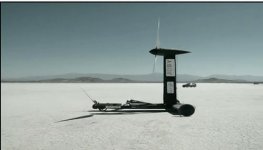
The albatross achieves a net downwind speed 40% faster than the wind speed (wind speed at the highest point of the maneuver) without flapping the wings:
http://esoaring.com/albatros_presentation_esa.pdf
Connect two albatrosses or RC-gliders on mirrored tracks with a string, and you have a DDWFTTW-glider in steady state (no net altitude loss).
As for the BB exploiting the wind-gradient:
- I don't see how this would work (and neither does humber)
- I don't think it would violate NALSA rules
- I don't see the point of it, if you have ground contact anyway.
But
your theory is squashed by the fact that the cart operates just as well 25 degrees off wind, so is wrong. The cart is not a specifically ddw cart, but one that exploits crosswinds and
calls itself ddw.
Why is it, that you think you can second-guess EVERY expert? They are always wrong, even if chosen by you, unless they agree with you.
Dr Camp is "a bit right" where the bits are those you agree with.
It is not for you to say if there is enough power from the cross-winds AND the general non-ddw path, unless you can prove it. Yevgheni has shown that the "obvious" choice is wrong, because the math says so.
The electrical model says so.
As usual humber is trying to make spork's & JB's achievements look far more amazing, than they are:
- The BB is so efficient that it can achieve 3 WS using wind gradients
Trivial. Could be much better. It is an inefficient sail cart
- The BB is so efficient that it can tack downwind at few degrees to true wind
Try 30. Data manipulation, changing the claim to meet reality. Short term performance in a variable wind. The real question is why is it so slow?
Making up the rules. Burying failures. Unwillingness to supply data, or answer to anomalies in that data. Smells like fraud.
- The TM models are super-efficient vibration engines powered by the sound of the TM against the belt.
Are they paying this guy?
The Creator has no math skill, and shows little technical expertise, but to compensate for that, tells himself that he has "intuition" and can see all sorts of abstract things. That led him to the misbegotten notion that the TM was a GT. At first the cart did not stay on the belt, so he fiddled with it until it did. He tinkered with it. But did not ask himself, why changing the tyres may do that, so failed to notice that the reason it stayed on the belt, was because of a change in the mode of operation.
Yevgheni, Harold and I, do indeed understand that change of mode, and we didn't need to tinker to work it out.