Merged DDWFTTW in a “Real” Wind

Status
Not open for further replies.
This is one of the best worded indictments of Harold's nonsense I have seen.

+1

JB


Static Thrust of Propellers
The thrust of a propeller is not constant for different flight speeds. Reducing the inflow velocity generally increases the thrust. A reduction of the aircraft speed down to zero tends to increase the thrust even further, but often a rapid loss of thrust can be observed in this regime.
That is why the static thrust of a propeller is not such a terribly important number for a propeller - the picture of a propeller, working under static conditions can be distorted and blurred.

As long as an aircraft does not move, its propeller operates under static conditions. There is no air moving towards the propeller due to the flight speed, the propeller creates its own inflow instead. A propeller, with its chord and twist distribution designed for the operating point under flight conditions, does not perform very well under static conditions. As opposed to a larger helicopter rotor, the flow around the relatively small propeller is heavily distorted and even may be partially separated. From the momentum theory of propellers we learn, that the efficiency at lower speeds is strongly dependent on the power loading (power per disk area), and this ratio for a propeller is much higher than that for a helicopter rotor. We are able to achieve about 80-90% of the thrust, as predicted by momentum theory for the design point, but we can reach only 50% or less of the predicted ideal thrust under static conditions.

http://www.mh-aerotools.de/airfoils/prpstati.htm
Dr Martin Hepperle, author of Javaprop.

Static Power and Thrust
http://aerade.cranfield.ac.uk/ara/1940/naca-report-684.pdf

Cp = power coefficient
= P/(pn^3*D^5)
D= prop diameter
n = AV
p = air density
P = engine power.

Static force does no work. It is simply not physically possible for a prop to generate truly static thrust. Some fans can come close, where there is a static pressure, but will generally oscillate.
 
Last edited:
zero divided by anything = zero as we are talking about NUMBERS, not functions!
... functions, ... 'Hopital's rule. ...numerator...denominator ...as it does not matter.
Yes yes.

Tell me, if the thrust would be 500 bajillion pounds and the velocity would be zero, what would the propulsive power be?
 
Last edited:
But if you only have numbers and there is a zero in the numerator, you can forget about the denominator altogether as it does not matter.

That's not right.

I could just as easily say, if there's a zero in the denominator, the answer is infinite, and you can forget about the numerator altogether as it does not matter.

That's not right either.

There's a reason you're not supposed to divide by zero.
 
In fact, I haven't made any speculative claim whatsoever of the chain's efficiency. That was you. I have merely pointed out some rather obvious mistakes you made when you started pulling numbers out of your backside.

If you ever have any factual basis for making a claim of a particular value of efficiency I'll be happy to read it.

OK. I can't make a definite claim of a particular value. I said my estimate was about 75% in contrast to the CLAIM made for 90% and I supported that with evidence that you have not contradicted. If you refuse to see the degraded performance of that chain on the cart, literally flapping in the breeze and running against skateboard wheels, twisted and misaligned, then that is your right. But I can't take anything you say on this forum seriously, either.
 
The engine provides a hell of a lot of Power, unlike the cart that has none at wind speed.

None? What about all that groundspeed and kinetic energy? You're the ground frame guy, aren't you? If the cart's travelling at windspeed then the wheels are turning and the prop is spinning. Are you claiming that a spinning propeller moves no air?
 
The engine provides a hell of a lot of Power, unlike the cart that has none at wind speed.

What kind of power are you talking about?

I thought we were talking about thrust power, which is the thrust of a propeller times the speed of the propeller relative to far-away air. When a helicopter is on the ground, its rotor is not moving (vertically) relative to far-away air, so its thrust power is zero.

The engine provides a lot of power, but that gets transferred to the air near the propeller. Thrust power doesn't measure that.

But if we are talking about shaft power, of which a helicopter's rotor has a lot, the cart's propeller also has a lot: torque is being applied to the propeller, and the propeller is spinning, and shaft power = (torque)(angular speed).
 
None? What about all that groundspeed and kinetic energy? You're the ground frame guy, aren't you? If the cart's travelling at windspeed then the wheels are turning and the prop is spinning. Are you claiming that a spinning propeller moves no air?

Switch off a fan. The blades are still spinning for a short while but there is no power (remember, you switched it OFF, right)
Would you call that residual air motion thrust? I call it the air is now taking the remaining stored kinetic energy out of the fan blades as the fan slows down.

Same is true IF a DDW cart were to ever reach wind speed. The source of power is OFF. Now the ground takes the remaining stored energy out of the cart as it slows down, propeller woefully and feebly spinning down producing NO thrust. But don't worry, because the cart will never reach that point!
 
OK. I can't make a definite claim of a particular value. I said my estimate was about 75% in contrast to the CLAIM made for 90% and I supported that with evidence that you have not contradicted. If you refuse to see the degraded performance of that chain on the cart, literally flapping in the breeze and running against skateboard wheels, twisted and misaligned, then that is your right. But I can't take anything you say on this forum seriously, either.

I think you'll find I pointed out where the evidence flatly contradicted a whole series of claims you made about chains. We never even got to the point made in the Johns Hopkins link that oil in the chain links seemed to serve to exclude contamination from the bearing surfaces.

If you have any evidence showing what sort of losses would accrue from a 90° twist in a 5 meter chain than let's have it.
 
Any number x 0 = 0

Therefore:

0 / any number = 0

as I stated.

Done.

You are assuming what you're trying to prove.

You are trying to prove that you're allowed to zero by zero (and that the answer is zero). But, in going from
any number x 0 = 0​
to
0 / any number = 0,​
you are assuming that you're allowed to divide both sides by 'any number', which might be zero.
 
Same is true IF a DDW cart were to ever reach wind speed. The source of power is OFF.

The source of power is the wind. The wind is still blowing.

Or would you like to switch to a reference frame in which the air is stationary and the ground is moving?
 
Switch off a fan. The blades are still spinning for a short while but there is no power (remember, you switched it OFF, right)
Would you call that residual air motion thrust? I call it the air is now taking the remaining stored kinetic energy out of the fan blades as the fan slows down.
The "first spin-up video" shows the BB's prop being turned by hand at 15rpm in still air. From the fall in AV between applied force from the hand, and the KE of the prop, it can be calculated that the air power produced will be about 3W.
It should be possible to calculate the applied power, but that seemed rather pointless. I did the calculation in opposition to the figure provided, and of the order of KW, obtained by yet more barefoot use of an online calculator.

Also, generally,
attachment.php
 

Attachments

  • propcalc.jpg
    propcalc.jpg
    24.2 KB · Views: 38
Last edited:
Any number x 0 = 0

Therefore:

0 / any number = 0

as I stated.

Done.

No one could post something this nonsensical in good faith. It seems to me that is prima facie evidence that it is a pure troll.

So, as this forum seems to have a lot of rules about the posts but no specific rule against trolling; Serious question, is trolling ok?
 
The source of power is the wind. The wind is still blowing.

Or would you like to switch to a reference frame in which the air is stationary and the ground is moving?

Actually he needs to pull numbers from both at will with no transform. That is the foundation he builds his nonsense on.
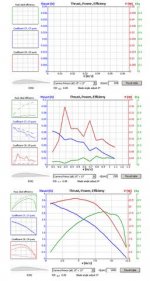
 
Actually he needs to pull numbers from both at will with no transform. That is the foundation he builds his nonsense on.

Cp = power coefficient
= P/(pn^3*D^5)
D= prop diameter
n = AV
p = air density
P = engine power.

The cubic relationship of n, give the boys a headache mas grande,
when the "generator power" is linearly related to AV, by the blisteringly stupid idea of gearing the prop to the wheels.
 
Status
Not open for further replies.

ISF - Join now!

Every member here is approved by hand. No bots, no spam, just people who care about evidence and honest debate.

Membership is free!

Create your free account

Back
Top Bottom