
Merged DDWFTTW in a “Real” Wind

Status
Not open for further replies.
I'm becoming more impressed with our feat all the time. After all, we managed to go directly downwind at nearly 3 times the wind speed with a horribly inefficient chain drive, a horribly inefficient propeller, and zero power to turn the prop - so no thrust. I think we deserve another record.

ETA: incidentally, if you have zero power to turn the prop, do you really care how inefficient your transmission is? That's kind of like getting your money for nothing and your chicks for free.
 
Last edited:
When the cart (in your imagination only) reaches windspeed ddw, there is no wind energy,
I thought you want to work in the ground frame only. So please show us how there is no wind energy in the ground frame.
 
Last edited:
I'm becoming more impressed with our feat all the time. After all, we managed to go directly downwind at nearly 3 times the wind speed with a horribly inefficient chain drive, a horribly inefficient propeller, and zero power to turn the prop - so no thrust. I think we deserve another record.

ETA: incidentally, if you have zero power to turn the prop, do you really care how inefficient your transmission is? That's kind of like getting your money for nothing and your chicks for free.

Record for biggest joke of the year? Yep, horribly inefficient chain drive (75%) horribly ineffiicient propeller (62%) and the data says the cart did not go directly down wind. Now all we need to figure out what the wind speed was at the cart, to determine if it even went faster than the wind, which is no accomplishment anyway! I'm glad you see the humour in it, as I do.

I wonder if NALSA will be laughing along?
 
You don't suppose that a longer chain has more links, now do you?
How difficult is that?


Large sprockets have more teeth, and more friction with the chain. Difficult concept?


It tells me the same thing it should tell you: The longer chain has more links and more internal friction. The bigger sprockets have more teeth and more external friction. The chain is not straight, but is twisted and that causes misalignment (one of the principle causes of inefficiency). The long chain, with home made tensioners, is in no way properly tensioned. The tensioners themselves are crude and add friction to the chain running against them. The higher power will cause the chain to stretch, adding to the inefficiency. The dirt from the environment will cause more friction and inefficiency.

Still want to claim 90% efficiency? 75% is being generous.

Psst! Spork and JB. Now is a good time to try to set a new record. All that hand waving profpangloss is doing is generating a real good wind.
 
Apparently it is far too difficult for you to understand that there is plenty of energy being transferred in what is known as a "slip stream" when the propeller is operating at static conditions.

Except there is no slip stream if the propeller is moving at wind speed, ddw. How can there be, as it is effectively in still air, yet supposedly powered by wind? So here we have a wind-powered vehicle in still air, with no power but producing its own slip stream? Neat trick!
 
Yes I do, so does everyone else.
Are you sure? 650lb-ft at the prop shaft ? And the wheel always drives the prop? And the large Sprocket is 12" and the wheel is 27"?
Way to go.

Sure looks like 56 MPH to me.

It would. And it travels ~2m/sec for 1:30s in an 18mph wind?
You don't have the data, and NALSA did not offer it to you.

The only data you have that can be used to support the cart is from ONE record trial.

Thrust force, not net force.
All Spork's methods show a rising NET force and an increasing THRUST.


humber said:
730ft lb = 899N-m.
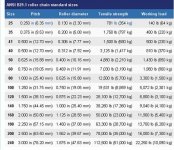
If that is at the prop shaft, the chain of the (12') sprocket will see
~6000N.
989 N-M, 6500 N 1460 lbs.... so?

6500N in the bike chain? Static load? OK.

attachment.php


The turns ration is 2.8:1, so the diameter of the smaller sprocket must be about 4", so r ~ 0.05m. (6500N on a 4" bike sprocket)
Wheel shaft torque = 6500*.05 = 325N-m.
Wheel = 27", r = 0.34
Force at ground = 325/.34 = 955N
 

Attachments

  • chain.jpg
    chain.jpg
    64.9 KB · Views: 34
Last edited:
[qimg]http://www.internationalskeptics.com/forums/attachment.php?attachmentid=22163&stc=1&d=1305340986[/qimg]

And the rest of the data, where Spork's errors of calculation are a smaller percent of the total. Now try.
 
Well there is that as well, but he thinks the torque on the axle, with the 23t sprocket, is higher than the torque on the prop shaft, with the 65t sprocket.

Guess what 650ft-lb prop torque means for the forces on the prop blades? I took the least egregious interpretation of "the torque of a Corvette".
 
Last edited:
Yup - that's my favorite. Well that and the act that he's trying to be condescending while explaining that the fat kid has to sit further from the pivot on the see-saw.

Your cart generates 32N when in full flight, and is constant.
The breakages are not due to large forces, but engineering incompetence.
 
Thinairdesigns said:
Repeatedly weighed during and after construction.
Evidence.

Thinairdesigns said:
NALSA has no weight restrictions. They care not what it weighs.

And you told me in no uncertain terms that NALSA weighed the cart.
 
I'm becoming more impressed with our feat all the time. After all, we managed to go directly downwind at nearly 3 times the wind speed with a horribly inefficient chain drive, a horribly inefficient propeller, and zero power to turn the prop - so no thrust. I think we deserve another record.
It's more like an Edison cylinder, than a shellac 78.

ETA: incidentally, if you have zero power to turn the prop, do you really care how inefficient your transmission is? That's kind of like getting your money for nothing and your chicks for free.
[/quote]

Because you knowingly ran the cart in 100 degree crosswinds, misled NALSA, failed to supply the appropriate instruments and manipulated the data.
 
Last edited:
Are you sure? 650lb-ft at the prop shaft ? And the wheel always drives the prop? And the large Sprocket is 12" and the wheel is 27"?
Way to go.


It would. And it travels ~2m/sec for 1:30s in an 18mph wind?
You don't have the data, and NALSA did not offer it to you.

The only data you have that can be used to support the cart is from ONE record trial.


All Spork's methods show a rising NET force and an increasing THRUST.


6500N in the bike chain? Static load? OK.

The turns ration is 2.8:1, so the diameter of the smaller sprocket must be about 4", so r ~ 0.05m. (6500N on a 4" bike sprocket)
Wheel shaft torque = 6500*.05 = 325N-m.
Wheel = 27", r = 0.34
Force at ground = 325/.34 = 955N

If you use r = 0.054 for the smaller sprocket that is 350 n-m
and r = 0.343 for the wheel, that is 1020 N force at the ground.

At what velocity is all of this supposed to be happening?
 
Status
Not open for further replies.

ISF - Join now!

Every member here is approved by hand. No bots, no spam, just people who care about evidence and honest debate.

Membership is free!

Create your free account

Back
Top Bottom