• Security incident: ISF was recently accessed by intruders. Please change your password, and change it anywhere else you used it. Read more

Merged DDWFTTW in a “Real” Wind

Status
Not open for further replies.
Humber's "Top Secret" treadmill Cart.

Humber,

I would also be very interested in seeing your cart go up a treadmill given the following conditions on a posted video:

No energy storage in the device.
No strings or other attachments to anything other than the belt of the treadmill.
Steady state start and no change of speed of the treadmill.
No weird vibrational jumping around due to a "chattery" treadmill.
No obvious "stupid tricks".

It may use the relative wind but if it doesn't, it should start from 0 and accelerate on a level floor! This would truly surprise me given no internal storage of energy.

I'm all for it. Let's see it!
 
Humber,

I disagree with I Ratant's aero-friend also but I don't mock him. His lack of understanding is reasonable but wrong. It's a subtle point that the prop is not acting in the relative wind that the cart is. This is a reasonable confusion. If one could ride along with one of the blades of the prop, I believe it would always be like watching a sail on a broad reach once it starts spinning. It's counterintuitive (but that's what makes this fun) to realize that 0 WS for the cart is not 0 WS for the prop blade and that it merrily accelerates past this point with no change in dynamics. This was the epiphany that made me realize this would work. I originally thought it wouldn't also. But, after thinking about it for a couple of hours and looking at the explanations and vectors, it became clear it would work and does! Very cool!

That still contains the idea, directly expressed or not, that the aero-friend has some deficiency that prevents him from "seeing" the solution. That does not excuse TAD for the inane remarks about his unknown ability.

When I hear "counter-intuitive" as an explanation, I think of a snow storm, where the onus of actual explanation is put upon the questioner, and not upon the claimant. It's your fault if you don't "get it".
TAD have no mathematical support for the cart,because they lack that particular skill.

Resort to graphics and intuition, are not a supplementary aids to teaching, but the entire arsenal. One may imagine all sorts of ways in which a prop could behave to drive the cart, but none are extraordinary, so why have they not already been employed?
No aeronautical text book mentions the tacking prop, nor do sailing texts or general articles, refer to propellers or Planet Oil Barrel when trying to explain
the "counter-intuitive" fact that boats can travel up or downwind faster than the wind. Why not?

I Ratant's friend is correct. There is no power to run the idea. That matter of power, and where the energy comes from, never enters TAD's graphics or hand-waving explanations.
The trial circumvented that problem by running the cart away from ddw and in heavily changing wind, where that energy is available. Evidence for that claim is available from the published chart.
That is why TAD defend it still. The record is shaky, and I Ratant's carts, and my TM carts, are a threat to that record.

 
And you have actually tested it? No tricks?

My first guess is it has a flywheel and must initially be pushed to greater than belt speed. But such stored energy is not allowed, so that would certainly count as a "trick".

It would be really cool if this turned out to be a genuinely novel and interesting design, which worked as advertised, but on track record alone I'm braced for disappointment.

Nope. Runs real time.
 
Humber,

I would also be very interested in seeing your cart go up a treadmill given the following conditions on a posted video:

No energy storage in the device.
No strings or other attachments to anything other than the belt of the treadmill.
Steady state start and no change of speed of the treadmill.
No weird vibrational jumping around due to a "chattery" treadmill.
No obvious "stupid tricks".

It may use the relative wind but if it doesn't, it should start from 0 and accelerate on a level floor! This would truly surprise me given no internal storage of energy.

I'm all for it. Let's see it!

You don't seem to understand where humber is coming from. He does not think that the treadmill is equivalent to wind speed travel. And he does think that the carts that advanced used either stored energy or the vibrations of the treadmill to accomplish what they did.

So he is trying to show a cart that works that way without a prop.
 
The concept was mine, but it turns out I wasn't the first to think of it.
That means it wasn't your concept. Not only that, but Prof Ruina, published the same ideas and analogies in 1980. Prop/turbine combination extend back to the late 19th Century.

Even if you claim that you did not know of them, their influence will be there in consequence. To say you "thought of it" is like seeing gas stations, roads and engines, but no cars, and then patting yourself on the head for thinking of the car as a consequence.
And...that you don't do your research, because you are vain enough to think that it must be original.


Nice history lesson.

could you tell me why this doesn't work?

http://www.youtube.com/watch?v=IMEerIkOVZ0
 
Humber,

Actually, I have a text called "The symmetry of sailing" by Ross Garrett that does refer to DDWFTTW sailing and does a pretty good job of discussing it. At the time it was written, I don't believe any boats had achieved this.

There has been a lot of discussion about math to explain this and the primary objection seems to be a violation of conservation of energy which no one that built the cart claims. All the energy comes from the differential of the air over ground. The real "math" issue boiled down is:

When the cart is at 0 relative WS, is the propeller producing more thrust than the resistance of the wheels and frictional losses? If so, the cart will accelerate past 0 WS (relative to the cart not the prop blades). So the only relevant math is: When the cart is at WS (0 relative wind), is the props thrust > or < the wheel/drivetrain resistance + frictional losses. (The cart is at 0 WS in this condition so there are no aero losses to add.) Everything else is an aside and irrelevant.

The point about I Ratant's friend is that it is easy to confuse the idea of the props relative WS with the carts. The idea is that the prop (with a source of torque) will produce thrust at 0 WS. (otherwise a Cessna couldn't start taxiing). This "static thrust" is exactly what BB is using when it obtains WS to accelerate. Again it is worth noting that there are no regimes from the props point of view once it leaves its initial "stalled condition" on start up. It produces more and more thrust until finally at well above wind speed, the carts aerodynamic and rolling drag equal the props thrust. From there it will no longer accelerate at that WS. (steady state well above WS)

Again, let's see that cool cart of yours on video working as described.
 
Nice history lesson.

could you tell me why this doesn't work?

http://www.youtube.com/watch?v=IMEerIkOVZ0

More than history. That same vanity, the need to be the first, is what drives the entire project, the promotion, and a confirming result at the expense of truth.

1) There are very nicely presented graphics promoting anti-gravity devices.

2) The cart is in some sort of wheeled device that travels less distance than the sail thingy does. True, that in one direction the average is the same, but the little sail device, travels further over the ground. That is exactly how a tacking boat works, but without the wheeled gizmo. Ddw, the BB's prop hub does not take that path, but the one taken by the wheeled gizmo.
Work = force*distance. If that work is available, then any machine can use that to gain a higher translated speed, while the average (RMS) velocity remains the same as the four-wheeled device.
 
Last edited:
Lyricist,

Yes, I got that. Thanks.

That's why I want to see Humber's cart do what he describes. If it does not use the relative wind, then as stated, it should start on a level floor and accelerate with no sources of energy. That is the concept I want to see demonstrated. I'm perfectly OK with it starting on the treadmill and doing this under the conditions described since one inertial frame is as good as any other to me. If his cart does not have any other sources, I will be very surprised that it does anything other than roll backwards off the treadmill from steady state since equilibrium on the belt is traveling at belt speed. As I said, let's see it!

Thanks,
 
Last edited:
I would think the prop is installed backwards? Also...who knows if the pitch is proper for this application. Pitch seems critical and this prop looks like it needs to be closer to flat. And the proper gear ratios seem important for maximum effect.
.
Definitely.
Pitch makes a difference.
The lower pitches I've been using have faster response times to the wind.
Freewheeling, the lower pitches wind right up.
This (to my way of thinking) gets the prop to a higher amount of windmilling drag in lower winds.
Gear ratios.
The choice of parts from my slot cars parts was limited. :)
Finding two crown gears with the same number of teeth and pitch was pure accident.They are 24 tooth, the pinion is 18. 3:2 reduction.
I have only that pair for the wheels drive axle.
I can change the ratio at the prop end, using pinion gear from the r/c car store.
 
More than history. That same vanity, the need to be the first, is what drives the entire project, the promotion, and a confirming result at the expense of truth.

1) There are very nicely presented graphics promoting anti-gravity devices.

2) The cart is in some sort of wheeled device that travels less distance than the sail thingy does. True, that in one direction the average is the same, but the little sail device, travels further over the ground. That is exactly how a tacking boat works, but without the wheeled gizmo. Ddw, the BB's prop hub does not take that path, but the one taken by the wheeled gizmo.
Work = force*distance. If that work is available, then any machine can use that to gain a higher translated speed, while the average (RMS) velocity remains the same as the four-wheeled device.


The wheeled device IS the cart. The wheeled device is moving directly downwind faster than the wind. The 'tacking element' is just the mechanism used to achieve this.

So you accept that DDWFTTW is possible then? at least in theory?
 
Last edited:
.
Definitely.
Pitch makes a difference.
The lower pitches I've been using have faster response times to the wind.
Freewheeling, the lower pitches wind right up.
This (to my way of thinking) gets the prop to a higher amount of windmilling drag in lower winds.
Gear ratios.
The choice of parts from my slot cars parts was limited. :)
Finding two crown gears with the same number of teeth and pitch was pure accident.They are 24 tooth, the pinion is 18. 3:2 reduction.
I have only that pair for the wheels drive axle.
I can change the ratio at the prop end, using pinion gear from the r/c car store.

Ye, wide and flat. Like a fan. That is the way to develop low rev thrust. Take a look at Bauer's prop. It is thin, and is a compromise that will operate nearly as well at a turbine as it does a prop. He has variable pitch to improve upon that as necessary.
attachment.php
 

Attachments

  • bauer_video.jpg
    bauer_video.jpg
    14.9 KB · Views: 54
I suspect they are talking about this, I Ratant.
http://www.youtube.com/watch?v=nudBjrOF3LE
When free, the wheels turn into the wind.
.
I'd like to see the gearbox at the driving end. :)
.
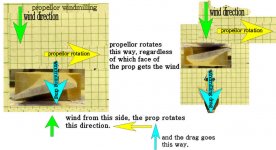
The gearing can be arranged to use the normal windmilling direction of the prop to drive the cart.
I had that on the late evening tests.
But that direction doesn't replicate the BB setup.
The normal windmilling directions of a conventional right-hand twist propellor....
 

Attachments

  • jrWindmillingPropellor.jpg
    jrWindmillingPropellor.jpg
    99.8 KB · Views: 2
I Ratant,

I think "your way of thinking" is a problem here. The prop on a properly functioning DDWFTTW cart will never be "windmilling" It will always be functioning as a propulsive prop in all speed regimes except at the zero start up point. This is a critical point for the proper functioning.

The cart guys could probably give you some nice tips on prop size/pitch etc. with a nice request. Don't let ego get in the way of all your hard work! Just ask them nicely!

Thanks,
 
The wheeled device IS the cart. The wheeled device is moving directly downwind faster than the wind. The 'taking element' is just the mechanism used to achieve this.

So you accept that DDWFTTW is possible then? at least in theory?

No. That is the deception. One is divorced from the other.
And BTW, balloons do not behave like that, not do they travel at WS.

You won't accept even basic aerodynamics, but Newton says they won't.
For each force there is an equal and opposite force. If not, the world would be chaotic, and you wouldn't be here.
 
I Ratant,

I haven't built a cart and am not part of the team. So this is shooting in the dark. In the build videos, it says to ensure the larger gear is on the prop shaft-this means that every time the wheel axle turns, the prop turns less revolutions ( at the least a 1:1 ratio). This allows the wheels to have a mechanical advantage over the prop (leverage).

Also, in your explanation there is an issue. As soon as the prop starts turning, it produces thrust to push the cart downwind. There is no transition point below or at windspeed!!!

The faster the cart goes, the more thrust the prop creates due to the wheels turning the prop. At < wind speed, the prop is thrusting. At = to WS, the prop is thrusting more. At > WS, the prop is thrusting even more.

Cart guys, please let me know if I got this right. Thanks,
.
The prop turning in the normal direction, is a sail. Drag, not thrust. When being pushed from behind, the forward speed lessens the drag/sail effect as it increases in rpm as the cart approaches wind speed.
Achieving windspeed, the prop has no drag effect... but also, there should be no thrust.
There's no incoming wind at the windspeed point.
It's turning, but what is going on there, as the vehicles obviously do go faster?
As propellors do develop thrust when being driven by motors regardless of the wind direction or speed.. wheels in this case, is that the thrust that moves it faster?
As I've said before, makes my head hurt. :)
 
Status
Not open for further replies.

ISF - Join now!

Every member here is approved by hand. No bots, no spam, just people who care about evidence and honest debate.

Membership is free!

Create your free account

Back
Top Bottom