Cult Archaeology

LW said:

There are actually several slightly different lists of the wonders. The one that is most often mentioned is:

1) The Great Pyramids of Giza --- still standing

2) Hanging Gardens of Babylon --- doubtful if they ever really existed at all.

3) Statue of Zeus at Olympia --- Transported to Constantinopole where it was destroyed in a fire in AD 462.

4) Temple of Artemis at Ephesus --- First burned down by Herostratus (BC 356) later fixed and finally torn down by christians (AD 401).

5) Mausoleum at Halicarnassos --- dismantled in the 15th century, stones used to build a nearby castle.

6) The Colossus of Rhodes --- fell in an earthquake in BC 226, material sold as scrap metal in AD 654.

7) The Lighthouse of Alexandria --- damaged by numerous earthquakes, finally dismantled and material used for castle building by Mamelouks in AD 1480.

As things must come to pass, I guess. Ah well. Strange how many of them were ripepd apart for raw materials... as for the gardens, if they never existed then i don't much feel compelled to support the mythos. Modern gardens and acropoli are no doubt far more fantastic than ancient people managed... even if we had nicer tools to play with.

Which leaves only one question... how do statues burn? :D
 
Akots said:
One thing i just remembered hearing about, which will no doubt compound the evidence of my ignorance in this area... it may not be a woo-woo question, but at least it's dispelling ignorance.

How many of the "7 ancient wonders of the world" are left standing? I remember hearing once that only one remained intact; the great pyramids. As little as I know about them, the idea that the other 6 were destroyed saddens me greatly.

Which ones are still standing, and which have been destroyed? and by what means?

The list of the Seven Ancient Wonders was compiled sometime during the middle ages; the Great Pyramid at Giza is the only one among them still standing.

The others were the statue of Zeus at Olympia, the Colossus of Rhodes, the Hanging Gardens of Babyon, the Greek Temple of Artemis (at Ephesus), the Lighthouse of Alexandria, and the tomb of King Maussollos at Halicarnassus (from which we get the modern word "Mausoleum"). As far as I can remember, they all deteriorated in the elements after so much time - all of them but the Great Pyramid. Score one for the Egyptians!

(Edit...it appears I've been beaten to the punch, and, I was wrong about how some of the wonders were destroyed.)
 
Sorry Joshua, you've not yet convinced me.

I tohught the shafts were just supposed to be ports to carry the Pahroas to their rightful place in the heavens - pointing to particular stars, not particular direction. Again North/South dhas no relevance. So it isn't a question of having it both ways. The Pyramids and the Nile mimic the milky way and Orion's belt and shafts are the routes to the relevant stars.

Also, I can't see why bendy shafts is such a problem. Is there sometihng in ancient Eqyption religion and mythology surrounding their Pahroas that means any shaft designed to be a road to the heavens needs to be straight?

If you feell inclined, you might like to fill me in a little bit more about the backgrounfd to this theory and why it seems to be so controversial. It seems perfectly rational to me and fits with ancient Egyption beliefs.
 
Steveo said:
Great thread Joshua, Thanks for the info. I have another one. I read a book Years ago by Berry Fell, Called America B.C. It talks about a possible link between the ancient Celtics and New England. Going back as far as 800 BCE. It sounded pretty far-fetched and I have never heard much else on the subject. Is there anything to it?
I have not read Fell's book, but I know he was involved in the translation of alleged ancient Ogam inscriptions discovered in West Virginia, the most famous being the Horse Creek Petroglyph. More here: http://members.aol.com/jlcooke/petroglyph.htm

There's also a guy who claims the Horse Creek Petroglyph was actually written in Basque, not Gaelic. http://www.islandnet.com/~edonon/horse.html
 
Drooper said:
Sorry Joshua, you've not yet convinced me.

I tohught the shafts were just supposed to be ports to carry the Pahroas to their rightful place in the heavens - pointing to particular stars, not particular direction. Again North/South dhas no relevance. So it isn't a question of having it both ways. The Pyramids and the Nile mimic the milky way and Orion's belt and shafts are the routes to the relevant stars.

Also, I can't see why bendy shafts is such a problem. Is there sometihng in ancient Eqyption religion and mythology surrounding their Pahroas that means any shaft designed to be a road to the heavens needs to be straight?

If you feell inclined, you might like to fill me in a little bit more about the backgrounfd to this theory and why it seems to be so controversial. It seems perfectly rational to me and fits with ancient Egyption beliefs.

Here are the problems:

  • The theory about the soul of a Pharaoh needing shafts to get to heaven is unfounded - no other Pharaonic pyramid or tomb employs them, and no text supports them. As the incarnation of Ra, the sun god, a Pharaoh would have no place in the night sky anyway. In truth, no one knows exactly what the shafts were for.
  • The bendy shafts are a problem if one contends they point as specific stars, based on the angle of the shafts as they come off the Queen's Chamber. When the shafts bend, they point at completely different areas of the sky than they would had they travelled in a straight line. But this ultimately doesn't matter, since (as the last point indicated), Pharaohs didn't use little shafts to get to heaven.
  • The Belt of Orion, while noticed by the Egyptians of course, did not have any special significance in Egypt. There was no reason for the Egyptians to arrange the Giza plateau in such a manner...and if they had, surely they would've included a monument where Sirius is supposed to be, given its immediate proximity to Orion and its significance (it was the most important star in the sky to the Egyptians).
  • You say that you believe the theory because it is both rational and consistent with ancient Egyptian beliefs, but this is where you are wrong. It is markedly inconsistent with ancient Egyptian beliefs, which is where the biggest problem lies. If the shaft theory and the Orion theory are correct, they require the complete invention of an entirely new facet of religious or scientific belief in ancient Egypt that is not supported by any artwork or texts, anywhere in Egypt. In other words, there is a distinct lack of evidence, aside from subjective interpretation.
 
Pie said:
1- I like to know about mummies, and why there appears to be a recent surge of fake mummies.

2- Why is it dismissed that trade was going on around the world, and yet the serpent image for example appears in Mayan temples Chinese temples and Egyptian temples, how can such wide spread people build similar structures when it is said nobody traveled around?

Persia fascinates me.

I have so many questions about this I will limit it to 2.

1. I haven't heard about fake mummies being resurgent of late. Do you have a reference?

2. The most simplistic answer is covergent social evolution. Sorta the same way that both Bats and Beetles developed wings, though in toally different contexts. Thor Heirdahl had some fascinating theories that he was able to evidence though his RA II and Kon Tiki expiditions (I've been to a museum in Oslo {or was it Copenhagen, I forget} with replicas of both) but not enough to demonstrate actual cultural exchanges between pre-Columbian America and socieities from the east or west. If you look at the representation of Kukulkan on "El Castillo" in Chichen Itza (which I have) and compare it with the representation of snakes in Egypt (which I have not) you see two very different mythologies only connected by the image of a snake.

RE: Persia.

When I was a boy, my dad (and our family) had the priviledge of being stationed in Iran. I have been kicking myself in the ass for almost 15 years (since I discovered ancient Perisa as a teen) that I did not accompany my mother on a trip that included Persepolis. I have pics. I have her recollections. I really want to/wish I'd gone myself. I have an on-line Iranian friend who I would love to travel back to her country with and have her take me to my old house in Tehran and to see Persepolis - where Alexander destroyed the Persian empire and Zoroastrianism.

But I don't think it's going to happen. :(
 
UnrepentantSinner said:

Thor Heirdahl had some fascinating theories that he was able to evidence though his RA II and Kon Tiki expiditions (I've been to a museum in Oslo {or was it Copenhagen, I forget} with replicas of both) but not enough to demonstrate actual cultural exchanges between pre-Columbian America and socieities from the east or west. If you look at the representation of Kukulkan on "El Castillo" in Chichen Itza (which I have) and compare it with the representation of snakes in Egypt (which I have not) you see two very different mythologies only connected by the image of a snake.

You also must consider the time periods involved. The Mayan civilization dates between 320 (CE, I should really format my dates by the new standard) and 1100 CE, when the Toltecs conquered them. The ancient Egyptian civilization (if we measure from the Early Dynastic to the beginning of the Ptolemiac) spanned thousands of years, from around 3000 BCE to about 320 BCE - but ultimately ending about 600 years before the emergence of the Maya. The two civilizations were simply not contemporary.
 
Joshua Korosi said:


You also must consider the time periods involved. The Mayan civilization dates between 320 (CE, I should really format my dates by the new standard) and 1100 CE, when the Toltecs conquered them. The ancient Egyptian civilization (if we measure from the Early Dynastic to the beginning of the Ptolemiac) spanned thousands of years, from around 3000 BCE to about 320 BCE - but ultimately ending about 600 years before the emergence of the Maya. The two civilizations were simply not contemporary.

Yes, but.. and this is a woo woo but, not a rational thinker but... The end of Ptolomaic Egypt would give a few hundred year window (on either side) for a RA type reed boat expidition bringing the culture and knowledge of Egypt to meso-America "perhaps" planting the seeds for later Mayan and subsequent Aztec pyramid building civilizations.

But then again, I've been to Chichen Itza and not to Giza so what do I know. ;)
 
UnrepentantSinner said:


Yes, but.. and this is a woo woo but, not a rational thinker but... The end of Ptolomaic Egypt would give a few hundred year window (on either side) for a RA type reed boat expidition bringing the culture and knowledge of Egypt to meso-America "perhaps" planting the seeds for later Mayan and subsequent Aztec pyramid building civilizations.

But then again, I've been to Chichen Itza and not to Giza so what do I know. ;)


Excellent! And although the Egyptian cobra was always paired with the Vulture (being the symbols of upper and lower Egypt), given the process of time resulting in garbling of the message, by the time it got to meso-America, the Vulture was left out, and they simply gave the serpent feathers. The product - Kukulkan. Fascinating... ;)

Hey, I should be writing these books...
 
On the subject of feathered serpents, what exactly is a Quetzalcoatl? I mean besides the prehistoric dinosaur-glider. I love the name, and i love the imagery it conjures up in one's imaginations, but i know nothing of it's signifigance, or where it originated from.
 
Akots said:
On the subject of feathered serpents, what exactly is a Quetzalcoatl? I mean besides the prehistoric dinosaur-glider. I love the name, and i love the imagery it conjures up in one's imaginations, but i know nothing of it's signifigance, or where it originated from.

Historically speaking, a Quetzalcoatl is a Toltec king, born about 950 CE or thereabouts. His father, Mixcoatl, was king until he got killed by a jealous uncle (Lion King, anyone?) who took the throne.

Quetzalcoatl didn't have that name to begin with. He was a precocious genius, apparently, and his teachers gave him the name - which means "plumed serpent" - and was synonymous with "sage". Quetzalcoatl grew up and, after a fight, pushed his evil uncle into a sacrificial fire, thereby reclaiming his rightful place as king (The ciiiircle of liiiiiife.......).

Quetzalcoatl was a "bleeding-heart liberal" who abolished human sacrifice (after bumping off his uncle), declaring only snakes, birds, and plants approved for the ritual. This seriously pissed off the priests - and this is where the real Quetzalcoatl starts becoming intertwined with legend and myth. The priests hired a Bad god whose name started with a T (sorry, can't help you more than that). With the help of some other Bad gods, he got Quetzalcoatl very drunk, and used a beautiful girl to seduce him. His hangover the next morning was nothing compared to the shock of his broken vow of celibacy, and he ran away in shame, wandering around for some 20 or 30 years until he got to the Gulf of Mexico.

Promising some witnesses that "I shall return", Quetzalcoatl sailed off like General MacArthur across the sea, landing amongst the Mayas in the Yucatan peninsula, who called him Kukulkan, "feathered serpent". They loved him, but for some reason he couldn't take life anymore and went out in a blaze of glory, torching himself Buddhist monk-style (sorry). Suffering from moderate to acute death, Quetzalcoatl was unable to make his glorious return to Mexico.

The Toltecs never knew this, even after conquering the Maya; so when they became the Aztecs over time, the story of Quetzalcoatl promising to return was passed on. Like Joe DiMaggio, Quetzalcoatl was so popular that after he'd been dead (or missing, in this case) awhile, he became a god. Somehow, though, Quetzalcoatl also became white - and when about 200 Spanish Conquistadores invaded, they were able to destroy an empire of thousands of warriors, because the Aztecs were afraid to touch the white visitors, who may have been embodiments or relatives of Quetzalcoatl. Religion never hurt anyone...

 
Joshua Korosi said:


Quetzalcoatl was a "bleeding-heart liberal" who abolished human sacrifice (after bumping off his uncle), declaring only snakes, birds, and plants approved for the ritual. This seriously pissed off the priests - and this is where the real Quetzalcoatl starts becoming intertwined with legend and myth. The priests hired a Bad god whose name started with a T (sorry, can't help you more than that). With the help of some other Bad gods, he got Quetzalcoatl very drunk, and used a beautiful girl to seduce him. His hangover the next morning was nothing compared to the shock of his broken vow of celibacy, and he ran away in shame, wandering around for some 20 or 30 years until he got to the Gulf of Mexico.

To prevent any misunderstandings, I should perhaps be a bit more forthcoming. Although the legend says priests in league with evil gods conspired to bring about the end of Quetzalcoatl's reign, there's obviously been some rewriting of history done here. Quetzalcoatl may have gotten drunk and had his tryst with the lovely girl, but it's unlikely the gods and priests had a hand in it.

I believe Quetzalcoatl did get drunk and violate his vow, but there's no need for gods or scheming priests to explain the events. He was a man who happened to be weak where most me are, and got caught - it was simply the fact that he was king, and not supposed to be weak, that was the crux of the problem (QuetzalClinton?).

Quetzalcoatl imposed his 20 or 30-year exhile on himself; with such freely expressed shame, it's doubtful that he ordered the spread of the "evil priests and gods" story. Rather, after his departure and the raising of his life to the status of legend, his followers themselves seem to have concocted the story. For all his great deeds, Quetzalcoatl was human after all - and the people may have simply forgiven his slip. He was loved even after he left, and for centuries afterward - and eventually morphed into a divinely-guided megaman who could do no wrong in the peoples' eyes, so they made an excuse for him.

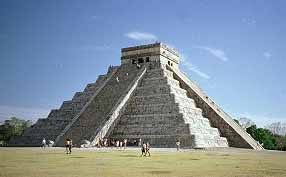
As Kukulkan, he had a rather nice pyramid dedicated to him. UnrepentantSinner saw it at Chichen Itza...

chichensides.jpg
 
Supercharts said:
I understand that ancient people ate with their hands. I understand that toilet paper is a recent invention. What's that all about then? :confused:
I have heard that in some cultures (not necessarily ancient ones), one always wipes with the left hand, and eats with the right. This (I have heard) is one of the reasons why in some cultures, extending your left hand to shake hands is a grave insult.
 
Mormons have a great interest in finding signs of great pre-Columbian civilizations in the Americas, due to one of their holy books (the Book of Mormon, I think) giving "historical accounts" of said civilizations.

Has anything been found that they have latched onto?
 
RSLancastr said:
I have heard that in some cultures (not necessarily ancient ones), one always wipes with the left hand, and eats with the right. This (I have heard) is one of the reasons why in some cultures, extending your left hand to shake hands is a grave insult.

I lived in one of those cultures. In Iran, at least in the 1970s, it was still common for them to wipe with their left hand and then wash it off.

You can imagine the look of horror my neighbors gave me when I hungrily dug into my lunch... with my left hand.
 
Joshua Korosi said:
In the diagrams I've provided above, the entire contents of the cartouche are not included (because they are considered irrelevant, apparently)...but I think they are relevant, because they exhibit the exact same kind of effect (fill plaster falling out) that resulted in the "helicopter".

Yup. The mysterious-looking box with the jackal-headed standard is actually combination of two hieroglyphs: wsr that occurs in Ramsesses's regal name (Usermaatresetepenre - try to say that out loud) and mn that occurs in Seti's name (Menmaatre). It may be interesting to note that even though in both names the 're' syllable occurs last, it is written first in the cartouche since it was, after all, name of the sun god.

BTW, above I confused the identities of Upper and Lower Egypt, as the bee was for Lower and reed for Upper part of the land.

In any case, the names of Egyptian pharaohs are rather interesting. They had five royal names: one that signified his aspect as Horus, one for his role in protection of "Two Ladies", or the Vulture Goddes of Upper Egypt and the Cobra Goddes of Lower Egypt, one "Golden Horus" name whose significance is, as far as I know, unknown. The two most important names were his birth name ("Son of Ra" or "duck and sun" name) that was given to him at birth and the regal name ("Bee and reed" name) that he took when he ascended to the throne and that was his "official" name. Most modern sources use birth names for the pharaohs, or more precicely, Greek renditions of them.

Another interesting trivia tidbit is that it is highly anachronist to use the title "pharaoh" for Khufu, the builder of the Great Pyramid. The literal translation of the title is "Great House" and it originally ment only the palace of the king. Gradually its meaning shifted to "Court of the King". The first inscriptions that use 'pharaoh' as a synonum for the king date from Akhenaten's reign, almost 1200 years after Khufu's death. (And 50 years before the reign of Seti).
 
Steveo said:
Great thread Joshua, Thanks for the info. I have another one. I read a book Years ago by Berry Fell, Called America B.C. It talks about a possible link between the ancient Celtics and New England. Going back as far as 800 BCE. It sounded pretty far-fetched and I have never heard much else on the subject. Is there anything to it?

Barry Fell... Now there is a perfect example of a guy who could find evidence for his "theories" in a box of Corn Flakes.

Every "mystery" he ever investigated turned out to perfectly support the conclusion he had drawn before he even put his boots on to go check them out (i.e. The Kensington Stone, the Los Lunas Inscription, "America's Stonehenge", etc...)

He was an expert marksman when it came to drawing the bullseyes around the bullet holes.

btw... here is a pretty good cult archaeology debunking site:

http://www.ramtops.demon.co.uk/
 
RSLancastr said:
Mormons have a great interest in finding signs of great pre-Columbian civilizations in the Americas, due to one of their holy books (the Book of Mormon, I think) giving "historical accounts" of said civilizations.

Has anything been found that they have latched onto?

The Book of Mormon was a series of gold plates given to one Joseph Smith (the founder of the Church of Jesus Christ of Latter Day Saints) by an angel in 1829. The plates were inscribed in an indecipherable language, and the angel also gave Smith a set of super secret spy spectacles with which he could read the text in English. The plates were buried in a nearby wood, and Smith, using not the spectacles but a special "seeing stone" that he often used during magic tricks (he was formerly a magician), began dictating to a note-taker the English translation of the Book of Mormon. The dictation took 60 days, allegedly. However, Smith had actually begun dictating the book a year earlier; but those 116 pages were lost when the secretary took the pages home to show his wife. Dictation then stopped until the following year, when he began again - not only "translating" the text with his seeing stone, but receiving "revelations" as well, which he included in the text. One of them featured a warning from God of the possibility that the previous pages would be found, and that


"...they will say that you have lied and that you have pretended to translate, but that you have contradicted yourself. And, behold, they will publish this, and Satan will harden the hearts of the people to stir them up to anger against you, that they will not believe my words."

This is an obvious attempt to cover himself in case the original pages were found, and shown not to be the same as the new ones, which would indeed prove that Smith had pretended to translate.

Many Mormon sites feature a "challenge" to those who contest the authenticity of the Book of Mormon; the challenge involves composing a similar epic involving ancient Tibet (because you probably know nothing about ancient Tibet, just like Smith knew nothing about ancient America), and requires that the challenger be "23 years old" and "have had only 3 years of formal education, having spent most of his life in backwoods farming communities". The epic must also be "proven true", as the Book of Mormon has. This, coupled with the other conditions of the "challenge", makes it obvious that the challenge is rhetorical.

But the fact of the matter is, the Book of Mormon has failed, time after time, the very challenge its advocates offer in support of it; no archaeological evidence has been found, anywhere, that substantiates anything in the Book of Mormon. It has apparently been "proven true" by virtue of the fact that all its believers say it is true - and after all, the Book of Mormon itself says it is true. Of course, the Book of Mormon also says the Red Sea is in Galilee, instead of near Egypt.
 

Back
Top Bottom