
Oystein
Penultimate Amazing

- Joined
- Dec 9, 2009
- Messages
- 18,948
From what I can see, truthers have made NO attempt to eliminate any other potential sources of these microspheres. They've decided it can only be thermite, and since that fits into their beliefs, they are satisfied with it. Debate over.
It's about as far away from the scientific method as one can get.
This.
It is well known that metals and their oxides melt at temperatures below the bulk melting point when they come in micron-sized particles.
Dave Thomas shows that something as ordinary as iron burning can produce iron-rich microspheres. This goes to prove that thermite is not the only possible way to get such microsphere. It does howevere not prove that burning iron was the source of (all or some) of the iron-rich microspheres in the WTC dust. In fact, this can be rules out for almost all such spheres.
Now, In my opinion, the whole issue of where do all the iron-rich microspheres come from in the WTC is not resolved to my total satisfaction. I see a lot of speculation on the debunker side, some of it reasonable, but hardly any real evidence. I likewise see specultation and great leaps of faith and serious shortcuts on the truther side. So the issue remains open as far as i am concerned.
Harrit e.al. present in Fig. 21 of their infamous paper a BSE image of a sphere that measured in the single digits µm across, collected from post-DSC residue of an unidentified specimen, along with its XEDS spectrum. They say that the Fe:O ratio is 4:1, and explain that this means that some of the Fe is not bound to any O - i.e. is elemental. I think this indeed somewhat surprising. Looking at Fig 6,. it seems that the gray layer of chips which I believe to be spalled, oxidized steel, is iron oxide throughout, at least there seems to be more O-atoms than Fe-atoms. So if the chip that resulted in Fig. 21 was similar to chips (a)-(d), then it would appear that indeed iron was reduced in the DSC reaction.
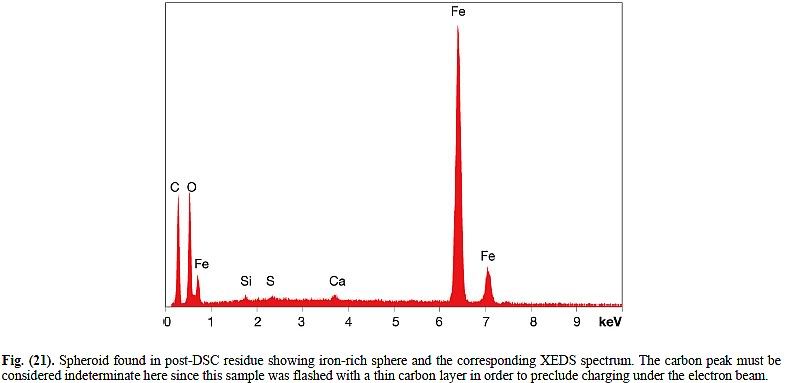
However, there are some formal arguments that shed doubt on this finding:
- We don't have any idea what the chip that resulted in Fig 21 looked like before its DSC test - no image, no XEDS.
- We don't know if it is possible or not to find regions within the gray layers before any thermal treatment where Fe:O is higher than average
- I am not even sure if the 4:1 ratio is by mass or by atom count. If the latter, we are indeed looking at some elemental iron. But if the former (and that is actually what I expect), then 4:1 by mass means 1.15:1 by atomic count - the difference to 1:1 may well be within the margin of error of the "conventional quantitative analysis routine" they employed from the XEDS data, and then we are looking at a tiny sphere of FeO - an iron oxide that may be produced from magnetite in the presence of carbon (graphite). One wonders if this could result from experimental error. We know that the DSC tests were carried out by an absolute DSC beginner, Jeff Farrer, and that they flashed the sample with a thin carbon layer before doing the XEDS.
I wish I had access to an electron microscope or even an XEDS instrument...
Last edited:


 I just guess that his red "paint chips" are chips of Tnemec paint (or some other red primer) and alleged "thermitic chips" are chips identical with Bentham chips (a) to (d), aka Laclede paint chips. For me, Kevin Ryan simply keeps (at least) two kinds of paint chips. It's up to him to show me(us), that I am (we are) wrong


