d4m10n
Penultimate Amazing

Can you please be more specific?Is anyone talking about Trump cancelling news organisations?

Can you please be more specific?Is anyone talking about Trump cancelling news organisations?

Just to be clear, do you recognize any conceptual distinction between informal cultural issues and formal legal issues? Seems like those require different solutions but I want to hear your take.The recent time, that was overturned by the Supreme Court
I do not recognise any conceptual distinction between so-called "cancel culture" and the Trump administration, no. Trump is one of the biggest cancellers on the planet.Just to be clear, do you recognize any conceptual distinction between informal cultural issues and formal legal issues? Seems like those require different solutions but I want to hear your take.


 www2.thedailybeast.com
Some say politics are downstream of culture, which makes policies a lagging indicator of the zeitgeist at best.I do not recognise any conceptual distinction between so-called "cancel culture" and the Trump administration, no.
 www.bbc.com

Narrator: They aren't.The US Administration cancelling black and female vets:
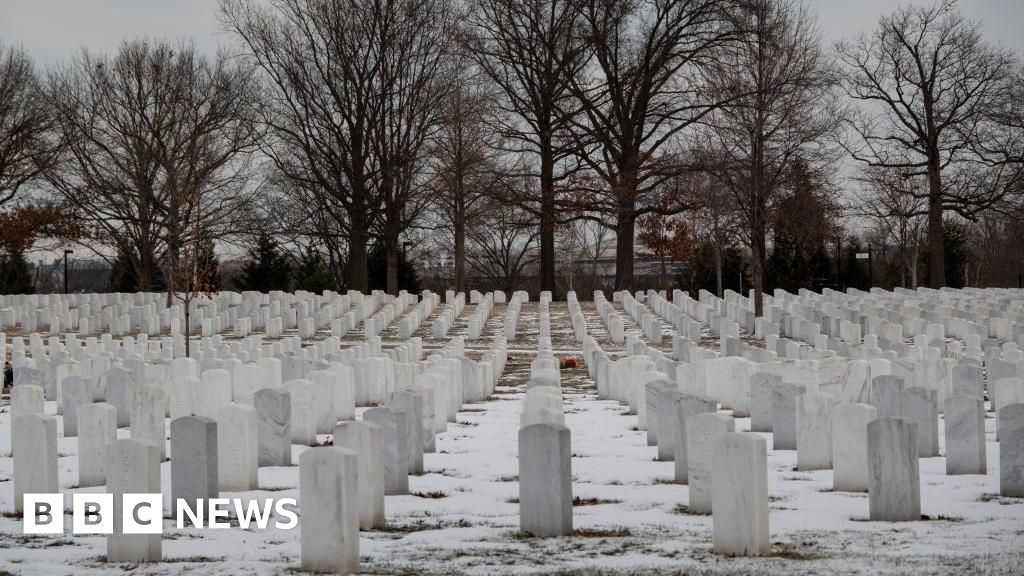
Arlington Cemetery strips content on black and female veterans from website
The Army-run cemetery said it is working to follow Trump's orders on ending diversity while restoring information.
Colin L. Powell, U.S. Army (1937–2021) — Vietnam veteran Gen. Colin Powell was the first African American to hold three of the U.S. government’s highest positions: national security advisor (1987-1989), chairman of the Joint Chiefs of Staff (1989-1993) and secretary of state (2001-2005). The son of Jamaican immigrants, Powell grew up in the South Bronx and enrolled in Army ROTC during college; he was commissioned as a second lieutenant in 1958. By 1989, he had risen to the rank of four-star general. His many awards and decorations include two Presidential Medals of Freedom and the Congressional Gold Medal. (Section 60, Grave 11917)
Lt. Col. Hector Santa Anna, U.S. Air Force — This decorated World War II B-17 bomber pilot, Berlin Airlift pilot and career military leader had a memorable last name: Santa Anna happened to be the great-great nephew of Mexican general Antonio Lopez de Santa Anna, who famously led the siege of the Alamo during the Texas Revolution of 1836. In July 1943, he completed his flight training at Brooks Army Air Field in San Antonio, Texas (ironically, near the Alamo). Among the 97 cadets in his class, Santa Anna was the only Latino. The Army utilized Santa Anna’s bilingualism by assigning him to train Central and South American military pilots at Waco Army Air Field in Texas. He volunteered for combat duty in August 1944 and, in October, deployed to England with the 486th Bomb Group, 3rd Bomb Wing, of the 8th Air Force. He flew 35 combat missions over Western Europe, earning two Distinguished Service Medals, five Air Medals and a Commendation Medal. After the war, Santa Anna continued his military career in the newly-created U.S. Air Force. During the Berlin Airlift of 1948-1949, he flew 127 missions in support of Allied efforts to provide humanitarian aid to Soviet-blockaded Berlin. After retiring from the Air Force as a lieutenant colonel in June 1964, Santa Anna held leadership positions at NASA and the Federal Aviation Administration. During the administration of President Richard Nixon, he served as the Office of Equal Opportunity’s White House representative and a member of the president’s Cabinet Committee on Opportunities for Spanish-Speaking People. (Section 54, Grave 571)
Race/ethnicity is quite relevant sometimes, and it is ahistorical to pretend otherwise.OMG, the horror of a national cemetery treating all servicemembers as if their sex and their race are irrelevant to their careers and honors!
You might note that the entries for the individuals continue to note their race when it's relevant. Nobody is being ahistorical.Race/ethnicity is quite relevant sometimes, and it is ahistorical to pretend otherwise.
Ethnic and religious groups which were traditionally segregated from the majority group (i.e. WASPs in U.S.A.) merit some special consideration, of course, if we happen to be memorializing and teaching American history.Do you think some races are more noteworthy and more deserving of special treatment than others?
I think you're missing the point here. It's fine and dandy to acknowledge the barriers they were up against at the time. It's something different to use federal funds at a national cemetery to explicitly call out a race in its entirety.Ethnic and religious groups which were traditionally segregated from the majority group (i.e. WASPs in U.S.A.) merit some special consideration, of course, if we happen to be memorializing and teaching American history.
Felix Longoria is personally noteworthy specifically because his family refused to allow him to be buried in a segregated cemetery.
Maximiliano Luna served the U.S. in the First Volunteer Cavalry during the Spanish American War, back when his fellow Americans were even less keen on native Spanish speakers than they are today. Teddy Roosevelt saw to it that his name was memorialized alongside fellow Rough Riders, making him the first Hispanic American to be honored at Arlington.
The Tuskegee AirmenWP and the Borinqueneers are especially noteworthy because they served with distinction despite cultural difficulties integrating African Americans and Puerto Ricans into traditionally white ranks.
I don't think we can tell the fully story of what made these men significant while leaving off the fact that they were up against color barriers.
ETA: This has almost nothing to do with "cancel culture" which is more about mob justice meted out upon living individuals.
The content of someone's character cannot be blithely decoupled from the "barriers they were up against at the time" because character is forged by overcoming challenges. There is nothing remotely wrong with using federal funds to teach historical facts about people who overcame color barriers and/or broke through glass ceilings, and there is something wrong with censoring such material to assuage unearned white guilt.What has changed is that there's no longer a "black people" list or a "hispanic list" or other exclusionary list that places more focus on the color of their skin than the content of their character.
Yes, precisely the sort of crowd who are motivated to take down webpages (and books) highlighting Hispanic American heritage, African American heritage, women's breakthroughs, etc. Do you object to my characterization of their motives on grounds of style or substance?You do realise that "white guilt" is always a phrase used by the anti-woke, anti-SJW, anti-CRM crowd, right?
Hmm. Nothing has been decoupled from those barriers. If you read the entries, the information is still present.The content of someone's character cannot be blithely decoupled from the "barriers they were up against at the time" because character is forged by overcoming challenges. There is nothing remotely wrong with using federal funds to teach historical facts about people who overcame color barriers and/or broke through glass ceilings, and there is something wrong with censoring such material to assuage unearned white guilt.
You do realise that "white guilt" is always a phrase used by the anti-woke, anti-SJW, anti-CRM crowd, right? Nobody who argues for social justice or the redress of historical wrongs is ever talking about "white guilt".

This statement is not entirely true. For example, sentences like "the “Felix Longoria Affair” played a significant role in catalyzing Mexican American political consciousness and activism" were stripped entirely from the official website but remain preserved in the Wayback Archive.If you read the entries, the information is still present.
What I said was something more like "I don't think we can tell the full story of what made these men significant while leaving off the fact that they were up against" various ethnic and racial barriers to integration within the armed services. Can you see the difference?You seem to think that creating entire categories in a government database that are solely about a service member's race is a good thing to do.
I've no idea how you came to this conclusion. Mentioning that the Borinqueneers were Puerto Rican and not yet integrated into other units is a noteworthy historical fact, but it isn't considered more important than their meritorious service. Seriously, who even says that sort of thing?I think it's counterproductive and continues to make color of skin a more important characteristic than content of character.
If you want to honor the Tuskegee Airmen, you have to honor everything they achieved including how they altered the perceptions of policymakers regarding the capabilities of African American servicemen generally and pilots specifically.The purpose of Arlington is to honor deceased servicemembers - the end.
