
You are using an out of date browser. It may not display this or other websites correctly.
You should upgrade or use an alternative browser.
You should upgrade or use an alternative browser.
Bigfoot - The Patterson-Gimlin Film
- Thread starter Skeptical Greg
- Start date
-
- Tags
- bigfoot film patterson gimlin
- Status
- Not open for further replies.
RayG
Master Poster

There is no evidence Freeman faked prints...
I'm sure that at least some among the older Bigfoot buffs still have a copy of the Good Morning America program. Should they decide to play the tape again they will see and hear ABC'S Steve Fox ask, "You tried to make fake footprints?" with Freeman answering, "Yes, I did." Fox then asks, "To create prints?" and Freeman again says, "Yes, I did." Fox is bent on being absolutely clear and so he asks, "You admit those were fake foot prints," and Freeman is seen nodding in agreement.
An admission certainly looks like evidence. LAL, do you think Freeman way lying about his admission on Good Morning America?
In November of 1995, Richard Greenwell handed me a copy of Bigfoot of the Blues. as we flew from San Francisco to Eureka, California on our way to investigate the Redwoods video site. During lulls in the conversation I paged through the book. I was initially intrigued by what I did not find. Surprisingly, there were no illustrations - -no photos of footprints, no casts, no persons straining to match step length, no sketchy eyewitness renderings. There were few or no obligatory speculations about Gigantopithecus, migratory routes or extraordinary senses or physical prowess. Instead, there was a narrative, focusing on events in the Blue Mountains of southeastern Washington State spanning a ten-year period between 1982 and 1992.
Meldrum commends the author on NOT including questionable evidence as support for bigfoot, but then applauds the anecdotal accounts over a ten year period. I suspect anecdotal accounts won't get this mystery solved, no matter how entertaining they may be.
[1.] Joel Hardin, an acclaimed U.S. Border Patrol tracker pronounced the l982 tracts to be fakes.
[2.] Later in l984, Rene Dahinden, a life long Bigfoot investigator, examined a trackway and declared it hoaxed.
[3.] Then, in l989, Edward B. Winn "surreptitiously" removed fibers from a twisted tree branch presented by Freeman at the l989 Membership Meeting of the International Society of Cryptozoology and tested them for chemical composition and melting point. He later concluded that the fibers were a synthetic modacrylic fiber and he labeled the entire presentation as "scientific vandalism" (Edward B. Winn, l99l Physical and Morphological Analysis of Samples of Fiber Purported to be Sasquatch Hair, Cryptozoology, Vol. 10: 55-65).
Three strikes and yer out?
Orchard immediately laid to rest the assertion that there was no Bigfoot in the Blue Mountains until Paul Freeman arrived on the scene in l982, recounting incidents dating back to l900. Frequent reports of witnesses not connected with Freeman's involvement further contradicted such allegations. For example, incidents were reported to the U.S. Forest Service in the late l960's as described by USFS employee Wayne Long. This was further corroborated by additional reports from the files of John Green and from the newly-formed North American Science Institute (NASI) of incidents throughout the Blue Mountains in both Washington and Oregon.
Notice Orchard doesn't refute the hoax accusations leveled at Freeman. Not once.
RayG
Correa Neto
Philosopher

- Joined
- Aug 4, 2003
- Messages
- 8,548
Since Correa evidently didn't have time to present his argument to Dr. Meldrum, I did it for him. This is the reply:
"LAL,
Sorry, but after taking a quick scan through the other lists you are participating in, I don't think it is worth my time to respond more than just briefly to the latest criticisms. They are of a different nature than the points raised by Jim. ...snip...
http://www.bigfootforums.com/index.php?showtopic=14342&st=40&#entry300929
First of all LAL, thanks for submitting to Meldrum the incoherencies I found. Its beter than just using the standard appeal to authority. And also, whenever you have the chance, please send a "Thank you" to Meldrum. I'm also a busy man and I know how hard it is to find spare time.
Now, I am sorry to say, but the answer has not convinced me, quite possibly because he was in a hurry. Please allow me to tell why:
Neto clearly has no concept of the calculation of the mechanical advantage of the triceps surae (calf musculature) as evidenced by his comments and attempt to diagram his point.
Note that my diagram shows that the bones act as levers that rotate around joints (the articulations). The longer the lever -bone in this case- the more efficient will the transmittion of the energy will be. Muscles generate the energy to rotate the bones (actually bones play a double role is double since they also provide support to the muscles). The longer the lever, more efficient will be the transmittion of the force. Meldrum´s bigfoot foot model shows short "levers" when compared with a human foot. Also, note that there's an extra articulation. Beside the greater complexity, this induces extra waste of energy due to attrition. What also means its not as efficient as a human foot in terms of energy saving and transmition when walking. And will also be an extra wear point. The only way to compensate for this is by raw force, increasing the sizes of the muscles involved, may not be a sound approach (more muscles = more energy needed to feed). So far, I am not convinced...
The model of the sasquatch foot is a very natural extension of trends displayed in a size-graded sample of ape feet from gibbons to chimps to lowland gorillas to mountain gorillas, not only in relative elongation of the heel but in lessened divergence of the great toe. Humans have departed from this pattern by adopting a fixed arch.
The MT break has little to do with the loss of divegence of the big toe, until the fixation of the arch, at which point the aligned big toe becomes the distal support of the arch. There are a number of interacting modifications at play during the evolution of the modern human foot.
Well, gibbons, chimps, lowland and mountain gorillas have different ecological niches than the ones bigfeet are supposed to have and the species from the genus Homo have or /had. gibbons, chimps, lowland and mountain gorillas are not fully developed bipedals. Homo and bigfeet (assuming they are real and the usual suppositions about them are correct) are bipedals, adapted to stride along great distances across the terrain. Am I correct untill now? Thus, since the evolutionary proccesses tend create similar forms to achieve similar tasks, the feet of humans and bigfeet (assuming the last ones are real) must share a lot of features. The rigid arch is an example. The position of the big toe another. Even with all the "interacting modifications at play", since the evolutionary pressures were similar.
And also we must remember that if what some of the pictures show are real bigfoot footprints, they -apart from their size- are virtually indistinguishable from those produced by humans. And since a footprint is a mold of the foot that made it, and since foot shape is a function of bone structure and attached muscles, why should the foot that made those footprints (assuming it was a real foot) have a different bone structure?
And yes, I have scrolled down the page and I saw the feet comparsion. Call me obtuse if you want, but I fail to see the "modest transition in the series from a mountain gorilla to a "typical" sasquatch foot". Note I posted a similar comparsion ages ago to show how different they are.
See? I am still unconvinced. The answer don't seem, IMHO to have really touched the issues I raised. Actually it seemed quite vague. Understood what I wrote LAL? Because I tried to make the explanation as simple as possible so everybody interested in the subject can understand.
Sure. I can't help but agree with the above statement. Really. Honestly.(Some people should do the research required before asserting their opinions with such conviction.)
The comments about the casts and footprints illustrated on my webpage and the comaprisons made between the Laverty photo are simply without merit.
Not sure if its directed to me, but if it was, I think the above statment is without merit, thus I will not answer. If not, sorry, nothing to see here, move one, move on.
Nice of him to take the time to reply, wasn't it?
Yes, it was very nice of him to reply. And I was also very nice to reply, don't you think?
When will you be nice as we are and either back or remove the claims and insinuations you made about me?
Oh, and if JREF is such a waste of time, why you still post here?
Now, if you forgive me, I will go back to my RL, where my lovely wife and son wait for me.
Last edited:
RayG
Master Poster
RayG said:I just don't get how an expert on primate feet can transfer that expertise to an undiscovered, uncatalogued, unknown species. Isn't it all a good guesstimate at best?
Why don't you ask him? He's still posting.
Consider it done.
...how is it possible to transfer your expertise in primate feet to an undiscovered, uncatalogued, unknown species? Isn't it all [bone details/reconstruction, degree of flexion, midtarsal flexibility, etc.] a good guesstimate at best?
RayG
LTC8K6
Penultimate Amazing

So, Meldrum does in fact dismiss his critics out of hand?
Well, we're even then, I guess. His ideas are also without merit, being based on a house of cards.
Well, we're even then, I guess. His ideas are also without merit, being based on a house of cards.
LTC8K6
Penultimate Amazing
It also looks like Meldrum is in fact thinking "missing link" to me.
LAL
Illuminator

- Joined
- May 19, 2005
- Messages
- 3,255
So, Meldrum does in fact dismiss his critics out of hand?
Well, we're even then, I guess. His ideas are also without merit, being based on a house of cards.
No, he dismissed your arguments as being without merit.
They are.
LAL
Illuminator
- Joined
- May 19, 2005
- Messages
- 3,255
It also looks like Meldrum is in fact thinking "missing link" to me.
No, he's looking at evolution of primate feet. Nowhere does he make a claim Sasquatches are an intermediate form between apes and humans. The whole "missing link" idea is a journalistic construct in the first place.
Skeptical Greg
Agave Wine Connoisseur

Perhaps you missed it?
"QUOTE(djmeldrum @ Mar 4 2006, 11:52 AM)
LAL,
Sorry, but after taking a quick scan through the other lists you are participating in, I don't think it is worth my time to respond more than just briefly to the latest criticisms. They are of a different nature than the points raised by Jim. Neto clearly has no concept of the calculation of the mechanical advantage of the triceps surae (calf musculature) as evidenced by his comments and attempt to diagram his point. The model of the sasquatch foot is a very natural extension of trends displayed in a size-graded sample of ape feet from gibbons to chimps to lowland gorillas to mountain gorillas, not only in relative elongation of the heel but in lessened divergence of the great toe. Humans have departed from this pattern by adopting a fixed arch.
The MT break has little to do with the loss of divegence of the big toe, until the fixation of the arch, at which point the aligned big toe becomes the distal support of the arch. There are a number of interacting modifications at play during the evolution of the modern human foot. (Some people should do the research required before asserting their opinions with such conviction.)
The comments about the casts and footprints illustrated on my webpage and the comaprisons made between the Laverty photo are simply without merit.
The particular cast you asked about is one of Timus's casts."
http://www.bigfootforums.com/index.php?showtopic=14342&st=40&#entry300982
We saw it the first time Lu..
St. Meldrum ( of the holy Church of Bigfoot ) will not demean himself by discussing the observations of amateurs...
--------------------------------------------------------------------------
In case you don't get it..
" The comments about the casts and footprints illustrated on my webpage and the comaprisons made between the Laverty photo are simply without merit."
....... Is not an argument.. It's an opinion..
Looks like he contradicted your claim that we were not looking at ' his ' web page...
LAL
Illuminator
- Joined
- May 19, 2005
- Messages
- 3,255
First of all LAL, thanks for submitting to Meldrum the incoherencies I found. Its beter than just using the standard appeal to authority. And also, whenever you have the chance, please send a "Thank you" to Meldrum. I'm also a busy man and I know how hard it is to find spare time.
Done.
Now, I am sorry to say, but the answer has not convinced me, quite possibly because he was in a hurry. Please allow me to tell why:
Note that my diagram shows that the bones act as levers that rotate around joints (the articulations). The longer the lever -bone in this case- the more efficient will the transmittion of the energy will be. Muscles generate the energy to rotate the bones (actually bones play a double role is double since they also provide support to the muscles). The longer the lever, more efficient will be the transmittion of the force. Meldrum´s bigfoot foot model shows short "levers" when compared with a human foot. Also, note that there's an extra articulation. Beside the greater complexity, this induces extra waste of energy due to attrition. What also means its not as efficient as a human foot in terms of energy saving and transmition when walking. And will also be an extra wear point. The only way to compensate for this is by raw force, increasing the sizes of the muscles involved, may not be a sound approach (more muscles = more energy needed to feed). So far, I am not convinced...
Well, gibbons, chimps, lowland and mountain gorillas have different ecological niches than the ones bigfeet are supposed to have and the species from the genus Homo have or /had. gibbons, chimps, lowland and mountain gorillas are not fully developed bipedals. Homo and bigfeet (assuming they are real and the usual suppositions about them are correct) are bipedals, adapted to stride along great distances across the terrain. Am I correct untill now? Thus, since the evolutionary proccesses tend create similar forms to achieve similar tasks, the feet of humans and bigfeet (assuming the last ones are real) must share a lot of features. The rigid arch is an example. The position of the big toe another. Even with all the "interacting modifications at play", since the evolutionary pressures were similar.
The rigid arch may be a late development that evolved in anatomically modern humans.
And also we must remember that if what some of the pictures show are real bigfoot footprints, they -apart from their size- are virtually indistinguishable from those produced by humans. And since a footprint is a mold of the foot that made it, and since foot shape is a function of bone structure and attached muscles, why should the foot that made those footprints (assuming it was a real foot) have a different bone structure?
They're a third wider. The toes are relatively longer. Some seem to show a bunched plantar pad. Human feet may reach some of the lengths, but not the width. The print is not an exact mold, depending on substrate, and casts tend to be slightly larger that the print.
And yes, I have scrolled down the page and I saw the feet comparsion. Call me obtuse if you want, but I fail to see the "modest transition in the series from a mountain gorilla to a "typical" sasquatch foot". Note I posted a similar comparsion ages ago to show how different they are.
See? I am still unconvinced. The answer don't seem, IMHO to have really touched the issues I raised. Actually it seemed quite vague. Understood what I wrote LAL? Because I tried to make the explanation as simple as possible so everybody interested in the subject can understand.
Sure. I can't help but agree with the above statement. Really. Honestly.
Not sure if its directed to me, but if it was, I think the above statment is without merit, thus I will not answer. If not, sorry, nothing to see here, move one, move on.
No, it wasn't. It referred to Bill's claims about fakes on the web page.
Yes, it was very nice of him to reply. And I was also very nice to reply, don't you think?
Yes.
When will you be nice as we are and either back or remove the claims and insinuations you made about me?
I have already explained I can't retract a claim I didn't make. I asked if Pat Kelley was you under a different SN. That is not a claim, any more than another poster's suggestion about Hunster and me being "sock puppets". I assume that was a joke too.
If I'd made the claim, I would have retracted it, but I wasn't serious in the first place. The point was that Kelley seemed to have a similar style and arguments, that's all. I didn't mean it to be offensive, although it evidently was. We were rather, uh, adamant at the time as I recall, and I've felt rather insulted myself for reasons I've already explained.
So, I'm sorry you took offense. Does that work?
I did insinuate you weren't actually writing a paper and that turned out to be true, so I don't think I need to retract on that one. Anything else seemed to be a leap on your part and I think we'vee been over that before.
I think I'm usually the nicest person here, but that's just me.
Oh, and if JREF is such a waste of time, why you still post here?
I explained that on BFF.
I gets my adrenaline flowing, sometimes, and I need that. Posting on message boards in general is a rather a waste of time, IMO, but it's fun and is good brain exercise and I have time to waste. I've found it helps ward off depression. I've made some good cyber friends, too. I still get PMs from AOL folks wondering where I went.
Now, if you forgive me, I will go back to my RL, where my lovely wife and son wait for me.
Thanks for the reply. I'll repost on BFF in case Meldrum's still posting.
(RL? Room living?)
LAL
Illuminator
- Joined
- May 19, 2005
- Messages
- 3,255
We saw it the first time Lu..
The post was for Correa. I was wondering why he hadn't responded. I thought perhaps I was filtered and was about to ask someone to repost.
St. Meldrum ( of the holy Church of Bigfoot ) will not demean himself by discussing the observations of amateurs...
-------------------------------------------------------------------------
I'm sure he gets enough of that teaching.
I'll bet you spent a lot of time in the principal's office. Or did the attitude come later?
In case you don't get it..
" The comments about the casts and footprints illustrated on my webpage and the comaprisons made between the Laverty photo are simply without merit."
....... Is not an argument.. It's an opinion..
One I share.
Looks like he contradicted your claim that we were not looking at ' his ' web page...
The claim was that it's his website. It's not.
The comments that they're fakes and the "mismatch" are "simply without merit". Too bad he didn't see the confusion over the toes and the "right-left" on the Bossburg prints.
The burden of proof is on the claimant and I've seen no proof of any hoaxing on these things, though I do marvel at the distortions and convoluted thinking I see as some posters try to fit it all into their hoax paradigm. It's awesome to watch. At first I was dismayed, but now I find it just...........funny.
Last edited:
Skeptical Greg
Agave Wine Connoisseur
They're a third wider. The toes are relatively longer. Some seem to show a bunched plantar pad. Human feet may reach some of the lengths, but not the width. The print is not an exact mold, depending on substrate, and casts tend to be slightly larger that the print.
Patty's feet look like normal human proportions, and she's supposed to be the beat evidence you have...
Ask Meldrum about the proportions of Patty's feet..
Some seem to show a bunched plantar pad.
Seem to show ? How does that work ?
Skeptical Greg
Agave Wine Connoisseur
Lu:
Share? Or accept without question ?
If you really share it ( Meldrum's opinion ), then you should be able to present your arguments without deferring to him..
Hint: Pasting Krantz or Greeen, is no more ' your ' argument, that Meldrum's is...
One I share.
Share? Or accept without question ?
If you really share it ( Meldrum's opinion ), then you should be able to present your arguments without deferring to him..
Hint: Pasting Krantz or Greeen, is no more ' your ' argument, that Meldrum's is...
Last edited:
Dfoot
Thinker

- Joined
- Jan 27, 2006
- Messages
- 164
LAL -- I always look forward to your responses as I'm bound to learn something from them. I had no idea I was the only one fooled by me. Also, I had no idea that wooden feet used decades ago couldn't possibly develop a crack later. Although you might want to re-think that last one.
I didn't "pull a hoax" at all. I made it perfectly clear and I fully expected a few negative comments about the "new suit" to be followed by someone saying, "Hold on Dfoot... THAT IS PATTY. You bastard!" But it actually took four photos with the last one being a close-up of Patty's back using a background that is nearly a duplicate of Bluff Creek before one person finally saw what I was getting at.
The moral is that hoaxing is simple. Lying is also done in used car salesman style by folks like Gimlin, Patterson and Wallace all the time. In fact, Gimlin was a used car salesman at one time. (Sorry salsemen... no offense)
Posting a photo of Patty to people who study every detail of Patty isn't an attempt at hoaxing. It's just making the point that sometimes one can get so close to a subject that objectivity is lost.
Below are instructions for a real Bigfoot hoax ---
Obtain info on any organized group of Bigfoot searchers devoted to STAR FLEET RULES (that means no guns allowed that might bring harm to a Bigfoot or cause the accidental shooting of a fellow searcher) and do the following….
1 – Find out where a Bigfoot Expedition is to take place that will host around 25 participants. Go there the week before to make tracks going from a water source (creek or lake) and up into the forest.
2 – Make a few more tracks in an area higher up a mountain – perhaps with dermal ridges in them – in the direction of the prints near the water source. If discovered it will be declared that no hoaxer would have made such ridges in prints that are far from the others and most likely not to have been seen. (*The truth is that you know the hunters will go in the direction of the tracks down by the water and may very well make this discovery)
3 – Hide a battery-powered loudspeaker system inside a hollow tree or hidden in rocky crevice in a difficult-to-reach area far from where the expedition should be camping. This will contain a long play recording of Roger Patterson yelling in a bucket (which became known as the world’s first Bigfoot recording). You will have slowed down and sped up this in editing to create varied versions of this call on your tape.
4 – Leave the area for a few days.
5 - Show up after expedition arrives to see where trail cameras are installed. Try to stay hidden – but pretend to be camping out and fishing if seen. Most likely if the tracks have already been discovered the group will be fanning out in the direction of the prints.
6 – At night approach any trail cam left far from expedition members in a Bigfoot suit or simply hold mask of Bigfoot up to lens for a photo op.
7 – Leave area as you remotely activate hidden loudspeaker. Time the tape to begin its sounds an hour after you leave. Three varied Bigfoot screams should echo loudly through the forest and blast out every 2 ½ hours for three occurrences before shutting off. (If you are really prepared you might also like to install such a device further away that will contain an “answer call” and “wood knocks” to give the illusion that the Bigfeet are communicating over distance.)
Stay tuned to the Internet to see how your hoaxed evidence gets reported.
Since you did this all without an accomplice there will be no one you have to trust to keep quiet. Since you didn’t fake any footage yourself there will be no need to lie about anything. All of the evidence will have been discovered by reputable people who can pass lie detector tests, etc…
This is an updated version of a Wallace-style hoax similar to his allowing footprints to be simply “discovered” by people who might then tend to justify their own findings and perhaps even lead to a resurgence of Bigfoot activity to thrill those involved in the pursuit of the creatures.
_____________________________________________
There you have it. That would be a hoax.
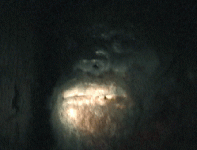
Below is a pic from a game trail camera that I set up while camping in the virgin wilderness by a logging road.
I showed it to my dentist and asked him if those looked like teeth in the photo. He said, "Yes... they do look like teeth. Is that a gorilla?" Imagine his surprise when I pointed out that this photo was the first game trail camera pic ever taken of a genuine Sasquatch.
The proof is in the photo. According to our research methods it's up to you to show me the monkey suit or else this has to be a real Sasquatch. Just look at those huge, huge blocky teeth.
I start touring on Monday.
- Dfoot
Correa Neto
Philosopher
- Joined
- Aug 4, 2003
- Messages
- 8,548
So be it.Done.
The rigid arch may be a late development that evolved in anatomically modern humans.
"Mays" aside, let me remember that we've already been through this, and I also compared footprints from australopithecines (regarded as a "border species", a species that exploits the intresection of two niches or ways of life). These species had some foot flexibility, and the position of the big toe is quite different from what's seen in the Homo genus and in the alleged bigfoot footprints. And note that since they were border species, they were not fully anatomically adapted to a lifestyle such as the one adopted by Homo and bigfeet (assuming they are real and the usual suppositions about they are correct).
They're a third wider. The toes are relatively longer. Some seem to show a bunched plantar pad. Human feet may reach some of the lengths, but not the width. The print is not an exact mold, depending on substrate, and casts tend to be slightly larger that the print.
"Some seem to show"... Already discussed. The variablity is big. So big that it seems unlikely to have been produced by the same species. And since I find Coleman's conclusions... Well... Unlikley... Its' just another problem with bigfoot's alleged anatomy (not for Beckjord, of course).
And I just fail to see the footprints are 1/3 wider than humans' neither the relatively longer fingers. All I see are enlarged human feet. Again, maybe I'm being "obtuse". And even if they are, and even if they are prints from an actual bigfoot, I still think foot morphology is not compatible with a mid tarsal break.
And the casts being larger than the prints, well, that's not an excuse for changing the anatomical features in question.
No, it wasn't. It referred to Bill's claims about fakes on the web page.
So be it, but I made similar critics regarding pics he used in his works. Quite possibly some are fakeries while some others are misinterpretations.
I have already explained I can't retract a claim I didn't make. I asked if Pat Kelley was you under a different SN. That is not a claim, any more than another poster's suggestion about Hunster and me being "sock puppets". I assume that was a joke too.
If I'd made the claim, I would have retracted it, but I wasn't serious in the first place. The point was that Kelley seemed to have a similar style and arguments, that's all. I didn't mean it to be offensive, although it evidently was. We were rather, uh, adamant at the time as I recall, and I've felt rather insulted myself for reasons I've already explained.
So, I'm sorry you took offense. Does that work?
For that particluar item, yes.
And what about the others?
I did insinuate you weren't actually writing a paper and that turned out to be true, so I don't think I need to retract on that one. Anything else seemed to be a leap on your part and I think we'vee been over that before.
The problem LAL, is the context. It was not so simple like this. And the other insinuation you posted about me at BFF (or TBFF)? Were those leaps also?
These last days I've even been accused (not by you) of stalking. Is this the standard proceeding? I just remembered the BFRO X BFF war, so there's no real need to answer...
I think I'm usually the nicest person here, but that's just me.
Well, if you are trying to be funny, its OK. Actually I hope you are making a joke... There's strong competition from Interesting Ian (bigfoot and QM prove materialism is wrong), American (bigfoot totally copied King Kong), WanderingWTF (bigfoot are real i can summon it with my mind theres one right behind u now), the members of the homeopathic gang (bigfeet are real and active even when there are no bigfeet molecules in the solution) and others.
Posting on BFF is also a waste of time?I explained that on BFF.
I gets my adrenaline flowing, sometimes, and I need that. Posting on message boards in general is a rather a waste of time, IMO, but it's fun and is good brain exercise and I have time to waste. I've found it helps ward off depression. I've made some good cyber friends, too. I still get PMs from AOL folks wondering where I went.
If not, why? Because almost everibody there accepts bigfeet as real creatures and there's little challenging of certain dogmatic positions?
Thanks for the reply. I'll repost on BFF in case Meldrum's still posting.
(RL? Room living?)
Nope. Real Life, the place where I am going again right now.
Last edited:
Correa Neto
Philosopher
- Joined
- Aug 4, 2003
- Messages
- 8,548
Hey Dfoor, the teeth are too white!If this shows up you will witness the world's very first game trail cam pic of the big guy.
- Dfoot
Easier to nitpick when one already know its a hoax, eh?
Dfoot
Thinker
- Joined
- Jan 27, 2006
- Messages
- 164
Hey Dfoor, the teeth are too white!
Easier to nitpick when one already know its a hoax, eh?
Hoax? What hoax? That has yet to be proven. Till then I'm leaning more towards the idea that this is the face of Bigfoot. I find this more compelling than some dents in the mud.
Besides, the flash is what caused the teeth to appear too white according to my dentist - and he's a CRYPTOTOOTHOLOGIST (He who studies teeth that have never been studied) and is much more qualified than you or I to make judgements here.
As you can see in the image that followed the previous one, these teeth are obviously stained in the tradition of a true omnivore. The head is in motion. The eyes appear to be adapted to night vision (though I still have to ask my optometrist about that one). I can see nothing in this photo that would point to a hoax.
At this juncture you are being warned that your 'Doubting Thomas' ways may cause you to be frozen out from further discussion of this subject.
Deeply Offended,
Dfoot
Correa Neto
Philosopher
- Joined
- Aug 4, 2003
- Messages
- 8,548
Hoax? What hoax? That has yet to be proven. Till then I'm leaning more towards the idea that this is the face of Bigfoot. I find this more compelling than some dents in the mud.
Besides, the flash is what caused the teeth to appear too white according to my dentist - and he's a CRYPTOTOOTHOLOGIST (He who studies teeth that have never been studied) and is much more qualified than you or I to make judgements here.
As you can see in the image that followed the previous one, these teeth are obviously stained in the tradition of a true omnivore. The head is in motion. The eyes appear to be adapted to night vision (though I still have to ask my optometrist about that one). I can see nothing in this photo that would point to a hoax.
The images are not blurry enough for me to do any in-depth study.

1 quick OT question:
Ever considered anonimously -or "fakeidentificationsly"- submitting your PhotoPattyShop to BFRO and see the outcome? That would be a nice double-blind test or calibration of interpretation bias for later experiments.
At this juncture you are being warned that your 'Doubting Thomas' ways may cause you to be frozen out from further discussion of this subject.
Deeply Offended,
Dfoot
My first name is not Thomas.

- Status
- Not open for further replies.