
Roger Knights
Thinker

- Joined
- May 30, 2005
- Messages
- 218
Patty's Thigh-to-Torso Ratio is 79% of an Average Human's Ratio
Knee-to-hip: .53 (hip height) - .285 (knee height) = .245
Hip-to-shoulder-joint: .818 (shoulder height) - .53 (hip height) = .288
The human hip-to-shoulder-joint distance is thus only 85% the hip-to-shoulder-joint distance (.245 / .288). (You were measuring on the surface, as so the top of the shoulder is a bit (an inch?) above the shoulder joint, so a somewhat higher figure (88%?) would be justified. However, in what follows, I’ve compared only joint-based measurements, to keep everything on an apples-to-apples basis.)
knee-to-hip--21 mm.
hip to shoulder joint (the horizontal line marked with a “19”)—40 mm.
Thigh-as-%-of-torso: 21 / 40 or 53%, indicating Patty’s thigh is much shorter than her torso. (Used here to mean the portion of the body between the hip and shoulder joints.)
My measurement on the Bourtsev statuette from the cover of Perez’s Bigfoot at Bluff Creek booklet (the image posted by Parcher) yields a more conservative (and more likely) result:
Knee-to-hip: 30 mm. I measured along the midline of the thigh. I located the knee joint on a slanting-upward-to-the-right line running from the crease behind the knee to the point of the kneecap. I located the hip joint where the torso crisply intersects the front of the thigh.
Hip-to-shoulder joint: 45 mm. I measured parallel to Patty’s forward lean, and stopped where a perpendicular line starting a tad below the top of the shoulder would intersect it.
Thigh-as -%-of-torso: 30 / 45 or 67%, again indicating Patty’s thigh is much shorter than her torso. A human’s thigh is 85% of his torso; Patty’s thigh is 67% of her torso. Patty’s thigh therefore is only 79% (67 / 85) of an average human’s thigh of the same height. (The comparative figure for the lower leg should be similar.)
I urge you (or someone) to post a photo-image of Patty, with the three joint landmarks indicated on it (and ideally with the two lines drawn between them as well), and the thigh-as -%-of-torso figure worked out.
(When you are computing that figure, remember, if you are using a shot mostly from the back, as Parcher was, to lengthen her torso to compensate for her torso’s forward lean. That lean is about 30 degrees in the Bourtsev statuette, although less in frames when not turning around. To compensate for a 30-degree forward lean, add 15%. (I didn’t add any such compensation in my figures above, because I used side-views.)
/
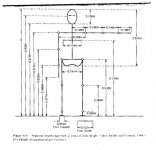
The diagram below has been reprinted in a couple of anthropometry texts--this one is from Engineering Anthropometry Methods, by J.A. Roebuck et al., p. 176. It shows various average longitudinal body measurements as a percentage of height ("H" in the diagram). E.g., the head is "0.130H", or 13% of the height, on average. The lengths of certain body parts aren't given directly (as they would clutter the diagram with figures), but must be arithmetically "derived." Here is how I computed the two lengths you mentioned above:When I was taking anatomy it was a good rule of thumb [<begin-interjection>Everyone should run to Amazon and buy the three terrific “Rules of Thumb” books by Tom Parker—RK <end-interjection>] that to see if legs were in average human proportion in a picture that you would hold your hand out, measure the distance between the knee and the hip between your thumb and forefinger and then take the same measurement from hip to shoulder. In adult humans this measurement should be roughly the same.
Knee-to-hip: .53 (hip height) - .285 (knee height) = .245
Hip-to-shoulder-joint: .818 (shoulder height) - .53 (hip height) = .288
The human hip-to-shoulder-joint distance is thus only 85% the hip-to-shoulder-joint distance (.245 / .288). (You were measuring on the surface, as so the top of the shoulder is a bit (an inch?) above the shoulder joint, so a somewhat higher figure (88%?) would be justified. However, in what follows, I’ve compared only joint-based measurements, to keep everything on an apples-to-apples basis.)
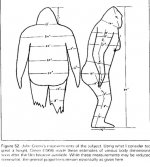
Unfortunately, your photo-image has vanished—I didn’t get a chance to measure it. Green did a profile-drawing of Patty (which I’ve also posted below). (It’s from p. 445 of his Sasquatch: the Apes Among Us). A reproduction of his diagram can be found on p. 105 of Krantz.) Measured from the diagram in Green’s book, the distances are:In this photograph, it is roughly the same.
knee-to-hip--21 mm.
hip to shoulder joint (the horizontal line marked with a “19”)—40 mm.
Thigh-as-%-of-torso: 21 / 40 or 53%, indicating Patty’s thigh is much shorter than her torso. (Used here to mean the portion of the body between the hip and shoulder joints.)
My measurement on the Bourtsev statuette from the cover of Perez’s Bigfoot at Bluff Creek booklet (the image posted by Parcher) yields a more conservative (and more likely) result:
Knee-to-hip: 30 mm. I measured along the midline of the thigh. I located the knee joint on a slanting-upward-to-the-right line running from the crease behind the knee to the point of the kneecap. I located the hip joint where the torso crisply intersects the front of the thigh.
Hip-to-shoulder joint: 45 mm. I measured parallel to Patty’s forward lean, and stopped where a perpendicular line starting a tad below the top of the shoulder would intersect it.
Thigh-as -%-of-torso: 30 / 45 or 67%, again indicating Patty’s thigh is much shorter than her torso. A human’s thigh is 85% of his torso; Patty’s thigh is 67% of her torso. Patty’s thigh therefore is only 79% (67 / 85) of an average human’s thigh of the same height. (The comparative figure for the lower leg should be similar.)
I urge you (or someone) to post a photo-image of Patty, with the three joint landmarks indicated on it (and ideally with the two lines drawn between them as well), and the thigh-as -%-of-torso figure worked out.
(When you are computing that figure, remember, if you are using a shot mostly from the back, as Parcher was, to lengthen her torso to compensate for her torso’s forward lean. That lean is about 30 degrees in the Bourtsev statuette, although less in frames when not turning around. To compensate for a 30-degree forward lean, add 15%. (I didn’t add any such compensation in my figures above, because I used side-views.)
/
Check and mate, baby.That is a man, baby.
Attachments
Last edited:


