Bigfoot - The Patterson-Gimlin Film

Status
Not open for further replies.
The answer to my own question from Noll. So the samples have been tested more than once and in different ways. Still nothing unusual identified. So now we have foot lounging around in the mud and chewing on apples and leaving nothing behind, except possibly a single hair fragment.

And his nut prints, of course....


5. Dr. Henner Fahrenbach was only given one set of hair samples collected from the imprint site. The other samples will be used for different types of testing. We divided the samples (Hair and apple) this way because we did not want anything to get lost and if it did we would have a backup.
 
I think it's been mentioned a few times the substrate was clayey sand. She was by the stream at first. The feet may have been wet and sand stuck to them.

Right. Everyone seems to agree that the substrate at Bluff Creek was a "clayey sand". It may have clung to the feet of a Bigfoot or somebody in a Bigfoot costume. When I look at the various still frames from the PGF, I do not see that "clinging substrate" might be causing any difficulty in determining the foot/sole shape.

Here is "Paddlefoot" again. I'm sorry that I cannot extract the single image that shows this foot and am forced to post the whole 4-frame group...

post-1-1101237919.gif


Here is "Blockfoot" (again). Please also note the "somewhat compact", "cupped" right hand...

040.jpg
 
The answer to my own question from Noll. So the samples have been tested more than once and in different ways. Still nothing unusual identified. So now we have foot lounging around in the mud and chewing on apples and leaving nothing behind, except possibly a single hair fragment.

And his nut prints, of course....


Every time I review the Skookum expedtion, it cracks me up..
http://www.bfro.net/news/bodycast/expedition_details.asp

If these animals have been avoiding confrontations with humans for thousands of years, might this behavior -- avoidance of leaving distinctive footprints -- be an ancient survival strategy?

Right.. It looks like after thousands of years they are not very good at ' not leaving distinctive footprints ', since that is the most persistant evidence.

Also ' the avoidance of leaving distinctive footprints ' doesn't seem to be a necessary skill that would have been reinforced over thousands of years, since none have been sucessfully hunted, in spite of the thousands of footprints that have been left...

Credulosity at it's best.....
 
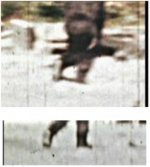
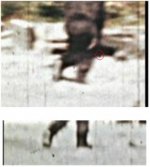
Still frames from Patty3.mov showing the very dark front part of Patty's left foot.

The bottom one is the opening frame, and the top one is a few frames later.

I don't know what that thing is that appears to be dangling underneath her right knee. It travels with Patty, whatever it might be.
 

Attachments

  • Picture 1.JPG
    Picture 1.JPG
    67.6 KB · Views: 35
Last edited:
Heironimus was wearing flat-soled "clown feet" that were part of the Bigfoot costume. He described them as being like house slippers.
 
Right. Everyone seems to agree that the substrate at Bluff Creek was a "clayey sand". It may have clung to the feet of a Bigfoot or somebody in a Bigfoot costume. When I look at the various still frames from the PGF, I do not see that "clinging substrate" might be causing any difficulty in determining the foot/sole shape.

...snip...

Whoever thinks wet clay, mud or sand would stick to a foot in such an homogeneous way never actually walked barefeet over a river bank...

BTW, with so many hits and links to his article, I wonder if Meldrum is not lurking at JREF. And if he is, I really would like to hear his opinions.
 
Transcription of Dr. Krantz's apearance on Arthur C. Clarks Mysterious Universe. 1980
This is a 17" track that was picked up in north eastern Washington state, and this is what is evidentally a crippled individual, because here we have two tracks of the same individual, you're looking at the bottom of the feet, and this right foot is crippled. It is distorted lenght wise, bent, missing one toe, and most critically the two buldges on the outside of the foot, they represent spaces between bones, and if this had been just a gigantic human foot, or some kind of fake like that, these buldges and these bone spaces should have been set farther back. The fact of where they are indicates that this is a foot designed with diferrent leverage; longer heal, shorter forepart. Which is exactaly what would have to be done to make a foot that would lift an 800 pound animal.

So Krantz thought that a fake crippled foot would simply have looked a little bit different? A faker would have known to make the foot, but he would have had the bulges in the wrong place?

Talk about rationalization....

A faker could indeed have faked a skew foot, but Krantz would have spotted a fake skew foot...
 
Chilcutt states that there are human fingerprints on the Elkins creek cast along with Bigfoot dermal ridges, attributing the human ridges to accidents by the cast maker. Below we have a picture of a human fingerprint on a bigfoot cast.

Are there any casts which do not have human dermal ridges along with the bigfoot dermal ridges?

dermal01.jpg

I'm not sure I've seen that photo before. I think that's a photo of Paul Freeman's "Mill Creek" cast. Michael Dennett let me photograph and examine with a loupe a copy of that cast made by Krantz himself. Indeed the "Mill Creek" cast has dermals all over the toes. They certainly look to me like human dermals and that was also the conclusion Chilcutt came to.

I'm still unclear about the notion of "accidental" dermals impressed into a cast. Does that mean that someone impressed their own fingers into the track before it was cast or that someone impressed their fingerprints into a still curing cast? I doubt the latter, because if a cast is cured enough to lift it out of the track without breaking it, it is too hard to be impressed by one's fingers. I must qualify this by saying I have not tested this specifically, so it's more like I'm doubtfull.

I've seen pictures of the "Elkins" cast surface textures from Georgia, I don't know what to make of it. I wouldn't hazard an opinion without looking at the cast itself.

I believe Paul Freeman's "Wrinkle Foot" cast has no human dermals.

Bob Titmus cast a track in Hyampom California way back in the early 1960's that I believe is alleged to contain dermals; I never got a chance to ask Meldrum of Chilcutt about this one.

The Skookum cast is claimed to show both felxion creases and friction ridge skin on the feature that is claimed to be a heel. Chilcutt showed me a copy of this "heel" feature. It does indeed contain textures which resemble flexion creases. It would be prudent to run tests on soil samples taken from the Skookum cast site to determine what the potential for holding texture detail is. I have not personally examined soil samples from the site.
 
I was a sideshow performer, not a carny. I was one of the founding members of the Jim Rose sideshow, which started in Seattle in the early 1990's. A book about our adventures by Jan Gregor is entitled Circus of the Scars.

"Mark" is old time carny slang for an unsophisticated customer. Our audience was more of the "modern primitive" type.

I've seen Bobby Reynolds' "100 pound rat" exhibit in Coney Island, it was actually a 100 pound capybara.

After reading Greg Long's book, I see many similarities between Jim Rose and Roger Patterson...

Kewl!

Jim Rose voices 'Simon' on SSX Tricky for PS2 (and probably other places)... I've started taking an interest in this colorful guy!
 
Ummm... nothing? Which photos do you mean?

You mean the message they'll toss your arse out of here if you keep that up didn't come up for you?

Exactly what I quoted a dozen posts or so ago.

The casts are still considered good evidence by some. If I were to discover, say, a large ruby and later sold fabrications, the original ruby wouldn't suddenly become fake. It would still be a large ruby.

Each piece of evidence has to be examined objectively. Some of the handprints are pretty interesting, too.

The only link of interest that I hadn't seen before was this one, though the information it contains is certainly not new:

http://www.internationalbigfootsociety.com/html/news.php

RayG

I was looking for that one and couldn't find it. Thanks for posting it.
 
Last edited:
Sorry, forgot to surround my query with <sarcasm> indicators. It was meant to get LAL to actually look at the results, not to confirm whether they had been done. My bad.


Even if nothing was proven to come from a squatch, it still gets presented as though it was, ("hair was found in the imprint and scat and possible prints were found in the area.")


Not many scientists have even looked at the cast in those 5 years. There was some kerfuffle over on the BFF about whether access was being granted to selective scientists or not, but still, five years later... tick...tick...tick...

Further links on the BFF regarding the Skookum cast:
http://www.bigfootforums.com/index.php?s=&showtopic=2645&view=findpost&p=56610
http://www.bigfootforums.com/index.php?showtopic=2516&st=0

RayG

My point was that these things had already been found by the last day of the expedition. What good would it have done to gather more of the same during a "hot pursuit"? Sceptics would dismiss the evidence afterward as easlily as any found before. I'm not sure when the scat was found. The hair was afterward, of course, and found in the imprint. It was too close to human to rule out contamination, but the physical examination indicated it wasn't human. Even Sarmiento said that it wasn't human (on LMS). It had never been cut.


As I've mentioned a gazillion times, I used to live in Skamania County. Sightings there were almost common. The seven mile long double trackway was probably what convinced me in the first place. I was very pleasantly surprised to learn about the Skookum Cast after I moved to NC and very pleased the imprint was found miles northeast of where I lived instead of in some area I know little about. It's not a great reach for me to think the imprint shows what it seems to show, and all other possiblities, including elk, seem to have been ruled out. There were experiments done.

If members of the team had been up all night and actually seen the animal sit down, would their testimony make any difference, or would they just be dismissed as liars? Too bad someone didn't set a bear trap under the mud where the animal was going to sit down. There might have been a sizeable chunk of DNA left behind. What an appalling lack of foresite! And they should have brought a large cage and some elephant guns, of course, and more than enough cameras.............a full scale scientific expedition would have thought of all this, of course, and never mind the cost

It would be interesting to see a list of all qualified scientists who have actually bothered to look at the cast and their conclusions. Dr. Daegling been there yet?
 
Whoever thinks wet clay, mud or sand would stick to a foot in such an homogeneous way never actually walked barefeet over a river bank...

BTW, with so many hits and links to his article, I wonder if Meldrum is not lurking at JREF. And if he is, I really would like to hear his opinions.

I doubt he has time. He does pop up in Coleman's Yahoo group sometimes. Last time he was looking for a citation, presumably for the book he's writing.

Damp sand/clay could be picked up, dropped, picked up again. She was on a sandbar, mostly, wasn't she? That is no longer there.........
 
OK, that makes sense. This is called "motion blur" correct? Since the foot is moving more quickly that the rest of the body it blurs more, correct?
Well, it may be a combination of things. The foot is also lighter and exposes, or overexposes more quickly. In other words the lighter color under the foot tends to "wash out". This combined with the swift movement of the foot likely caused the squarish image of the foot. The other alternative is that someone produced an unprecedentedly good suit and then put a block of a foot on it. M.K.
 
Well, we still have an odd looking foot even in a decent shot. The foot that is relatively still at the end of it's movement is all blocky. The foot that is still moving upwards has all the detail. Curious. The feet look completely different to me, and within just a frame or three, too.

No detail, blockfoot:
frame72.jpg


Details, perfectfoot:
017.jpg
 
My point was that these things had already been found by the last day of the expedition. What good would it have done to gather more of the same during a "hot pursuit"? Sceptics would dismiss the evidence afterward as easlily as any found before.

Yes, I'm sure it would have been easily dismissed. Why ?
Because it's easy to dismiss ..
Give us something that is not easy to dismiss..


I'm not sure when the scat was found. The hair was afterward, of course, and found in the imprint. It was too close to human to rule out contamination, but the physical examination indicated it wasn't human. Even Sarmiento said that it wasn't human (on LMS). It had never been cut.

Your point? ( with regard to this being evidence that we have a Sas butt print ? )

As I've mentioned a gazillion times, I used to live in Skamania County. Sightings there were almost common. The seven mile long double trackway was probably what convinced me in the first place. I was very pleasantly surprised to learn about the Skookum Cast after I moved to NC and very pleased the imprint was found miles northeast of where I lived instead of in some area I know little about. It's not a great reach for me to think the imprint shows what it seems to show, and all other possiblities, including elk, seem to have been ruled out.
Ruled out by whom? How did they rule out elk, when elk hair was indeed identified ?

And how does you having lived in the area, add any weight to the validity of the cast?

WTF is ' almost ' common. :confused:


There were experiments done.

If members of the team had been up all night and actually seen the animal sit down, would their testimony make any difference, or would they just be dismissed as liars?
Yes, unless they offered some verifiable evidence.
Too bad someone didn't set a bear trap under the mud where the animal was going to sit down. There might have been a sizeable chunk of DNA left behind. What an appalling lack of foresite! And they should have brought a large cage and some elephant guns, of course, and more than enough cameras.............a full scale scientific expedition would have thought of all this, of course, and never mind the cost..
Yeah, a trap would have worked.. One working camera is more than enough ..
It would be interesting to see a list of all qualified scientists who have actually bothered to look at the cast and their conclusions. Dr. Daegling been there yet?

I don't think it would be interesting at all.
Do you really think if Noll had such a list, that supported his beliefs, he wouldn't be all in our faces with it ?
 
Well, we still have an odd looking foot even in a decent shot. The foot that is relatively still at the end of it's movement is all blocky. The foot that is still moving upwards has all the detail. Curious. The feet look completely different to me, and within just a frame or three, too.

No detail, blockfoot:
frame72.jpg


Details, perfectfoot:
017.jpg
What I don't understand is, why is there any question about the subject's height ?

That foot is exactly 14.5 inches, right ?

Someone explain to me why we can't use that foot to come up with a very close height estimate ...
 
The Skookum cast is interesting, but useless.

No one can tell what it is with any certainty at all.

Some people believe stongly that it was left by a bigfoot, but that means very little.

There is no actual useable evidence to show that it was left by a bigfoot.

None.

Now, if we had some corroboration....like what might have come to light if this particular bigfoot had been followed.

Or if we had some primate hairs, or DNA (we don't have either no matter how many times it is claimed we do) it would certainly be harder for me to say the print could not be connected to bigfoot.

Regarding primate hairs, though....
I notice no one taking precautions against their own hair falling into the mud while making the skookum cast. People are leaning right over the mud and whatever is on their clothes and their bodies is falling all over the print and contaminating it. We know that someone actually stepped in the mud, as well.
 
Status
Not open for further replies.

ISF - Join now!

Every member here is approved by hand. No bots, no spam, just people who care about evidence and honest debate.

Membership is free!

Create your free account

Back
Top Bottom