Merged Global Warming Discussion II: Heated Conversation

Status
Not open for further replies.
1. Snow falls do occasionally occur in Antarctica, where average suface temps often hover around 70 below zero. The snows rarely amount to tenths of an inch, as the amount of moisture that can be held in such "warm air masses" is very small.
Nonsense. Antarctica has a tremendous amount of snowfall on the coast. The dry high interior is almost snow free, but the water vapor which is always there precipitates as diamond dust, not snow.

And that has nothing to do with the NH boreal winters, much less the lower latitudes. It's funny that this ridiculous nonsense is being posted as winter storm Titan is happening.

Ironic even,
 
Last edited:
Nonsense. Antarctica has tremendous amount of snowfall on the coast.

Yes. Care to guess why ?

It's funny that this ridiculous nonsense is being posted as winter storm Titan is happening.

You continually saying that something is nonsense without explaining why doesn't show you in a good light. It seems like you don't even know why you say what you say.
 
Trakar
If you are really interested in increasing snow cover in some Boreal regions in the colder months of the season, the question that should immediately spring to mind is: "why do we have increasingly more warm, moisture-rich air masses hugging the surface in these high northern regions at these times of the year?"

that same question applies to Antarctica - some areas are seeing rain for the first time in recorded history and as indicated some parts of the eastern continent are gaining mass and the ONLY way that happens is moister air.

Some models predict that continued climate change will actually result in increased snowfall around East Antarctica. A recent numerical ice sheet model projected climate change and snow fall in East Antarctica until AD2500 14. However, this increased snowfall increased ice discharge around the continent, meaning that it had little effect in mitigating global sea level rise caused by the melting of other glaciers and ice caps, and global ocean thermal expansion. Generally, dynamically driven ice loss as a result of increased snowfall was around 30-60% of the mass gain. Indeed, the authors reported a 1.25 m global sea level contribution from the East Antarctic Ice Sheet by 2500 under the strongest warming scenarios

and

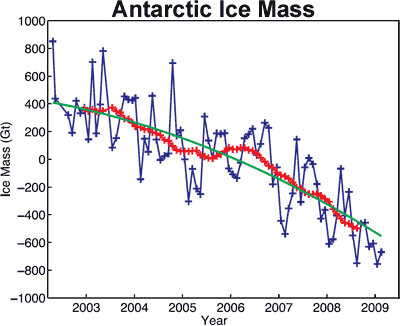
The bottom line is satellite gravity measurements of Antarctica find that the continent as a whole is losing mass. Not only that but losing mass at an acclerating rate. I will repeat the graph showing the total mass loss from Antarctica as the empirical data doesn't seem to have sunk in yet:

Antarctica_Ice_Mass_zpsdfab325a.gif


You're also correct in pointing out that snow accumulating in the East Antarctic interior is increasing, presumably due to increased precipitation caused by more humid conditions caused by warming air. That Antarctica is losing mass at an accelerating rate while gaining mass in the interior is a testament to the sensitive nature of ice sheet dynamics - ice sheets are proving more sensitive than previously realised and are sliding into the oceans at a faster rate.

This is also borne out by paleo studies that have looked at ice sheet and sea level behaviour in the past and found sea levels to be over 6 metres higher than current levels when temperatures were only 1 to 2 degrees warmer than now. Multiple lines of evidence point to the same answer - the ice sheets are sensitive to warming temperatures and are going to cause significant sea level rise over this century (and beyond).

https://www.skepticalscience.com/antarctica-gaining-ice.htm

•••

Originally Posted by r-j
Nonsense. Antarctica has tremendous amount of snowfall on the coast.
Yes. Care to guess why
?

Hehe .....yes R-J - why is that when the interior is much much colder.

we'll wait for an answer.

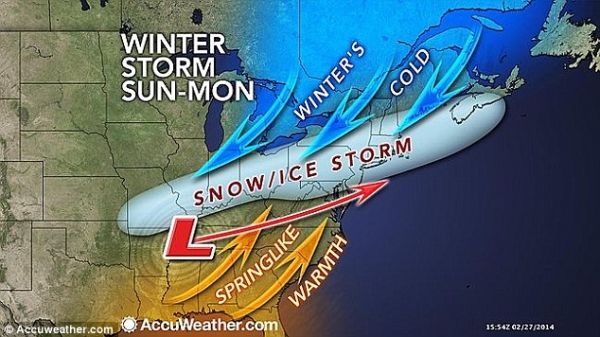
and thank you for mentioning Titan as it is very illustrative. Cold dry arctic air meets warm moist gulf air = lotsa snow. Moisture is the controlling element - not temperature.
You can bet northern Quebec is not getting hammered unless it happens to be downwind of open water in Hudson or James Bay.

Tis ironic you brought Titan up.

winter-storm-titan_zpscc1e8c11.jpg
 
Last edited:
Originally Posted by macdoc
Additional snow cover is not related to cold weather - more snow is an artifact of more moisture in the atmosphere.
R-J snarked
Once more, we see incredible woo woo claims being made.

I back my statements with supporting documents from science sources and as a pilot a very sound understanding of how the basics work in the atmosphere.

You on the other hand use sloppy language regarding phenomena you clearly do not understand and retreat to insults to cover the squirming when shown to be factually wrong.

BTW did you answer the question?
Is the earth closer to the sun in the winter or in the summer?
 
Originally Posted by r-j
Nonsense. Antarctica has a tremendous amount of snowfall on the coast.
Yes in general - you got one thing correct yet don't see the irony.

The dry high interior is almost snow free,
yes

but the water vapor which is always there precipitates as diamond dust, not snow.
:dl:

And that has nothing to do with the NH boreal winters, much less the lower latitudes. It's funny that this ridiculous nonsense is being posted as winter storm Titan is happening.

are you claiming that meteorological principals change with latitude now???
I hate to be the one to tell you but once more you are factually incorrect.

What happens on the coast of Antarctic when cold winds blow across open water is EXACTLY what is happening here - moisture levels to produce snow is NOT always present in air masses...it drops with temperature so dry cold air will not produce snow until it hits a moist warmer air mass as you can see below.

The phenomena have EVERYTHING to do with each other and with your nonsense about colder NH Boreal winters which are a mythical artifact of your own imagination and flawed understanding of the world you live in.

winter-storm-titan_zpscc1e8c11.jpg
 
that same question applies to Antarctica - some areas are seeing rain for the first time in recorded history and as indicated some parts of the eastern continent are gaining mass and the ONLY way that happens is moister air.

Certainly, though this is at least partly due to warm water upwellings and increasing instabilities and contractions in the circumpolar currents,...or so I seem to recall reading recently, let me look through my recent research and see if I have anything handy.

Tis ironic you brought Titan up.

[qimg]http://i106.photobucket.com/albums/m269/macdoc/junk%20album/winter-storm-titan_zpscc1e8c11.jpg[/qimg]

Ironic? perhaps.

I prefer "inconveniently coincident" to some positions, given the largely identical explanations recently expressed in words by various contributors, now supported by independent graph. IIRC, these are the same types of compelling explanations and similar turns of the discussion to relevant issues and real climate science which have resulted when similar attempted derailments have occurred in the past. Hobby horses designed to distract those who lack rigorous understandings born of compelling evidences and time devoted to learning.
 
Last edited:
Winter starts at the end of December and lasts until the end March
Not in regards to what we are discussing. Meteorological winter is defined as the three coldest months throughout the winter, or December 1st through March 1st. Educate yourself before trying to teach others.

According to your reference there is an trended increase in NH snow cover in December, January and February and generally declining trends March through September.
What reference? And I assure you none of the scientific sources belong to me in any way. All the sources of snow data show the same thing. I covered this in detail last year.

What isn't apparent, is what significance you attach to this?
You probably just forgot. It was explained in great detail.

We can demonstrate that it isn't relating cooler temperatures over the NH in the same periods neither monthly, seasonally, nor annually.
Then demonstrate it. Show us what you claim is happening. This absurdism that somehow, the winters are getting warmer, but at the same time the extent and amount of snow is increasing. I would love to see this. Because it's just not possible. Shucks, if it was, I'm pretty sure somebody would have already done it, just to shut me up and make me look like a total fool. You know? I first pointed it out last winter, which seemed to be pretty bad. But my oh my, this one has turned out to be the worst ever.

After one of the coldest winters on record
Which planet was that? :confused:
Now in 2010, you could be excused for not knowing, but in 2014, you might realize that while 2009/10 was epic bad, this year really drives home the facts. Winters in large, important areas of the NH are getting worse. This was true when I said it in 2013, it's even more true now.
"Subzero Temperature Days Reaching Record Levels in Midwest"

That's a really hard record to beat btw. None of this should be a surprise, as scientists and researchers, who became alarmed after the 06/07 disaster, started looking for reasons, and really became concerned after the 2010 crisis. The winters have never let up since.

While I was going through some of the great links in Macdoc's sig line
http://www.macmagic.ca/ubbthreads.php?ubb=showflat&Number=45753#Post45753
I stumbled across a nice explanation of why the US can expect to experience severe winters, especially in the eastern states. I think the graphs and illustrations may be helpful in countering the climate change denial associated with the colder winters occurring in the US.

From
http://www.arctic.noaa.gov/future/impacts.html

"This dome of warm air and elevated atmospheric pressure surfaces over the pole changes the Arctic atmospheric wind patterns, allowing outbreaks of cold Arctic air to the south."

also
"United States has more severe winter storms

Preliminary results from numerical computer simulations indicate that the significant cold anomalies over the eastern US in winter are associated with the decrease of the Arctic sea-ice cover in the preceding summer-to-autumn seasons (Figure 4, right).2

Although there is considerable year to year variability, as summer Arctic open water area increases over the next decades, an increasing influence of loss of summer sea ice on northern hemisphere wind patters can be anticipated, with resultant impacts on northern hemisphere weather"

All this from the "Future of Arctic Sea Ice and Global Impacts"
http://www.arctic.noaa.gov/future/

They updated the page/info here in Jan 14
http://www.pmel.noaa.gov/arctic/atmosphere/polar_vortex_2014.html

This winter in the US is no surprise to me, just like last year was no surprise. The trend clearly shows colder winters, which is always associated with more snow. Always. In a continental climate cold is directly associated with snow. Only deserts and areas isolated by mountains can experience extreme cold with out the associated snow and ice. Like the interior of Antarctica, or parts of the arctic regions in winter.

As for the nonsense about "increased moisture", that is easily debunked by looking at the precipitation records.

It doesn't matter how cold a high pressure system is, if it meets a low, there will be snow. If it's an ocean fed low, like we see driving winter storm Titan, there will be lots of snow.

If US temperatures were "normal" right now, we would be seeing the front farther north, and there would be more thunderstorms and tornadoes, instead of a blizzard. The huge dome of high pressure, which is really really cold, is the source of the snow and ice.

The Pacific ocean is the source of the warm moist air that is feeding Titan. This is basic meteorology. Learn some before you say another thing about weather.

Even a cursory look at a synoptic map will show you why it's not Gulf moisture and warmth feeding this blizzard.

 
Last edited:
ah okay thanks

•••


Hmmmm ...cold trend in NH winters???....

NOT

A new Boston University study shows that the consequences of milder winters -- a smaller snowpack leaving the ground to freeze harder and longer -- can have a negative impact on trees and water quality of nearby aquatic ecosystems far into the warmer growing season.

In a paper in the journal Global Change Biology, BU biology Prof. Pamela Templer and her co-authors show that soil freezing due to diminishing snowpack damages the roots of sugar maple trees and limits their ability to absorb essential nitrogen and other nutrients in the spring. This leads to greater run off of nitrogen into ground water and nearby streams, which could deteriorate water quality and trigger widespread harmful consequences to humans and the environment.

"Most people think that climate change means hot, sweltering summer months, but it affects the winter as well," said ecologist Templer, currently on fellowship at Harvard University, noting that winter snowpack has been shrinking over the past 50 years due to climate change and is likely to continue diminishing over time.
more
http://www.sciencedaily.com/releases/2014/02/140228093112.htm
 
Last edited:
Not in regards to what we are discussing. Meteorological winter is defined as the three coldest months throughout the winter, or December 1st through March 1st. Educate yourself before trying to teach others.

Personal attack aside, it is evident that I understood the time frame you were discussing or I wouldn't have continued in the very next sentence with the following:

Winter starts at the end of December and lasts until the end March

According to your reference there is an trended increase in NH snow cover in December, January and February and generally declining trends March through September...

What reference? And I assure you none of the scientific sources belong to me in any way. All the sources of snow data show the same thing. I covered this in detail last year.

"your reference" = the reference you cited in support of your argument. This is commonly used phrasing, quite typical in normal discussion.


Then demonstrate it. Show us what you claim is happening. This absurdism that somehow, the winters are getting warmer, but at the same time the extent and amount of snow is increasing. I would love to see this. Because it's just not possible. Shucks, if it was, I'm pretty sure somebody would have already done it, just to shut me up and make me look like a total fool. You know? I first pointed it out last winter, which seemed to be pretty bad. But my oh my, this one has turned out to be the worst ever.

apparently you have forgotten or are simply mistaken as this data has been shown to you several times over the last winter or two and yet you still reject the data and return with the same flawed argument yet again.

But just in case you there is some reason you just have not seen any of these evidences offered by many different posters over the last few winter's discussions, here is one example of such evidences:

http://data.giss.nasa.gov/cgi-bin/g...013&base1=1951&base2=1980&radius=1200&pol=rob

picture.php
 
Last edited:
R-J
This absurdism that somehow, the winters are getting warmer, but at the same time the extent and amount of snow is increasing. I would love to see this. Because it's just not possible..

The severity of snow storms is increasing....you will not find anyone but you nattering on about more snow in winter in the NH or colder NH winters and you have been called out any number of times on your misapprehensions.

This has been posted several times.

Global warming means more snowstorms: scientists
Mar 01, 2011

. Climate change is not only making the planet warmer, it is also making snowstorms stronger and more frequent, US scientists said on Tuesday.

"Heavy snowstorms are not inconsistent with a warming planet," said scientist Jeff Masters, as part of a conference call with reporters and colleagues convened by the Union of Concern Scientists.

snip

Masters said that the northeastern United States has been coated in heavy snowfall from major Category Three storms or larger three times in each of the past two winters, storms that are unparalleled since the winter of 1960-61.
"If the climate continues to warm, we should expect an increase in heavy snow events for a few decades, until the climate grows so warm that we pass the point where it's too warm for it to snow heavily."

Mark Serreze, director of the National Snow and Ice Data Center in Boulder, Colorado, said less sea ice in the Artic translates to more moisture in the atmosphere, and could also cause an atmospheric circulation pattern in polar regions known as Arctic Oscillation.

"It's still cutting-edge research and there's no smoking gun, but there's evidence that with less sea ice, you put a lot of heat from the ocean into the atmosphere, and the circulation of the atmosphere responds to that," Serreze said.

"We've seen a tendency for autumns with low sea ice cover to be followed by a negative Arctic Oscillation."

Read more at: http://phys.org/news/2011-03-global-snowstorms-scientists.html#jCp
 
Last edited:
But just in case you there is some reason you just have not seen any of these evidences offered by many different posters over the last few winter's discussions, here is one example of such evidences:

http://data.giss.nasa.gov/cgi-bin/g...013&base1=1951&base2=1980&radius=1200&pol=rob

[qimg]http://www.internationalskeptics.com/forums/picture.php?albumid=839&pictureid=8633[/qimg]​

That's not evidence of the cooling trend for the boreal winters. You know, the subject of Cohen et al(2012)

When you duplicate their research, then you will understand.
 
Arctic thaw significantly worsens global warming risk

* 12:53 18 February 2014 by Jeff Hecht
* For similar stories, visit the Climate Change Topic Guide

Melting ice is cooking the planet. Shrinking Arctic sea ice means the ocean is absorbing more energy from the sun, and it's now clear the effect is twice as big as thought – adding significantly to heating from greenhouse gases.

Arctic temperatures have risen 2 °C since the 1970s, leading to a 40 per cent dip in the minimum summer ice coverage in the Arctic Ocean. Open water soaks up more sunlight than ice, so as the ice retreats the ocean absorbs more energy, warming it and causing even more melting.

To measure the effect, Ian Eisenman of the Scripps Institute of Oceanography in La Jolla, California, and colleagues turned to data from NASA's CERES satellite. They found that the Arctic Ocean's albedo – the fraction of sunlight it reflects back into space – dropped from 52 per cent in 1979 to 48 per cent in 2011. That may not seem like much, but it means a big rise in energy absorbed – equal to 25 per cent of that trapped by the rise in atmospheric carbon dioxide over the same period.

"That is big – unexpectedly big," says Eisenman. "Arctic sea ice retreat has been an important player in the global warming that we've observed during recent decades."

"It reaffirms that albedo feedback is a powerful amplifier of climate change, maybe even more so than is simulated by the current crop of climate models," says Mark Flanner of the University of Michigan in Ann Arbor.

The extra energy absorbed goes into the ocean, particularly on the side of the Arctic near Alaska and Siberia, which is losing the most ice. "
more
http://www.newscientist.com/article...ignificantly-worsens-global-warming-risk.html
 
That's not evidence of the cooling trend for the boreal winters. You know, the subject of Cohen et al(2012)

When you duplicate their research, then you will understand.

As I suspected, there was no honesty or trustworthiness in your statements, merely more word games rolled into an apparently never-ending escapade of moving goalposts, distortions, and disingenuity.

...Then demonstrate it. Show us what you claim is happening. This absurdism that somehow, the winters are getting warmer, but at the same time the extent and amount of snow is increasing. I would love to see this. Because it's just not possible. Shucks, if it was, I'm pretty sure somebody would have already done it, just to shut me up and make me look like a total fool. You know? I first pointed it out last winter, which seemed to be pretty bad. But my oh my, this one has turned out to be the worst ever.
(...)
This winter in the US is no surprise to me, just like last year was no surprise. The trend clearly shows colder winters, which is always associated with more snow. Always. In a continental climate cold is directly associated with snow. Only deserts and areas isolated by mountains can experience extreme cold with out the associated snow and ice. Like the interior of Antarctica, or parts of the arctic regions in winter...

Here you speak of colder winters, not the locally focused regions of boreal winters of Cohen et al. (which, btw, were addressed conclusively and definitively several pages ago as the locally anomalous events they are), which neither make their overall regions (north-western segment of the north hemisphere, north-eastern segment of the northern hemisphere) nor the northern hemisphere in general into cold trending regions over the period of time covered.

You have received compelling evidences that your assertion that NH winters are trending colder over climatically relevant timeframes is incorrect and yet you persist in hand waving it away while you continue to make the same, demonstrably incorrect assertions. Actions like these are how some people earn the label "climate science denier."

Here we see the same thing that happened last year, at the point where a few people realized that yes, there is this colder winter trend happening, and the snow amounts are trending higher, so then it was claimed that the winter cooling trend was predicted by the climate models.

It wasn't true then, and it isn't true now. What has happened, is after the fact people are trying to explain why the colder winter trend is happening. The 2010 paper is the result of what happened. In no way is it evidence that climate models predicted the colder winters that have already happened. So CapelDodger and others are attempting to provide evidence of climate modles predicting colder winters, based on models created after it has happened. Which is just so dishonest.

Again, no mention of locally focused boreal regions which had been addressed and covered several pages previous to when this assertion was made.

Winters have been getting colder. If this had been predicted as part of global warming, we would be hearing about how cold it's been, and crying over global warming.

Just like the mild winter last year in the US meant global warming.

more of the same, and so on for much of the last 8-10 pages, you have proven immune to the evidences you claim do not exist despite repeated exposure to them. Like years previous, there is no sense in continuing to attempt rational discourse on this subject matter with people who are not interested in reasoned and rational discourse of the topic.
 
Last edited:
Hmmmm ...cold trend in NH winters???....
One more time.
And, it's not that "Certain regions in the Northern Hemisphere" are now and then having a bad winter, it is a clear trend. And "Certain regions in the Northern Hemisphere" is quite ambiguous. The NH boreal winters is what the Cohen et al paper was speaking of, however, as some may have noticed, the trend is also colder for non-boreal regions as well.

Each time you misrepresent what I cleary stated, you lose credibility. I'm talking about with other people, you have none at all to me.
You are committing the fallacy that a lot of people fall into, which is not understanding what somebody says, nor looking at the evidence they use to explain why they said it. I always support my points with evidence, and ask others to do the same. At the time I was telling you the NH winters have been trending colder, I posted evidence that clearly shows this. Multiple times. In this this thread. ...

I posted a dozen sources to support my points.
At least try to respond to what is there.

You actually posted something useful, about New Hampshire, which is one of those places that is actually seeing a warming trend for winters.

The snow and temperature relationship there is interesting. It does seem the warmer winters is messing with the forests in unexpected way.
 
Last edited:
As a side note, some seem to be repeating the rather common trope regarding it being "too cold to snow," in actuality this is not true. What tends to prevent snow in extremely cold environments is the fact that extremely cold air simply cannot hold much moisture and will release that moisture long before it gets extremely cold.1

I think this is what people are saying when they say "to cold to snow". With some exceptions like Orographic effects snow requires a warm and cold air mass. As you say it can snow when the "warm" air mass is below -10 to -15 deg C but the accumulation would be small and in practical terms be disregarded by most. Their not unaware of the light dusting of snow, it's just not significant enough the discuss. Like Orographic snow it's a corner case that isn't really relevant to the discussion on snow accumulation.

Related but worth noting is that the coldest days in boreal climates are invariably very clear and dry. the dryness means very little in the way of greenhouse gasses so any heat that is present can escape readily to space. The same thing happens in deserts at night.


If you are really interested in increasing snow cover in some Boreal regions in the colder months of the season, the question that should immediately spring to mind is: "why do we have increasingly more warm, moisture-rich air masses hugging the surface in these high northern regions at these times of the year?"

Indeed, this is the point quite a few people have been making.
 
Status
Not open for further replies.

Back
Top Bottom