Now when objects fall solely under the influence of gravity, they do so by a given amount of acceleration which varies slightly according to where you are on the earth. This value is approximately 9.8m/s².
Only in a vacuum.
So this collapse time of 6.5 seconds
An old measurement I made put it at ~6.6s, though that would need checking against more recent T
0 eastimates.
... is compared to the time that it would have taken WTC 7 if it were in free fall. This is a proximately 6 seconds.
186m in vacuum... 6.16s... approximately 6.2s
As an aside, given the reminder about air resistance, an apple dropped from 186m would take ~8.9s to reach the ground, though the effect is less with larger and heavier objects.
But let's start with that 6.5 second collapse time.
My old calc, as mentioned above, is here...
linky
The NIST reports contain no such figure because it is simply not possible to calculate it.
By synchronising multiple viewpoints, a reasonable estimate can be made, as show in the link above...T
0 caveats aside of course.
So what about the claim that buildings that experience control demolition have an average acceleration which is 'almost' or 'essentially' free fall?
Some do, some don't. 1515 Flagler approached similar acceleration to WTC7...
He shows in this simple experiment that control demolition at least in this case, does not collapse typically at free fall acceleration
In at least one other case the same does not hold true. It is entirely down to what structure, and how, so far as I can see from the various I've traced. Some are raipd, some not so rapid.
NIST estimated that the collapse time for this period was 5.4 seconds.
Can of worms. I'll point you to some better measurements if you're interested.
They then calculated the free fall time for the same collapse at 3.9 seconds and concluded that the average acceleration was not free fall and was in fact 40% longer. This conclusion is absolutely correct.
I'm afraid not. NIST measurements are somewhat out.
Based on what I have said already, it becomes clear that
some sleight of hand is going on here.
Always worth verifying measurements yourself before being, er, positive about "absolute correctness".
Not so much a matter of principle, as presentation!!
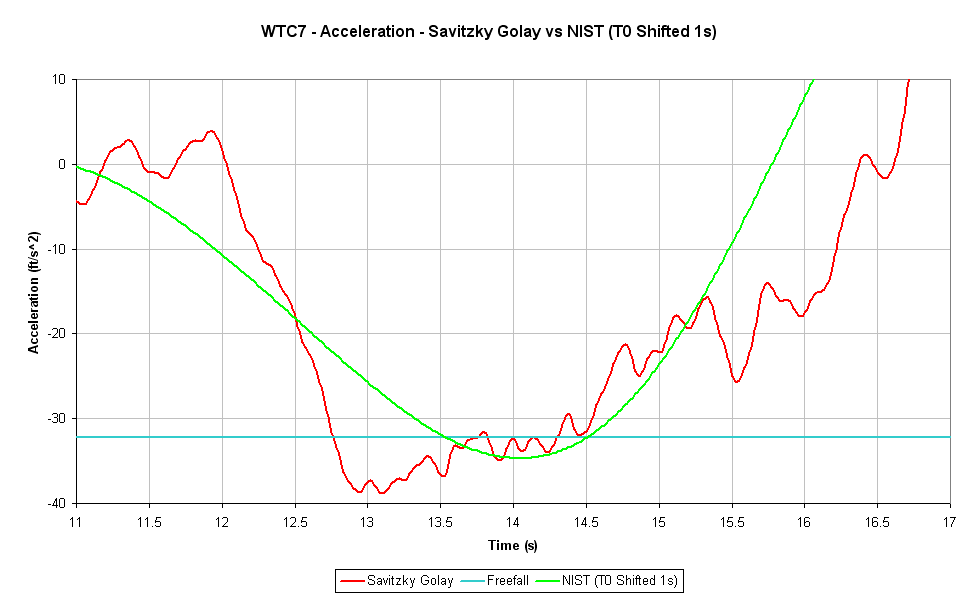
Acceleration profile of WTC7 has been traced in some detail.
One of many...
SG is my data.
It showed that the 5.4 seconds could be broken down into three stages.
They didn't do a great job of it.
It showed that gravitational acceleration was not typical due to the first and third stages, especially the first, which had seen the façade collapse 7ft in 1.75 seconds. This is where most of the resistance came from and accumulated the 40% greater time over all.
Their T
0 was very badly placed, skewing their results.
It is true that NIST acknowledges 2.25 seconds of gravitational acceleration for the next 100ft
Which is again far from accurate.
As it appears you hold the NIST data with some reverence, I'll dig you out somewhat of a critique of their methods and data in the specific areas you mention, so that you are aware of the issues there.



 ) that (I find it plausible) an attached weight would help accelerate the falling object. So no need for floors to evaporate, just a sufficiently limited resistance below these.