• Security incident: ISF was recently accessed by intruders. Please change your password, and change it anywhere else you used it. Read more

Can 15 floors crush one floor?

You need to explain how the columns could have been put out of alignment during the first story of the drop in WTC 1. You can't just wave your hand and say they were and then use some sort of argument against me personally to make your point.

Bucking during the collapse initiation phase.
 
You need to explain how the columns could have been put out of alignment during the first story of the drop in WTC 1.

If they weren't out of alignment the building wouldn't be falling. Judging by the GZ debris field we'd assume that elastic buckling led to connection failure, given the overwhelming preponderance there of straight column sections that were in multiples of their fabricated length.

Once buckled and failed the column ends can no longer meet as the gap is, by definition, less than the section length.

You can fit 2 12" rulers axially into a 24" gap. Make the gap 23" and those rulers cannot meet end-to-end axially. This doesn't seem so hard to comprehend that you should need such basic explanations but, apparently, you do.
 
It wasn't a surprise to see that nobody here actually answered this.

I responded in the very next post :rolleyes:

Lateral motion began before release.

I may have a look and see if that lateral motion was also present further down the building, and if so column misalignment becomes trivial to assert (not that it isn't without such)


Studies of perimeter sheet behaviour have been performed over a long period of time Tony.

It can be observed that either upper face passed in front of or behind lower face for all observable faces.

That takes out perimeter-perimeter impacts, and replaces such with perimeter-floor assembly collision.


How could they possibly stay IN alignment ?

Why would IB as observed on the perimeter not also be present for sections of the core ?

By WHATEVER method of failure, including "explosives", you are not going to have nice neat flat column ends at any point. Instead, bend and mangled column ends that may not have even severed at that point.

You have a large upper section, which is not rigid, is in motion in more than one direction, and is also tilting (which indicates eccentric load response).

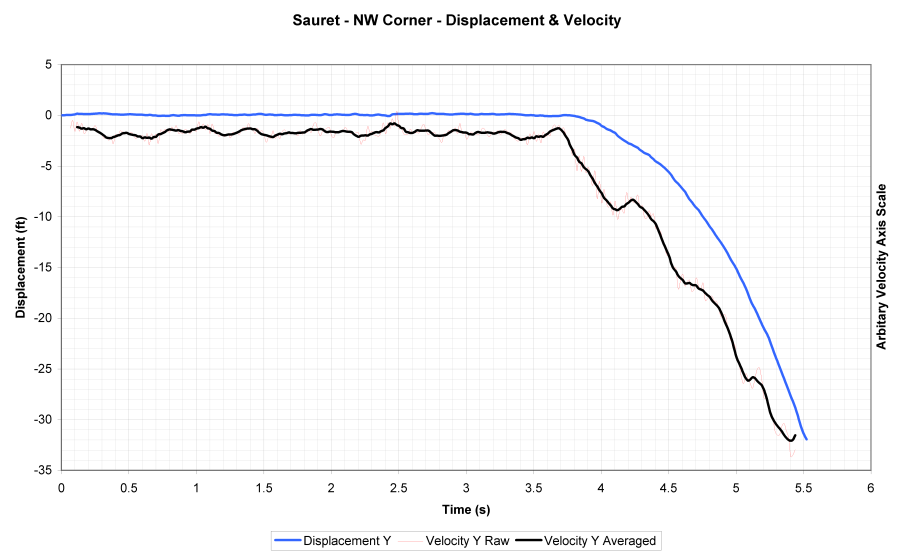
You have a structure flexible enough for the antenna to be observed to move independently to the NW corner.

There's no reason to think that core motion is tied to perimeter motion, and could have been moving in all sorts of directions.

You have the "upper section" in motion >9s prior to release.

What caused that motion ?

What impacted what ?


What impact ? Between what and what ? (Or more to the point, what impactS ? Thousands and thousands of them over finite amounts of time, smearing "jolts" out)

Natural or otherwise, what difference does it make ?

How do you invoke release (>9s before it actually goes) and STOP your expected "jolt" ?


Recalculate your expected "jolt" with a 1 degree tilt, 5cm SE upper section displacement, and no perimeter-perimeter contact.

Then find a route through the structure which is capable of transmitting that smeared out "jolt" through a floor assembly structure in order to present at the NW corner.


You are getting carried away.

Where do you get "at least the first couple of storeys" from ?

The 1 degree metric applies to the point of release.

Tilting continued after release.

Oystein also responded...

1° of tilt around a pivot on one face, and everything else equal, means
  1. the level on opposite face corresponding to the pivot has moved inward about 1 cm = (1-cos(1°)) * 63 m
  2. the same level has moved downwards by 1.1 meters = sin(1°) * 63 m
  3. from this >1 m drop follows that perimeter columns below that line are either severed - their "top part" ends are out of touch with the "bottom part" ends - or they have formed plastic hinges, i.e. they are not straight anymore. (Or both)

Tony, before I draw inferences from this scenario, can you point out if I get anything wrong so far?

Quickly followed by...

I don't think treating the "upper section" as a rigid block is a good idea, but...


Which, even assuming a "rigid upper section" (wrong) and no further rotation (wrong) would mean that the first "virtual impact" would occur following...

3.66 - 1.10 = 2.56m

...of descent. (and be between misaligned south perimeter columns only)

There would then be a continnual series of "impacts" over the next 1.10m of descent until the North face had descended a single storey...which took ~0.2s.

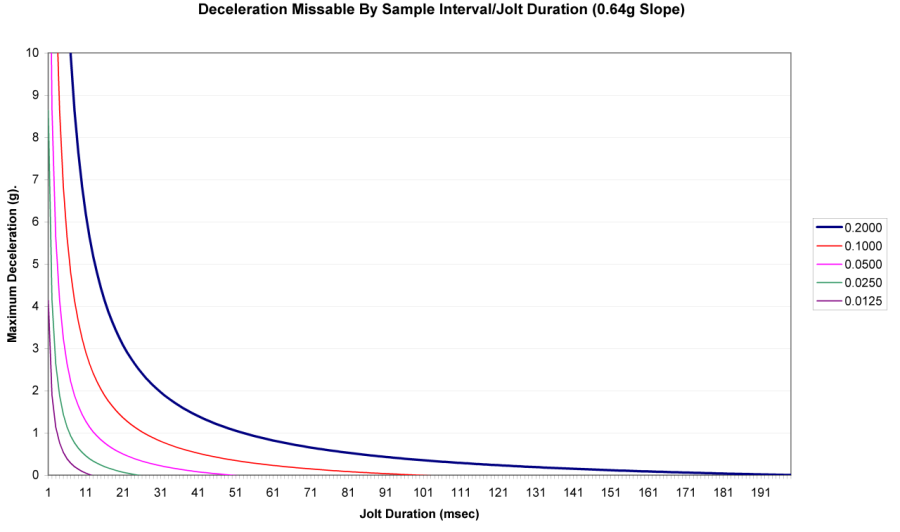
Going back to the "missable jolt" formula (which Tony assisted in determining)...


...what is the jolt duration ? Not 200msec.

How many individual "impacts" shall we have over that 200msec period ?

1000 ? 10000 ?

Silly ? Perhaps. Tony had the jolt duration at 17msec iirc.

A 17ms jolt duration with an expected deceleration of 3g and a sample interval of ~0.16s would STILL be "missable".

The different series are sample interval.

Lots of little "jolts", perhaps, but not one big one.

No expectation to be able to see a smeared out singular "jolt" with Tony's data.

There are a couple of "mini jolts" in my higher fidelity data...


ETA: Bottom line...

We know there was tilt.

Tony,

Step 1 : Recalculate with 1 degree tilt, resulting in a series of separate impacts over a period of 200msec. Minimum number of "impacts" tbd...58 (perimeter) + 8 (core rows) + 3 (OOS regions). 69 minimum. Still virtual, but whatever.

...or...

What impacted what ?

And when.


All of which you've somehow been utterly 'blind' to.

It doesn't wash Tony.
 
Last edited:
You would be thinking wrong. The towers were designed to support their weight with a much larger factor of safety than any of the Verinage demolitioned buildings.

In other words, pound for pound the twin towers were much stronger.

Um... again, I'm talking about during the collapse, not the 30 years it was standing there without giant holes in them. That failed demo in Turkey (IIRC) a brick building rolled. That would never happen with the towers. Nothing was going to save any part of the them once they started moving. Just too damn big and heavy.
 
There is no basis for the ends of buckling columns to move out of vertical alignment while buckling due to a vertical load.

That has got to be one of the most ignorant statements ever made by someone that is supposed to be an engineer.

It is as if you and C7 are competing to see how can make the most ignorant claim.
 
You would be thinking wrong. The towers were designed to support their weight with a much larger factor of safety than any of the Verinage demolitioned buildings.

In other words, pound for pound the twin towers were much stronger.

And a completely meaningless claim.
 
Tony's failure at grasping things I am sure a 12-year old would after this amount of explanations we offered him, it occurs to me that perhaps the person who is posting here using the nickname "Tony Szamboti" is not the "real" Tony Szamboti, the mechanical engineer from Pennsylvania? Can this be verified?
 
In a long litany of really dumb posts, this one may take the cake.

I am saying the inertia of the upper section of WTC 1 would keep the columns aligned during the first story of the fall and that there should have been a serious deceleration observed during at least the first impact, which there mysteriously wasn't.

Right ….

And "the inertia of the Shuttle Challenger should have kept all its pieces flying in perfect alignment after the explosion, allowing the astronauts to calmly walk to the exit & step out…"

And the inertia of the Tacoma Narrows bridge should have kept all of its beams & girders in alignment just after the cables failed, allowing that person to walk to the car & get the little dog out…"

And "the inertia of that 1/2" steel cable that some idiot was attempting to pull his boat out of the water through wet sand should have caused it to drop serenely, safely to the ground when it snapped, instead of virtually cutting in half a high-school friend of mine who was walking over to tell him to stop…"

[Same fate for sailors on aircraft carrier due to failed arrestor wires on a tragically regular schedule.]

Do you have the slightest clue about "stored energy in huge elastic structures on the brink of failure"?

Do you have any clue about what happens to those structures & all the internally stored energy when the structure finally fails?

To counter you are simply asserting that the columns were out of alignment. That doesn't work. If you disagree you need to explain how the columns of WTC 1 were caused to be out of alignment during the first story of the fall and before the first impact, and why there would be no deceleration observed during that impact in a natural collapse.

Note: It is proven that there was no more than 1 degree of tilt for at least the first couple of stories of the fall, so make sure your answer takes this into consideration.

Anyone who attempts to make any statement about the location of the free ends of a bolted-together pair of columns that have been overloaded under compression & bending & then buckled, based on their location just prior to buckling (REGARDLESS of any tilting angle of the assembly) is a damn fool.

Anyone who suggests that an array of about 300 columns, who have had about 20 of those columns removed preferentially on one side, and is struggling (& finally failing) to remain upright (read: undergoing massive bending loads in the remaining columns), is a damn fool.

Anyone who suggests that, after one story of fall, the free ends of columns in the above scenario will impact squarely onto mating column ends THAT DO NOT EXIST at that 1 story down location is a damn fool, raised to some power.

Anyone who refuses for years to acknowledge that there are no free ends of columns for his magically aligned column studs to impact is a damned fool, raised to the power of incompetence.

It wasn't a surprise to see that nobody here actually answered this.

That a good enough answer for ya, Tony?

 
Last edited:
You would be thinking wrong. The towers were designed to support their weight with a much larger factor of safety than any of the Verinage demolitioned buildings.

In other words, pound for pound the twin towers were much stronger.

Ah, so now the size is a factor. I'm noticing a lack of any evidence here, though. Did that "safety factor" include full-speed impacts by jumbo jets that didn't exist when the towers were completed, and the resulting fires?

And you're still not posting your calculations that led you to arrive at your 3 floors figure. Unless you went "verinage takes 2 floors, and the Towers were stronger, then they would've taken, uhh...three?"
 
He then underestimated the enery absorption capacity of the columns in the lower structure by 3.3 times.

Wrong.

Anyone who calculates the energy absorption capacity of a fragmented, ripped apart structure impacted with massive side loads using calculations based upon perfectly axial loading of pristine, undamaged columns is a damned fool.

Anyone who calculates the energy absorption capacity of a column based upon an impact that cannot possibly happen is not only a damned fool. He is damned incompetent, too.

Bazant's estimate of the energy absorption capacity of the columns was actually a rather massive overestimate. He knew it was when he clearly stated that it was a limiting case calculation.
 
Last edited:
Tony's failure at grasping things I am sure a 12-year old would after this amount of explanations we offered him, it occurs to me that perhaps the person who is posting here using the nickname "Tony Szamboti" is not the "real" Tony Szamboti, the mechanical engineer from Pennsylvania? Can this be verified?

It would explain a great deal, wouldn't it? I mean, a lot of the technical stuff flies right over my head at freefall speed, but I can still understand the basic gist of what you professionals are saying. And I can clearly see how this Tony, real or not, is the dictionary definition of clueless. Imagining the column would strike the one below it in perfect alignment, arresting the top block?

WHAT?!?!?

Actually, the thought of anything at all arresting the top block is bizarre if you think about it....
 
Last edited:
He knows that, which is why he's focusing on the "missing jolt" or whatever. Have you noticed how vague he gets when pressed on certain details he should logically have already?
 
Tony's failure at grasping things I am sure a 12-year old would after this amount of explanations we offered him, it occurs to me that perhaps the person who is posting here using the nickname "Tony Szamboti" is not the "real" Tony Szamboti, the mechanical engineer from Pennsylvania? Can this be verified?
Unless this mystery poster has managed to also hijack Tony's email account, it's really Tony.
 
He knows that, which is why he's focusing on the "missing jolt" or whatever. Have you noticed how vague he gets when pressed on certain details he should logically have already?
I think you are being too generous. :D

Being vague is the third level of his denial processes. The top three levels IMO are:
1) IGNORE: The posts he ignores are more damning than the ones he responds to with outright false comments.
2) Give Explicit False response: And those are more damning than the ones he
3) Give vague response.

However IMNSHO you are spot on that his underlying obsession is with the "Missing Jolt" fantasy. Probably the main error with "Missing Jolt" was that he made a false assumption then, in effect, followed a train of "logic" round in a circle until he "proved" his assumption.

I challenged him on that a year or two back and pressed him till he went vague on topic then switched to outright denial and off topic personal insult then ignore. So, in series, "3)" then "2)" then "1)" of the "hierarchy" I described above which seem to be his SOP. So, when dealing with Tony, being ignored is the highest level proof that your arguments are too good for him. It indicates that he is baulking at acknowledging that he has been shown to be wrong.

The main error he keeps repeating in this thread is the claim that columns would land on columns. Persuasive proof has been posted by me, femr2 and Oystein where we come at the same logical points from differing perspectives. Tony gives all the his highest grade of "1) IGNORE..." which is prima facie proof in Tony speak of "your arguments are too good for me".

Alternatively stated he claims the columns could not miss. He makes that single error because of three underlying false premises:
1) He denies visual evidence that the columns did miss.
2) Presented with that visual evidence he makes the false choice that reality is wrong and his assumption is correct. That is back to front. The reality is that reality is -- er--"real". :) THEREFORE his assumptions (geometry and rigidity) are false.
3) He relies on false sequencing in that he describes the stage of "top block" falling as preceding the column ends coming into contact. That is wrong in physical layout and in timing sequence. Once the top block started falling the ends had already missed or were in process of missing. He is looking for a jolt that has already been "missed". There are other opportunities for jolts as collapse progresses but the one he looks for has already been passed.

And all three of those were also issues of errors underpinning the false claims of Missing Jolt.

I've never published a paper based on grossly false logic so I have no experience of the psychology of denial that such a situation could lead to.
 
...Anyone who suggests that, after one story of fall, the free ends of columns in the above scenario will impact squarely onto mating column ends THAT DO NOT EXIST at that 1 story down location is a damn fool, raised to some power....
Add tfk to those who have pointed out this bit of reality. Each in our own styles but the same point.

Well done tfk
thumbup.gif

...That a good enough answer for ya, Tony?
It should be good enough to warrant "IGNORE" if my classification of Tony responses is accurate and he follows his SOP's. ;)


Aaaaarrrggghh... Oystein beat me to it.

Grr...:blush:


:D
 
Last edited:
...I can still understand the basic gist of what you professionals are saying...

I am not a professional at all in this or any vaguely related field, and have no relevant education beyond having been pretty good (if I may brag: having excelled) at high school physics and math, some 25+ years ago!

And yet I find it easy to school this "engineer" and spot his many many grave and amazing errors!
 
You need to explain how the columns could have been put out of alignment during the first story of the drop in WTC 1. You can't just wave your hand and say they were and then use some sort of argument against me personally to make your point.

Others have already done so in this thread quite adequately. I was just following up explaining the consequences of their insights, which falsify your theory a number of ways.

Again, your assertion that some kind of minimum drop happen is a red herring as it assumes intact, column-to-column axial impacts. That assumption is not valid, so neither is the minimum drop requirement. QED.
 
You would be thinking wrong.

No, this is correct. The floorpans were not designed to carry the mass of the upper block. Therefore anytime such a mass impacted the floorpans they would fail instantly.

The towers were designed to support their weight with a much larger factor of safety than any of the Verinage demolitioned buildings.

In other words, pound for pound the twin towers were much stronger.

Again. Irrelevant. Based on faulty assumptions regarding what was impacting the structure below and where. This isn't difficult to understand, Tony. Your 'perfect world' scenario didn't happen, so your argument fails no matter how many times you repeat it.

Just as Bazant's limiting case was not supposed to be the actual collapse - it simply established some best-case-for-survival parameters....which were not met in reality.

Why do you keep expecting things which are not expected in reality? Where do you think this is going to get you?
 

ISF - Join now!

Every member here is approved by hand. No bots, no spam, just people who care about evidence and honest debate.

Membership is free!

Create your free account

Back
Top Bottom