• Security incident: ISF was recently accessed by intruders. Please change your password, and change it anywhere else you used it. Read more

Can 15 floors crush one floor?

It is incredible that you think the column flange and web areas have to hit exactly square area to area to cause a deceleration and then to top it off you have the nerve to question me.
This is precisely why people like you don't get any respect. You are not the world's leading structural engineer nor fire investigator. I think we have all made it clear from our side that there has to be something relatively un-yielding in the way of the majority of falling debris to arrest collapse. The only thing capable of arresting collapse would have been intact columns aligned with the falling debris. They were out of allignment. No arrest. Go play in a sandbox somewhere.
 
I fail to see why column alignment matters at all.

I speculate that: once a building portion of 15 floors accelerates at one g over a distance of 12-15 feet it will fail whatever portion of the below structure it impacts regardless of alignment.

For comparison, the top section of the North Tower had ~ the mass of a WWII Tennessee-class battleship. When the battleship drops 12 ft. onto the top floor of the building, the building loses.
 
For comparison, the top section of the North Tower had ~ the mass of a WWII Tennessee-class battleship. When the battleship drops 12 ft. onto the top floor of the building, the building loses.

Come on, Redwood, a moon-sized field of debris couldn't have broken the top floor of the building. ;)
 
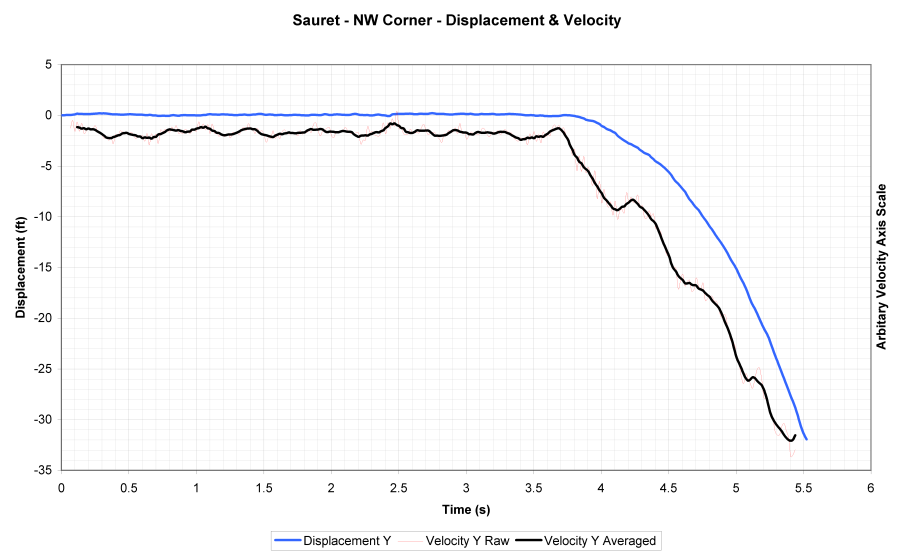
111trackingjustbeforecollape.jpg

Plot just before collapse. No CD. Should I smooth the data? lol

Can 15 floors crush one floor?
http://www.nist.gov/el/disasterstudies/wtc/faqs_wtctowers.cfm

If you carefully place 11 to 12 floors on a WTC tower floor, it fails. Dropping them is extra credit fail.
15 floors is too many to crush one floor.
 
This is precisely why people like you don't get any respect. You are not the world's leading structural engineer nor fire investigator. I think we have all made it clear from our side that there has to be something relatively un-yielding in the way of the majority of falling debris to arrest collapse. The only thing capable of arresting collapse would have been intact columns aligned with the falling debris. They were out of allignment. No arrest. Go play in a sandbox somewhere.

I am saying the inertia of the upper section of WTC 1 would keep the columns aligned during the first story of the fall and that there should have been a serious deceleration observed during at least the first impact, which there mysteriously wasn't.

To counter you are simply asserting that the columns were out of alignment. That doesn't work. If you disagree you need to explain how the columns of WTC 1 were caused to be out of alignment during the first story of the fall and before the first impact, and why there would be no deceleration observed during that impact in a natural collapse.

Note: It is proven that there was no more than 1 degree of tilt for at least the first couple of stories of the fall, so make sure your answer takes this into consideration.
 
Last edited:
I am saying the inertia of the upper section of WTC 1 would keep the columns aligned during the first story of the fall and that there should have been a serious deceleration observed during at least the first impact, which there mysteriously wasn't.
Lateral motion began before release.

I may have a look and see if that lateral motion was also present further down the building, and if so column misalignment becomes trivial to assert (not that it isn't without such)

To counter you are simply asserting that the columns were out of alignment.
Studies of perimeter sheet behaviour have been performed over a long period of time Tony.

It can be observed that either upper face passed in front of or behind lower face for all observable faces.

That takes out perimeter-perimeter impacts, and replaces such with perimeter-floor assembly collision.

If you disagree you need to explain how the columns of WTC 1 were caused to be out of alignment during the first story of the fall and before the first impact
How could they possibly stay IN alignment ?

Why would IB as observed on the perimeter not also be present for sections of the core ?

By WHATEVER method of failure, including "explosives", you are not going to have nice neat flat column ends at any point. Instead, bend and mangled column ends that may not have even severed at that point.

You have a large upper section, which is not rigid, is in motion in more than one direction, and is also tilting (which indicates eccentric load response).

You have a structure flexible enough for the antenna to be observed to move independently to the NW corner.

There's no reason to think that core motion is tied to perimeter motion, and could have been moving in all sorts of directions.

You have the "upper section" in motion >9s prior to release.

What caused that motion ?

What impacted what ?

and why there would be no deceleration observed during that impact in a natural collapse.
What impact ? Between what and what ? (Or more to the point, what impactS ? Thousands and thousands of them over finite amounts of time, smearing "jolts" out)

Natural or otherwise, what difference does it make ?

How do you invoke release (>9s before it actually goes) and STOP your expected "jolt" ?


Recalculate your expected "jolt" with a 1 degree tilt, 5cm SE upper section displacement, and no perimeter-perimeter contact.

Then find a route through the structure which is capable of transmitting that smeared out "jolt" through a floor assembly structure in order to present at the NW corner.

Note: It is proven that there was no more than 1 degree of tilt for at least the first couple of stories of the fall, so make sure your answer takes this into consideration.
You are getting carried away.

Where do you get "at least the first couple of storeys" from ?

The 1 degree metric applies to the point of release.

Tilting continued after release.
 
Last edited:
... you need to explain how the columns of WTC 1 were caused to be out of alignment during the first story of the fall and before the first impact, and why there would be no deceleration observed during that impact in a natural collapse.

Note: It is proven that there was no more than 1 degree of tilt for at least the first couple of stories of the fall, so make sure your answer takes this into consideration.

1° of tilt around a pivot on one face, and everything else equal, means
  1. the level on opposite face corresponding to the pivot has moved inward about 1 cm = (1-cos(1°)) * 63 m
  2. the same level has moved downwards by 1.1 meters = sin(1°) * 63 m
  3. from this >1 m drop follows that perimeter columns below that line are either severed - their "top part" ends are out of touch with the "bottom part" ends - or they have formed plastic hinges, i.e. they are not straight anymore. (Or both)

Tony, before I draw inferences from this scenario, can you point out if I get anything wrong so far?
 
Last edited:
1° of tilt around a pivot on one face, and everything else equal
I don't think treating the "upper section" as a rigid block is a good idea, but...

the same level has moved downwards by 1.1 meters = sin(1°) * 63 m
Which, even assuming a "rigid upper section" (wrong) and no further rotation (wrong) would mean that the first "virtual impact" would occur following...

3.66 - 1.10 = 2.56m

...of descent. (and be between misaligned south perimeter columns only)

There would then be a continnual series of "impacts" over the next 1.10m of descent until the North face had descended a single storey...which took ~0.2s.

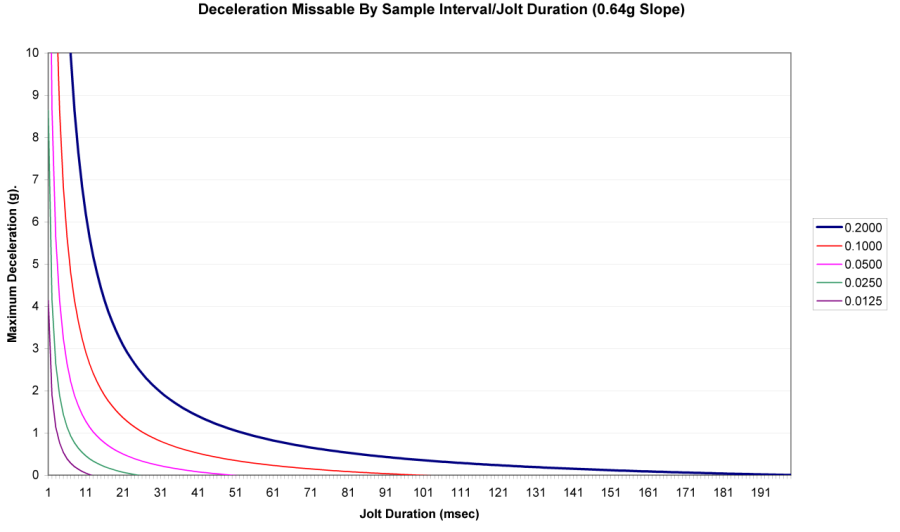
Going back to the "missable jolt" formula (which Tony assisted in determining)...


...what is the jolt duration ? Not 200msec.

How many individual "impacts" shall we have over that 200msec period ?

1000 ? 10000 ?

Silly ? Perhaps. Tony had the jolt duration at 17msec iirc.

A 17ms jolt duration with an expected deceleration of 3g and a sample interval of ~0.16s would STILL be "missable".

The different series are sample interval.

Lots of little "jolts", perhaps, but not one big one.

No expectation to be able to see a smeared out singular "jolt" with Tony's data.

There are a couple of "mini jolts" in my higher fidelity data...


ETA: Bottom line...

We know there was tilt.

Tony,

Step 1 : Recalculate with 1 degree tilt, resulting in a series of separate impacts over a period of 200msec. Minimum number of "impacts" tbd...58 (perimeter) + 8 (core rows) + 3 (OOS regions). 69 minimum. Still virtual, but whatever.

...or...

What impacted what ?

And when.
 
Last edited:
Folks it is a lot simpler that we seem to be making it. Please take care you don't fall for the trap of accepting Tony's logic which is arse about on at least two critical factors. You only need one fact to start with. We are talking about the stage where the "top block" is falling. That means that all columns have failed. Think on that till you really accept it for the simple truth it is. Now to save me referencing the many times I have published the critical bit of information lets look to what femr2 describes:
...It can be observed that either upper face passed in front of or behind lower face for all observable faces.

That takes out perimeter-perimeter impacts, and replaces such with perimeter-floor assembly collision...
Concisely stated femr2 and exactly the same point I have made often in my own explanations. The column ends missed each other. Visible proof for the perimeter. Proof by reasoning available for the core and the perimeter. But it should be self evident.

However I said Tony's version was "arse about logic" Here is one aspect - "arse about in time". He is looking for something landing column on column at the end of the first fall of the "Top Block". The visual evidence from femr2 says it didn't - at least for the perimeter. The column ends had already missed each other at that point in time. The moment Tony is looking forward to was already in the past. I have repeatedly made the same claim based on reasoning for both core and perimeter as femr2 confirms by observations for the perimeter.

So the next bit of arse about logic is the claim that structural rigidity would ensure column ends landing on column ends. Well we know that they didn't land "end on end" so the premise must be wrong. THEREFORE geometric arguments relying on structural rigidity have failed. That means that the structure was not as rigid as Tony presumes.

And that is what any competent structural engineer would expect. Flexibility sufficient for column ends to bypass each other. There are several other supporting factors which we don't need here.

So that deals with Tony's arguments.

And I note without further comment his trademark attempt to reverse "burden of proof":
If you disagree you need to explain how the columns of WTC 1 were caused to be out of alignment during the first story of the fall and before the first impact, and why there would be no deceleration observed during that impact in a natural collapse....
...no we don't Tony. All we have to do is to falsify your claim. We have done just that. Me completely. femr2 completely and Oystein well on the way having identified the key point of your logical error.
 
I don't think treating the "upper section" as a rigid block is a good idea, but...
Especially in a setting where Tony is desperate to wrongly assume high rigidity equivalent to solid block. :(
...Lots of little "jolts", perhaps, but not one big one...
I would expect two sizes of little "jolts":
1) The micro jolts you are talking about in this post which are the bits of impacts as the falling "Top Section" traverse the first storey of fall. Presumably with lots of messed up junk there from the initiation mechanism. (The boundaries of both those concepts are dubious BTW - the base of top section/top of lower tower AND "one storey' as the initial fall. :rolleyes: ) These "micro jolts" within the time frame of my comments in the previous post.
2) The following mini jolts of successive floor impacts. Even those probably not clear single events because the different zones of OOSD fell at different speeds times. These "mini jolts" occurring at a later time than my comments in the previous post.
 
Holy Jesus on toast.

This discussion reminds me of the Far Side cartoon:

"Yes, we know they're all idiots. But what KIND of idiots are they?"
 
I don't think treating the "upper section" as a rigid block is a good idea, but...

Of course it isn't. It is stupid and silly and moronic. Especially when you are an engineer. Which Tony is, and I aren't.

My goal here is to show that even within Tony's stupidly false premises, his conclusions are false.

Even if we accept his moronic premises, which are equivalent to the following hypothetical:
  • Saw off the top part across one floor 12 or 15 floors below the roof with laser sharp precision
  • Leave all columns in pristine shape - perfectly straight, perfectly vertical
  • Lift the top block by a little more than 1.1 m exactly straight up
  • Tilt top part 1° around a horizontal pivot within one facade
  • Trim column ends on either top or bottom part such that all bottom ends all have the same vertical distance to their corresponding lower top ends
  • gently lower the top part back down until columns ends barely touch
(note: We are pretending total rigidity, no damage at all to any part of the assembly except for the clean cuts, all distances between member in the top block precisely in their as-designed state, same for the llower block, absolutely no lateral movement except that imparted by the 1° rotation around the pivot, and no downward velocity/momentum left from the act of rotating)
What do we observe then:
  • On the side opposite to the pivot top column ends are about 10 mm laterally shifted inwards
  • Since plate thickness of the 14"x14" perimeter columns is only 7.5 mm, inner and outer web plate will completely miss each other
  • Instead of top column end touching bottom column end over an area of ca. 100 cm2 (4 x (14"* 2.5 cm/inch) x 0.75 cm), only the flanges touch each other over a length of 14" - 1cm, for an area of slightly less than half of what it was before
  • Consequently, load bearing capacity at that connection will be roughly reduced by 50%

Tony claims that, under his moronic, unreal premises, this contact will result in a decelaration of 3 g's, because that's the FoS. He is of course wrong. If we let our simplistic, comic-style scenario continue:
  • Load bearing capacity is reduced by 50%, so FoS is reduced to 1.5
  • As unconnected column ends are not loaded prior to impact, and we are now suddenly applying full static load at g, as we allow the top block to start moving again, top block will start moving down, loading the "springs" that both column essemblies are. According to simple laws of elastic springs, upward force will be proportional to compression, so force starts at 0, increases as top block moves down and compresses bottom columns (and itself), reaches -1g x M(top) with v(down)>0 reaching a local max. After that time, a > -g
  • It can be shown (read: I am now too lazy to show, as I want to be in the swimming pool in 20 minutes) that in this scenario, FoS must be at least 2, for a will have to reach -2g to JUST avert column failure
  • But FoS is 1.5 < 2 because of 1 cm of misalignment, so column will fail, collapse will progress

Even assuming Tony's moronic premises, granting total rigidity, perfect verticalness, pristine columns, and a rotation block that is kind enough to magically get rid of all momentum gained during the 1° tilt phase before making the best possible column-on-column contact, and a FoS of 3 that may be exaggerated, collapse will not arrest after initial tilt of 1°.

(Sure, there would be a jolt under such extreme conditions, but that wasn't his argument - the question is still: Can 15 floors crush 1 floor? And the answer is: If we have tilt of 1°, and columns ends have separated, 15 floors will crush 1 floor even if column magically reconnected)

... Oystein well on the way having identified the key point of your logical error.
You guys identify that point very well, and it is obvious enough. Tony didn't get it whenb you and femr2 said it, and he won't get it if I say it. I'll leave that part to you.

Tony is wrong on many levels: His premises contradict observed reality.

But they even contradict his own other premises.

The goal is to document that Tony is a very very incompetent engineer on many levels, so incompetent in fact that a layman like myself can point out his errors. On more levels than 1.


And if Tony is an exemplary for the "Experts speaking out" for AE911Twoof, 'nuff is said.
 
Another one of Tony's minutae is to ignore the fact that even if the columns had landed square-on, there's simply no way they could've still held up under the load, considering that it was several times that of the entire building. Heck, they couldn't even take that as a static load.
 

ISF - Join now!

Every member here is approved by hand. No bots, no spam, just people who care about evidence and honest debate.

Membership is free!

Create your free account

Back
Top Bottom
