Richard Gage Blueprint for Truth Rebuttals on YouTube by Chris Mohr

Status
Not open for further replies.
To belabor the obvious once more, the hallmark of a controlled demolition has nothing to do with its physical characteristics; rather, it's the intent of the demolition team to minimize risk to adjoining structures. If best done by getting the building to fold in on itself, that is what is done. If best done by toppling it to one side, that is what is done.

This contrasts with something like a military demolition of a structure like a bridge, done to deny use to an advancing army. In this case, the structure is massively overloaded with explosives, and potential damage to adjoining structures is little, if any, concern.
clap.gif

Well said - concise and clearly expressed.

I had need to say much the same on the "Col79 walkoff" thread about 2 hours back.

I was a bit more verbose. :o
 
Can you put your >g curve on the NIST FFA graph like they did with their displacement curve? That's what I was talking about when I said they could not be compared. But NIST did it so maybe you can.
Not sure what you mean.
Your graph has the FFA line horizontal and NIST has it at an angle. Plus you have >g below the line and the scale is different. It's impossible to see how the two relate. Would you put your curve:

femr1.jpg


on the NIST graph, so we can see how they compare.

nistfreefallgraph.jpg
 
Your graph has the FFA line horizontal and NIST has it at an angle. Plus you have >g below the line and the scale is different. It's impossible to see how the two relate. Would you put your curve:

[qimg]http://img19.imageshack.us/img19/2173/femr1.jpg[/qimg]

on the NIST graph, so we can see how they compare.

[qimg]http://img823.imageshack.us/img823/1338/nistfreefallgraph.jpg[/qimg]
Crikey C7. You seem really lacking in understanding about what you're looking at.

My graph, which you are repeating use of an old version of, and should use one of the Savitzky-Golay smoothed versions...

...contains acceleration/time data.

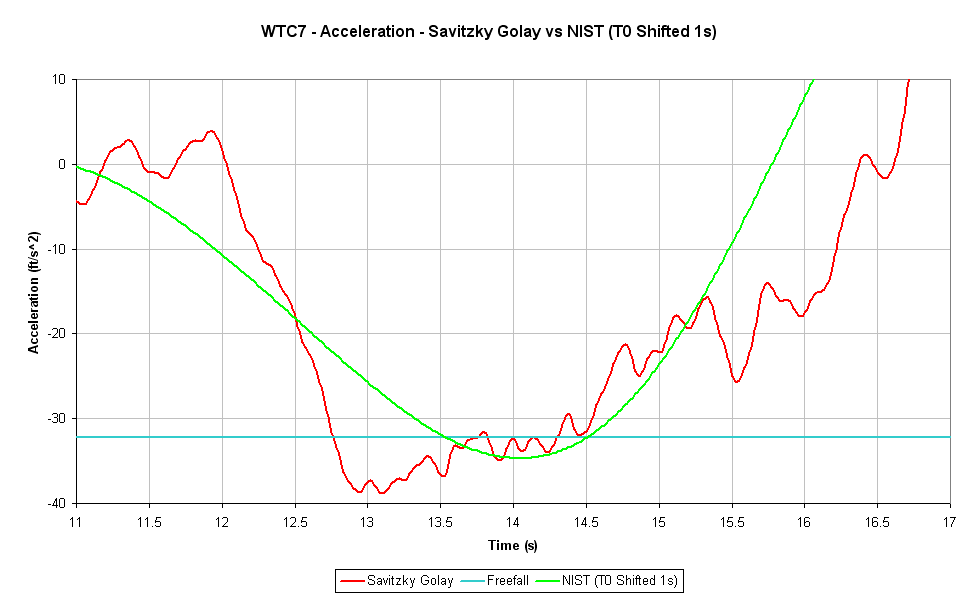
The graph above compares my acceleration data to the NIST acceleration function obtained by deriving their provided velocity function.


The NIST graph you provided shows velocity/time data.


Do you understand at all how you get from velocity to acceleration ?


Do you understand why placing my acceleration data back on a velocity graph is effectively showing you my velocity data ? (I could integrate the acceleration data, but that would simply result in a smoothed velocity profile, several of which you've already seen)


Do you understand why the linear fit on NISTs velocity graph isn't directly showing you acceleration, and what the gradient of the line tells you ?


The best way forward for your odd request is for me do it the other way round, namely placing the NIST "linear fit acceleration data" on my acceleration graph...


The thick black line is your line "FFA NIST has at an angle".
 
Last edited:
The best way forward for your odd request is for me do it the other way round, namely placing the NIST "linear fit acceleration data" on my acceleration graph.
That was a rather long "no". Is it because you can't put your curve on the NIST graph or that you won't?

ETA: How did you get your data points? Chandler shows how he did it in a video. Did you do the same?

Also: Would you correlate the start times please?
 
Last edited:
That was a rather long "no". Is it because you can't put your curve on the NIST graph or that you won't?
Are you unable to read ?

What you are asking for is pretty silly.

I asked you a number of questions, which you've ignored. I will assume you do not know the answers. Not a surprise given what you're asking.

But hell, I've integrated the acceleration data, generated by differentiating the velocity data in the first place, back into velocity data (which is a pretty pointless thing to do) and overlaid it on the actual NIST image (otherwise you'll get yourself all lost and confused)...


It's the thick black slightly wobby line.

Happy ?

You'd be much better off with the original velocity plots...


I suggest you answer my questions. You need to improve your levels of understanding to continue this "discussion".
 
ETA: How did you get your data points? Chandler shows how he did it in a video. Did you do the same?
You've been told several times. Essentially, yes, though using an automated and significantly higher accuracy method.

I use SynthEyes for data collection.

A (very old) example or two...


Original size...
814421844.png


Tracing accuracy...
515553996.gif


Read the following thread in full...
Discussion of femr's video data analysis
...there's >50 pages of it.
 
Your graph has the FFA line horizontal and NIST has it at an angle. Plus you have >g below the line and the scale is different. It's impossible to see how the two relate. Would you put your curve:

femr1.jpg


on the NIST graph, so we can see how they compare.

nistfreefallgraph.jpg
They are two different charts measuring two different things. One is a velocity vs time the other is an acceleration vs time chart. What you're asking for (a NIST/femr2/other acceleration chart) has already been provided in the Clinger's Wringer filtered chart I posted at #5415 above.
 
Last edited:
But hell, I've integrated the acceleration data, generated by differentiating the velocity data in the first place, back into velocity data (which is a pretty pointless thing to do) and overlaid it on the actual NIST image. It's the thick black slightly wobbly line.

Happy ?
Yes, thank you. That clears it up quite nicely. Your curve is more accurate than NIST's. Well done. It's closer to the FFA line than NIST's dots. There is no >g between 2.25 s and 2.5 s as Chris Mohr surmised. The out of line dot at 2.5 is just an artifact, most likely due to atmospheric distortion.

There is no >g at all unless it's around 2 s when the roofline is just starting to move down. That is what I suggested could happen as the core columns, that started falling a split second before the exterior columns, pulled the exterior columns down at slightly faster than g for a split second until they equalized at g. For the core columns to pull the exterior columns down at >g, they had to be falling at g [no resistance] and there can be no resistance to the exterior columns.

The important point is: There is a period of ~2 s of absolute g (FFA) [as close as can be measured] FFA means no resistance to any of the columns.

 
http://www.internationalskeptics.com/forums/showthread.php?postid=7152221#post7152221
W.D.Clinger/femr2– WTC7 Acceleration vs time chart.
Chandler: “This video tracks the motion of the NW corner of Building 7 of the World Trade Center on 9/11 2001. For a period of ~2.5 seconds. This means it was falling through itself for over 100 feet with zero resistance, an impossibility in any natural scenario. This period of freefall is solid evidence that explosives had to be used to bring the building down.
Chandler : FFA=Explosives CD. For FFA= explosive CD. Since the initial collapse was at less than FFA, the initial failure could not have been caused by explosives. The collapse began at less than FFA and continued toward FFA and greater acceleration. There was no need to demo a building that had already failed. The lack of a step and the smooth curve between <FFA on its way to FFA also indicates there was no sudden transition caused by explosives.

Same for WTC1,2 but I couldn’t find a similar chart to the above, where FFA is a horizontal line.

Good. Then it is also proven that the 1515 Flagler Dr collapse was not demoed also. No step function proves they only thought they demoed this building.

What MT believes I think is not what I said.
For, If, Given FFA=explosive CD (Candler's claim) then the subsequent analysis proves Chandler wrong. This is popular false truther meme believed by, for instance, C7.

<FFA does not prove a building was not explosively/other demolished. A demolition could have destroyed some of the columns, allowing the rest to resist and produce <FFA.

FFA does not prove the building was explosively/other demolished. As shown in Chandler's WTC7 analysis above.
Exception:If the initial movement acceleration from 0 to FFA is a step function then all supports failed together simultaneously, not achievable in a gradual natural failure (as in by fire).
 
The important point is: There is a period of ~2 s of absolute g (FFA) [as close as can be measured] FFA means no resistance to any of the columns.
Besides showing unequivocally just how little understanding of basic physics you have, you're still drawing the wrong conclusion. The presence of over-g acceleration proves beyond doubt that there were more forces acting on the façade, thus completely invalidating your claim that FFA means no resistance.

Since we know you don't understand basic physics, we also know that you won't understand why that's so. But for the benefit of the rest, let me summarize it.

The resistance of the columns can be represented as a force, F1, pointing up.

The pulling down force that causes over-g at a certain point can be represented as another force, F2, pointing down. Remember my diagram.

wtc7fall3.png


Here F1 is represented by the arrows pointing up, and F2 is represented by the sum of the small arrows pointing down.

F1 *needs* to decrease as the columns buckle. You've pasted several times graphs that show that.

F2 is expected to decrease over time too, because there are no plausible mechanisms (that I can figure out) that can exert such force indefinitely; however, you're wrong about the duration of such force. There are several mechanisms that can make that force to last longer than you claim, and about 2 seconds is not unexpected.

Now, when F2 > F1, you get over-g.

When F2 = F1, you get g.

When F2 < F1, you get under-g.

Therefore, it's FALSE that "FFA means no resistance to any of the columns". In reality, FFA means that the vector sum of forces (excluding gravity) give a NET result of zero.
 
That clears it up quite nicely.
I very much doubt that.

Your curve is more accurate than NIST's.
Correct.

It's closer to the FFA line than NIST's dots.
You are still looking at a velocity plot. I have simply reintegrated the acceleration data...
590673176.jpg

...and placed it over the velocity plot.

By definition the acceleration data still contains the over-g period...it's just harder to see on a velocity plot, obviously.

There is no >g between 2.25 s and 2.5 s
There is the SAME >g period as in the acceleration plot above :rolleyes:

There is no >g at all unless it's around 2 s when the roofline is just starting to move down.
NISTs T0 is early (as they misinterpreted the kink motion) and so the over-g period is around 1s after release, not 2s.

That is what I suggested could happen
ROFL. I've lost count of the number of times you've said over-g is impossible/not present. Think I'll quote them for you in a moment, unless you admit clearly and plainly that you may have been wrong and have now changed your position/stance.

equalized at g
Nope. Around, and constantly changing.

For the core columns to pull the exterior columns down at >g, they had to be falling at g
Nope, they simply had to impart enough additional force on the structure connected to the NW corner to result in a period of >g at the NW corner.

The important point is: There is a period of ~2 s of absolute g (FFA) [as close as can be measured] FFA means no resistance to any of the columns.
Nope.

Now you're getting around to accepting some simple data, it's time to get to grips with the various mechanisms which can cause >g without the need to have "no resistance"...regardless of what you believe initiated the process.

The NW corner was decelerating almost constantly after it had descended about 10ft.
 
Last edited:
The NW corner was decelerating almost constantly after it had descended about 10ft.
You certainly need to correct that statement. I don't see the acceleration switching sides until after ~16.5s in your graph.

Maybe you mean the NW corner's acceleration decreased at an almost constant rate?


The data accuracy is impressive.
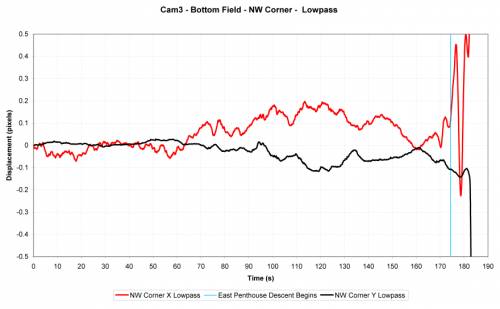
Why is it farting itself up and down for the first 7 seconds before it falls.

One of the problems with the velocity/acceleration/position vs time charts produced to date is that they are not calibrated by out of sample data. They all begin at the moment of movement. Confirmation/improvement of the in sample data could be corroborated by say a time period before movement equal to the time period of movement.

Bazant proposed in one of his later papers the installation of sacrificial sensors in demolitions that would provide better data in the understanding of demolitions.
 
Last edited:
You certainly need to correct that statement. I don't see the acceleration switching sides until after ~16.5s in your graph.

Maybe you mean the NW corner's acceleration decreased at an almost constant rate?

:) Yes, the rate of acceleration was decreasing almost constantly (but not at a constant rate) after the NW corner had descended about 10ft.
 
Last edited:
There is the SAME >g period as in the acceleration plot above :rolleyes:
Your line is right on the FFA line at that point

NISTs T0 is early (as they misinterpreted the kink motion) and so the over-g period is around 1s after release, not 2s.
Precisely where is the >g and how long does it last? That's the part I wanted to clear up. Define "after release" please. On the NIST timeline, where is the >g?

C7 said:
That is what I suggested could happen as the core columns, that started falling a split second before the exterior columns, pulled the exterior columns down at slightly faster than g for a split second until they equalized at g.
I've lost count of the number of times you've said over-g is impossible/not present.
You haven't been reading all my posts. I have said that several times.
 
One of the problems with the velocity/acceleration/position vs time charts produced to date is that they are not calibrated by out of sample data. They all begin at the moment of movement.

I have provided position/time data stretching back ~7 minutes prior to release...
666377698.jpg

835427944.jpg

212241494.jpg

...and many similar graphs, numerous times.

I have released raw data...
http://femr2.ucoz.com/load/

...and provided longer timescale velocity plots...
656459373.jpg
 
You have to state how much reistance "the exterior columns are providing" or admit that you are in denial.
 
Status
Not open for further replies.

Back
Top Bottom