Richard Gage Blueprint for Truth Rebuttals on YouTube by Chris Mohr

Status
Not open for further replies.
I had not read chapter 12
Do you mean 12.5.3 ?

How can you have had an opinion on the NIST data without reading that in advance ?

Their Stage 1 is incorrect.
It's inaccurate, yes.

Their curved line is above the data points between 1.75 s and 2.5 s. Correcting these errors puts the displacement curve almost exactly on the FFA line for over 2 s.
It doesn't work like that. That's basically dry-labbing. You don't "fix" things to get the result you want. There are not enough degrees of freedom in the NIST velocity function to capture any kind of subtle behaviour anyway.

Is the error that datapoint off out in the wilderness ? Probably. I don't have such extreme excursions in my data.

it appears that everything but the west end starts down before the west end
"Appears", good. Again, it depends what angle you look from. The building was undergoing quite complex flexure and twisting prior to and during descent. From the cam#3 viewpoint...

...NW first there.

And...


Both early traces. Sure they could be improved these days, and noise reduced.

Can you put your >g on the NIST FFA graph like they did with their displacement curve? That's what I was talking about when I said they could not be compared. But NIST did it so maybe you can.
Not sure what you mean. I've provided Displacement, velocity and acceleration graph containing both NIST and my own data.

You have WTC 7 falling at >g for about 1.6 s and as much as 38 ft/s2.
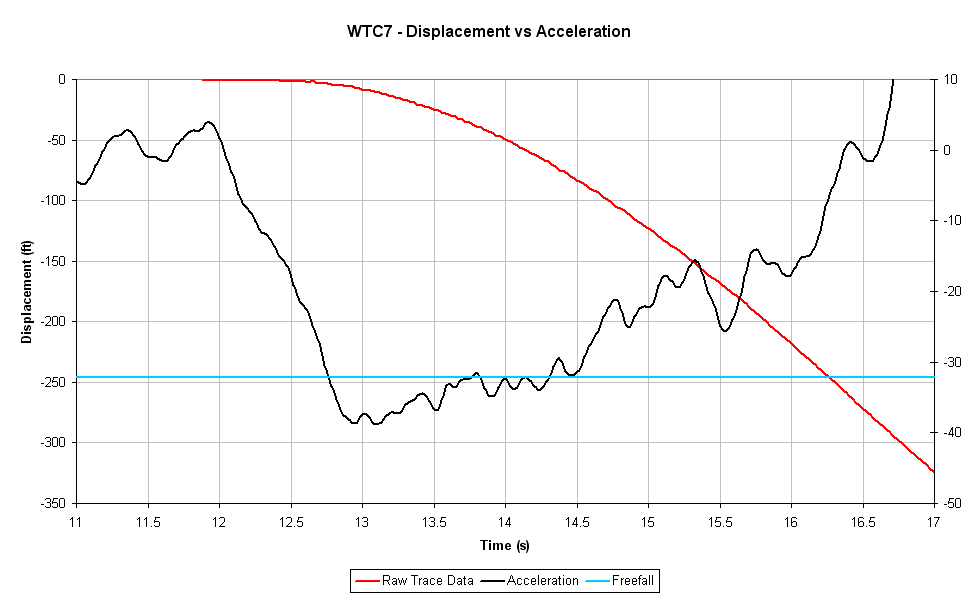
I suggest >g for ~1s. Note that maximum acceleration is reached before the building corner has descended 10ft. All slowing down from there on...

I would like to see what that looks like on the NIST graph.
Not sure what you're after...

NIST displacement or velocity graph ? (They didn't publish an acceleration graph)

femr2 displacement, velocity or acceleration data ?

This might help you...
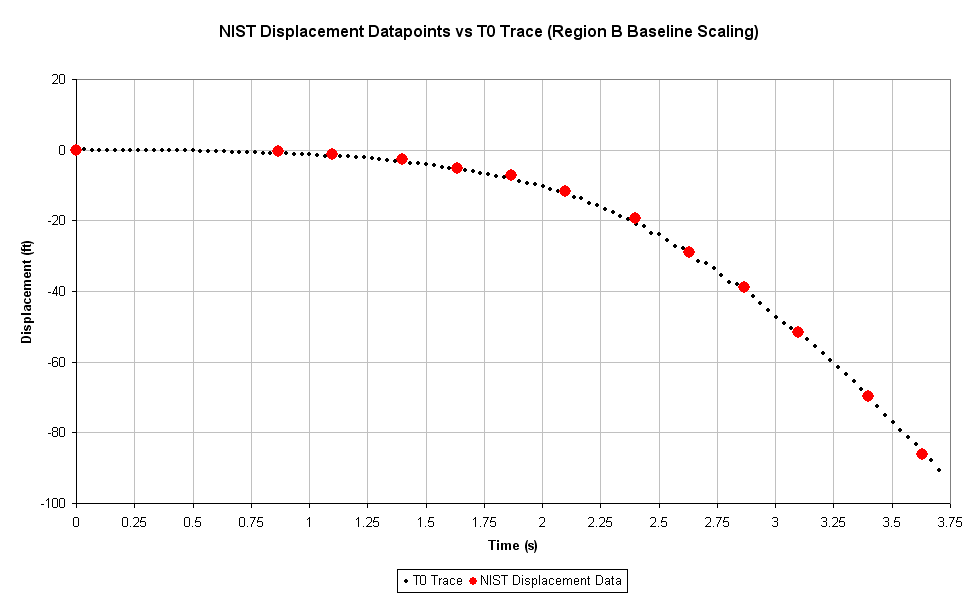
...my data is the small black dots. Lots more of them than the big red NIST dots. Note that they SHOULD be exactly the same, but NISTS do not match mine, including for that dodgy sample around the 1.75s mark.

It will take some time to figure out how you got 2 + 2 to = 5.
What do you mean ?
 
Their Stage 1 is incorrect. They determined that inward bowing was downward motion even though they knew that might be what they were looking at.
NIST Appendix L pg 32
A kink developed in the north facade approximately where column 76 projects to the north face. The kink may have formed in the plane of the north facade or it may represent a displacement in the structure along this line towards the south.

A ground-level camera could be 'fooled' into reading southerly motion as downwards motion. In this case the distance is ~10', so with a camera looking up at a 45° angle it would require a southerly motion of a very similar amount to achieve the misinterpreted effect.

However, a roof-level camera won't be fooled in the same way. femr2's measurements are from video taken quite close to roof level.

Chris, your entire performance regarding the "there is no < g phase" only exists because you have adopted an extreme CD p.o.v. Can't you just adopt a simpler one? It would at least mean you don't have to go through these absurd contortions.
 
No. Displacement data accuracy. NISTs should not diverge from mine at all. Some points do by quite a margin, visible even.

Out of curiosity, what is the order of magnitude of the difference? Are we talking fractions of an inch, whole inches, or even feet of real difference in the measured displacement data?
 
This might help you...
[qimg]http://femr2.ucoz.com/_ph/7/2/314382096.jpg[/qimg]
...my data is the small black dots. Lots more of them than the big red NIST dots. Note that they SHOULD be exactly the same, but NISTS do not match mine, including for that dodgy sample around the 1.75s mark.


What do you mean ?

They look the same to me. What do you mean here?
They may even be the same, to within the margin of error using NIST's measurement technique. With femr2's more accurate technique, they aren't the same to within femr2's smaller margin of plausible error.

Another thing to keep in mind is that curves such as these show data for only one spot on the building, or in some cases show data patched together or inferred for two or more spots. We normally think of the building's exterior as perfectly rigid, but that wasn't true by the time it had weakened enough to collapse, and it certainly wasn't true as the collapse progressed. You should therefore expect measurements made using one spot of the building's face to differ slightly from measurements made using a different spot. (I don't remember whether NIST and femr2 were using the same spot for this particular curve, but I know some of femr2's measurements involve spots NIST did not measure.)

Small differences in displacement measurements are amplified when you use those data to calculate velocity by differencing. Consider NIST's Figure 12-77:
155958691.jpg

I believe femr2's graph of the displacement uses a horizontal time scale that differs from NIST's by almost half a second, and that the outlier femr2 was talking about near 1.75s on his scale results (after differencing) in the outlier at 1.75s in NIST's Figure 12-77. That outlier lies well below NIST's non-linear model for velocity (the solid black curve) but lies only slightly below NIST's linear model for velocity in Stage 2 (the red line). NIST's decision to use that outlier as the leftmost of the points used to calculate the parameters of its linear model for velocity had the effect of increasing the constant acceleration for Stage 2 that is implied by NIST's linear regression, which contributed to (but does not fully explain) NIST's over-estimated 2.25s at an acceleration approximating freefall.

This is minutia, and people shouldn't worry about it so much. NIST's section 12.5.3 was trying to characterize the big-picture "downward motion of the north wall", not the motion of one specific point on that wall. As explained above, different points on the wall would have slightly different displacement, velocity, and acceleration curves, so obsessive concern with the minute details of any one point's motion is an activity best left to NIST-pickers.
 
Thanks. That's along the lines of what I figured. I hadn't thought about the effect of comparing "displacement" from different points on a twisting, collapsing wall though. Obviously, that would affect things. (and I realize that neither of us is sure that is what femr2 is doing in this case)
 
I don't remember whether NIST and femr2 were using the same spot for this particular curve
Same spot. Same start frame. This one...
NIST T0 Selection

By usage of the brightness profile in NIST Figure 12-75 the exact pixel and (interlaced) frame that NIST selected was determined...

[qimg]http://femr2.ucoz.com/_ph/7/2/378832692.jpg[/qimg]

Source Video | CBS-Net Dub7 47.avi (RAW NIST FOIA - 1Gb DV File)
Pixel | 304, 171
Frame | 5398
That point is the exact start of the NIST Stage 1.

I believe femr2's graph of the displacement uses a horizontal time scale that differs from NIST's by almost half a second
Trace start time is frame accurate.
 
I still remember this very educational post of yours on the subject:

http://www.internationalskeptics.com/forums/showpost.php?p=6094041&postcount=79
...and tfk's demonstration of what not to do with data containing noise and fairly high sample rate...
In short, either:

A. The measured point on that building is undergoing absurd levels of acceleration (10 to 80 G's).
B. I can't program on the fly like I used to.
C. There are some serious artifacts that your video technique is introducing into your data.

I vote "C".
The root problem was...

D. Symmetric differencing with a +/-1 sample window is the wrong method of deriving the data.

Interesting to see how things have progressed over time.
 
danA.png


http://www.internationalskeptics.com/forums/showthread.php?postid=7152221#post7152221
W.D.Clinger/femr2– WTC7 Acceleration vs time chart.

Chandler : FFA=Explosives CD.
Chandler: “This video tracks the motion of the NW corner of Building 7 of the World Trade Center on 9/11 2001. For a period of ~2.5 seconds. This means it was falling through itself for over 100 feet with zero resistance, an impossibility in any natural scenario. This period of freefall is solid evidence that explosives had to be used to bring the building down.
For FFA= explosive CD. Since the initial collapse was at less than FFA, the initial failure could not have been caused by explosives. The collapse began at less than FFA and continued toward FFA and greater acceleration. There was no need to demo a building that had already failed. The lack of a step and the smooth curve between <FFA on its way to FFA also indicates there was no sudden transition caused by explosives.

Same for WTC1,2 but I couldn’t find a similar chart to the above, where FFA is a horizontal line.
 
Last edited:
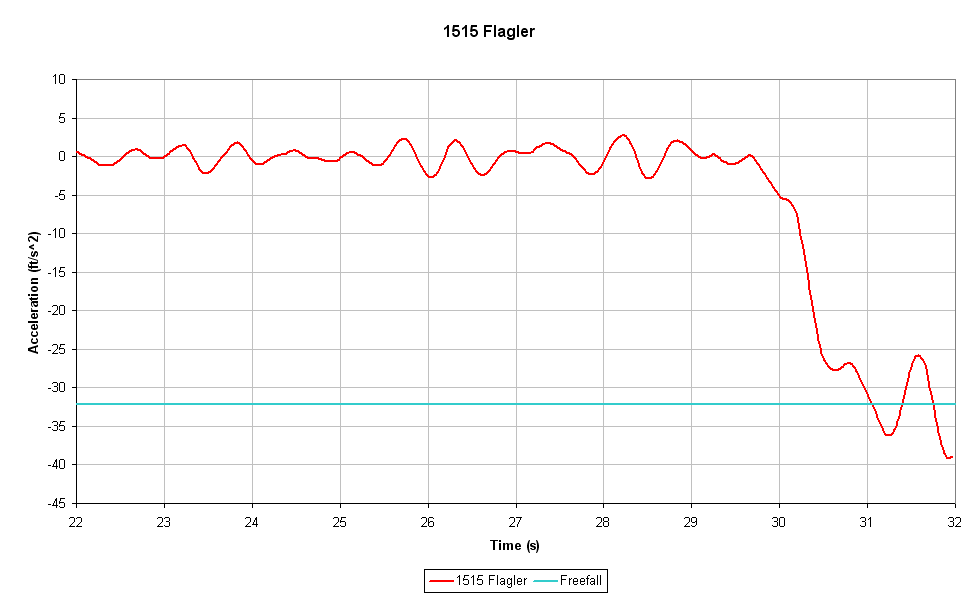
The Demolition of 1515 Flagler Dr...

44753876.png

898155405.png


A quick look at derived acceleration suggests very near to freefall, if indeed it is not actually reached...

657018636.png

Good. Then it is also proven that the 1515 Flagler Dr collapse was not demoed also. No step function proves they only thought they demoed this building.
 
Last edited:
Good. Then it is also proven that the 1515 Flagler Dr collapse was not demoed also. No step function proves they only thought they demoed this building.

puff_dog.jpg

The data accuracy is impressive.
Why is it farting itself up and down for the first 7 seconds before it falls.
 
Yes, you are insane :D


I just did a little research on the well-known Ft- Worth Landmark Tower demolition in 2006 - perhaps this has a place somewhere in your rebuttals?

Found this video:

http://www.youtube.com/watch?v=JhaTHN3McXY

It was shot from a location 0.4 miles by foot away from the tower, that would be roughly 2000 feet as the bird flies:

See Google Maps

You can check that if you zoom into Google StreetView at location "A", pan around, and compare with the video.


Please note the following features:
  • There are at least two helicopters overhead, creating a blanket of noise that certainly depresses the sound recording level
  • At 1:10 minutes, the first flashes are seen...
  • ...and immediately noticed, as the man says "there it goes" at 1:11
  • At 1:12 the first in a serious of very noticable BANGs is heard. Sound travels at ca. 1,100 ft/second, so just under 2 seconds delay is expected
  • Also at 1:12, the building has clearly began to move down (sometimes I think I see a bit of downward displacement while the 1:11 mark is still on, but difficult to be certain without a good video tool)...
  • ...AND immediately it also starts to lean to the left
  • At the 1:17 mark it drops out of view behind the overpass
  • By that time, the roofline has moved laterally by about half the width of the face of the tower, which I estimate to have been perhaps 90 feet.

This falling to the side was by design:

Source: http://www.dhgt.com/PDF/A talented team of demolition experts.pdf


I think the two main lessons to be learned from these observations are:
a) The MANY explosions are CLEARLY heard 2000 feet, even against really loud background noises.
b) "Symmetry" is not a defining characteristic of controlled demolitions. CDs can be designed to go straight down, but they also have to be designed to topple if that is what's desired.

To belabor the obvious once more, the hallmark of a controlled demolition has nothing to do with its physical characteristics; rather, it's the intent of the demolition team to minimize risk to adjoining structures. If best done by getting the building to fold in on itself, that is what is done. If best done by toppling it to one side, that is what is done.

This contrasts with something like a military demolition of a structure like a bridge, done to deny use to an advancing army. In this case, the structure is massively overloaded with explosives, and potential damage to adjoining structures is little, if any, concern.
 
...Chandler : FFA=Explosives CD....
Yes - Chandler relies on the false truther meme...

However a bit of interaction with Major_Tom results from this:
...The lack of a step and the smooth curve between <FFA on its way to FFA also indicates there was no sudden transition caused by explosives...
To which M_T responds with this:
Good. Then it is also proven that the 1515 Flagler Dr collapse was not demoed also. No step function proves they only thought they demoed this building.

Is there any chance that you two could correctly interpret the target you are shooting at THEN hit that target rather than miss? :D

The first statement is a truism of circularity: "The lack of a step and the smooth curve ...indicates there was no sudden transition...." Surely that is TRUE and must be true?

AND the qualifier "..caused by explosives." is redundant because it is attached to a truism??

Then Major_Tom tries irony which gets missed for a couple of reasons that I see:
1) Irony doesn't go over well on forums (and possibly not expected from M_T??? :rolleyes: ) AND
2) The target of BA's circular claim doesn't support the analogy underpinning the irony.

And let's not forget the current objective of discussion is "prove femr2 at any cost."

AND that is intended to be ironical. ;)

[/ozeco-smart-arsing] for fun - just in case that gets missed also :o
 
Last edited:
Status
Not open for further replies.

Back
Top Bottom