• Quick note - the problem with Youtube videos not embedding on the forum appears to have been fixed, thanks to ZiprHead. If you do still see problems let me know.

NIST blew WTC7 Stage 1 analysis

I'm well aware of how it started.
Pretty silly of you to say...
Is this another of those famous f2 and mt threads that really don't belong in a 'conspiracy' subforum, because they don't propose any conspiracy?
...then. The thread title is quite specific, and as you know, started by tfk.

If you want to complain about the "conspiracyness" of the thread, speak to tfk.

I'm talking about what it is now. Sexy graphs and charts, no substance. No conclusions.
lol. Sexy ? Nice. My responses deal directly with the requests of the OP.

Again, speak to tfk if you have a problem with the subject matter.

NIST is wrong.
Their "stage 1" is very inaccurate, yes. I note you are not "complaining" about the detail in my responses, but instead simply "complaining" about me personally. Shock, horrors ! :)

FEMR is right.
Thanks.

Nothing to say about the NIST Stage 1 analysis then ? Oh.
 
Nope, nothing to say, other than the fact that fire felled WTC 7, and nobody he's even come close to proving otherwise. Harping on minutae hasn't changed a thing.
 
Also, W.D.Clinger, if you want to highlight what you think are errors, then do so. No point keeping them to yourself now, is there ?


Since my remarks of more than a year ago are in the archives, it would be impossible for me to keep them to myself.


Although that is misleading (and I presume you wanted it to be misleading), it improves upon the mischaracterizations you were giving us in May 2011.

Just today, in an altogether different thread, you gave a less misleading characterization of NIST's non-linear model for acceleration:

You need to listen carefully.

The text you are critiquing is from your NIST quote.

By "velocity curve" NIST meant the shape of the datapoints in their derived velocity profile...

[qimg]http://femr2.ucoz.com/_ph/7/155958691.png[/qimg]

The "dots" as you call them, form a curve. Forget the straight line. Forget the solid curved line. The datapoints themselves form a varying curve.

By "The slope of the velocity curve is approximately constant" NIST mean just that, that for a part of the time the points can be said to form a slope which is approximately constant. It's not constant. It's approximately constant, with the resoluton and fidelity of the data they had available.

The "meaningless curved line that does not follow the dots" is the NIST derived velocity profile fit. In the same way that the linear fit (the straight line) does not "follow the dots" exactly, neither does the derived velocity curve, given by NIST as...

v(t) = 247.52(0.18562t)2.5126exp[-(0.18562t)3.5126]


Whether from the datapoits or curve fit makes no difference. Both are "approximately constant" for a whie. Again, not constant, approximately constant. Therefore any derived acceleration is also approximate during the region of interest.

...snip...

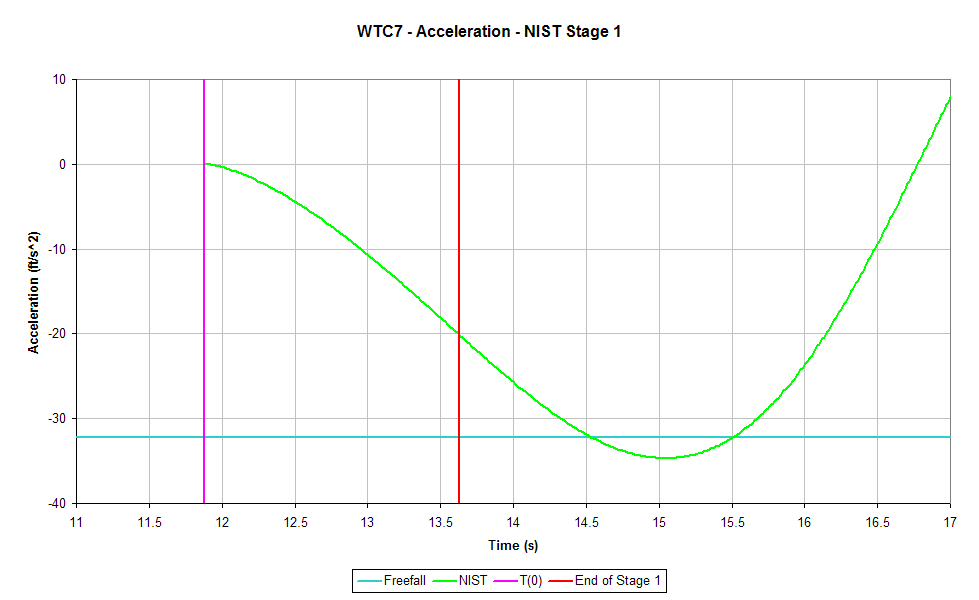
NIST say their estimation of approximate and average acceleration is equivalent to the acceleration of gravity during that period.

The bolded words are important.

The words are from NIST themselves.

Language is not independant of local context.


I accept that NIST said what I wrote above.

...snip...
 
Since my remarks of more than a year ago are in the archives, it would be impossible for me to keep them to myself.
...and what a variety of mistakes you made.

Although that is misleading (and I presume you wanted it to be misleading), it improves upon the mischaracterizations you were giving us in May 2011.
Not misleading in the slightest. NIST performed only a linear approximation for acceleration, choosing not to further derive their chosen displacement function...or perhaps you'd like to provide detail from the NIST report which even SUGGESTS that their velocity function was derived for acceleration at any point in time... ?

Just today, in an altogether different thread, you gave a less misleading characterization of NIST's non-linear model for acceleration

Is that the only (non) issue you have ? (NIST didn't derive for acceleration. Linear fit only... :rolleyes:)

By all means list others.
 
Since my remarks of more than a year ago are in the archives, it would be impossible for me to keep them to myself.
...and what a variety of mistakes you made.


I have certainly made a wide variety of mistakes in my life, and a small fraction of those mistakes are documented in this subforum. You, however, have linked to one of your own posts, not to one of mine, and that post doesn't appear to have anything to do with my mistakes.

Even now, I'm not the one who's pretending he never doubted or denied the non-linearity of NIST's model for velocity.

Nor am I the one who's still denying that NIST's model for displacement implies an obviously non-linear model for acceleration as well as velocity.
 
I'm not the one who's pretending he never doubted or denied the non-linearity of NIST's model for velocity.
Lol. No denial going on there matey. We were talking about acceleration.

Nor am I the one who's still denying that NIST's model for displacement implies an obviously non-linear model for acceleration as well as velocity.
ROFL. What on earth are you talking about ?

I include my derivation of NIST's displacement linear fit derivation for velocity...(5/5/11)...
795385257.png

... and the resultant (poxy) acceleration profile plot...

...many times.

Again, the point of our earlier discussion was that NIST never derived to acceleration, at all.

Who's denying what ? :rolleyes:
 
I have certainly made a wide variety of mistakes in my life, and a small fraction of those mistakes are documented in this subforum. You, however, have linked to one of your own posts, not to one of mine, and that post doesn't appear to have anything to do with my mistakes.

Even now, I'm not the one who's pretending he never doubted or denied the non-linearity of NIST's model for velocity.

Nor am I the one who's still denying that NIST's model for displacement implies an obviously non-linear model for acceleration as well as velocity.

Wow.......I just read for the first time your discussion on this (today I also went through some of the discussion with MT).....very interesting.

Here is what I am left with at the end of the discussions....

I think certain people are good at using software to smooth data, curve fit data, etc but they dont really understand the math in any depth....they just use the software (or excel) and fiddle with parameters and get an answer.

But the kind of depth that comes from DOING MATH they simply lack because they never took any courses beyond basic math and wouldn't understand a college level textbook if they read it. I think that is the issue here....a lack of any real DEPTH of knowledge about math (we can throw physics and engineering in too for good measure ;)).

So while your points seemed clear and somewhat OBVIOUS to me.....I think much of it went completely over the head.

But the effort is appreciated.....the "linear vs non linear" error is quite telling indeed.
 
is the sky really blue?

I'm not the one who's pretending he never doubted or denied the non-linearity of NIST's model for velocity.
Lol. No denial going on there matey. We were talking about acceleration.


The word I've highlighted below looks like "velocity" to me. YMMV.

And that there evident dynamics in all the data (NIST's, Chandler's & femr's) that Chandler missed (ignored? suppressed?) by choosing to perform a linear fit to the velocity data.
I'm not sure either the NIST or Chandler data has enough resolution to make a definite call, but I agree the behaviour was missed.

Could you show me where NIST provided anything other than a linear fit... ?
155958691.jpg

(full report section...http://femr2.ucoz.com/_ph/7/563913536.png)

(Might have missed it, but only see a linear regression.)


(ETA: The caption for that figure and the label for its vertical axis also appear to use the word "velocity".)

For context, here are some excerpts from tfk's post to which femr2 thought he was responding:

BTW, there is only one person here, Tony Sz, (but lots of ill-informed truthers around the blogosphere) who has ever said anything about "expecting a building to exhibit a step function in acceleration".

[Tony said, and when questioned, emphasized, that the building went into "immediately free fall". Thereby asserting a step function in acceleration.]


Mathematical fact: A step function for acceleration is equivalent to a piecewise linear graph for velocity.

My second conclusion is that the north wall of the building did undergo an acceleration that was NEAR "G" for a period of around 1 second. And that there evident dynamics in all the data (NIST's, Chandler's & femr's) that Chandler missed (ignored? suppressed?) by choosing to perform a linear fit to the velocity data.


Mathematical fact: A linear fit to the velocity data over some interval of time is equivalent to a constant acceleration during that interval.

Mathematical fact: A step function for acceleration is equivalent to a sequence of intervals with a constant acceleration within each interval.

Conclusion: tfk was talking about how Chandler begged the question (assumed his desired conclusion of a step function for acceleration) by performing a linear fit to the velocity data.

So tfk was talking about the velocity curve, but femr2 thought tfk was talking about the acceleration curve.

(Mathematical fact: the two curves are so closely related that it's impossible to talk about one of them without implying a great deal about the other, but femr2 doesn't like for me to mention that.)

In May 2011, I mistakenly assumed that femr2 had understood that tfk was talking about the velocity curve. In his post above, femr2 denied that possibility.

Glad we were finally able to clear that up.
 
Last edited:
The word I've highlighted below looks like "velocity" to me. YMMV.
Again, the discussion was about acceleration...
BTW, there is only one person here, Tony Sz, (but lots of ill-informed truthers around the blogosphere) who has ever said anything about "expecting a building to exhibit a step function in acceleration".

[Tony said, and when questioned, emphasized, that the building went into "immediately free fall". Thereby asserting a step function in acceleration.]

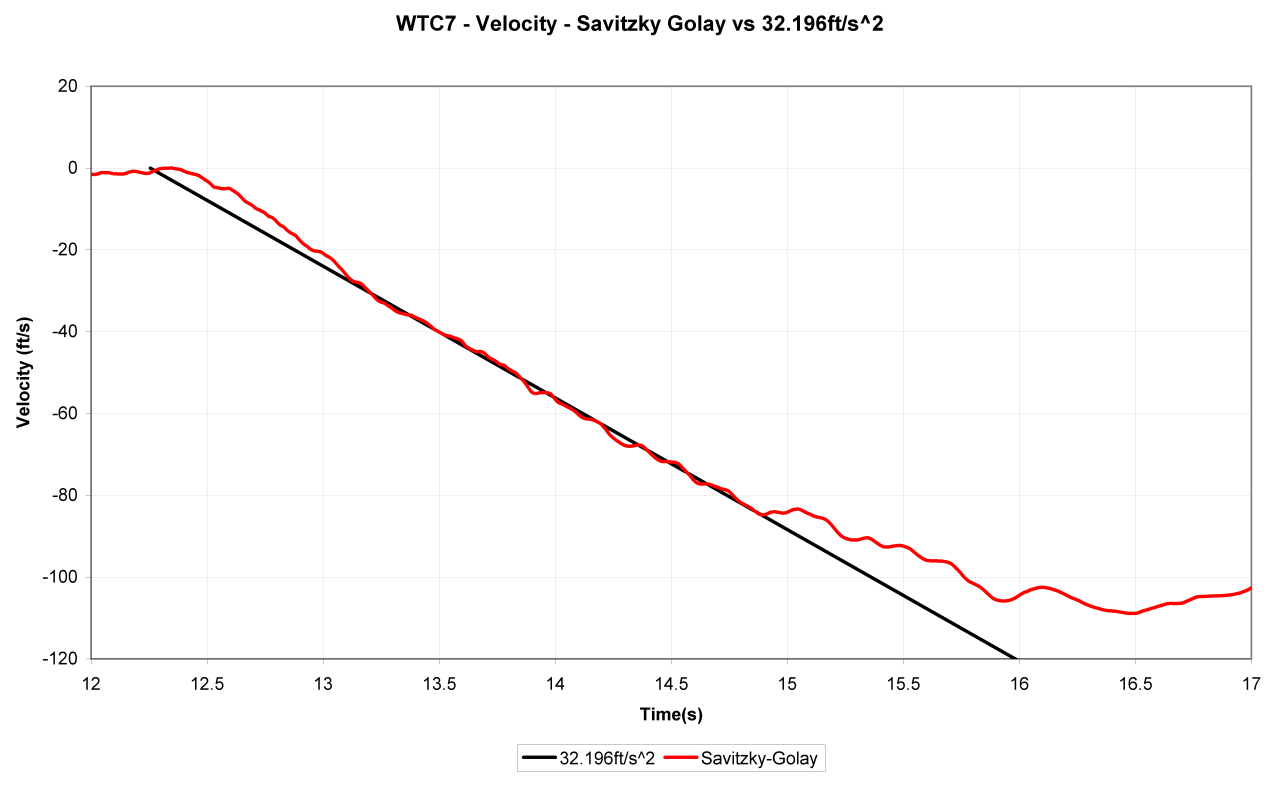
Both NIST (1.75 seconds) and Chandler (0.75 seconds) have a slow onset acceleration before they report approximate "g".

This is a random free hand drawing of what would pass for real free fall acceleration for ~2.25 seconds.

picture.php


As noted, the blue line shows a rapid onset (~0.5 seconds) acceleration, with a fairly constant accel at "g" (-32 ft/sec^2), indicating no viscosity (i.e., "drag") effects.

The green line shows a slow onset (~2 seconds) acceleration, with an acceleration that drops to "g", and then shows a slowly decreasing acceleration as the object speeds up, typical of viscosity or drag effects.

Neither femr's nor my acceleration curves resemble these curves.

My conclusion is that Chandler's statement that the building (or, more correctly, the north wall) are "at free fall acceleration for 2 seconds" is not supported by the data.

My second conclusion is that the north wall of the building did undergo an acceleration that was NEAR "G" for a period of around 1 second. And that there evident dynamics in all the data (NIST's, Chandler's & femr's) that Chandler missed (ignored? suppressed?) by choosing to perform a linear fit to the velocity data.
And you choose to try and suggest the single instance of the word velocity somehow supports your feet shuffling ? :rolleyes:

tfk is talking about MY data, which tfk derived to acceleration.
 
is the sky really blue? because femr2 disagrees

Again, the discussion was about acceleration...

And you choose to try and suggest the single instance of the word velocity somehow supports your feet shuffling ? :rolleyes:


My previous post explained my reasoning with rather more technical detail than would be necessary when teaching a freshman-level course. I'm sure tfk would understand my reasoning, even though you do not.

tfk is talking about MY data, which tfk derived to acceleration.


tfk is the only true authority on what he was discussing, so he is the only person who can settle this dispute.

For reasons you so presciently explained earlier in this thread, I don't think I should just take your word for what tfk thinks or was discussing:

http://www.internationalskeptics.com/forums/showpost.php?p=8331926&postcount=11
tfk said:
If you want, I'll happily go back there and show clearly:

1. where you intentionally quote-mined one of my postings to present an impression that was (& that you KNEW was) 180° divergent from my opinion.
Please do.

That's called "lying", femr.
Can you justify that slur ?

2. Where there are several blatant errors in your repeat-at-every-opportunity, tedious list of "NIST deficiencies" in their collapse timing data.
Please do.

That's called "incompetent", femr.
Can you justify that slur ?

3. Where you and your buddies in your 9/11 Tree house have completely screwed the pooch on your back-slapping, in-bred, rah-rah conclusion about NIST's "erroneous beginning & end of stage 1 portion" of the descent of WTC7.
Strike-out mine. I'm not responsible for what anyone else says.

Please do.

You screwed this particular pooch because your club is comprised of a bunch of incompetents (synonymous with "Truther") & you are all way too enthusiastic about achieving a "yeah, yeah, that's right. NIST blew it" conclusion to ANY question.


If you truly believe tfk was talking about a linear fit to anything other than the velocity data when he wrote "linear fit to the velocity data", then I suggest you send him a private message saying you need his help in this thread.
 
I'm sure tfk would understand my reasoning, even though you do not.
Repeating yourself is never going to make you right Will.

tfk is the only true authority on what he was discussing, so he is the only person who can settle this dispute.
ROFL. Ye gads man, it's clear what we were discussing. Are there no limits to the levels of sadness you'll engage in to appear to be right ? Hilarious.

For reasons you so presciently explained earlier in this thread, I don't think I should just take your word for what tfk thinks or was discussing
Do what you like. Seems you've already forgotten that you started this dumb-ass "discussion" with the following dumb-ass accusations...
I'm not the one who's pretending he never doubted or denied the non-linearity of NIST's model for velocity.

Nor am I the one who's still denying that NIST's model for displacement implies an obviously non-linear model for acceleration as well as velocity.
...and are now quote mining old posts for discussion with tfk, not yourself, not about NIST, ...funny stuff.

If you truly believe tfk was talking about a linear fit to anything other than the velocity data when he wrote "linear fit to the velocity data", then I suggest you send him a private message saying you need his help in this thread.
LOL. tfk quite clearly mentions that Chandler (not NIST remember) missed acceleration dynamics (which we've managed to find in my data) because Chandler only did a linear fit to velocity. That you think that means our discussion was about velocity when tfk mentions acceleration 11 times in that single post really is rather funny. tfk's acceleration graph is a bit of a giveaway there :) (And quite how any of this relates to your erronious accusation about denial wrt to NIST...who didn't derive their velocity function to acceleration...is...? :) )

But tfk is welcome to come to this thread which he started, then abandoned without a single additional post. As you quote above, he's made a number of silly accusations and I'm still waiting on a response...
 
Last edited:
ROFL. Ye gads man, it's clear what we were discussing. Are there no limits to the levels of sadness you'll engage in to appear to be right ? ..


No. It has no ending.

The entrenched positions will always remain. Here, TFK is the "expert". In the thread on my book, Pgimeno is the foremost spokesman for Bazant.

It never ends. What is seen now is what will always be seen.

The consequences of the thesis of my book are being lived here every day.

This is the collective "understanding", in 2012.
 
femr2 tries to rewrite the history of this thread

Do what you like. Seems you've already forgotten that you started this dumb-ass "discussion"


Untrue. You started this "discussion" on 23 May when you repeated the NISTpicking list you had already been posting in other threads. You repeated that list the next day and repeated that list again on 30 May. On 31 May, you quoted tfk's accusations that he had made in an altogether different thread. (You had to pull those accusations out of AAH, to which tfk's post had been consigned because it was one of many responses to another of Major_Tom's derails.) It's almost as though you were itching to start a fight.

I did not post within this thread until 2 June, a full ten days after you had started the discussion you now characterize as "dumb-ass". Even then, I only responded to NoahFence, who had asked what this thread was about. I did not participate in the discussion you characterize as "dumb-ass" until you explicitly asked me to do so.

with the following dumb-ass accusations...
I'm not the one who's pretending he never doubted or denied the non-linearity of NIST's model for velocity.

Nor am I the one who's still denying that NIST's model for displacement implies an obviously non-linear model for acceleration as well as velocity.

...and are now quote mining old posts


Speaking of quote mining, you edited that quotation above to remove my link. Here's what an honest quotation would have looked like:

Even now, I'm not the one who's pretending he never doubted or denied the non-linearity of NIST's model for velocity.

Nor am I the one who's still denying that NIST's model for displacement implies an obviously non-linear model for acceleration as well as velocity.


In post #88, I accepted your explanation that you believed tfk had been talking about the acceleration curve when he referred to Chandler's "linear fit to the velocity data".

This discussion could and should have ended there, but you couldn't let it go. Your desire to declare yourself right on every niggling detail led you to tell us that tfk's "linear fit to the velocity data" wasn't about the velocity curve. Although that's absurd on its face, it might carry some weight if you were known to be a reliable reader of tfk's mind.

As it happens, however, tfk is known to be quite unhappy with your previous misrepresentations of his words and opinions. Within this very thread, you had already quoted tfk as saying "you intentionally quote-mined one of my postings to present an impression that was (& that you KNEW was) 180° divergent from my opinion."

It appears, therefore, that tfk himself would not want anyone to regard you as an authority on what tfk was saying.

If you truly believe tfk was talking about a linear fit to anything other than the velocity data when he wrote "linear fit to the velocity data", then I suggest you send him a private message saying you need his help in this thread.
 
I did not post within this thread until 2 June, a full ten days after you had started the discussion you now characterize as "dumb-ass".
The "dumb ass" discussion I am referring to is the one started by your accusation...
In recent posts, femr2 has been quoting tfk out of context.
..to which I, of course, responded.

You followed it up by other unsupported accusations...
I'm not the one who's pretending he never doubted or denied the non-linearity of NIST's model for velocity.

Nor am I the one who's still denying that NIST's model for displacement implies an obviously non-linear model for acceleration as well as velocity.
...to which I also responded.

You've then drifted over to tfk mentioning velocity once in a post discussing acceleration, with no less than 11 mentions of such in a rather short post.

Your desire to declare yourself right on every niggling detail led you to tell us that tfk's "linear fit to the velocity data" wasn't about the velocity curve.
Where ? And tfk was talking about his acceleration graph, as he himself says in the post you are (deliberately) misinterpreting...
Neither femr's nor my acceleration curves resemble these curves.
...:rolleyes:

You really are scraping the barrel, like.

Within this very thread, you had already quoted tfk as saying "you intentionally quote-mined one of my postings to present an impression that was (& that you KNEW was) 180° divergent from my opinion."
And yet tfk has not bothered to justify or back up his accusation.

Again, I suggest he does.
 
Last edited:
http://www.internationalskeptics.com/forums/showpost.php?p=8331926&postcount=11

tfk said:
If you want, I'll happily go back there and show clearly:

1. where you intentionally quote-mined one of my postings to present an impression that was (& that you KNEW was) 180° divergent from my opinion.

Please do.

That's called "lying", femr.
Can you justify that slur ?

2. Where there are several blatant errors in your repeat-at-every-opportunity, tedious list of "NIST deficiencies" in their collapse timing data.
Please do.

That's called "incompetent", femr.
Can you justify that slur ?

3. Where you and your buddies in your 9/11 Tree house have completely screwed the pooch on your back-slapping, in-bred, rah-rah conclusion about NIST's "erroneous beginning & end of stage 1 portion" of the descent of WTC7.
Strike-out mine. I'm not responsible for what anyone else says.

Please do.

You screwed this particular pooch because your club is comprised of a bunch of incompetents (synonymous with "Truther") & you are all way too enthusiastic about achieving a "yeah, yeah, that's right. NIST blew it" conclusion to ANY question.
Again, I'm not responsible for what anyone else says.

By all means, please do state your case for the inflamatory remarks above.

Bump. Been well over a week now, tfk, and nothing...
 
By the way, I can understand C7's confusion in another thread. Just looking at about second 12.6, there seems to be a change in slope from >g to <g and then to >g. No such thing is seen in the acceleration plot, and an explanation would be nice.

[qimg]http://www.formauri.es/personal/pgimeno/xfiles/11-s/acceleration-question.gif[/qimg]
Derived acceleration has Savitzky-Golay smoothing applied.

There is noise in the data, of course, and without smoothing the profile would be almost unreadable.

As I've discussed with tfk many times, I'm confident that the profile "shape" is true.

There's not enough fidelity to really determine instantaneous acceleration.
 
Do you have a larger version of the velocity profile for the collection?

( I need them in pairs, you know. One small, one big)
 

Back
Top Bottom