cjnewson88
Graduate Poster

- Joined
- Oct 19, 2011
- Messages
- 1,766
the creation of iron-rich spheres is proof of a thermitic reaction
No, it is not.
Last edited:

the creation of iron-rich spheres is proof of a thermitic reaction

Do you know the difference between a red/gray chip and steel wool?No, it is not.
Do you know the difference between a red/gray chip and steel wool?

Your excessive verbiage is to obfuscate the fact that you are the one with an "alternative perception of reality".
Silicone dioxide is used in nano-thermite as a buffering agent. You ignore the fact that they put silicone dioxide in nano-thermite for a reason.
"This paper will discuss the performance of energetic nanocomposites containing Fe2O3-SiO2 binary oxidizing phases. Thermite nanocomposites have been prepared by mixing aluminum nanoparticles with both commercial Fe2O3-SiO2 nanopowders and solgel prepared Fe2O3-SiO2 nanopowders. The effect of these two synthesis and mixing techniques on the burning rates of the resulting thermites will be discussed. Finally, thermites containing binary oxidizing phases that incorporate organic functionality for gas generation will be evaluated."
"We have successfully synthesized energetic nanocomposites using sol-gel methodology. Nanocomposites based on energetic thermites have been produced with both burn rate modifiers and gas generators through a silica-oxidizing phase.
https://e-reports-ext.llnl.gov/pdf/318263.pdf
You thought they were the same? Fair enough, if slightly dumb.I thought they were. To you and your ilk, whenever anyone is wrong they are lying. That's because you see in others what your are yourself.next time you try to pass off a suggestion that chips (a)-(d) and the MEK-soaked chip are the same can clearly be recognized as a bold-faced lie.
Millette excluded aluminium. Please acknowledge!A chemist tells me that infrared spectroscopy is not decisive for identifying the presence of a compound in a mixture. I can only be decisive in excluding the presence of a compound.
You are deluded.And the extremely obvious fact is, they are different.
Liar. I admitted no such thing. Stop the lies. They make you look disgusting.Good to hear you admit that you are playing a stupid dishonest game.
You are showing greyish, reflective spherules. They have been shown to consist of many compounds. Why do you falsely call them "iron spheres"?Since when do organic materials produce iron spheres when ignited?
http://img831.imageshack.us/img831/3113/fig20.jpg
This has nothing to with your reply about organic materials. Why you had to move the goal post and run away from your stupid, dishonest insinuation is beyond meChristopher7 said:Do you believe that clay ignites at 430oC, produces an energy release spike and produces iron spheres?

Originally Posted by Oystein
next time you try to pass off a suggestion that chips (a)-(d) and the MEK-soaked chip are the same can clearly be recognized as a bold-faced lie.
Oystein said "next time" because you should know better by now.I thought they were. To you and your ilk, whenever anyone is wrong they are lying. That's because you see in others what your are yourself........
None are so blind . . . . .
If you think I'm going to read all that tripe your crazy.You thought they were the same? Fair enough,

If you think I'm going to read all that tripe your crazy.
The Al and Si partially separated in the purple/green images I posted.
And all your verbose babbling cannot change those facts.
The red/gray chips produced iron-rich spheres when heated to 430oC.

If you think I'm going to read all that tripe your crazy.
The Al and Si partially separated in the purple/green images I posted.
The red/gray chips produced iron spheres when heated to 430oC.
You don't have to be a scientist to see that.
And all your verbose babbling cannot change those facts.

Thanks
Of course it's against forum rules to change someones quote but the rules [like insulting other posters] don't apply to the "in" crowd.
...
The number of visual and numerical matching points to a commercial CD, are far too many to dismiss the significance of FFA just because we can't generate a laboratory-precise response curve...
MM
I am assuming this is deliberately ironic hypocrisy, a conscious choice not to simply say "You're using lots of words to hide the fact that you're wrong".Your excessive verbiage is to obfuscate the fact that you are the one with an "alternative perception of reality"....
They are quite similar, yes...Do you have trace and derived acceleration data of the NW corner from both viewpoints? If so, do they match?
If they match, that would play down the lens / warm air distortion arguments, as well as boost the argument on the accuracy of the data.
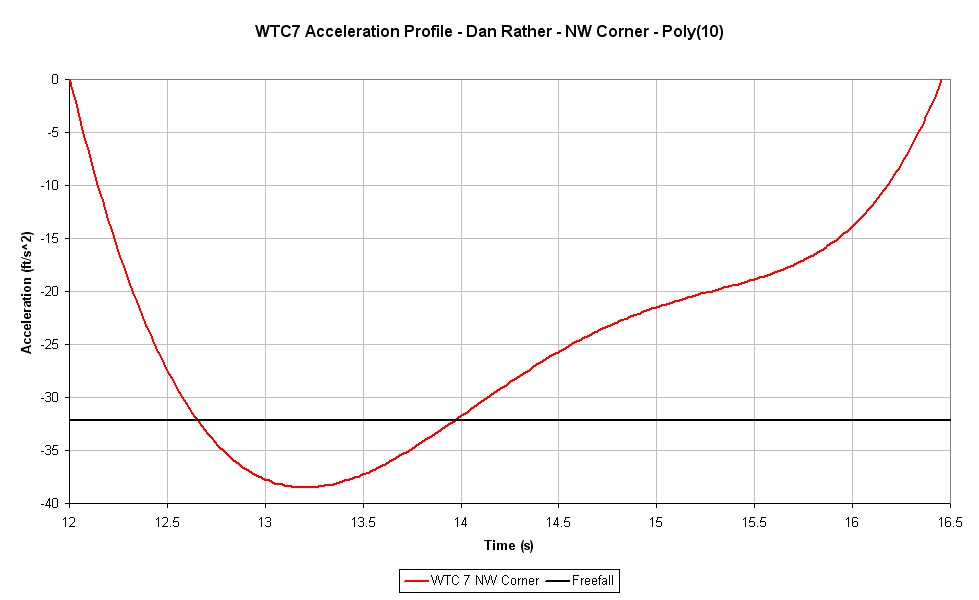
About 1s by my eyes (12s-13s), though I wouldn't call that a "slow buckling" phase at all. That's T0 (release) to maximum acceleration. Any "slow buckling" (creep) phase would be prior to T0.Ok ... so you still have faith in your trace, which you posted earlier yesterday, and which I interprete as having ca. 0.75 seconds of a "Stage 1" of "slow buckling" (a increasing from near 0 to near g in that time). Am I reading that right?
I'm confident in the acceleration profiles posted.he takes your data and interprets it differently.
What, or who, is wrong here?
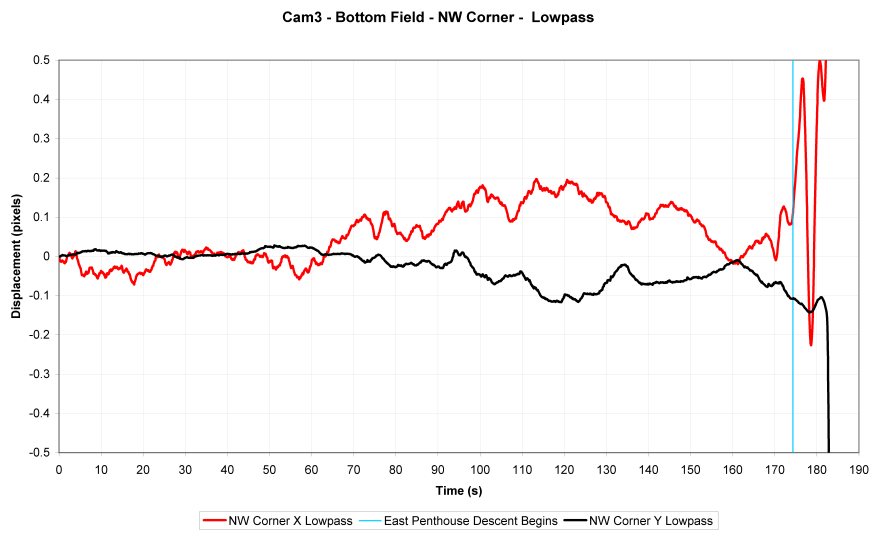
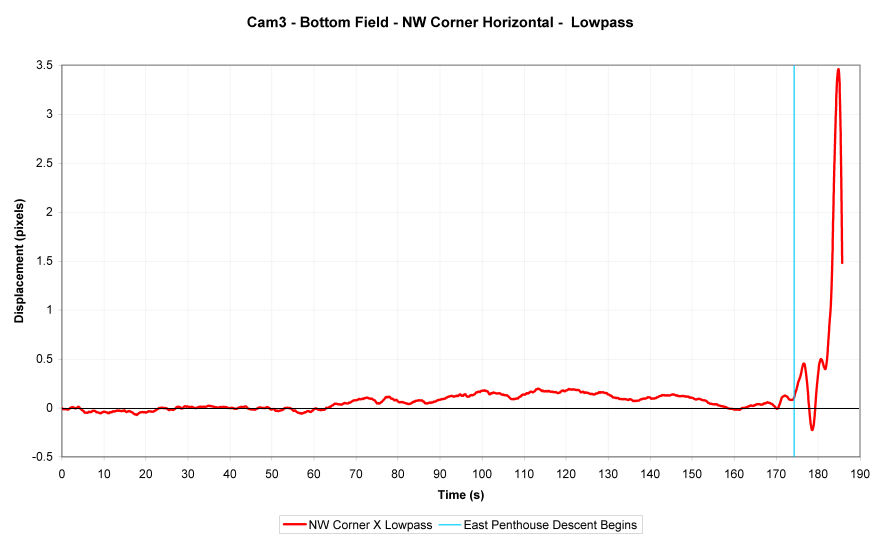

...
Be that as it may, the creation of iron-rich spheres is proof of a thermitic reaction, your objections and denial notwithstanding.
No, it is not.
Do you know the difference between a red/gray chip and steel wool?
How do you know it's tripe if you don't read it?If you think I'm going to read all that tripe your crazy.
You are using the "I won't listen so I won't learn" denial tactic.You are using the "talk it to death" denial tactic.
Alright. I don't see that. Can you point me to regions in those maps that are either high in Si and low in Al, or vice versa? Thanks.The Al and Si partially separated in the purple/green images I posted.
This is false on two counts.The red/gray chips produced iron spheres when heated to 430oC.
If you are honest (which is in very grave doubt), you totally overestimate your abilities.You don't have to be a scientist to see that.
I quoted achimspok there - let's not get hung up on the phrase "slow buckling". We are talking that "Stage 1" which lasts from release to reaching g, which you eyeball as being about 1s, and which achimspok describes as "reaches almost immediately G acceleration" and "There is no Stage 1".About 1s by my eyes (12s-13s), though I wouldn't call that a "slow buckling" phase at all. That's T0 (release) to maximum acceleration. Any "slow buckling" (creep) phase would be prior to T0.
I'm confused. What viewpoint is this image from then? The graph doesn't say.They are quite similar, yes...
Would have to have a dig for the more detailed Dan Rather graphs, but the same basic profile...pretty rapid to over-g, then diminishing acceleration.
My primary (preferred) trace datasets are extracted from the Dan Rather viewpoint...


