Richard Gage Blueprint for Truth Rebuttals on YouTube by Chris Mohr

Status
Not open for further replies.
People who understand that the data points are not exact, like NIST, Chandler and most everyone but the people here, know that the falling upper part of WTC 7 was not vacillating between slightly faster than and slightly slower than FFA, it was falling at FFA.

There is no rational basis upon which any reasonable person could accept your assertion here. It is self-rebutting.

If the measurement error is large enough to preclude the conclusion that the rate of acceleration varied, it is also large enough to preclude the conclusion that it was constant, based on the data alone. (I don't think anyone here would be surprised that your belief in "FFA" isn't rooted in data analysis.)

Not that you have demonstrated anything about the measurement error one way or another. Your irrational conclusion is based on an unsupported premise.
 
Frederick Henry-Couannier heated up the chips from samples given to him from the Jones group. He found zero evidence of thermite, after many attempts at provoking the thermite reaction. His conclusion was that the iron oxide chips were merely rust.
Henry-Couannier got his sample not from the Jones group, he got it directly from the finder. Don't remember though if the source was the same as one of Jones's.

He found only 1 red-gray chip in his sample and didn't get a meaningful reaction out of it. Since Harrit e.al. descibed at least 6 different kinds of red-gray chips, Henry-Couannier's sample is pretty meaningless from the get-go.

I say rusty chips are quite strange and need explanation, but at least we don't have to keep laboring under the false idea that they were unexploded thermite.
Quite the contrary. Look around you now. Do you see any metal surfaces in your vicinity? Doesn't matter if stainless steel, aluminium, structural steel (a nail, perhaps), brass, ... Unless it's gold or platinum, what you really see is a surface entirely comprised of oxidized metal. Especially in the case of non-stainless steel: Even if it looks metallic, the top 50-150 micrometers or so are layers of decreasingly oxidized iron: Fe2O3 on top, lots of Fe3O4 (magnetite) beneath, then FeO before you reach a depth where most / all of the iron atoms are free.

In short: "Rust" is the natural state for surface iron to be in.

Yes, Henry-Couannier found "rust" - the gray layer is iron oxide.
The red layer is not, it is still largely organic.

Finding rust chips and concluding thermite is like finding egg shells and concluding that a quiche Lorraine had just been baked.
I like that :D
 
I am stunned by the profound depth of C7's ... urrrrr ... "alternative perception of reality".

We have recently expanded this epoxide addition method to the synthesis of Fe2O3-SiO2 nanocomposites containing up to 60 wt% SiO2.
[FONT=&quot]https://e-reports-ext.llnl.gov/pdf/318263.pdf[/FONT]
HAHAHAHAHAHAAAA :D :D :D
This is really funny! Thanks for linking that paper: It proves exactly what I said in the post you replied to, where I said:
"silicon dioxide ... has properties that run counter to what Harrit e.al. needs to be, or is, achieved by nano-thermite: ... it is very hard to ignite, it slows other thermite reaction down when mixed ..."​
The proof is in Figure 2 of the linked paper, which clearly shows two things:
  • Combustion velocity decreases dramatically the more SiO2 you mix in (note the logarithmic scale! On a linear scale, you'd see much more clearly just HOW extreme the decrease is. For example, going from "ordinary" Fe2O3-only nanothermite to a mix with 20% SiO2 to 80%Fe2O3 decreases reaction velocity by a factor of more than 200! Going from 20% to 40% decreases it by a further factor of roughly 10. It appears that a nanothermite with more than 60% silica oxidizer does not react at all!)
  • The velocity depression is more pronounced for the nano-material than for the regular micro-material: all nano-mixes with SiO2 react slower than the corresponding mico-mixes
You see, adding SiO2 really only hinders the thermite reaction. I now learned why:
This trend is not surprising because the thermal properties of SiO2 are more insulative than the highly conductive thermal properties of Fe2O3. For example, the thermal conductivity for Fe2O3 is 20.0 W/m K and for SiO2 is 1.38 W/m K [12]. The presence of SiO2 hinders flame propagation by behaving as a thermal heat sink and resisting the transport of heat through the mixture, thereby reducing the velocity. Although SiO2 contributes to the chemical energy generated, adding SiO2 reduces the overall speed of the reaction by inhibiting thermal transport and reducing the combustion temperature.
The most important piece of data is however found on the front page:
March 25, 2005


The method he used did not separate the Al and the Si. That does not prove they are chemically bound, it only proves that method did not separate them. Harrit got them to separate proving they were not chemically bound.
When I first read this, I was flabbergasted, mouth literally dropped open, then I burst in loud laughter.

Could this be true? It reads not so much as if you don't understand chemistry and more like you don't even know what chemistry is!

But perhaps you simply did not read and understand, or remember, what Millette wrote in his preliminary report.

To remind you: He found kaolin (aluminium silicate) using unequivocal and competent methods, namely FTIR and TEM-SAED in conjunction with SEM and TEM microscopy and XEDS spectroscopy. He found no traces of elemental Al with these methods.

Kaolin is a mineral of a chemical compound with the sum formula Al2Si2(OH)5O4.

A chemical compound. If you don't know what a chemical compound is, please look it up: http://en.wikipedia.org/wiki/Chemical_compound
Wikipedia said:
A chemical compound is a pure chemical substance consisting of two or more different chemical elements that can be separated into simpler substances by chemical reactions. Chemical compounds have a unique and defined chemical structure; they consist of a fixed ratio of atoms[3] that are held together in a defined spatial arrangement by chemical bonds.
(my bolding and italics)

When Farrer or Jones (not Harrit) "separated" Al in one sample, they didn't do so by chemical reaction. They tried a physical reaction (solution), but tried it on a completely different kind of material than that which we are talking about: The MEK-soaked chip in the Harrit paper is very different from chips (a)-(d): The latter clearly contain kaolin, the former quite apparently does not. The former clearly contains calcium, zinc, magnesium and sulfur, the latter clearly does not. The former very likely is Tnemec red, the latter quite likely is LaClede primer.

Please follow the links and acknowledge verbosely that you have now learned that
A) There were several different kinds of chips in Jones's samples
B) There were several different kinds of primer paints on WTC steels
so that next time you try to pass off a suggestion that chips (a)-(d) and the MEK-soaked chip are the same can clearly be recognized as a bold-faced lie.

Alternatively, acknowldge that you do not understand this lesson I am giving you, and stop participating in this debate until you do.


To directly address the bizarrely stupid comment you made: Millette did not separate Al from Si because he already had proven that they are part of chemical compound that, by definition, cannot be separated by non-chemical processes such as soaking. Al and Si have been PROVEN to be chemically bound when Millette named the chemical compound (kaolin) that they are bound in.

Please return your accusation of lying to that dark recess from whence it came.
The March 2012 AE911Truth newsletter clearly lies about Millette's conclusions. This is a clear as day.

As for anyone going along with these lies, there are only two possibilities: They are intellectually incapable of understanding why these lies are wrong (deluded or too stupid), or they consciously perpetuate the lie.

Your choice then: Do you want me to assume you are a liar, a lunatic, or an idiot? There is no other possibility. Except to admit that Millette clearly showed there is no aluminium in these chips of type "(a)-(d)", and hence zero thermite.

I can see that they are similar but different.

[qimg]http://img404.imageshack.us/img404/9655/fig10alandsi.jpg[/qimg]
One purple, the other blue. The Si-map is slightly noisier, otherwise the correlation is PERFECT, and it takes an astounding level of self-delusion or dishonesty not to see that extremely obvious fact.

Do you believe that clay ignites at 430oC, produces an energy release spike and produces iron spheres?

[qimg]http://img831.imageshack.us/img831/3113/fig20.jpg[/qimg]
Don't play that STUPID or DISHONEST game with us! :mad:


You KNOW very well that NOBODY thinks clay ignites anywhere! You KNOW very well that the red layer is MOSTLY organic matrix., You SHOULD know very well that solid organic substances are prone to ignite at such temperatures. And surely you KNOW very well that every SANE and HONEST person claims that it is the ORGANIC matrix that must be burning there, NOT the minerals?

So why do you ask such a CRAP question?? Are you consciously trying to give the Twoof Movement an even worse reputation than it already has by playing such dumb-dirty tricks? Are you a disinfo shill?

 
I have said that the interior columns could momentarily pull the exterior columns down at faster than FFA but only for an instant. After that they would still be connected and falling together at FFA.

The "leverage" claptrap requires that the interior columns meet resistance. That would slow the fall, not increase it. There is no evidence or data that the "leverage" effect could have taken place in WTC 7. It's just straw grasping.

People who understand that the data points are not exact, like NIST, Chandler and most everyone but the people here, know that the falling upper part of WTC 7 was not vacillating between slightly faster than and slightly slower than FFA, it was falling at FFA.

Why would it only be for an instant? And why would it also NOT be able to pull the exterior at -g if it pulls with the same force as opposing resistance?

Also, why do you keep clinging to freefall without putting forth anything substantial to disprove femr2?

Here's another factor for you: what happens with the interior rubble when it hits the ground level? Could it also affect the exterior columns?

So far I see your case seems to be a lot of "it must be so" assertions. And you STILL haven't done anything that show's evidence of CD, beyond your attempts at "disproving NIST".

ETA: you're not doing engineering analysis, you're doing Intelligent Design of Destruction
 
Last edited:
People who understand that the data points they themselves measured are not exact enough because their methods were poor, like NIST, Chandler and most everyone but the people truthers here, know that the falling upper part of WTC 7 was not could not be definitely shown if it was vacillating between slightly faster than and slightly slower than FFA, the data only shows that in average it was falling at FFA.
Ftfy.
 
...
Don't play that STUPID or DISHONEST game with us! :mad:


You KNOW very well that NOBODY thinks clay ignites anywhere! You KNOW very well that the red layer is MOSTLY organic matrix., You SHOULD know very well that solid organic substances are prone to ignite at such temperatures. And surely you KNOW very well that every SANE and HONEST person claims that it is the ORGANIC matrix that must be burning there, NOT the minerals?

So why do you ask such a CRAP question?? Are you consciously trying to give the Twoof Movement an even worse reputation than it already has by playing such dumb-dirty tricks? Are you a disinfo shill?

Wow. Sarns managed to troll Oys into actual anger. He'll doubtless receive a bonus this month at Troll HQ for that.
 
Yep, it's the same trick Ergo tries; he can't understand the argument, so he just declares it nonsense or says that so-and-so clearly doesn't understand what's under discussion. And I've never seen him go into any more detail.
 
People who understand that the data points are not exact, like NIST, Chandler and most everyone but the people here, know that the falling upper part of WTC 7 was not vacillating between slightly faster than and slightly slower than FFA, it was falling at FFA.

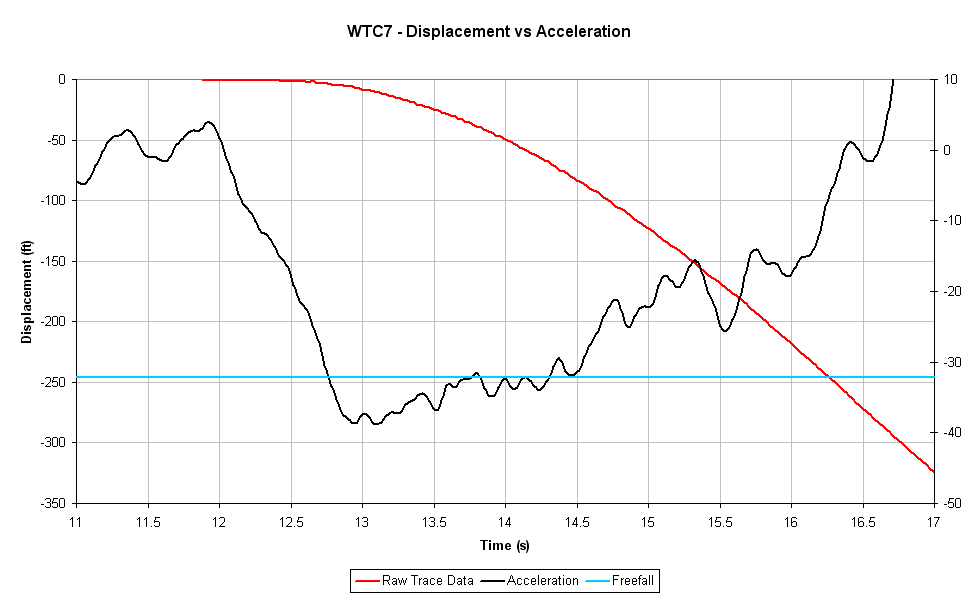
1) Any data derived from video (*should) relate to a single point on the building, not the "upper part of WTC7".

* Neither NIST nor Chandler bothered to ensure their data actually related to a single specific point on the facade with any accuracy.

2) The acceleration profile is slightly different for every point on the facade, of course.

3) The "falling upper part of WTC7" was most certainly not falling AT FFA for any measurable period of time. There's a second or so that could be said to be approx. FFA, for the point traced above (NW Corner).

I've derived what should be viewed as the most accurate acceleration profiles for various points upon the WTC7 facade during descent, with the following fairly consistent results...

447669743.png


A critical point of note: Maximum acceleration occurs before the point (on the roofline, NW corner) has descended about 10ft. From that point on, the general trend is reduction in acceleration.

A trivial point of note: The chance of anything descending at exactly FFA for any sustained period of time is zero, outside of a lab.
 
"I have said that the interior columns could momentarily pull the exterior columns down at faster than FFA but only for an instant. After that they would still be connected and falling together at FFA.

The "leverage" claptrap requires that the interior columns meet resistance. That would slow the fall, not increase it. There is no evidence or data that the "leverage" effect could have taken place in WTC 7. It's just straw grasping.

People who understand that the data points are not exact, like NIST, Chandler and most everyone but the people here, know that the falling upper part of WTC 7 was not vacillating between slightly faster than and slightly slower than FFA, it was falling at FFA.
"
"1) Any data derived from video (*should) relate to a single point on the building, not the "upper part of WTC7".

* Neither NIST nor Chandler bothered to ensure their data actually related to a single specific point on the facade with any accuracy.

2) The acceleration profile is slightly different for every point on the facade, of course.

3) The "falling upper part of WTC7" was most certainly not falling AT FFA for any measurable period of time. There's a second or so that could be said to be approx. FFA, for the point traced above (NW Corner).

I've derived what should be viewed as the most accurate acceleration profiles for various points upon the WTC7 facade during descent, with the following fairly consistent results...

[qimg]http://femr2.ucoz.com/_ph/7/447669743.png[/qimg]

A critical point of note: Maximum acceleration occurs before the point (on the roofline, NW corner) has descended about 10ft. From that point on, the general trend is reduction in acceleration.

A trivial point of note: The chance of anything descending at exactly FFA for any sustained period of time is zero, outside of a lab.
"

Sounds like fractional quibbling to me.

Of course time and motion data obtained from the video reference tape could never provide
the precision of data that a laboratory-designed experiment would provide.

And as much as I admire much of FEMR's work, his point #2 seems to contradict his starting point, #1.

The number of visual and numerical matching points to a commercial CD, are far too many to dismiss the significance of FFA just because we can't generate a laboratory-precise response curve.

What would be more useful, is more time and motion analysis of as many CDs as possible.

The current results from the NIST, and David Chandler, show a period of 'real world' FFA.

IMHO, arguing over insignificant percentages is a time-wasting task suited to corporate lawyers.

MM
 
IMHO, arguing over insignificant percentages is a time-wasting task suited to corporate lawyers.

If you managed to convince C7 that he is "arguing over insignificant percentages," you might actually contribute to the discussion. Good luck with that.

ETA: femr2's points 1 and 2 are both mutually consistent and very much on point. (1) If one isn't comparing a single point all the way down, the analysis is apples-to-oranges. (2) C7's compulsion to generalize about "the falling upper part of WTC 7" is problematic because one cannot assume that the entire "upper part" is descending at the same velocity at any point in time.
 
Last edited:
1) Any data derived from video (*should) relate to a single point on the building, not the "upper part of WTC7".

* Neither NIST nor Chandler bothered to ensure their data actually related to a single specific point on the facade with any accuracy.

2) The acceleration profile is slightly different for every point on the facade, of course.

3) The "falling upper part of WTC7" was most certainly not falling AT FFA for any measurable period of time. There's a second or so that could be said to be approx. FFA, for the point traced above (NW Corner).

I've derived what should be viewed as the most accurate acceleration profiles for various points upon the WTC7 facade during descent, with the following fairly consistent results...

[qimg]http://femr2.ucoz.com/_ph/7/447669743.png[/qimg]

A critical point of note: Maximum acceleration occurs before the point (on the roofline, NW corner) has descended about 10ft. From that point on, the general trend is reduction in acceleration.

A trivial point of note: The chance of anything descending at exactly FFA for any sustained period of time is zero, outside of a lab.

NIST had all the king's scientists, engineers, computers, time, and data. And they were unable to put together a legible explanation for the alleged collapses and the Pentagon attack. Checkmate, set and match. :p
 
NIST had all the king's scientists, engineers, computers, time, and data. And they were unable to put together a legible explanation for the alleged collapses and the Pentagon attack. Checkmate, set and match. :p

And yet they still have a better explanation than you do.
 
Has this been noticed and debated here or anywhere yet?

http://the911forum.freeforums.org/c...ked-freefall-collapse-of-building-7-t605.html

Last december, achimspok showed some own tracing and it looks like some points went from 0 to g faster than femr2, NIST or Chandler have it.

I didn't study his post, but it seems like he distinguished and eliminated early horizontal movement and found that some of the apparent early vertical movement isn't really going down.

For some reason, no one ever picked this up at the911forum.
 
Last edited:
Mr. Millette,

As a layman I understand the basics. When heated to 430oC, the chip ignited and there was a sudden release of energy. The result was iron microspheres.

There are also iron microspheres attached to some of the chips. How do you explain this if not from a thermitic reaction?

If the red/gray chip produces iron microspheres in a sudden release of energy then there was a thermitic reaction. Do you know of another explanation?

Does heating a [any] primer chip to 430oC produce this result?

This is a simple test that should have been replicated for your paper to be a valid replication of the Harrit et al analysis. By not doing this test you have only demonstrated that you avoided the critical test that initiates a thermitic reaction.

The same is true for the aluminum.

Aluminum and silicon are in nano-thermite and kaolin. You are assuming the latter is based on the analysis that could not get them to separate. But this does not necessarily mean that they are chemically bound together. Harrit managed to get them to separate and you should do the same test to see if you get the same results. You cannot do a different test and say there was no separation so it's not thermite.

Regards

Chris Sarns

Chris7: I'm not going to disprove your strange ideas like that "sudden release of energy" was observed when heating red-gray chips in DSC device in Bentham paper. If you think that release of energy from very tiny chip during 5 to 10 minutes (!!!) is "sudden" and DSC peaks in Fig. 19 and 29 are "narrow", this is your personal problem;)

Instead, I have some simple questions:
As you probably know, specifications of two red primer paints for protection of WTC construction steel were found in corresponding NIST reports, namely of Tnemec primer (for perimeter columns) and of Laclede primer (for floor trusses).
- Do you agree that chips of these two massively used red paints (probably attached to rusted steel in many cases) must be present in WTC dust? (Remember that we estimated the total mass of these paints to be of several tens of tons).
- If you agree, don't you think that at least some substantial portion of red chips found in the dust by both Harrit and Millette should be particles of these two paints?

(Thank you for your response. Btw, if I remember correctly, you are/were carpenter, so you are/were in everyday contact with polymers in glues, adhesives, sealants, even paints etc. Don't you think that such polymers (e.g. as binders in primer paints) burn in air (with distinct exothermic effect)?
 
Last edited:
Frederick Henry-Couannier heated up the chips from samples given to him from the Jones group. He found zero evidence of thermite, after many attempts at provoking the thermite reaction. His conclusion was that the iron oxide chips were merely rust.

I say rusty chips are quite strange and need explanation, but at least we don't have to keep laboring under the false idea that they were unexploded thermite.

Finding rust chips and concluding thermite is like finding egg shells and concluding that a quiche Lorraine had just been baked.


we have thousands of tons of steel that has been standing for 30 years in sea air and you find rust "strange"??????
 
That is not the real accleration, it is smoothed data. But it fits with the thread, Gage is not a real spreader of truth, he a smoothed liar.

Why does NIST need this?
1) Any data derived from video (*should) relate to a single point on the building, not the "upper part of WTC7".

* Neither NIST nor Chandler bothered to ensure their data actually related to a single specific point on the facade with any accuracy.

...
You never make a case of why. With no real objective, the why becomes something you think they need, not based on investigating the collapse, but some Monk like need to have the "best" data according to you and Major Tom in your quest to back in CD.

Gage is making a living selling woo as he ignores the best data, and rakes in the best money.

As some 911 truth cult members in their quest for the best data attack NIST, they never read the goals for NIST, and they never set their own goals. They are wasting their time, when they should be producing their own work and publishing it.

..., large parts of the building began falling to earth 10 seconds before this smoothed graph. Why not measure that acceleration? Your study of one point becomes ridiculous waste of time since that has nothing to do with the collapse. The failure in WTC 7 began well before the best data you have.

Maybe Gage can give you a grant to study more points.
 
Status
Not open for further replies.

Back
Top Bottom