Merged Apollo "hoax" discussion / Lick observatory laser saga

Status
Not open for further replies.
Obviously, I am not going to be claiming that teflon and aluminum do not burn under any circumstances.

Under what circumstances will they burn?

More than a spark is required to set a house on fire most of the time, and given teflon's properties, it is all the more the case that more than a simple spark is required to set teflon off and burning. Teflon is designed especially not to burn. My house is fire resistent. So too is Teflon, even more so. Let's see what NASA comes up with to convince the curious as to how this fire resistant material went off.

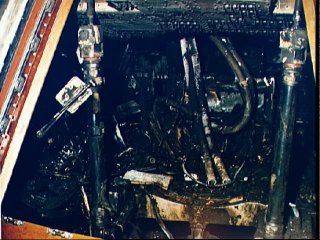
Is your house full of LOX? Need a reminder of what happens when a 100% O2 environment meets a spark?

apollo1fire.jpeg


Any teflon in that picture?

why it is that if one watches a film about Apollo 13, or hears Lovell, Haise, Kranz speak, they never mention teflon or aluminum.

Why should they? The problem they had to deal with was the effect of those things. The various reports and enquiries afterwards dealt with them. Your own line of argument says that if they had mentioned those things, it would have been deeply suspicious. You can't invent a scenario, decide what the outcome ought to be under rules that you specify, then abuse at people who failed to produce the results you think should have been produced. You're rigging it so that you win, but somehow still lose.
 
My point about teflon was not whether it might burn or not under exotic circumstances, but that it is NEVER mentioned in popular accounts of what happened in the context of Apollo 13 disaster presentations, nor is aluminum mentioned either, the latter may have burned as well according to NASA. What these people want to do is to get everyone to simply think, "WOW!! a tank of pure oxygen blew up!!!!" If that was not the case, they would mention the teflon. They would mention the aluminum. And they would mention that the fire was specifically a teflon fire and/or an aluminum fire. But you NEVER hear this.


What a load of BS.

Straight from Wikipedia (that "popular" enough for you, Patrick?):

In fact, the number 2 oxygen tank, one of two in the Service Module (SM), had exploded.[10] Damaged Teflon insulation on the wires to the stirring fan inside oxygen tank 2 allowed the wires to short-circuit and ignite this insulation. The resulting fire rapidly increased pressure beyond its 1,000 pounds per square inch (6.9 MPa) limit and the tank dome failed, filling the fuel cell bay (Sector 4) with rapidly expanding gaseous oxygen and combustion products. It is also possible some combustion occurred of the Mylar/Kapton thermal insulation material used to line the oxygen shelf compartment in this bay.[11]
(Bolding added.)
 
Patrick: go back to my post linking to Canada's equivilant of OSHA. Teflon will burn in the presence of cryogenic oxygen. And all you need for a fire is fuel, oxygen, and a source of ignition.

You're not only beating a dead horse - it was DOA.
 
What's funny is that you still seem to believe we all can't see you doing this. Who do you think you're fooling?

It's as I've said, Patrick...you're only "fooling" yourself. The rest of us recognize you as a rather "typical" Moon hoax believer, by how you "argue/ignore" inconvenient points.
 
My point about teflon was not whether it might burn or not under exotic circumstances, but that it is NEVER mentioned in popular accounts of what happened in the context of Apollo 13 disaster presentations, nor is aluminum mentioned either, the latter may have burned as well according to NASA.

Flip-flop.

Your original claim was that NASA staged these combustibility demonstrations for the benefit of the general public, who would thereby be fooled into thinking such available materials as PTFE and aluminum would burn, when scientists, engineers, and common sense knew they wouldn't. You went on at length about how there was no combustible fuel in the oxygen tanks, and how the public would eventually come to find out about this.

Now your claim is that enough wasn't done to bring to the public's attention the important fact that these materials would burn, such as all the scientists and engineers say. So now that tenacious public, who would supposedly discover that nothing combustible was in the tank in your first scenario, is too stupid to get hold of the public records of the Apollo 13 accident reports where the combustibility of the PTFE and aluminum are discussed. And coincidentally, you came to this conclusion only after they were brought to your attention by someone else.

Not only is that a complete turnaround of your "infallible" beliefs, it once again sets you up as the incontrovertible authority about what everyone else in the world should always be doing. Who made you the grand exalted pooh-bah of "popular accounts?" What makes your insight so special when all you've done is regurgitate what someone else told you by way of correction, then add your own lame spin to it?

I have only begun to investigate the details regarding NASA's claims about the fire in the tank.

Agreed. That's why your arguments, statements, and beliefs consistently lag beyond those of us who have studied these things for decades. You can't be considered the world's greatest authority on the subject if you're consistently having to play catch-up.

I stated in my first post about the teflon that it was an introduction to the subject.

Nonsense. In your first post on the subject you flat-out stated that PTFE was non-combustible. Now you're trying to have your cake and eat it too. You made yet another glaring error in an elementary scientific field, had your head handed to you, and you're now engaged in your typically feeble exercise of damage control -- you know, the backpedaling and flip-flopping that we all plainly see.

More than a spark is required to set a house on fire most of the time, and given teflon's properties, it is all the more the case that more than a simple spark is required to set teflon off and burning.

Your house isn't filled with a high concentration of oxygen. Despite having been assertively refuted according to a chorus of science on this point, you're still trying to draw analogies between a specialized engineering context and your layman's understanding of ambient stoichiometrics.

Give it up, Patrick. You're never going to convince anyone that your opinion on this point has any sort of education behind it.

Teflon is designed especially not to burn.

You were asked to document this. Why have you not?

What is clear already, what one can see plainly is that teflon and aluminum fires are almost never discussed in popular accounts of Apollo.

Damage control. You were wrong, everyone knows it, but you won't admit it. You want everyone to go along with you and pretend this was what you meant all along. Sorry, not taking that bait.

I am in the process of investigating the details of an explanation which will address exactly why that is indeed the case, why it is that if one watches a film about Apollo 13, or hears Lovell, Haise, Kranz speak, they never mention teflon or aluminum.

Translation: I'm in the process of making up a whole bunch of nonsense that I'll never provide any evidence for, and for which I will never take any sort of meaningful responsibility by engaging the men I libel.

 
And the engineers who designed the O2 tank one are well aware...

Under what circumstances will they burn?


Is your house full of LOX? Need a reminder of what happens when a 100% O2 environment meets a spark?

[qimg]http://www.astrocentral.co.uk/apollo1fire.jpeg[/qimg]

Any teflon in that picture?


Why should they? The problem they had to deal with was the effect of those things. The various reports and enquiries afterwards dealt with them. Your own line of argument says that if they had mentioned those things, it would have been deeply suspicious. You can't invent a scenario, decide what the outcome ought to be under rules that you specify, then abuse at people who failed to produce the results you think should have been produced. You're rigging it so that you win, but somehow still lose.

And the engineers who designed the O2 tank one are well aware of what may happen were something to spark in or around that tank. The wiring inside of the tank is covered with teflon for a reason threadworm.
 
My point about teflon was not whether it might burn or not under exotic circumstances, but that it is NEVER mentioned in popular accounts of what happened in the context of Apollo 13 disaster presentations, nor is aluminum mentioned either, the latter may have burned as well according to NASA.


No, that wasn't your point. That is not what you said. You said this:


So, what did NASA claim was inside of Apollo 13's Oxygen Tank Number Two that resulted in an explosion equivalent to 7 pound of TNT? What was the fuel, what was oxygen's partner in this case? Teflon... Seriously, not kidding...... NASA claims that what "burned" inside of O2 tank number two and resulted in the 7 pounds of TNT equivalent explosion was the Teflon covering the other wires inside the tank.

Keep in mind Teflon is specially designed to not burn, to not combine with oxygen. I think that that NASA even ran some experiments after the staged Apollo 13 Mission which they claimed demonstrated that under the "right circumstances" Teflon will burn, will combine with oxygen and release energy.

So we are asked to believe there was a 7 pound TNT equivalent of TEFLON wiring inside oxygen tank number two.......Anybody want to buy some quality real estate in Antarctica?


And you said it again:


Was there enough Teflon covered wiring such that when it "burned" in that tank it released enough heat to expand the O2 gas that COLD! to break that tank? Of course not. To suggest so is ludicrous beyond on the stars.....


It was only after qualified individuals gave you exact numbers from which one could mathematically prove that there was enough energy to cause the tank to rupture that you abandoned that point. You cannot now pretend you are only interested in how the story is reported in the popular press when you were actually debating the science itself one page earlier.
 
It seems rather silly to me that you would suggest my point was that teflon did not burn under any circumstaces...

For cryin' out loud....YOU POSTED IT, and now you're trying to back away from what you posted...

This is becoming an all too "typical" tactic for you...stop it.

When you make errors, then admit those errors...that's what an actual scientific researcher (which you claim to be) would do...why can't you do that??
 
It was only after qualified individuals gave you exact numbers from which one could mathematically prove that there was enough energy to cause the tank to rupture that you abandoned that point.

It is exactly as Jay recently posted...Patrick makes a claim, waits until it is explained to him how wrong he is, then changes his claim.
 
We have 100% oxygen flowing out of our hospital feeds....

Under what circumstances will they burn?


Is your house full of LOX? Need a reminder of what happens when a 100% O2 environment meets a spark?

[qimg]http://www.astrocentral.co.uk/apollo1fire.jpeg[/qimg]

Any teflon in that picture?


Why should they? The problem they had to deal with was the effect of those things. The various reports and enquiries afterwards dealt with them. Your own line of argument says that if they had mentioned those things, it would have been deeply suspicious. You can't invent a scenario, decide what the outcome ought to be under rules that you specify, then abuse at people who failed to produce the results you think should have been produced. You're rigging it so that you win, but somehow still lose.

We have 100% oxygen flowing out of our hospital feeds 24/7/365 with stuff a lot more flammable than teflon available nearby as fuel. Electrical equipment in and around ventilators that could "spark". You don't see us walking around on egg shells worried the ICU is going to blow threadworm.

Any time these people(NASA Apollo fraud perpetrators/insiders) do not mention something important it is obviously suspicious for obvious reasons. There is something to this consistent omission threadworm, otherwise they would be up front about it.

Were this thing real, I would actually have found it interesting myself that it was in fact teflon and/or aluminum that burned. Why don't they tell me that? Why do I need to look fairly hard to find that? It is because it is not real. That does not mean teflon doesn't burn under any circumstances. Rather, it means that a genuine, oxygen breathing teflon and/or aluminum fire does not/did not account for the phony fire that resulted in the staged Apollo 13 disaster.

There never was a real fire to begin with, otherwise they would have told me up front and very directly what it was that was burning instead of trying to trick me into thinking an oxygen tank blew up for no good reason because pure oxygen does that, blows up.
 
My point about teflon was not whether it might burn or not under exotic circumstances, but that it is NEVER mentioned in popular accounts of what happened in the context of Apollo 13 disaster presentations, nor is aluminum mentioned either, the latter may have burned as well according to NASA.

NEVER? I'm surprised that you, who cherrypicks googled references so frequently, failed to find what I did in about 30 seconds:

At Last the Real Story: Why Apollo 13 Failed
Popular Science, 1970


Teflon and aluminum are both mentioned as fuel sources for the accident.
 
You missed the entire point about the "exploding frying pan" and Teflon "burning" Garrison...

The point is that once again you made a claim that was utterly just for once stand up and admit.


The house I live in is combustible, as I presume your home is as well Garrison, and there is an abundance of oxygen around, plenty to feed fires that would take down both of our places of residence were a fire to start. But we leave our homes every day confident that they will be there when we return despite the ever threatening oxygen in the air. Why is that Garrison?

Seriously? You want to compare house fires to a tank of LOX? Come on Patrick, 'I was wrong about Teflon not burning', just type those words, you know its the right thing to do.

My point about teflon was not whether it might burn or not under exotic circumstances, but that it is NEVER mentioned in popular accounts of what happened in the context of Apollo 13 disaster presentations, nor is aluminum mentioned either,

No, Patrick, you stated it would not burn, come on you owe it every one here to own up to one of your mistakes.

I've cut the rest because it's just tedious self justification and yet another demonstration of how little you know about engineering.
 
I read the NASA report Garrison, how do you think I know....

The point is that once again you made a claim that was utterly just for once stand up and admit.


Seriously? You want to compare house fires to a tank of LOX? Come on Patrick, 'I was wrong about Teflon not burning', just type those words, you know its the right thing to do.


No, Patrick, you stated it would not burn, come on you owe it every one here to own up to one of your mistakes.

I've cut the rest because it's just tedious self justification and yet another demonstration of how little you know about engineering.

I read the NASA report Garrison, how do you think I know that the claim was teflon and/or aluminum? The report actually has the chemistry all written out complete with all the "exothermic details". I was the one who brought up the NASA claim, I think I should know what is in the the report.

Anyway, I shall move on as above. I actually think one could probably build a better case for aluminum being a factor , though I have not been able to find anything written about this outside of NASA's own stuff.
 
I did not say it is omitted from all references, I said most....

NEVER? I'm surprised that you, who cherrypicks googled references so frequently, failed to find what I did in about 30 seconds:

At Last the Real Story: Why Apollo 13 Failed
Popular Science, 1970


Teflon and aluminum are both mentioned as fuel sources for the accident.

I did not say teflon/aluminum were omitted from all references, I said most....I already mentioned that teflon was mentioned in Lovell's/Kluger's Apollo 13 book.
 
We have 100% oxygen flowing out of our hospital feeds 24/7/365 with stuff a lot more flammable than teflon available nearby as fuel. Electrical equipment in and around ventilators that could "spark". You don't see us walking around on egg shells worried the ICU is going to blow threadworm.

Who exactly is us? You admitted you made up your medical credentials for 'satire'. And as those who actually have working knowledge of such systems have pointed out, without you apparently bothering to read responses, it is dangerous and care needs to be taken.


Any time these people(NASA Apollo fraud perpetrators/insiders) do not mention something important it is obviously suspicious for obvious reasons. There is something to this consistent omission threadworm, otherwise they would be up front about it.

Again they didn't leave it out, its just like so many other things where you did second rate research and jumped to a conclusion.

Were this thing real, I would actually have found it interesting myself that it was in fact teflon and/or aluminum that burned. Why don't they tell me that? Why do I need to look fairly hard to find that?

So in two sentences we've gone from they didn't mention something important to you had to actually look to find out about it? Which exactly is it Patrick?

It is because it is not real. That does not mean teflon doesn't burn under any circumstances. Rather, it means that a genuine, oxygen breathing teflon and/or aluminum fire does not/did not account for the phony fire that resulted in the staged Apollo 13 disaster.

You stated Teflon didn't burn, and none of this hand waving changes that.

There never was a real fire to begin with, otherwise they would have told me up front and very directly what it was that was burning instead of trying to trick me into thinking an oxygen tank blew up for no good reason because pure oxygen does that, blows up.

You mean apart from the spark generated by the fault wiring during the stir? No reason given apart from that? And frankly your lack of knowledge points again to your poor research skills rather than a cover up, you are after all the person who confused a tape counter for the time of day and invented Julian Co-ordinates, oh and multiplied the Apollo budget by 10 when you should have divided.
 
We have 100% oxygen flowing out of our hospital feeds 24/7/365 with stuff a lot more flammable than teflon available nearby as fuel. Electrical equipment in and around ventilators that could "spark". You don't see us walking around on egg shells worried the ICU is going to blow threadworm.

Any time these people(NASA Apollo fraud perpetrators/insiders) do not mention something important it is obviously suspicious for obvious reasons. There is something to this consistent omission threadworm, otherwise they would be up front about it.

Were this thing real, I would actually have found it interesting myself that it was in fact teflon and/or aluminum that burned. Why don't they tell me that? Why do I need to look fairly hard to find that? It is because it is not real. That does not mean teflon doesn't burn under any circumstances. Rather, it means that a genuine, oxygen breathing teflon and/or aluminum fire does not/did not account for the phony fire that resulted in the staged Apollo 13 disaster.

There never was a real fire to begin with, otherwise they would have told me up front and very directly what it was that was burning instead of trying to trick me into thinking an oxygen tank blew up for no good reason because pure oxygen does that, blows up.

Oh, come ON now! You claim to work at a hospital and don't know about hospital electrical standards? About bedclothes flammability standards? And about the tight precautions around hyperbaric oxygen treatment (and what happens when someone isn't careful enough?!)

A hospital isn't a residential building with a coat of white and green paint.

Now, if you had said you treat the oxy tanks in a welding operation with less care than you do the acetylene (I'm guilty of this!) I might believe you. But a stream of oxygen from a low-flow portable oxygen concentration device (as carried by many of the elderly around my old workplace) is far, far from the conditions inside a pressurized tank of the pure stuff. And, yes...the former is implicated in a many accidents.

Seriously. Saying oxygen isn't dangerous? Next you'll claim 110 volts is too low to offer any significant shock hazard. More and more, I'm glad you don't work in my shop.
 
Were this thing real, I would actually have found it interesting myself that it was in fact teflon and/or aluminum that burned. Why don't they tell me that? Why do I need to look fairly hard to find that?


Yahoo! Answers is too hard for you?

Teflon wiring insulation inside the tank began to char in the intense heat, and in places burned through, exposing the bare metal wire.


http://answers.yahoo.com/question/index?qid=20110917053723AANJaAq
 
I did not say teflon/aluminum were omitted from all references, I said most....I already mentioned that teflon was mentioned in Lovell's/Kluger's Apollo 13 book.

And I did not claim that you said "teflon/aluminum were omitted from all references". For reference, here again is what you said, emphasis added:

My point about teflon was not whether it might burn or not under exotic circumstances, but that it is NEVER mentioned in popular accounts of what happened in the context of Apollo 13 disaster presentations, nor is aluminum mentioned either, the latter may have burned as well according to NASA.

Did you have a not-commonly-accepted definition of the word "NEVER" in mind when you wrote it in all caps? After all, a trivial search effort turned up at least one popular account in a popular magazine with the word "Popular" in its title...which effectively refutes the point you claimed to be making.
 
We have 100% oxygen flowing out of our hospital feeds...

How much oxygen is in your bike shop?

There is something to this consistent omission threadworm, otherwise they would be up front about it.

Begging the question -- rejected. Your personal definitions of "consistent," "omission," and "up front" do not apply to everyone. You've latched onto the one detail you got egregiously wrong and are still trying to trump up a case to include it. Is it not obvious that everyone can see what you're trying to do?

Were this thing real, I would actually have found it interesting myself that it was in fact teflon and/or aluminum that burned.

Then it's a good thing it was covered extensively in the officially-published original investigation findings and reported in Popular Science. No one else seems to have had much trouble determining what the combustion fuel was and why. Maybe the problem is just you.

Why do I need to look fairly hard to find that?

For the same reason you need to look fairly hard to find any detail. I'll let the other readers bask in the comedy of your attempt to make NASA responsible for your laziness and inattention. Maybe next time NASA has an accident, they should dispatch a special PAO from Ames to brief you at your bike shop so that you don't miss any of the details.

Just because you've chosen to fixate on Teflon today, as a means of backpedaling from egregious error, doesn't mean everyone else's lack of fixation is suddenly suspicious. It really is just you.
 
Status
Not open for further replies.

Back
Top Bottom