• Quick note - the problem with Youtube videos not embedding on the forum appears to have been fixed, thanks to ZiprHead. If you do still see problems let me know.

Crop circle debunking help needed

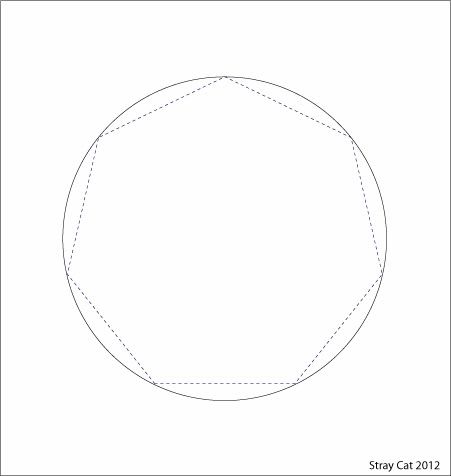
So, at this the point we've got to:

Frame-1.jpg


We have a heptagon marked out inside a large circle.

The next step is arranging the smaller pairs of heptagons around it's perimeter. To do this we take just one of the seven sides.
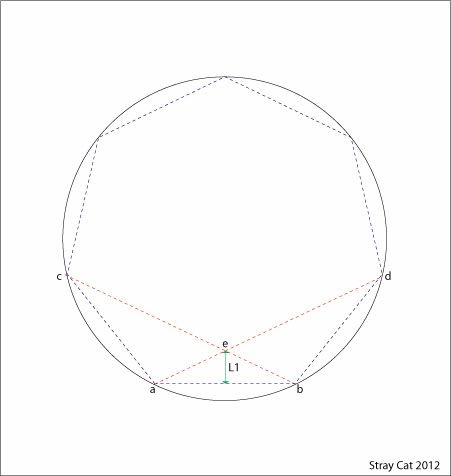
Frame-2.jpg


And by extending a tape along line a/d and one along b/c, we get intersection e.
A measure from e back to the line describing the edge of the large heptagon gives L1.

We need to measure the same (L1) beyond the circumference of the circle
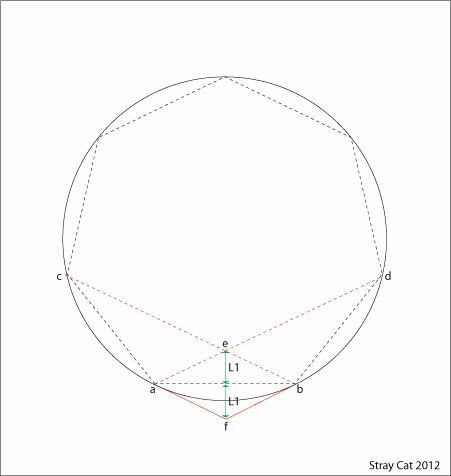
Frame-3.jpg


We now also have point 'f'.

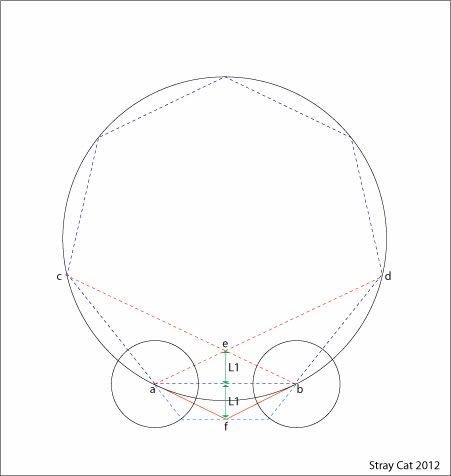
Frame-4.jpg


From point 'f' we run a line to point 'a' and halfway along that line is the radius we need to mark the outer points of the smaller pairs of heptagons (the two circles shown in black and centered on 'a' and 'b').
The blue dotted line marked c/a is then extended by the radius amount and the same is done for line b/d. These points are then joined by a straight line (shown in pale blue dotted).

The same process is repeated another six times for each of the seven sides.
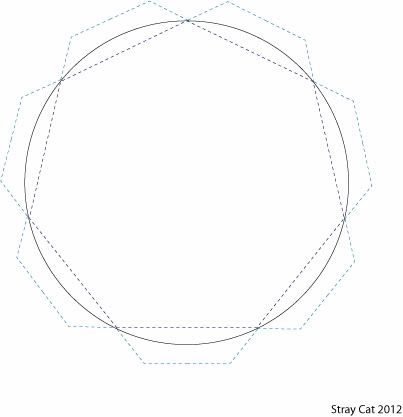
Frame-5.jpg


As you can see, the original footline circle is now within the crop that will later be flattened.

So, onto the inner part of the formation. There is actually no need to mark out fully the pairs of small heptagons because they aren't really there. The illusion is that they have been individually marked out but this is not the case.

All you need to do it take a line from one of the outer corners (pale blue dotted) and run a tape to it's opposite corner.
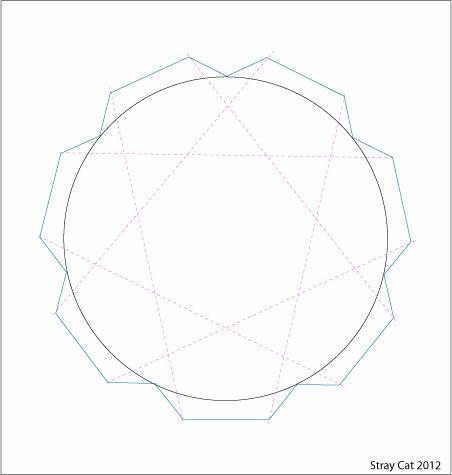
Frame-6.jpg


Repeating the same for each edge. Then take (probably one or two board widths) and mark out the inner lines which run parallel.
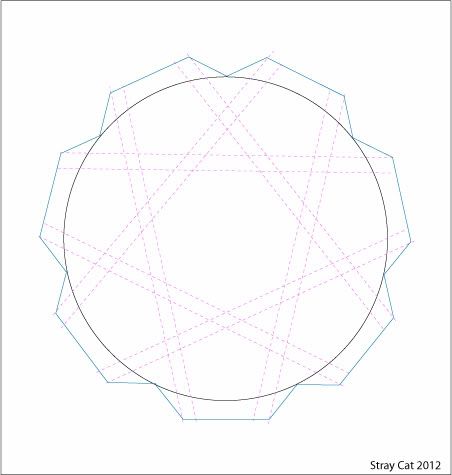
Frame-7.jpg


This will build up the inner pattern thus;
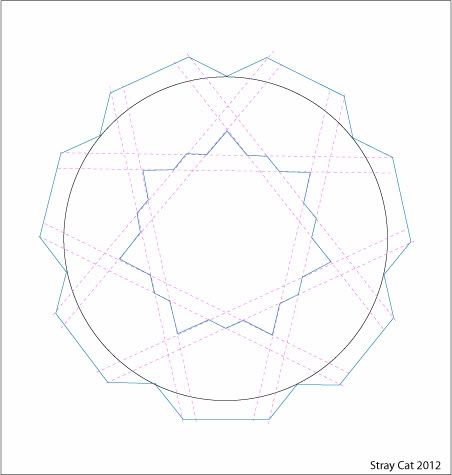
Frame-8.jpg


This has taken about 10 minutes per side and 20 minutes for the original heptagon plotting (90 minutes total) You're now ready to start stomping.
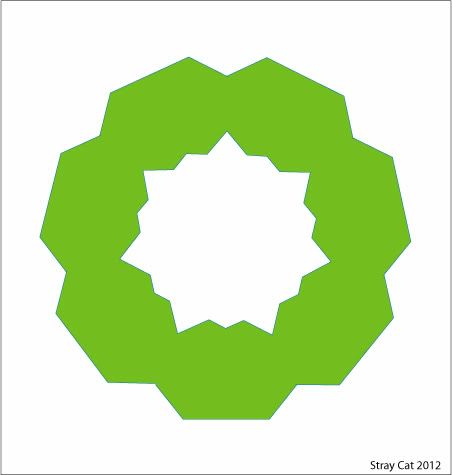
Frame-9.jpg


Now all that's needed is to add the (rather messy) grapeshot around the inner and outer edges.
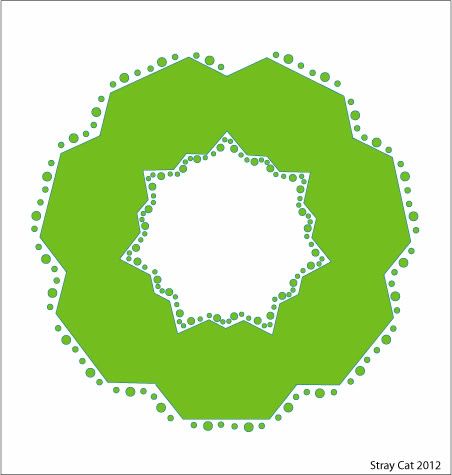
Frame-10.jpg


All done within 3 hours, lets go and get some sleep back at the Barge campsite. :)
 
(I'm not going to waste my time if you're not understanding it).

So to recap; What you see above is the outline which we are going to construct the smaller pairs of heptagons around. All you really need to make permanent marks of is the circle and the 7 points around it's circumference.

I'm sorry if you feel you're wasting time on me, that's not considerate of the others that are here and do understand if you quit. So if you don't want me to ask questions than there'd really be no need for this thread at all. So at the risk of being scolded, I'll ask a question more biased that you may enjoy. These "reference points" of the circle, are they possibly the little circles on the outside edges made to look like added decoration?
 
I'm sorry if you feel you're wasting time on me, that's not considerate of the others that are here and do understand if you quit.
I'm not talking about quitting, I'm talking about slowing down so you can understand.

These "reference points" of the circle, are they possibly the little circles on the outside edges made to look like added decoration?
No. I see we posted roughly at the same time so you posted probably without seeing my construction diagrams above.
 
[qimg]http://i246.photobucket.com/albums/gg117/ThePsychoClown/Frame-10.jpg[/qimg]

All done within 3 hours, lets go and get some sleep back at the Barge campsite. :)

You just did this with your computer in good lighting. But you missed some grapeshot at top right of center. How hard would this be in the field at night with no errors in your opinion? ;)
 
Last edited:
You just did this with your computer in good lighting. But you missed some grapeshot at top left of center. How hard would this be in the field at night with no errors in your opinion?

Errors are common. I noticed this one only after I'd posted the pic. :)
In this situation it's more a case of not pressing 'command' whilst dragging a group of grapeshot. That wouldn't ever occur in a field, though other things can and do happen (someone stomps the wrong section or misses a section that should be stomped). Some mistakes are not even noticable because unless someone knows what the design is supposed to be, no one is going to know if it was a mistake or deliberate. Other mistakes in the past have been given special significance by crop circle researchers who will conclude 'it's part of the message'. I've known circlemakers return the night after to correct some blatant mistakes.

To make this formation with "no errors" would be very difficult. But as all crop circles have inaccuracies and errors of some degree or other (the grape shot on this one are really messy and the internal shape obviously caused an amount of trouble), I can safely say that within the usual tolerances of crop circle construction, it could have been made quite easily with a team of five people within 4 hours. A bit of darkness is no trouble. There is always enough light to be able to see as much as you need to see and as no numbers are required, you can actually do it all by feel (when the tape goes tight, you know you're where you need to be).
 
A bit of darkness is no trouble. There is always enough light to be able to see as much as you need to see and as no numbers are required, you can actually do it all by feel (when the tape goes tight, you know you're where you need to be).

Is England cloudy usually? Where is this little bit of light coming from in the crop fields if not the moon? Street lights?

Also in Akhenatens link example, you missed step 12 rounding the corners.

http://www.zefdamen.nl/CropCircles/...awsmead98/Reconstruction1998TawsmeadCopse.htm
 
Is England cloudy usually? Where is this little bit of light coming from in the crop fields if not the moon? Street lights?
There is enough ambient light as long as you are above ground. England or anywhere for that matter. Clouds don't make much difference, but depending on what location you're at, they can actually make it lighter as they reflect light pollution from miles way.

Also in Akhenatens link example, you missed step 12 rounding the corners.

http://www.zefdamen.nl/CropCircles/...awsmead98/Reconstruction1998TawsmeadCopse.htm
Yes, that rounding the corners... I think that was done as a necessity of someone making a mistake. It's certainly not measured nor evenly done on all corners.
 
I'm guessing that strange environmental factors found inside a formation is of no interest.
 
You could also do it with the Pharaoh's two planks of wood nailed together at the appropriate angle, and a couple of bits of string. Mark the diameter, stand at the centre with the bits of wood, and mark the points on the circumference in turn; do you actually need to mark the circumference itself?


You don't need to mark the circumference no. But as there is no reason not to and as it gives you an easy way to negotiate around the formation as you are contructing it (rather than having to walk up and down long lengths of tram line) it is much easier to put down a footline.

Yes a pre-constructed protractor could be made as Akhenaten has shown, but as the job can be done without one, there is no need to go to such trouble. Indeed over recent years, circlemakers have started employing lazer protractors such as this one, but 14 years ago, this tech was really too expensive and cumbersome.


Somehow, the 'two short planks' method seemed a more appropriate suggestion in this particular discussion. Nice thick ones.

:)
 
To make this formation with "no errors" would be very difficult.

Obviously since you can't make it with no errors from the comfort of your own home while sitting on your arse, with lights, and a computer. Are there any errors in the formation made by humans at night you'd like to point at?
 

Back
Top Bottom