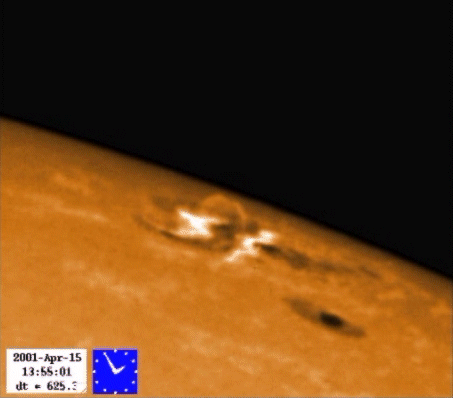
Solar Photosphere and Optical Depth (again) III
Even compared to the atmosphere of Earth, the surface of the photosphere is "wispy thin" Tim. ... That's pretty darn thin Tim. White light penetrates our atmosphere without even working up a sweat and the atoms in our atmosphere are MUCH heavier than hydrogen and helium.
Like I said before ...
To begin with, the photosphere is not a "wispy" or "thin" plasma by any reasonable standard.
Your standard of "wispiness", comparing the solar photosphere to Earth's troposphere is
extremely unreasonable. Earth's troposphere consists primarily of neutral N
2 and O
2 molecules (which together make up 99% of the entire atmosphere), along with trace smatterings of H
2O, Argon, CO
2, CH
4, and a whole bunch of other semi-irrelevant stuff. Earth's atmosphere is transparent to eyeball light. However, it is as opaque as a "brick wall" to X-rays, gamma-rays, and large chunks of the infrared wavelength region (see
Atmospheric electromagnetic opacity diagram courtesy of our old friend Wikipedia).
Whether an atmosphere is transparent, translucent, or opaque, and the degree to which it is any of those things, has absolutely not on thing to do with the number of particles to be found per unit volume. Rather, the degree to which the atmosphere is any of those things is solely and strongly dependent on the interaction between electromagnetic photons and the particles in the atmospheric gases, by absorption/emission and/or by simple scattering. The neutral molecular gases of Earth's atmosphere interact weakly with visible wavelengths of light. However, the
ionized gases (i.e., plasma) of the solar photosphere will necessarily interact strongly with electromagnetic photons precisely because they are a plasma.
You have been arguing about this for years, always relying on your own fatally flawed intuition, and always ignoring every sense of science, every sense of physics. You ignore physics like it's a poison. We have been over this before, but you never learn.
From 23 April 2010:
The fact that the sun is made mostly of hydrogen is crucial,
since we also know that, counterintuitively perhaps, the continuum opacity of stellar photospheres is dominated by the H- ion (e.g.,
Wildt, 1939;
Massey & Bates, 1940;
Chandrasekhar, 1945, a 5-part paper, all parts linked from this page;
John, 1988;
John, 1994;
The Observation and Analysis of Stellar Photospheres by David Gray, 3rd edition 2005, pp. 154-157;
Solar Astrophysics by Peter Foukal, 2nd edition 2004 section 5.3.2, pp. 149-150). Finally, there is quite good enough agreement between helioseismological observations, solar neutrino observations, and the standard astrophysical models of the sun, such that all of Mozina's alternate hypotheses are excluded with confidence (see, e.g.,
Bahcall & Ulrich, 1988;
Bahcall, Pinsonneault, & Basu, 2001 and citations thereto for both papers).
From 22 April 2010:
One should also keep in mind that the continuum opacity of the solar photosphere is actually dominated by the H- ion; yep, negative hydrogen, believe it or not (e.g.,
The Observation and Analysis of Stellar Photospheres; David Gray, 3rd edition 2005, page 154;
Wildt, 1939;
Chandrasekhar, 1945 & citations thereto).
From 19 July 2009:
You clearly don't have any idea what the words optical depth mean, so let me fill you in. It's nothing more complicated than the absorption integrated along the path length. Every plasma has a path length. Every plasma has a wavelength dependent absorption spectrum. Therefore every plasma has an optical depth. It is therefore a necessary consequence of the laws of physics that if the optical depth is high enough then no photons at all will transmit through the plasma along the given path length. If you're going to tell me that sounds like something I just made up I am going to laugh in your face in a very insulting manner because it is a very insultingly stupid thing to say.
From 6 July 2009:
I told you once before that "thin" is irrelevant. You don't believe me of course, but that's no surprise. But I'll say it again anyway.
"Thin" is irrelevant, whether you like it or not.
We call it "physics", and the key concept here is optical depth. The optical depth of anything depends not only on "thin" or "thick" (both of which you have yet to
quantitatively define), but on the absorption coefficient of the material at the wavelength(s) of interest. A strong absorption coefficient means strong absorption, even in a "thin" material, while a weak absorption coefficient can mean weak absorption, even for a "thick" material. After all, ordinary glass has about 1,000,000 times the mass density of the solar photosphere, and is "thick" by colloquial standards, but totally transparent to eyeball wavelengths of light, while totally opaque at other wavelengths.
And now we return to the present:
How is it possible not to know this and think you're qualified to discuss astrophysics? This is basic, basic, basic undergraduate stuff. Go learn it and come back when you're ready to say something well-informed.
Nothing like building your own strawman so that you can watch it burn.
There is nothing "strawmany" about it. Qualification is not necessarily having a degree, it's having a foundation of knowledge. You constantly rely on your ignorance and forsake knowledge. It's all about physics, which you choose to despise & ignore. It's all about science, which you choose to despise & ignore. It's all about knowledge, which you choose to despise & ignore. I, and others, have been telling you it's
optical depth for
years, but you ignore it every time and just continue to cascade one insult on top of another for years, treating knowledge like a psychic plague.
[size=+10]
Optical Depth
[/size]
Until you make the effort to learn what those words mean, you have no business,
and should have no right at all, to talk about the solar photosphere.


 .
.
 .
.