• Security incident: ISF was recently accessed by intruders. Please change your password, and change it anywhere else you used it. Read more

Merged Electric Sun Theory (Split from: CME's, active regions and high energy flares)

Status
Not open for further replies.
Solar Photosphere and Optical Depth (again)

This came up on the thread regarding Lambda-CDM cosmology, but this seems like the more appropriate venue for a response.

In terms of the photosphere you claim that a wispy light plasma acts like a 'black body'. Then you note that it doesn't.
Of course, this is not true.

I posted this in January 2011, referencing another post from June 2009, just over two years ago.
Having returned from the family reunion and a visit with my 88 year old aunt, allow me to point out that all of this about the opacity of the photosphere is, as one might expect, a recycled conversation. Been there, done that, with Mozina (and others), to no avail.

From 26 Jun 2009 ...
The huge problem in your idea is that the photosphere is far too thin to be a "black body" in the first place.
That is not true. The "thinness" of the plasma is irrelevant. It's the optical depth which determines whether or not the plasma will radiate as a black body. The solar photosphere plasma has an optical depth of 1.0 where it has a mass density of only 2.78x10⁻⁷ gm/cm3 (but an electron number density 7.7x10¹³/cm3 and a hydrogen atom number density 1.2x10¹⁷/cm3). An optical depth that high guarantees a black body spectral energy distribution.

It is well known that the emission from the solar photosphere is an approximate black body. It is in fact a superposition of multiple black bodies at multiple temperatures, since we can see emission from throughout the depth of the photosphere. The temperature profile shows 6520 Kelvins at optical depth 1, down to a minimum 4400 Kelvins at optical depth 4x10⁻⁴, after which the temperature increases again to 5160 Kelvins at optical depth 5x10⁻⁶. The base of the photosphere, about optical depth 24, has a temperature 9400 Kelvins. The region around optical depth 1 contributes most strongly to the black body shape; lower regions of higher optical depth are more opaque, and higher regions of lower optical depth emit less thermal energy. That's why the best fit single temperature black body for the photosphere is about 6000 Kelvins.

I am using the profile given in Solar Astrophysics by Peter V. Foukal (Wiley-VCH, 2004, 2nd edition), page 153. The inversion technique for building the temperature profile is briefly described in section 5.2.2, but far more detailed descriptions & explanations can be found in any book on atmospheric modeling, where inversions are long standing techniques.

The shape of the photosphere SED is well represented in the diagrams on the Wikipedia page for solar radiation. Foukal's book gives far more detailed information for the curious reader.

In the post above, optical depth is defined such that I = I0 * e-tau where tau is the optical depth (I have probably misused the word here and it should be opacity instead, but this is the way I have used it so I proceed apace to maintain consistency), I0 is the radiation intensity at the source and I is the radiation intensity measured by the observer. So at an optical depth of 24, as I have used it, then the observed light intensity is down by a factor of e24 or 2.65x10¹⁰ (that means the observed radiative intensity is 3.78x10⁻¹¹ of the intensity at the source). That level is about 100 km below the level where the optical depth (tau) = 1. The optical depth itself increases exponentially, so if you go down another 100 km, the optical depth will be at least an order of magnitude greater. As anyone can see, this certainly counts as "opaque" by any physically reasonable standard. The idea that one could see to a depth of 4800 km through such a medium, via electromagnetic radiation, is physically ridiculous.

Also see my posts from the following days, Atmospheric Profile Inversion Techniques, and Re: Validity of plasma properties & inversion techniques, which give references to the validity of the techniques used to derive atmospheric profiles from the observations. These methods, especially limb sounding, have been heavily validated in our own atmosphere, where in situ measurements are used to verify the inversions. Other relevant posts from the same time frame are Optical Depth, Solid Surface and Photosphere, Solid Surface and Photosphere II, 171 Angstroms & the Solar Transition Region, and 171 Angstroms & the Solar Photosphere & Chromosphere. All of these posts date from the same time period, June & July 2009, about 18 months ago. And here we are going over the same old thing again like it never happened. An endless loop.

We visit the same topic again in the spring of 2010: Photospheric Opacity and Photospheric Opacity and Composition. And from the summer of 2010: Solar Black Body Emission.

Bottom Line: There is no physical justification for the idea that the photosphere is transparent or translucent beyond a depth of approximately 100 km below the level where the optical depth (as I have defined it here) is equal to one.

And we have discussed this several times in the years between.

From 14 June 2010
Any optically thick plasma will emit electromagnetic radiation in a very nice approximation of a true blackbody, if it is isothermal. The photosphere of the sun does in fact emit as a very nice approximation of a true blackbody, but it is not isothermal. So each temperature layer of the photosphere emits nearly blackbody radiation; we see little from the bottom because there is too much absorbing & scattering material above it, little from the top because it is becoming optically thin, and most from the middle where it is still optically thick but there is not too much stuff above it. So all those blackbody (Planck-law) spectral energy distributions (SEDs) add up to one SED that looks like a blackbody at about 5777 Kelvins. The observed optical spectrum is a sum of that near blackbody continuum plus absorption features from the photospheric gases.


From 23 April 2010
We already know, as a matter of fact, that the mixture of plasma Mozina wants to investigate, both for the general photosphere and sunspot umbrae, exists nowhere in or on the sun. We can look at the sun and see what it is made of. We know its chemical composition (by number about 92% hydrogen, 8% helium and less than 1% everything else; see, e.g., Solar Astrophysics by Peter Foukal, 2nd edition 2004 section 5.6 and table 5-3; Asplund, et al., 2009). We have known that the sun is composed mostly of hydrogen since about 1930 (e.g., Russell, 1929; Stromgren, 1932; Eddington, 1932). The fact that the sun is made mostly of hydrogen is crucial, since we also know that, counterintuitively perhaps, the continuum opacity of stellar photospheres is dominated by the H- ion (e.g., Wildt, 1939; Massey & Bates, 1940; Chandrasekhar, 1945, a 5-part paper, all parts linked from this page; John, 1988; John, 1994; The Observation and Analysis of Stellar Photospheres by David Gray, 3rd edition 2005, pp. 154-157; Solar Astrophysics by Peter Foukal, 2nd edition 2004 section 5.3.2, pp. 149-150). Finally, there is quite good enough agreement between helioseismological observations, solar neutrino observations, and the standard astrophysical models of the sun, such that all of Mozina's alternate hypotheses are excluded with confidence (see, e.g., Bahcall & Ulrich, 1988; Bahcall, Pinsonneault, & Basu, 2001 and citations thereto for both papers).

Clearly, if we pick an unrealistic mix of elements, we get an unrealistic opacity as a result. 90% neon means a lot fewer H- ions and, perhaps, a lot less opacity. So if we find that the Mozina mixture is indeed much more translucent than we are claiming for the photosphere here, so what? Since the chosen mixture is very unphysical, so will the low opacity be representative only of the Mozina sun, as opposed to the real sun we look at. It will still remain to show that there is observational support for the Mozina mixture, and some objective reason not to believe the standard mixture, which has been built up over 80 years of careful observations of the sun. I suspect that Mozina will be as incapable of supporting his alternate hypothesis for the solar chemical abundances as he is incapable of just about everything else, but we will see.


From 22 April 2010
Foukal's semi empirical model runs from 3.18x10⁻⁷ at the base (9400 Kelvins) to 2.183x10⁻¹¹ at the top (6150 Kelvins) and 2.249x10⁻⁷ at the 5790 Kelvin level, in gm/cm3 (Solar Astrophysics, Peter Foukal, 2nd revised edition 2004; table 5-2 page 153). Electron density ranges from about 1015 at the base to 1011 at the top, in e-/cm3.

So to match the 5800 Kelvin layer, one might want about 10-7 for mass density and 1013 electron density, the latter being I think more significant than the mass density due to photon scattering off the free electrons.


From 19 July 2009
This sounds like one of those mythical claims that cannot be demonstrated in a lab. Which experiment would you like to cite that demonstrates that a mostly hydrogen and helium plasma, with the density of the photosphere shows that these elements at this density and temperature have the ability to act like a 'black body'? I think you're making this up.
You already asked and I already answered.
Where do you propose that one might build a 1000 km long plasma tube to contain the experiment? How do you propose to conduct the experiment, if and when it is built?

You constantly revert to an insistence on controlled laboratory experiments. But you yourself will reject even the most controlled of laboratory experiments, when they contradict your pre-conceptions, as you do with magnetic reconnection. So why should anyone be impressed by your insistence that other people adhere to criteria that you will not adhere to yourself?

And you fail to notice that some things cannot be demonstrated to your satisfaction in any conceivable controlled laboratory experiment. This is one example. Even a "thick" plasma, let alone a "thin" plasma, can be transparent or translucent under laboratory conditions, while being opaque in nature because nature exists on spatial scales that cannot be duplicated in any laboratory. The photosphere of the sun is on the order of 1000 km deep. So the concept at work here is what astronomers call column density. Even where the photosphere is "thin", with a hydrogen atom number density about 9x10¹² atoms/cm3, a column of that plasma 1000 km long will hold 9x10²⁰ atoms. A real photospheric column will hold rather more than that, since that is based on a minimum density, probably closer to 1024 or 1025 neutral hydrogen atoms. Is that "thin"?

I told you once before that "thin" is irrelevant. You don't believe me of course, but that's no surprise. But I'll say it again anyway. "Thin" is irrelevant, whether you like it or not. We call it "physics", and the key concept here is optical depth. The optical depth of anything depends not only on "thin" or "thick" (both of which you have yet to quantitatively define), but on the absorption coefficient of the material at the wavelength(s) of interest. A strong absorption coefficient means strong absorption, even in a "thin" material, while a weak absorption coefficient can mean weak absorption, even for a "thick" material. After all, ordinary glass has about 1,000,000 times the mass density of the solar photosphere, and is "thick" by colloquial standards, but totally transparent to eyeball wavelengths of light, while totally opaque at other wavelengths.

You must pay attention to the relevant physics, just as you demand of others to do the same, or you just wind up in a thread dominated by a sea of insults and minor conversations on unimportant points, as you are now.

You clearly don't have any idea what the words optical depth mean, so let me fill you in. It's nothing more complicated than the absorption integrated along the path length. Every plasma has a path length. Every plasma has a wavelength dependent absorption spectrum. Therefore every plasma has an optical depth. It is therefore a necessary consequence of the laws of physics that if the optical depth is high enough then no photons at all will transmit through the plasma along the given path length. If you're going to tell me that sounds like something I just made up I am going to laugh in your face in a very insulting manner because it is a very insultingly stupid thing to say.

That post pointed out that a column of photosphere plasma about 1000 km long would hold at minimum about 1021 to 1025 atoms. This is called a column density in astrophysics and it is an important concept to keep in mind. It is not the volume density that is important in deriving the opacity of a gas or plasma, but rather the column density along the line of sight between the observer and the source of radiation. If the path length is large enough, even a small volume density can add up to a large column density, which can in turn lead to a large opacity or optical depth along that line of sight. That's why stars like the sun exhibit limb darkening, because the longer path length leads to a larger opacity. The same effect leads to red sunsets on Earth, where the longer path length creates a larger opacity for shorter wavelength light (i.e., blue) and scatters it out of the line if sight, so only longer wavelength (i.e., red) light can get through.

As you can see, with Mozina it's always deja vu. But once again, Mozina contradicts Mozina, so which Mozina are we supposed to believe (if either)? As I said above, even the thinnest part of the photosphere has a hydrogen atom number density about 9x10¹² atoms/cm3. Mozina today has referred to it as "a wispy light plasma", and two years ago as "far too thin". He continues to insist that the photosphere plasma is too thin to act as a blackbody. However, he seems to have no problem with the interstellar plasma acting as a blackbody. So how "thin" is the interstellar plasma compared to the photosphere? The answer was posted only a few days ago.

To begin with, photons scattering off of a plasma can produce a thermal spectral energy distribution (SED) for the photons only if the plasma is extremely dense (e.g., a stellar interior, where the particle densities are on the order of 1025 particles per cubic centimeter; that's about 100 gm/cm3 mass density, typical for the sun), which makes the photon mean free path very short and the collision frequency between photons & particles very high. However, in the average interstellar medium, while you might get 105/cm3 in a dense (and primarily neutral) molecular cloud, the far more common and far more sparse interstellar plasma will sport something like 10-4/cm3, and the even more sparse intergalactic medium, you might be as dense as 10-7/cm3. There is simply no way in creation you will ever get a thermal SED from photons scattering in such a sparse plasma. So your hand-wavy arguments about scattering have a lot more to do with wishful thinking than it does physics. Furthermore, to make matters even worse for you, the CMB not only has a thermal SED everywhere on the sky (or so it appears, even allowing for problems in removing the Milky Way foreground), but it has the same temperature everywhere on the sky, within about +/- 0.001 Kelvins. A scattering explanation for those two simultaneous facts will require you to wave your arms around so vigorously that you will fly away.


So, according to Mozina, the photosphere is far too thin & wispy to produce a blackbody spectral energy distribution (SED) by scattering sunlight. However, also according to Mozina, the interstellar plasma, which is about ten thousand trillion times thinner, will produce a blackbody SED by scattering starlight with an energy density about a trillion trillion times smaller than the energy density of the sunlight scattered by the photosphere. Surely this must be Mozphysics at its finest!
 
http://sdo.gsfc.nasa.gov/assets/img/latest/latest_1024_0304.mpg

FYI, there was a really nice example today of a dark filament eruption flare around 4:00. Prior to the flare the darker ribbons can be seen (in the iron ion wavelengths as well), and that material can be observed being blown out into space around 04:00. Fortunately, most of the mass looks to be directed up and away, and not directed at Earth. Dark filament eruptions seem to be involved in all or most of the larger CME events, particularly the ones with extremely large (potentially dangerous) mass flows.
 
Last edited:
So, according to Mozina, the photosphere is far too thin & wispy to produce a blackbody spectral energy distribution (SED) by scattering sunlight. However, also according to Mozina, the interstellar plasma, which is about ten thousand trillion times thinner, will produce a blackbody SED by scattering starlight with an energy density about a trillion trillion times smaller than the energy density of the sunlight scattered by the photosphere. Surely this must be Mozphysics at its finest!

Darn, I missed this earlier!

You have the wispy photosphere doing supernatural, physics defying magic tricks in only a few hundred kilometers Tim. You have a thin little plasma presumably blocking *EVERY SINGLE* wavelength of light under the sun in just a few hundred kilometers.

On the other hand, I'm willing to entertain the possibility that over *MILLION IF NOT BILLIONS OF LIGHT YEARS* that a light plasma is "opaque" to a few wavelengths of light.

You're comparing apples and oranges Tim, and kilometers to light years.
 
Darn, I missed this earlier!

You have the wispy photosphere doing supernatural, physics defying magic tricks in only a few hundred kilometers Tim. You have a thin little plasma presumably blocking *EVERY SINGLE* wavelength of light under the sun in just a few hundred kilometers.

On the other hand, I'm willing to entertain the possibility that over *MILLION IF NOT BILLIONS OF LIGHT YEARS* that a light plasma is "opaque" to a few wavelengths of light.

You're comparing apples and oranges Tim, and kilometers to light years.

And you've got nothing other than your hunch to back up your assertion. It seems plausible to you, but really, how would you know? On what basis do you make your conclusions about the optical depth of stellar versus intergallactic plasmas? Where are your numbers?

But really, I don't have to ask. You don't have any. You never have any.
 
Michael Mozina:

The amount of time you spend on forums would be better spent getting a Master's or PhD in physics. I have one of these. They're very nice. Once you have one, reconsider all this, and I'm sure you'll make a lot more sense to us.
 
You're comparing apples and oranges Tim, and kilometers to light years.

The laws of physics allow you to compare kilometers to light years. One light year is about 10^13 km.

We've known about the CMB since 1964, we've known about its 10ppm anisotropy since 1991, we've known about the fifth acoustic peak since 2004, its polarization since 2005. It's now 2011, you've been in this game for five or six years, and the best you can do in advancing your 1960s-vintage theory is:

I'm willing to entertain the possibility that over *MILLION IF NOT BILLIONS OF LIGHT YEARS* that a light plasma is "opaque" to a few wavelengths of light.

Not "here's a detailed PC model that explains the 2005 data". Not "here's a conference abstract claiming to match the 1991 data". You're not even at "here's a cocktail napkin with some numbers in the right order of magnitude to match the 1964 data".

You're still at "willing to entertain the possibility".

When, exactly, do you plan on taking the next step?
 
Last edited:
Darn, I missed this earlier!

You have the wispy photosphere doing supernatural, physics defying magic tricks in only a few hundred kilometers Tim. You have a thin little plasma presumably blocking *EVERY SINGLE* wavelength of light under the sun in just a few hundred kilometers.

On the other hand, I'm willing to entertain the possibility that over *MILLION IF NOT BILLIONS OF LIGHT YEARS* that a light plasma is "opaque" to a few wavelengths of light.

You're comparing apples and oranges Tim, and kilometers to light years.

Darn, you are still ignorant!
  • The photosphere is not 'wispy' or 'thin'. It is 1,000,000,000,000,000,000 times more dense than the interstellar medium.
  • It is doing standard physics.
  • By definition, the photosphere is where all of the light comes from. It does block *EVERY SINGLE* wavelength of light under the sun in just a few hundred kilometers for that simple reason.
  • You cannot understand the word scatter does not mean block.
And your 'entertain the possibility' is an admission of ignorance.
We were willing to entertain the possibility but know that the evidence is against it since we can detect microwaves from galaxies at large z (*MILLION IF NOT BILLIONS OF LIGHT YEARS*).
 
Last edited:
Solar Photosphere and Optical Depth (again) II

So, according to Mozina, the photosphere is far too thin & wispy to produce a blackbody spectral energy distribution (SED) by scattering sunlight. However, also according to Mozina, the interstellar plasma, which is about ten thousand trillion times thinner, will produce a blackbody SED by scattering starlight with an energy density about a trillion trillion times smaller than the energy density of the sunlight scattered by the photosphere. Surely this must be Mozphysics at its finest!
Darn, I missed this earlier! You have the wispy photosphere doing supernatural, physics defying magic tricks in only a few hundred kilometers Tim. You have a thin little plasma presumably blocking *EVERY SINGLE* wavelength of light under the sun in just a few hundred kilometers.
Not at all. To begin with, the photosphere is not a "wispy" or "thin" plasma by any reasonable standard. Even at its thinnest, the hydrogen atom particle density in the photosphere is about 1013/cm3 and the free electron density is about 1011/cm3. At its base the hydrogen atom number density rises to about 1017/cm3 and the free electron density rises to about 1015/cm3.

However, your worst offense is this: "presumably blocking *EVERY SINGLE* wavelength ... " Quite the contrary. As our old friend Wikipedia tells us, "In other words, a photosphere is the deepest region of a luminous object, usually a star, that is transparent to photons of certain wavelengths." I would replace "transparent" with "translucent", but the point is the same. After all this time you still have not caught on to the fact that the photosphere is not the region that blocks photons, it's the region where photons are first able to escape. The bottom of the photosphere is the deepest region in the atmosphere of the sun from which we can see photons that carry information about the place they came from. That's exactly the opposite from the way you describe it.

The reason the spectral energy distribution (SED) of the light from the photosphere is approximately thermal is that the dense (not "wispy") plasma in the lower regions of the photosphere is dense enough to scatter photons around enough that they come into thermodynamic equilibrium with the particles. Since they are in thermodynamic equilibrium then they have a thermal SED. That's not magic, it's an absolute requirement of the laws of physics, of which laws you personally know not one damn thing.

Since the photosphere is not isothermal, different photons arriving to us from different layers conform to different temperature SEDs. When we look at the photosphere we see photons from all layers simultaneously and that simultaneous population of photons shows us an SED that is approximately thermal, with a temperature that is approximately 5800 Kelvins.

On the other hand, I'm willing to entertain the possibility that over *MILLION IF NOT BILLIONS OF LIGHT YEARS* that a light plasma is "opaque" to a few wavelengths of light.
Believe away, but your belief makes absolutely no common sense at all.

First and foremost, it requires all of the plasma everywhere in the universe to be at the same temperature, within about +/- 0.001 Kelvins. All of it. Everywhere. We already know that's not true, so we already know that what you choose to believe is contrary to the way things are observed to be.

Second, consider the column density in the photosphere. About 1000 km of plasma with the number densities as I give them above will show us about 1024 hydrogen atoms /cm2 and about 1021 free electrons /cm2. On the other hand, the cosmological average particle density is about 10-6/cm3. In order to see a column with 1024/cm2 you need a column 1030 cm long. That's 1025 km or 1012 light years. That's a trillion light years. Good luck finding a line of sight that long in this universe. So in fact, a 1000 km column of photosphere plasma is both physically & optically thicker than billions of light years worth of cosmological plasma (on average).

Thirdly, you reveal that you have no true concept of the physical meaning of the word "scatter". Ever hear the old question, "why is the sky blue?" It's blue because of Rayleigh scattering. You see the scattering coefficient looks like d6/w4 where w is the wavelength of the scattering wave, and d is the diameter of the scattering particle. If d and w are comparable in size, the numerator dominates and scattering is efficient. But if the particle is very much smaller than the wavelength, then the denominator dominates and scattering is inefficient. Make the particle small enough and scattering simply does not happen at all for any practical purpose. The thermal cosmic microwave background (CMB) peaks in intensity at a wavelength just shy of 2 mm. That's a wavelength no less than 1012 times larger than the scattering particle. That's a scattering efficiency that looks like 10-48. So you are trying to tell us that the truly thin & wispy cosmic plasma is going to scatter mm wave photons efficiently enough to make them look thermal, despite a scattering coefficient that looks like 10-48? You have the wispy cosmic plasma doing supernatural, physics defying magic tricks.
 
All About ME (almost)

Great explanation, Tim. Are you a professional astronomer or something?
My formal education is in physics (BS 1978, MS 1985, California State University at Los Angeles). But most of my professional career has been in atmospheric physics and astrophysics. I retired from the Jet Propulsion Laboratory in 2008, a few months shy of the 28 year mark (my last assignment was in the Evolution of Galaxies Group). I worked in the old Radio Astronomy Group studying the atmospheres of the gas giant planets and the plasma environment around Jupiter (Gulkis, et al., 1983; Bolton, et al., 1989). I was a field technician and atmospheric scientist for the Advanced Spaceborne Thermal Emission and Reflection Radiometer (see the Algorithm Theoretical Basis Document for ASTER Thermal Radiometry Over Land; it was almost finished when I joined the group and verified the radiative transfer software, getting my name on a document that was otherwise already finished before I got there). I was on the technical staff of the Center for Long Wavelength Astrophysics (which lasted for about 5 years before being bureaucratically re-organized out of existence) working on enhanced resolution methods for Spitzer Space Telescope images (Stapelfeldt, et al., 2004; Velusamy, et al., 2008; Pravdo, et al., 2009). I spent my career in technical staff positions, so my chances to co-author published papers were few & far between, but I manged a few reasonable efforts.

I know a fair amount about astrophysics and atmospheres. Cosmology is another matter. I worked & interacted with a lot of the COBE & WMAP & Planck scientists, so I actually know a fair amount about the observational side of the CMB business. But I am not well versed on general relativity, so my knowledge of the theoretical side of cosmology is quite limited. And of course basic physics is what my degrees are all about and I think I have a pretty good handle on a wide array of physics topics.
 
Not at all. To begin with, the photosphere is not a "wispy" or "thin" plasma by any reasonable standard. Even at its thinnest, the hydrogen atom particle density in the photosphere is about 1013/cm3 and the free electron density is about 1011/cm3. At its base the hydrogen atom number density rises to about 1017/cm3 and the free electron density rises to about 1015/cm3.

Even compared to the atmosphere of Earth, the surface of the photosphere is "wispy thin" Tim.

http://en.wikipedia.org/wiki/Sun

The photosphere has a particle density of ~10^23 m−3 (this is about 0.37% of the particle number per volume of Earth's atmosphere at sea level; however, photosphere particles are electrons and protons, so the average particle in air is 58 times as heavy).[47]

That's pretty darn thin Tim. White light penetrates our atmosphere without even working up a sweat and the atoms in our atmosphere are MUCH heavier than hydrogen and helium.

However, your worst offense is this: "presumably blocking *EVERY SINGLE* wavelength ... " Quite the contrary. As our old friend Wikipedia tells us, "In other words, a photosphere is the deepest region of a luminous object, usually a star, that is transparent to photons of certain wavelengths." I would replace "transparent" with "translucent", but the point is the same. After all this time you still have not caught on to the fact that the photosphere is not the region that blocks photons, it's the region where photons are first able to escape. The bottom of the photosphere is the deepest region in the atmosphere of the sun from which we can see photons that carry information about the place they came from. That's exactly the opposite from the way you describe it.

That's because you folks can't seem to make up your minds. Sometimes it is supposedly (GM style) "opaque" when you wish it to act like a "black body" (at a single temp no less), and sometimes it's translucent too. :)

Like all real emissions patterns from light plasma, the sun actually acts NOTHING like a pure "black body" at a single temperature. It has discharge process running through it that heat plasma to millions of degrees, both above and below the surface.

The reason the spectral energy distribution (SED) of the light from the photosphere is approximately thermal is that the dense (not "wispy") plasma in the lower regions of the photosphere is dense enough to scatter photons around enough that they come into thermodynamic equilibrium with the particles. Since they are in thermodynamic equilibrium then they have a thermal SED.

Assuming we go deeply enough into the core, sure, eventually all light is likely to be scattered, absorbed, or otherwise blocked. A bunch of wispy light hydrogen plasma won't do that in a few hundred kilometers however. The materials involved in such a process would have to be MUCH more dense than we observe anywhere near the surface.

Since the photosphere is not isothermal, different photons arriving to us from different layers conform to different temperature SEDs. When we look at the photosphere we see photons from all layers simultaneously and that simultaneous population of photons shows us an SED that is approximately thermal, with a temperature that is approximately 5800 Kelvins.

That pointless BB calculation approximately does nothing to explain those million degree coronal loops, those X7 flares like we saw today, etc. It's not a black body Tim. It doesn't act like one either. Get over it. You folks have an irrational fixation on that term.

http://www.swpc.noaa.gov/ftpdir/plots/xray/20110809_xray.gif

Believe away, but your belief makes absolutely no common sense at all.

First and foremost, it requires all of the plasma everywhere in the universe to be at the same temperature, within about +/- 0.001 Kelvins. All of it. Everywhere.

Not exactly. It just has to AVERAGE about the same temperature in every direction over BILLIONS OF LIGHT YEARS. Some of it can be warmer. Some of it can be cooler. It just has to have an AVERAGE that peaks at around 2K.

We already know that's not true, so we already know that what you choose to believe is contrary to the way things are observed to be.

Tim the original "calculation" for a "background temperature" of space was done a LONG time ago. Surely you don't believe that the universe has NO temperature (heat) that is related to the light and energy from stars? We already know for a FACT from the raw images that these very same wavelengths are generated by stars.

Second, consider the column density in the photosphere. About 1000 km of plasma with the number densities as I give them above will show us about 1024 hydrogen atoms /cm2 and about 1021 free electrons /cm2. On the other hand, the cosmological average particle density is about 10-6/cm3.

Is that before or after you folks "discovered" that the universe is at least twice as "dusty" and twice as bright as you first thought?

http://www.space.com/5348-view-universe-suddenly-bright.html

In order to see a column with 1024/cm2 you need a column 1030 cm long. That's 1025 km or 1012 light years. That's a trillion light years. Good luck finding a line of sight that long in this universe.

I think you really must not comprehend the concept of an "infinite" universe very well Tim. In Ari's universe, the universe doesn't move, it has not set age, and it has not set size. So what if it takes 2000 trillion light years?

So in fact, a 1000 km column of photosphere plasma is both physically & optically thicker than billions of light years worth of cosmological plasma (on average).

Again, so what?

Thirdly, you reveal that you have no true concept of the physical meaning of the word "scatter".

Sorry Tim, but you didn't even grasp the fact that EM fields are KINETIC in nature, let alone account for their effects on the plasmas of space. I think I'll just skip that ridiculous claim.

You're essentially ignoring several key points. A static universe can be ANY size Tim, it's not limited to a set size like your "faster than light speed", physics defying, creation thingy. It MUST have a "background temperature" that is related to the average energy density of the universe. As long as you keep ignoring these two points, you won't "get it".
 
Last edited:
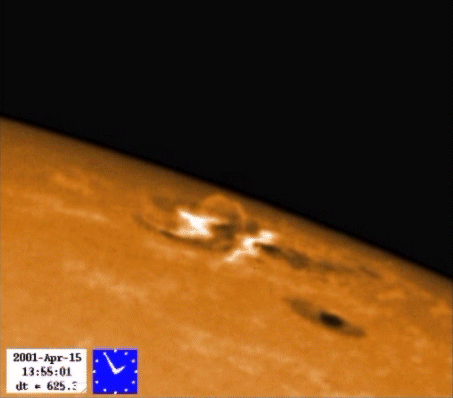
FYI Tim, do you recall that white light TRACE image on my website?

15%20April%202001%20WL.gif


Take a look at the surface of the photosphere during that last flare sequence in SDO images Tim. You can see the excess energy flow up and through the photosphere. In fact the whole thing clearly resembles an electrical discharge inside a cloud covering. Now that the sun is more active, we can even see the materials being blown off the surface during flare activity. The coronal loops are not "heated" in some magical place in the sky, they come THROUGH the surface of the photosphere already radiating at millions of degrees Kelvin.

The energy associated with these high energy flares begins WAY below the surface of the photosphere and the effect of those million degree plasmas can be seen on the surface of the photosphere as they come up and through it's surface.
http://sdo.gsfc.nasa.gov/assets/img/latest/latest_1024_1600.mpg
http://sdo.gsfc.nasa.gov/assets/img/latest/latest_1024_1700.mpg
 
Last edited:
Even compared to the atmosphere of Earth, the surface of the photosphere is "wispy thin" Tim.

That's pretty darn thin Tim. White light penetrates our atmosphere without even working up a sweat and the atoms in our atmosphere are MUCH heavier than hydrogen and helium.

Why the hell would you want to comparing it to the atmosphere of the Earth? One is made of neutral, homonuclear diatomic molecules, the other is made of plasma. They're different.

A 10um sheet of beryllium foil is even thinner than that atmosphere by any possible measure, and it's opaque. A meter-thick slab of lead-glass is thicker than the atmosphere by any possible measure, and it's more transparent.


That's because you folks can't seem to make up your minds. Sometimes is (GM style) "opaque" when you wish it to act like a "black body" (at a single temp no less), and sometimes it's translucent too. :)

No, there's only one criterion we use over and over again. Use physics to figure out the photon cross section. If the laws of physics say it's opaque, we report it to you as opaque. If the laws of physics say it's transparent, we report it to you as transparent. What, do you think we make this stuff up?

Like all real emissions patterns from light plasma, the sun actually acts NOTHING like a pure "black body" at a single temperature. It has discharge process running through it that heat plasma to millions of degrees, both above and below the surface.

Surely you don't believe that the universe has NO temperature (heat) that is related to the light and energy from stars?

The light and energy from stars is called "starlight". We can tell you all about the interactions of starlight with interstellar gases, plasmas, etc.; it's standard physics, not EU/PC guesswork. Do you want to use the laws of physics to calculate how much starlight should heat up the intergalactic medium? Or do you want me to do it for you?
 
This came up on the thread regarding Lambda-CDM cosmology, but this seems like the more appropriate venue for a response.

In retrospect I don't think it's even remotely related to an "electric sun", so perhaps we should continue this part of the discussion in the previous thread.
 
Even compared to the atmosphere of Earth, the surface of the photosphere is "wispy thin" Tim.

http://en.wikipedia.org/wiki/Sun

That's pretty darn thin Tim. White light penetrates our atmosphere without even working up a sweat and the atoms in our atmosphere are MUCH heavier than hydrogen and helium.


It is a fool's errand to compare Earth's atmosphere to that of the Sun like this. Most reasonably observant people have noticed there are somewhat different thermal characteristics, among other significant details.

That's because you folks can't seem to make up your minds. Sometimes is (GM style) "opaque" when you wish it to act like a "black body" (at a single temp no less), and sometimes it's translucent too. :)


The photosphere of the Sun becomes opaque somewhere in the neighborhood of 500 kilometers deep. Nobody can see anything below that point. Opaque, as in no light comes from there or gets through there. From the discussion where this nonsense gets trotted out about seeing a solid surface a few thousand kilometers into the photosphere, it simply can't be done.

Like all real emissions patterns from light plasma, the sun actually acts NOTHING like a pure "black body" at a single temperature. It has discharge process running through it that heat plasma to millions of degrees, both above and below the surface.


Sure. An electrical discharge. Just like lightning here on Earth. Gigantic sparks heating the plasma to millions of degrees. ZZZaaaaappPPP! Oh, wait, not in a conductor like plasma.

Assuming we go deeply enough into the core, sure, eventually all light is likely to be scattered, absorbed, or otherwise blocked. A bunch of wispy light hydrogen plasma won't do that in a few hundred kilometers however. The materials involved in such a process would have to be MUCH more dense than we observe anywhere near the surface.


The photosphere, by definition, is the region where the Sun's atmosphere goes from being transparent to being opaque. It is around 500 kilometers deep.

That pointless BB calculation approximately does nothing to explain those million degree coronal loops, those X7 flares like we saw today, etc. It's not a black body Tim. It doesn't act like one either. Get over it. You folks have an irrational fixation on that term.


Lacking a reasonable understanding of what is meant by "black body", any argument based on it is a pointless argument from ignorance.

You're essentially ignoring several key points. A static universe can be ANY size Tim, it's not limited to a set size like your "faster than light speed", physics defying, creation thingy. It MUST have a "background temperature" that is related to the average energy density of the universe. As long as you keep ignoring these two points, you won't "get it".


To suggest Tim has been describing anything remotely resembling a "'faster than light speed', physics defying, creation thingy" would be, of course, a lie.
 
Why the hell would you want to comparing it to the atmosphere of the Earth?

Because we were defining density measurements, specifically the term "wispy thin", and it's a natural comparison. You'll note that someone at Wiki already beat me to it.

They're different.

I didn't suggest otherwise, I simply noted it's 'wispy thin' in comparison to air, roughly 0.37 percent as dense as air at sea level in fact.

A 10um sheet of beryllium foil is even thinner than that atmosphere by any possible measure, and it's opaque.

Huh? Suppose we measure the average density of the foil sheet, vs the average density of a sheet of air of the same size and thickness? Density is certainly a determining factor.

A meter-thick slab of lead-glass is thicker than the atmosphere by any possible measure, and it's more transparent.

To all wavelengths? Hmmm?

No, there's only one criterion we use over and over again. Use physics to figure out the photon cross section. If the laws of physics say it's opaque, we report it to you as opaque. If the laws of physics say it's transparent, we report it to you as transparent. What, do you think we make this stuff up?

No, of course not. I simply don't think you properly understand the conditions as they exist.

The light and energy from stars is called "starlight". We can tell you all about the interactions of starlight with interstellar gases, plasmas, etc.; it's standard physics, not EU/PC guesswork. Do you want to use the laws of physics to calculate how much starlight should heat up the intergalactic medium? Or do you want me to do it for you?

You're welcome to do that calculation if that makes you happy, but it's bound to be an overly simplistic calculation unless it includes the influence of neutrinos, the electrons traversing an electric universe, cosmic rays and all the other influences that might be involved. You're trying to falsify a concept based on known laws of physics, while quite literally "making up" new laws of physics with invisible "properties" to compare it to. Do you really think you're going to accomplish anything useful by comparing metaphysical apples to empirical oranges?
 
:s2:I see Mozina is back discussing his pretend science.:s2:

Irony overload. Actually I only discuss science that actually works in the lab. Your claims are the ones that actually require 96% "pretend" science with "pretend" forms of energy and "pretend" forms of matter to achieve a "pretend" black body spectrum.
 
Because we were defining density measurements, specifically the term "wispy thin", and it's a natural comparison. You'll note that someone at Wiki already beat me to it.

There is a term of art, "optical thickness", which perhaps you are not familiar with. For understanding radiation transport, you don't care about density (grams per cm^3) you care about optical thickness (probability of scattering per unit distance).

Huh? Suppose we measure the average density of the foil sheet, vs the average density of a sheet of air of the same size and thickness? Density is certainly a determining factor.

Not for radiation transport; we're talking about column density, remember? Visible light can shine right through a 1 kg/cm^2 column of O2 and N2, but it's absorbed by 0.01 g/cm^2 of beryllium. Meanwhile, far-UV light can shine through a few mg/cm^2 of nitrogen, but can easily cross 1kg/cm^2 of xenon. Density is totally irrelevant. When I talk about thickness in a radiation problem we always mean optical thickness.

How is it possible not to know this and think you're qualified to discuss astrophysics? This is basic, basic, basic undergraduate stuff. Go learn it and come back when you're ready to say something well-informed.
 
There is a term of art, "optical thickness", which perhaps you are not familiar with.

I love how you went from "perhaps you are not familiar with" to:

How is it possible not to know this and think you're qualified to discuss astrophysics? This is basic, basic, basic undergraduate stuff. Go learn it and come back when you're ready to say something well-informed.

Nothing like building your own strawman so that you can watch it burn.
 
Status
Not open for further replies.

ISF - Join now!

Every member here is approved by hand. No bots, no spam, just people who care about evidence and honest debate.

Membership is free!

Create your free account

Back
Top Bottom