
You are using an out of date browser. It may not display this or other websites correctly.
You should upgrade or use an alternative browser.
You should upgrade or use an alternative browser.
Merged Discussion of femr's video data analysis
- Thread starter tfk
- Start date


I'm pretty sure I explained my conclusions and my reasoning for those conclusions, prior to those questions. NIST got the initiation time right, or close enough to right to be within the minimum achievable error range.
Are you still set on stating that all motion indicates column buckling ?
As an example of the previous paragraph... You have not offered any alternative explanation of motion, other than a notion regarding "amplification" of smaller-magnitude movements by an unspecified mechanism. Nor have you provided error analysis by which to assess the statistical likelihood that the data in these traces indicates any actual motion at all. So I have concluded that column buckling is the best available explanation, pending a better one.
A great number of Truthers -- possibly not yourself, I don't recall -- have claimed that the rapidity and near-simultaneity of the release and collapse of columns of various buildings on 9/11 are highly suspicious. That implies that slow buckling is the expected norm, what "should have happened" instead. And yet you seem to doubt that slow buckling is even possible. What can I say, except not my problem either way?
Answering these call-out posts of yours is wasting my time. Do you have any new points or any conclusions to discuss?
Respectfully,
Myriad
I'm pretty sure I explained my conclusions and my reasoning for those conclusions, prior to those questions. NIST got the initiation time right, or close enough to right to be within the minimum achievable error range.
As an example of the previous paragraph... You have not offered any alternative explanation of motion, other than a notion regarding "amplification" of smaller-magnitude movements by an unspecified mechanism. Nor have you provided error analysis by which to assess the statistical likelihood that the data in these traces indicates any actual motion at all. So I have concluded that column buckling is the best available explanation, pending a better one.
A great number of Truthers -- possibly not yourself, I don't recall -- have claimed that the rapidity and near-simultaneity of the release and collapse of columns of various buildings on 9/11 are highly suspicious. That implies that slow buckling is the expected norm, what "should have happened" instead. And yet you seem to doubt that slow buckling is even possible. What can I say, except not my problem either way?
Myriad, why not just be honest and admit that you have no idea what that early motion signifies?
NIST didn't detect it, Femr did, and to be honest, none of us have a clue what is making the building sway over that time.
Why pretend you have some answer or explanation when you have none?
>>>>>>>>>>>>>>.
If it helps get the ball rolling, I'll be the first to admit I have no freaking clue what could make the building sway like that in the period leading up to the first visible motion reported by the NIST.
To me it is a total mystery. To this I would add, just as I did earlier before the last "intellectual mugging" I endured:
To discover "how and why" WTC7 collapsed is their stated goal.
Bad drop data cannot help you in determining the "how". Good drop data will, but bad data certainly will not.
The more mistakes made, the further away from determining how.
Or just as I was summarizing your last arguments on the early acceleration profile, the same seems to apply now:
Don't you know that the NIST already discovered the "how"......Well, kind of....I mean...enough for the stated purposes of the NIST report which is......to discover the how and why of the collapse....................but........they did it well enough for their purposes which was.....
Hell, femr.......everybody knows what happened anyway......because the NIST proved it............well. they proved it enough.....um......
Last edited:
Myriad, why not just be honest
and admit that you have no idea what that early motion signifies?
Because it's not possible to be honest and lie simultaneously.
Respectfully,
Myriad
There was quite a bit left unsaid (and unanswered). I'll summarise later.I'm pretty sure I explained my conclusions and my reasoning for those conclusions, prior to those questions.
Which one ? Are you referring to their global T0 at the first visible sign of East penthouse descent ? (Which by definition is after propogation of failures from lower in the building), or do you mean their rather flawed (for the many reasons I've highlighted) T0 for vertical descent of the North facade ?NIST got the initiation time right, or close enough to right to be within the minimum achievable error range.
Either way, I suggest your statement above is simply highlighting your lack of interest in determining accurate values.
I'll suggest one now if you like...*breakage* of structural support, rather than buckling. Such breakage could include things like floor sections becoming detached from the core. Such behaviour is not what I would term *buckling* which implies a rather different and gradual process. Shearing, fracture...As an example of the previous paragraph... You have not offered any alternative explanation of motion, other than a notion regarding "amplification" of smaller-magnitude movements by an unspecified mechanism.
Motion is detectable around 6 minutes prior to release.
Are you suggesting slow buckling of vertical supports over this period of time causing oscillatory motion of the building ?
Are you forgetting that the late motion was analysed by NIST ? ...Nor have you provided error analysis by which to assess the statistical likelihood that the data in these traces indicates any actual motion at all.

There's an entire appendix for analysis of such...
NCSTAR1-9 Vol 2 - Appendix C - VIDEO ANALYSIS OF WTC 7 BUILDING VIBRATIONS
As I have already shown you...

...my methods and data compare extremely well (and exceed NISTs accuracy imo).
The longer timescale traces...
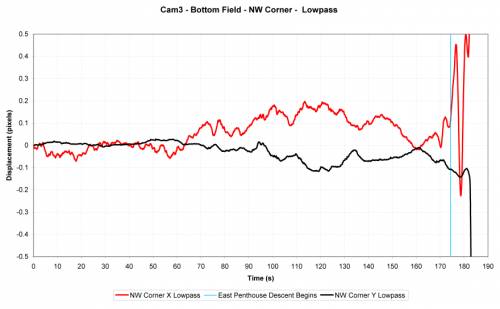
...include that late motion at the end of the trace.
The magnitude of the motion between T=60s and T=160s in my trace above is at least twice that of the initial oscillation within the NIST *moire* based trace.
If you accept the validity of the NIST trace, you should have no real doubt about the validity of my data.
Have you read Appendix C in detail ?
Assuming you have refreshed your reading of Appendix C, do you still hold by that ?So I have concluded that column buckling is the best available explanation, pending a better one.
I have received all manner of insult and abuse from folk here for providing data which clearly shows that premise to be false. Kinda ironic I rekn.A great number of Truthers -- possibly not yourself, I don't recall -- have claimed that the rapidity and near-simultaneity of the release and collapse of columns of various buildings on 9/11 are highly suspicious.
I don't think slow buckling is the cause of the very early motion. As I've said above, I suggest that it may be caused by fractures of horizontal members, rather than buckling of vertical columns, reducing the the rigidity of the building low down, and allowing the building to oscillate.That implies that slow buckling is the expected norm, what "should have happened" instead.
I'd reiterate that I think the point of inflexion around the 160s mark may indicate the final *teeter* in your previously mentioned terms.
Nonsense. I've highlighted early motion, but I think there are other reasons for the very early motion. Catch-all slow buckling of columns does not answer-all behavioural questions.And yet you seem to doubt that slow buckling is even possible.
If you want to understand the motion and sequence of the demise of the building, I don't see how you can avoid drilling into more detail.What can I say, except not my problem either way?
I don't see it as call-out at all. Being specific, you answered the first third of my indicated post and ignored the final two thirds. I've been asking you to address the final two thirds. Call out ? No. Completeness.Answering these call-out posts of yours is wasting my time.
I'd like you to confirm you think that all motion whether vertical or horizontal indicates column buckling. I think you're wrong...Do you have any new points or any conclusions to discuss?
By the wording stated, absolutely, and therefore pre-decisional. Not a good start to a scientific study which includes analysis to determine whether there was any nefarious activity. Tsk, tsk
You already have my answer.
Really ? So what, other than observation and interpretation of such observation applied to everything else they chose to investigate, is their purpose actually based upon ?
Is it their virtual model ?
Well, it's useful to understand that their descent simulation was based upon a model which was never going to do anything except collapse...

Do you understand the significance of this diagram ?
As an aside, this is veering significantly off-topic. I suggest if you wish to pursue this line of discussion that you start a new thread. (I'm likely to ignore (much to NoahFence's CAPITALISED dismay, lol) discussion not on-topic).

I would LOVE to hear you give your personal interpretation of what these curves mean.
Please also explain how you conclude that these curves result in a building that can "never do anything except collapse."
Really ? How strange. They are clearly...I would LOVE to hear you give your personal interpretation of what these curves mean.
Gradual application (increase from zero) of gravity to the model over a period of 4.5s
Increase of temperature to modelled maximums over a period of 2s
What answer were you expecting exactly ?

The *curves* have nothing to do with my statement, the obviousness of which is clear by simply understanding the time-frame of the setup sequence.Please also explain how you conclude that these curves result in a building that can "never do anything except collapse."
Do you understand the significance of the diagram ?
Tell me, how long after application of *ANSYS damage* did collapse ensue ?
Did the model run for a few hours of simulated time then collapse, or did it immediately crumple like a overgrown tin can ?
Did collapse ensure before application of *ANSYS damage* ?
Last edited:
Horizontal motion began minutes prior to release.NIST timed the beginning of vertical motion ("the instant the roofline began to descend"), which would occur with the beginning of buckling, which also includes horizontal motion.
Do you think that motion indicates buckling, or not ?
Motion began minutes prior to release.They didn't time the collapse from "several minutes earlier" because the wall did not collapse several minutes earlier. I don't really know what else to say about that.
Do you agree that you are inadverntently highlighting your subjective interpretation of when you think the *release point* is ?
That subjective interpretation simultaneously coincides with *what NIST said* and directly contradicts what you have said about motion indicating buckling.
What is it to be, reaffirm your agreement with NIST whilst rescinding your previous assertion, or t'other way around, or a bit of both ?
What is it to be, reaffirm your agreement with NIST whilst rescinding your previous assertion, or t'other way around, or a bit of both ?
Consider it as the reaffirmation of the mystery of faith in the NIST.
Praise be to NIST.
A non-believer like you wouldn't understand. Sometimes in science you have to close your eyes and jump. Myriad understands that.
.................
It is just like the WTC1 and 2 collapse initiation sequences and movements. Who needs to study when your faith is firm and unshakable? Who needs all those stinking measurements or threads on the subjects when you know what happened in your gut?
Last edited:
Horizontal motion began minutes prior to release.
Do you think that motion indicates buckling, or not ?
Yes. (Applies to motion too rapid to be accounted for by direct thermal displacement, as explained before when you asked this exact same question.)
Motion began minutes prior to release.
So? Bucking is not release, and buckling of some part of the structure is not necessarily buckling of the north wall.
Do you agree that you are inadverntently highlighting your subjective interpretation of when you think the *release point* is ?
Sorry? Have I said anything about when a "release point" was? What event or events physically define a release point? I'd think any reasonable meaning of release point as applied to the north wall would correspond to the start of what NIST called Stage 2, but that isn't what we were talking about, is it? Is the timing of Stage 2 in question now?
That subjective interpretation simultaneously coincides with *what NIST said* and directly contradicts what you have said about motion indicating buckling.
Say what now?
What is it to be, reaffirm your agreement with NIST whilst rescinding your previous assertion, or t'other way around, or a bit of both ?
Huh?
This discussion is exhibiting a rapid decay of coherence. I suggest you make an effort to regroup upon some sort of point.
Respectfully,
Myriad
It is just like the WTC1 and 2 collapse initiation sequences and movements.
Since this thread is about femr2's video data analysis of building 7, please clarify: in what way is what like the WTC1 and 2 collapse initiation movements? Has femr2 also done video data analysis of those events, and if so, what insight from that analysis applies to the current discussion?
Respectfully,
Myriad
So not connection failures then ?Yes. (Applies to motion too rapid to be accounted for by direct thermal displacement, as explained before when you asked this exact same question.)
And other failure modes exist apart from buckling.So? Bucking is not release, and buckling of some part of the structure is not necessarily buckling of the north wall.
I'm giving you every opportunity of including other failure modes (or causes of motion), but you seem singularly focussed upon buckling. Why ?
Have you noticed that the vertical trace component oscillates ? Would you say there is or is not any actual vetical descent ?
Yes, of course.Sorry? Have I said anything about when a "release point" was?
I'd disagree. I'd, obviously, define the release point as T=0 for the structure in question.What event or events physically define a release point? I'd think any reasonable meaning of release point as applied to the north wall would correspond to the start of what NIST called Stage 2
Do you still agree with the NIST T=0 for the North facade then ?
The discussion has been about the release point for many pages Myriad. Why steer yourself into incredulity ? Oh, I see....but that isn't what we were talking about, is it?
Dear me Myriad, talk about intentional confusion.Is the timing of Stage 2 in question now?
In what way do you think discussion of the NIST T=0, the period of *freefall*, the timing of that period, the over-g nature of a portion of it...is NOT discussion of the *timing of stage 2* ?

Awkward questions ?Say what now?
Huh?
The loss of coherence is entirely your own I'm afraid, either by you losing track of the discussion, or choosing to do so.This discussion is exhibiting a rapid decay of coherence. I suggest you make an effort to regroup upon some sort of point.
As I said a while back, I'll summarise our recent dialogue soon

Last edited:

Are you even capable of answering a post without being condescending? Myriad was asking for clarification, and you basically called him a liar. A simple 'yes' would've sufficed.Dear me Myriad, talk about intentional confusion.
In what way do you think discussion of the NIST T=0, the period of *freefall*, the timing of that period, the over-g nature of a portion of it...is NOT discussion of the *timing of stage 2* ?
So not connection failures then ?
Connection failures might be the cause of buckling. But connection failures without buckling do not cause movement.
Consider, for example, a horizontal girder that detaches from its column at one end. That would cause a torque on the column that it's still attached to, which could cause that column to displace horizontally and possibly vertically. Likewise the column detached from could suffer from unbalanced lateral forces or insufficient bracing as a result, causing that column to displace horizontally and possibly vertical.
Guess what? Those column displacements are buckling. A displaced column is no longer vertical.
And other failure modes exist apart from buckling.
I'm giving you every opportunity of including other failure modes (or causes of motion), but you seem singularly focussed upon buckling. Why ?
Because only buckling releases energy in a way that can do work on the rest of the structure, and work is necessary to cause movement or distortion.
Have you noticed that the vertical trace component oscillates ? Would you say there is or is not any actual vetical descent ?
Something in the structure descended vertically, to provide the energy to cause the oscillation. That doesn't necessarily mean the specific small part you're measuring descended vertically (except in the sense that unless members are able to stretch or have become detached from the ground, horizontal movement without some small amount of vertical movement is geometrically impossible -- but that amount would probably be too small to directly observe).
I'd disagree. I'd, obviously, define the release point as T=0 for the structure in question.
T=0 is not a physical event. Time did not start at T=0. I'll ask again, what event or events physically define a release point?
How can you argue about the timing of an event you have not defined?
Do you still agree with the NIST T=0 for the North facade then ?
Within the available margins of error, yes.
The discussion has been about the release point for many pages Myriad. Why steer yourself into incredulity ?
Because I realize I've been wasting time discussing the timing of an event that is not physically defined. Start with a circular definition (the release point is T=0, T=0 is set at the release point) and it's no surprise to get a circular argument. Define the release point physically, and we can continue that discussion.
Hint: Both yours and NIST's methods of placing T=0 depend upon events subsequent to the T=0 mark itself. That is, if I were to feed you or NIST the data points one at a time in chronological order, you would not be able to identify T=0 by your methods until you'd seen data from well past the T=0 point you ultimately choose. That suggests that your definition, like NIST's, would not take the form of "the occurrence of instantaneous event X", but rather, "the beginning of the duration of sustained event Y."
In what way do you think discussion of the NIST T=0, the period of *freefall*, the timing of that period, the over-g nature of a portion of it...is NOT discussion of the *timing of stage 2* ?
Because the NIST T=0 defines the beginning of Stage 1. The timing of Stage 2 is defined by different physical events (from the observed velocity-vs-time curve becoming approximately linear, until it is no longer so) and would not be affected at all by moving the time marker of the beginning of Stage 1.
We seem to agree that the "over-g nature" of a portion of the curtain wall collapse is most likely due to dynamic interaction with the building's core that was already in a later stage of collapse when the wall collapse began. I said so years ago. What is the relevance of the choice of T=0 (start of Stage 1) definitions to that issue?
Your arguments seem to be based entirely on your finding it unbearable that I should agree with NIST's findings on any point. Is that it, and if so, why should I or anyone care?
Respectfully,
Myriad
femr,
Ahhh, I thought something like this was afoot.
You said to pgimeno:
The CLEAR implication of the "…" that one thing has something to do with the other...
... but when challenged to state that connection, you state that "the curves have nothing to do with [your] statement".
In other words, you get into a discussion with someone, JAQ off all over the place, make an wholly unsupported assertion (NIST's simulation was rigged to collapse) and then with zero warning switch topics & post some random, unrelated set of curves. Along with a call-out challenge.
In other words, once again you post words that merely appear to have content. But, when examined, have none whatsoever…
Yes I do.
You challenged pgimeno to explain them.
I invited you to meet your own challenge..
Now you are dancing & dodging.
You are invited to explain the curves.
You're still dancing…
You are invited to explain the curves.
You're still dancing…
You are invited to explain the curves.
You're still dancing…
Nothing new here...
tom
The *curves* have nothing to do with my statement, the obviousness of which is clear by simply understanding the time-frame of the setup sequence.
Ahhh, I thought something like this was afoot.
You said to pgimeno:
Well, it's useful to understand that their descent simulation was based upon a model which was never going to do anything except collapse...
Do you understand the significance of this diagram ?
The CLEAR implication of the "…" that one thing has something to do with the other...
... but when challenged to state that connection, you state that "the curves have nothing to do with [your] statement".
In other words, you get into a discussion with someone, JAQ off all over the place, make an wholly unsupported assertion (NIST's simulation was rigged to collapse) and then with zero warning switch topics & post some random, unrelated set of curves. Along with a call-out challenge.
In other words, once again you post words that merely appear to have content. But, when examined, have none whatsoever…
Do you understand the significance of the diagram ?
Yes I do.
You challenged pgimeno to explain them.
I invited you to meet your own challenge..
Now you are dancing & dodging.
Tell me, how long after application of *ANSYS damage* did collapse ensue ?
You are invited to explain the curves.
You're still dancing…
Did the model run for a few hours of simulated time then collapse, or did it immediately crumple like a overgrown tin can ?
You are invited to explain the curves.
You're still dancing…
Did collapse ensure before application of *ANSYS damage* ?
You are invited to explain the curves.
You're still dancing…
Nothing new here...
tom
Last edited:
Absolutely, but your inept assertion that the curves are significant merely draws attention to your lack of understanding, whilst simultaneously ignoring the questions I asked you, to confirm your understanding, which, surprise surprise, you've ignored.The CLEAR implication of the "…" that one thing has something to do with the other...
Nonsense. I've already told you the answer to that, and it would seem to have gone entirely over your head. Another surprise... but when challenged to state that connection, you state that "the curves have nothing to do with [your] statement".
 ...
...Tell me, how long after application of *ANSYS damage* did collapse ensue ?
Did the model run for a few hours of simulated time then collapse, or did it immediately crumple like a overgrown tin can ?
Did collapse ensure before application of *ANSYS damage* ?
Guess you didn't want to answer these questions.
See questions above, and bear in mind the simulation timescales. The model was not going to do anything except collapse. Numerous prior (and prior to writing of the actual report) assertions make that clear.make an wholly unsupported assertion (NIST's simulation was rigged to collapse)
ROFL. Hilarious Tom. You really don't seem to understand that the curves are utterly irrelevant. It is the setup sequence which is of import. Answer my questions above, and you'll perhaps begin to understand the diagram you've already said you understand...and then with zero warning switch topics & post some random, unrelated set of curves. Along with a call-out challenge.
ROFL. tfk can't separate the information contained within a diagram from *some curves* and his inept interpretation about their significance (or not, in this case). Go on tom, ask me about *THE CURVES* again.In other words, once again you post words that merely appear to have content. But, when examined, have none whatsoever…

The curves ! The curves ! ROFL. Start by answering my questions. We can then drill into the numerous instances of the report which lead to the diagram in question. I see the word coming up shortly, so, dance !Yes I do.
No you didn't. You, at the pinnacle of ineptitude, decided *THE CURVES* were significant, which they really aren't within context, then asked...You challenged pgimeno to explain them.
I invited you to meet your own challenge..
You are a funny man. IF you did actually understand what I was saying, and the diagram...you'd have answered my questions. You chose not to. Big surprise yet againI would LOVE to hear you give your personal interpretation of what these curves mean.
Please also explain how you conclude that these curves result in a building that can "never do anything except collapse."
ROFL...Now you are dancing & dodging.
Might be a good idea to address these questions, you know.The *curves* have nothing to do with my statement, the obviousness of which is clear by simply understanding the time-frame of the setup sequence.
Do you understand the significance of the diagram ?
Tell me, how long after application of *ANSYS damage* did collapse ensue ?
Did the model run for a few hours of simulated time then collapse, or did it immediately crumple like a overgrown tin can ?
Did collapse ensure before application of *ANSYS damage* ?
ROFL. Already have...You are invited to explain the curves.
Get a grip tom.Really ? How strange. They are clearly...
Gradual application (increase from zero) of gravity to the model over a period of 4.5s
Increase of temperature to modelled maximums over a period of 2s
What answer were you expecting exactly ?
Nonsense.You're still dancing…
ROFL. See above.You are invited to explain the curves.
You're still dancing…
ROFL. See above.You are invited to explain the curves.
You're still dancing…
Once you have your head around the actual significance of the diagram...which answering my questions will help you reach...you will find *new things*. Not new for me, but certainly new for you.Nothing new here...
I see you avoiding the questions with utter ignorance, so here y'are...
How long after application of *ANSYS damage* did collapse ensue ?
Immediately.
Did the model run for a few hours of simulated time then collapse, or did it immediately crumple like a overgrown tin can ?
It immediately crumpled like a overgrown tin can.
Did collapse ensure before application of *ANSYS damage* ?
No.
See how easy this actually is, if you don't choose to avoid questions ?
Final step, ansys damage applied...IMMEDIATE collapse ensued. What else was going to happen ?
You think it was going to stay up ?
Wow.Wind causes movementConnection failures might be the cause of buckling. But connection failures without buckling do not cause movement.
So does heat. So does...So you consider all flexing motion to be the result of buckling. Interesting.Guess what? Those column displacements are buckling. A displaced column is no longer vertical.
I assume this is linked to your statement above. Hmm. Rather boxing yourself in don't you think ?Because only buckling releases energy in a way that can do work on the rest of the structure, and work is necessary to cause movement or distortion.
Why not lateral restraint ?Something in the structure descended vertically, to provide the energy to cause the oscillation.
Do you think it would be possible to detect the effect of wind upon a 47 storey structure ?That doesn't necessarily mean the specific small part you're measuring descended vertically (except in the sense that unless members are able to stretch or have become detached from the ground, horizontal movement without some small amount of vertical movement is geometrically impossible -- but that amount would probably be too small to directly observe).
Agreed.T=0 is not a physical event.
As you already know T=0 is subjective, but is most simply put as the point in time at which, in this context, unrecoverable vertical motion begins. Pretty simple really.I'll ask again, what event or events physically define a release point?
It's been defined many timesHow can you argue about the timing of an event you have not defined?
What margin ? For the North facade, or that central location, or the NW corner, or the building ?Within the available margins of error, yes.
Release point has been defined many times. Want a list ?Because I realize I've been wasting time discussing the timing of an event that is not physically defined.
See above, again.Start with a circular definition (the release point is T=0, T=0 is set at the release point) and it's no surprise to get a circular argument. Define the release point physically, and we can continue that discussion.
Absolutely. Especially from the Cam#3 viewpoint.Hint: Both yours and NIST's methods of placing T=0 depend upon events subsequent to the T=0 mark itself. That is, if I were to feed you or NIST the data points one at a time in chronological order, you would not be able to identify T=0 by your methods until you'd seen data from well past the T=0 point you ultimately choose.
Absolutely, start of non-recoverable vertical descent.That suggests that your definition, like NIST's, would not take the form of "the occurrence of instantaneous event X", but rather, "the beginning of the duration of sustained event Y."
You have to bear in mind you are choosing the NIST data, which suffers from numerous perspective related distortions and issues...
It's meaningless. That point was in motion long beforehand. A point I HOPE you don't ignore.Because the NIST T=0 defines the beginning of Stage 1.
We can revert to near-at-over g discussion shortly I am sure.The timing of Stage 2 is defined by different physical events (from the observed velocity-vs-time curve becoming approximately linear, until it is no longer so) and would not be affected at all by moving the time marker of the beginning of Stage 1.
Absolutely.We seem to agree that the "over-g nature" of a portion of the curtain wall collapse is most likely due to dynamic interaction with the building's core that was already in a later stage of collapse when the wall collapse began.
NIST T=0 is slightly too early.What is the relevance of the choice of T=0 (start of Stage 1) definitions to that issue?
You can agree with NIST if you please, regardless of how many conflicting assertions are provided with supporting data, but by throwing out all other assertions you simply CHOOSE NIST, and not for the right reasons.Your arguments seem to be based entirely on your finding it unbearable that I should agree with NIST's findings on any point. Is that it, and if so, why should I or anyone care?
Perhaps I'll provide higher resolution data from the points NIST actually used.
Suggest all get back on topic.off topic
You have a smoothing method better than Savitzky-Golay ?femr2 smooths acceleration using silly methods
Last edited:
Reactor drone
Graduate Poster
- Joined
- May 22, 2009
- Messages
- 1,214
Once you have your head around the actual significance of the diagram...which answering my questions will help you reach...you will find *new things*. Not new for me, but certainly new for you.
I see you avoiding the questions with utter ignorance, so here y'are...
How long after application of *ANSYS damage* did collapse ensue ?
Immediately.
Did the model run for a few hours of simulated time then collapse, or did it immediately crumple like a overgrown tin can ?
It immediately crumpled like a overgrown tin can.
Did collapse ensure before application of *ANSYS damage* ?
No.
See how easy this actually is, if you don't choose to avoid questions ?
Final step, ansys damage applied...IMMEDIATE collapse ensued. What else was going to happen ?
You think it was going to stay up ?
Do you have an issue with the results of the 16 storey ANSYS analysis and how would you apply them to the LS-DYNA model?
For reference, the development of the kink (t=0) is at 16 seconds on that graph.

For a gravity collapse of a building? Yes, but then I am an engineer, and I do this for a living; engineering. You have not made a case for use of "your" filter or methods. You have not made much of anything with your goal free pursuit to back in your failed inside job claim, as you fail to produce evidence to support your Fictional Official Theory claim. You make up procedures and techniques that have no bearing on what your goal is. What was your goal? It only gets worse for you, as you continue to beat a dead horse and smooth it out to look like music, or a French curve. What was your overall goal and how does it fit with your claim of the "fictional official theory", your version of the inside job....
You have a smoothing method better than Savitzky-Golay ?
Conspiracy Theories » 9/11 Conspiracy Theories » Discussion of femr's video data analysis ...
How does your work relate to 911 truth's moronic claims of an inside job, the CD lies, and other fantasy claims of 911 truth?
Your work is nonsense, and one big reason we will not be seeing it in a journal where it would be ripped apart as, guess what? ... nonsense. You keep plugging away and one day you might figure out WTC 7 fell due to fires out of control, fires not fought. Good luck.
Last edited: