• Security incident: ISF was recently accessed by intruders. Please change your password, and change it anywhere else you used it. Read more

Merged DDWFTTW in a “Real” Wind

Status
Not open for further replies.
Clearly, humber is still pretty confused. The only time the rotor of a ddfttw cart acts as a turbine in any sense is at startup.
And so won't do well after that, but will stall below WS.

However, because of relationship of pitch, gearing and wheel size, the drag from the tailwind overcomes the torque the tailwind generates on the rotor.
Forces oppose at the blade surface. F=ma.
Gears transmit the resultant (net) force. The only work at the wheel is that due to rolling resistance.

Once the cart is in motion, the rotor is a propeller, pure and simple and generates thrust that accelerates the cart.
No, it never gets to WS by that means, but by tacking.
Above WS, the tailwind is gone, and the apparent wind of motion becomes the turbine force on the prop. If you say the wheels are driving the rotor as a prop, then you need to say where the energy comes from to do that, when the wind is doing the contrary. Spork has the rotor around the wrong way. He was told that many times. It will still fail, but at least coherently so.

This is why the cart is a real slug "off the line" and starts a lot better if given a push. However, far from being a disaster, it is what allows the cart to continue accelerating beyond wind speed.
NALSA say most starts were push starts. It stalls at around walking pace in the Jenkins' video. Yes, it does start to accelerate when the cart gets near the WS, because, wait for it, the wind has changed relative to the vehicle to produce from there the state of "WS". But, that "WS" is not at the average speed of the wind, but less. From a moving vehicle "windspeed" is apparent too. Not a coincidence of WS and wind change, but of one being the product of the other.

Of course, in humber logic, a successful downwind cart is a failed upwind cart.
It hilariously is. The rotor is geared "up". The larger sprocket is on the prop, so reducing the turbine force that would drive it backwards against the sail force. It's a failed upwind cart, which limps downwind by purposeful selection of the gears.

That later trick works against the cart when above WS, because from the wheel's perspective, more torque must be generated in the wheel axle to provide the same torque at the prop shaft.
 
Last edited:
.
Finally something more than "No".
Looking at the prop on the right side of the cart from the right side of the cart,
the leading edge of the prop is going down, to the right. Like the inset image of the prop I put there.
Black prop on this image.
Looking at the prop on the left side of the cart from the left side of the cart,
the leading edge of the prop the prop is going up, to the left. Green prop on this image.
Neither situation is represented in "C", which shows a ----pusher prop--- left hand twist, in propellor terms.
Ever so charming to converse.

That's because it is an "above wind prop", so it is the "wrong way" by conventional standards.
All props will turbine, but better one way than the other. That is seen in the short video I made, but what is not seen, is how well it behaves as a prop, when driven to speed via the axle.

When the cart is facing fan, it gets blown backwards. The fan is not exactly like the >WS headwind, because it is not generated by motion of the cart, but is an independent energy source. But that demonstrates that if the cart tries to gain energy from the wind, even if it were there, it still goes backwards.
Two major errors at the same time. One is to hope to gain energy from a wind that is the result of the cart's motion, so PM, and the other is a mechanical error, the denies the first idea anyway.

attachment.php
 

Attachments

  • prop_turbine3.jpg
    prop_turbine3.jpg
    24.5 KB · Views: 68
Backford's math is fine. It just doesn't show DDWFTTW to be impossible.

Your "opinion" that Backford's paper shows DDWFTTW to be impossible carries no weight at all.
It's "fine" is it? How convenient for you.
In other words: you can't support your claim using the math.
 
Last edited:
That's because it is an "above wind prop", so it is the "wrong way" by conventional standards.
All props will turbine, but better one way than the other. That is seen in the short video I made, but what is not seen, is how well it behaves as a prop, when driven to speed via the axle.

When the cart is facing fan, it gets blown backwards. The fan is not exactly like the >WS headwind, because it is not generated by motion of the cart, but is an independent energy source. But that demonstrates that if the cart tries to gain energy from the wind, even if it were there, it still goes backwards.
Two major errors at the same time.
Yours
One is to hope to gain energy from a wind that is the result of the cart's motion, so PM,
Still wrong no matter how many times you repeat it. The cart get's its energy from the tail wind, via the propeller, not from the head wind it generates. You are correct that getting energy from the wind generated by its own motion is impossible. You are completely wrong in your belief that this is what the cart is trying to accomplish. I was wondering what you though you were proving when you turned the cart around. One more time. Wheels drive the propeller, creating thrust.
and the other is a mechanical error, the denies the first idea anyway.
I have no idea what this is supposed to mean.
[qimg]http://www.internationalskeptics.com/forums/attachment.php?attachmentid=21760&stc=1&d=1302460526[/qimg]
Confused diagram by confused person.
 
Last edited:
And so won't do well after that, but will stall below WS.


Forces oppose at the blade surface. F=ma.
Gears transmit the resultant (net) force. The only work at the wheel is that due to rolling resistance.


No, it never gets to WS by that means, but by tacking.
Above WS, the tailwind is gone, and the apparent wind of motion becomes the turbine force on the prop. If you say the wheels are driving the rotor as a prop, then you need to say where the energy comes from to do that, when the wind is doing the contrary. Spork has the rotor around the wrong way. He was told that many times. It will still fail, but at least coherently so.


NALSA say most starts were push starts. It stalls at around walking pace in the Jenkins' video. Yes, it does start to accelerate when the cart gets near the WS, because, wait for it, the wind has changed relative to the vehicle to produce from there the state of "WS". But, that "WS" is not at the average speed of the wind, but less. From a moving vehicle "windspeed" is apparent too. Not a coincidence of WS and wind change, but of one being the product of the other.


It hilariously is. The rotor is geared "up". The larger sprocket is on the prop, so reducing the turbine force that would drive it backwards against the sail force. It's a failed upwind cart, which limps downwind

In humberese 2.7 x windspeed is limping
by purposeful selection of the gears.

That later trick works against the cart when above WS, because from the wheel's perspective, more torque must be generated in the wheel axle to provide the same torque at the prop shaft.

More torque at the wheels, but more speed from the prop.

Apparently, humber is now conceding that the wheels drive the prop, and abandoning his ridiculous assertion that the "headwind" is driving the prop as a turbine. Then again, maybe not. Humber has repeatedly shown himself able to believe two mutually exclusive things at the same time.
 
Actually, on the BB (in its record run configuration), there is always about 3 (60/22) X the torque on the prop shaft than on the axle.
 
Last edited:
Yours

Still wrong no matter how many times you repeat it. The cart get's its energy from the tail wind, via the propeller, not from the head wind it generates. You are correct that getting energy from the wind generated by its own motion is impossible. You are completely wrong in your belief that this is what the cart is trying to accomplish. I was wondering what you though you were proving when you turned the cart around. One more time. Wheels drive the propeller, creating thrust.

I have no idea what this is supposed to mean.

Confused diagram by confused person.

The same prop surface accelerates and decelerates the same air.
You lose. TM sucker bait. Trials a farce.
 
In humberese 2.7 x windspeed is limping
Jenkins video: Cart is less than walking pace for 1min:20sec

I
More torque at the wheels, but more speed from the prop.
More opposing torque at the wheel. Less at the prop.

Apparently, humber is now conceding that the wheels drive the prop, and abandoning his ridiculous assertion that the "headwind" is driving the prop as a turbine. Then again, maybe not. Humber has repeatedly shown himself able to believe two mutually exclusive things at the same time.

Nope, just putting more holes in your sieve.
 
Humber loves argument from authority. If the authority doesn't actually support humber, he just claims that it does.

Oh, really? Do show me where Drela's paper is anything like Spork's claim.
Blackford's too. I need to see that you have the necessary tools to get into the ring.
Drela did not address Spork of JB, nor did he refer to anything they posted.
Snubbed, in fact.
 
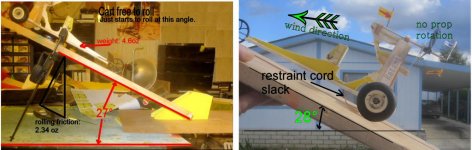
Some observations from yesterday's inclined plane tests...
The freewheeling prop cart makes .65 oz of thrust... That holds the restraining cord taut.
Any steeper angle on the inclined plane and the cart rolls backwards.
Didn't have the foresight to try it with the prop fixed. :(
The geared cart has 2.34 oz of static friction indoors.. the inclined plane at 27 degrees.
Outside, in the wind at that time, it would sit still on the inclined plane at 28 degrees.. same angle..
Observation: The prop on the geared cart has to provide more that 2.34 oz of drag to get the cart to go up the inclined plane.
The prop didn't rotate, only rotation the geared prop did was in the wrong direction, as the inclined plane angle increased to where the cart began to go down (upwind) on the inclined plane.
And today is a no-wind day in the Antelope Valley.
 

Attachments

  • jrFreewheelingPropCartUphill.jpg
    jrFreewheelingPropCartUphill.jpg
    99.1 KB · Views: 1
  • RollingFriction-DrivenCar-02t.jpg
    RollingFriction-DrivenCar-02t.jpg
    74.9 KB · Views: 1
Some observations from yesterday's inclined plane tests...
The freewheeling prop cart makes .65 oz of thrust... That holds the restraining cord taut.
Force down incline due to gravity = [latex]m.g.Sin\theta[/latex]
Wind force on the cart equals that.

The geared cart has 2.34 oz of static friction indoors.. the inclined plane at 27 degrees.
The gearing will produce more rolling friction than the free-wheeler does, so will roll back at a higher angle that the free-wheeler will. That will make it difficult to make valid comparisons in the wind, I Ratant. The test is static, so will be influenced by the static friction. Perhaps instead of a restraint, the carts should do work against a load, such as a suspended mass. Like the coffee cup?

Outside, in the wind at that time, it would sit still on the inclined plane at 28 degrees.. same angle..
Observation: The prop on the geared cart has to provide more that 2.34 oz of drag to get the cart to go up the inclined plane.
The prop didn't rotate, only rotation the geared prop did was in the wrong direction, as the inclined plane angle increased to where the cart began to go down (upwind) on the inclined plane.
And today is a no-wind day in the Antelope Valley.

Put them side by side in the wind, and ensure the wheels cannot lift, I Ratant. That is only holding TAD to their own claim: the wheels drive the prop. Why should they object?
When that is done, the free-wheeler will thrash the geared cart.
 
Originally Posted by EHocking
I agree - the article has bears no relationship to the land carts in question.
It does...
Ah, so when you think an opinion supports your incorrect assumption (which it actually doesn't) a boat IS like a land based cart - except when it isn't...
...2) Second error. Comparing a self-steering boat which has both air and water flow. The latter is in a dense fluid
These are factors that engineers call "different".
:boggled:
 
Status
Not open for further replies.

ISF - Join now!

Every member here is approved by hand. No bots, no spam, just people who care about evidence and honest debate.

Membership is free!

Create your free account

Back
Top Bottom