• Security incident: ISF was recently accessed by intruders. Please change your password, and change it anywhere else you used it. Read more

Merged DDWFTTW in a “Real” Wind

Status
Not open for further replies.
Doh. Make the table glass, and you can have an "observer" give you the same answer.
It's unclear what you mean but if you're implying that flipping the reel over is equivalent to looking at it from below through a glass tabletop then you are wrong. I wonder if you can figure out why.
When you try it as shown in the upper photo, things will not go well.
But, that is what you are hoping with the rack and gear.
Again, it's not clear what you have in mind. Pulling on both ends of the cord is equivalent to pulling on both ends of the chain in the gearwheel example. I don't see what you think that would achieve, nor why you think that is what anyone is "hoping" with the gear and rack.
When tensioned, the best you can do is drag the reel at the speed of the hand.
That's just not true. I can pull the ends of the cord just tightly enough to prevent the cord slipping on the reel and the result is that when I move the cord left and right the reel moves left and right and, importantly, it does not move at the same speed as the cord. Nothing slides. Nothing is dragged. It just rolls.
If you use one hand and allow the reel to turn, as in the lower photo ( I used a strip of leather but a shoelace should work), it too moves at the speed of the hand, but rolls.
Then the cord must be slipping on the reel because it is so loose. If it happens to move at exactly the same speed as your hand then that is a coincidence.
...Then don't give counter-arguments that employ grativty
When did I do that?
 
When tensioned, the best you can do is drag the reel at the speed of the hand.

Then your reel is too slippery. I just did it with a dumbell with grip tape on the handle and a piece of twine, and it works very easily. I can apply light tension or almost enough tension to break the twine and it still works.
 
It's unclear what you mean but if you're implying that flipping the reel over is equivalent to looking at it from below through a glass tabletop then you are wrong. I wonder if you can figure out why.
And that is evasion by rhetoric

Again, it's not clear what you have in mind. Pulling on both ends of the cord is equivalent to pulling on both ends of the chain in the gearwheel example. I don't see what you think that would achieve, nor why you think that is what anyone is "hoping" with the gear and rack.
It's a cotton reel with a thread wrapped around it. To move the reel, one had must relax as the other pulls, so it just like the version where one end is free and moves at the speed of the hand. What are you hoping to gain?
The math explains it all. A simple and basic exercise in mechanics.
The control of the variables determines the result. What a wonder.

That's just not true. I can pull the ends of the cord just tightly enough to prevent the cord slipping on the reel and the result is that when I move the cord left and right the reel moves left and right and, importantly, it does not move at the same speed as the cord. Nothing slides. Nothing is dragged. It just rolls.
Then the cord must be slipping on the reel because it is so loose. If it happens to move at exactly the same speed as your hand then that is a coincidence.When did I do that?

You don't have a leg to stand on. It is abundantly clear that providing equal force, means no motion at all. If the reels rolls, then you have relaxed one hand. Wow!

Of course, the math remains unaddressed as Carteers hope to bludgeon every one with their "vision" .
 
Then your reel is too slippery. I just did it with a dumbell with grip tape on the handle and a piece of twine, and it works very easily. I can apply light tension or almost enough tension to break the twine and it still works.

And the math? I can screw up experiments too, so you will need that to show that you haven't
 
And the math? I can screw up experiments too, so you will need that to show that you haven't

Yes, you have proven that. What math do you want? Yes, more force must be applied on one hand than the other - enough to overcome rolling resistance and other losses. Yes, this is more force than would be required to move the spool at the same speed if the spindle were larger. The machine trades force for speed. We all know this and it has been explained to you dozens of times. You still claim it "doesn't work", when it obviously does.
 
Last edited:
Yes, you have proven that. What math do you want? Yes, more force must be applied on one hand than the other - enough to overcome rolling resistance and other losses. Yes, this is less force than would be required to move the spool at the same speed if the spindle were larger. The machine trades force for speed. We all know this and it has been explained to you dozens of times. You still claim it "doesn't work", when it obviously does.

Err... and then it moves the same as the hand.

Ths is blind Carteerian faith at work. Blunt denial in the face of seeing that a simple trick has produced so much hot air.

You are relaxing one hand. Of course, any force can be used to add to Fd, the force of friction. So, you are back to the same math, but with more losses or a bias produced by intent to be right.

And object can never outrun the force that is driving it. Mistaking the length of cotton for the force is a bit naive to say the least.


attachment.php
 

Attachments

  • cottonreel_5.jpg
    cottonreel_5.jpg
    15.7 KB · Views: 75
Err... and then it moves the same as the hand.

The surface of the axle does, yes. The spool as a whole moves faster than the hand.

Ths is blind Carteerian faith at work. Blunt denial in the face of seeing that a simple trick has produced so much hot air.
I'm not sure why you consider it a trick, but you continue to claim that it doesn't work, then you go on and on about force and work, discussing it as if it does work. Well, which is it, does it work or not?

You are relaxing one hand. Of course, any force can be used to add to Fd, the force of friction. So, you are back to the same math, but with more losses or a bias produced by intent to be right.
English, please.

And object can never outrun the force that is driving it.
What does it mean to "outrun a force"?
 
It means, "when you push something with your hand against resistance, it will never outrun your hand". With the exception of a transient state of course.

Seriously, that's his favorite example of the "principle".
 
The surface of the axle does, yes. The spool as a whole moves faster than the hand.
No, you keep the tension the same as the length increases because the length of thread between the hand and reel changes, and then tell yourself that one is moving faster than the other.

I'm not sure why you consider it a trick, but you continue to claim that it doesn't work, then you go on and on about force and work, discussing it as if it does work. Well, which is it, does it work or not?

What does it mean to "outrun a force"
So, the paper strip is "pushing" the reel is it?

Put the reel on an incline, and then use a pencil against the inner reel to push it up the incline. That will stop you confusing energy added to the angular momentum of the reel by impulse, (so making it roll along the strip) and the point of applied force for the length of cotton, chain or whatever. Now try and make the reel move faster than the pencil. Good grief.

Carteers and their wonky Guru, have been bullying all opposition with primitive notions.

ETA:
Not to mention bad experimental control, where the the desired outcome is forced at all cost.

That fully explains why the DDW steady-state cart, was traded for a not-ddw transient cart.
 
Last edited:
By now, humber will have found a bobbin and a piece of string, and he'll be trying to figure out what trick we've pulled to make them behave so strangely.
.
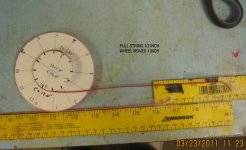
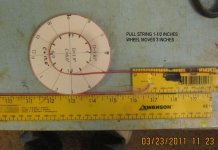
Not exactly a bobbin and piece of string...
Getting the big wheel to track the scale without slipping took a little time.
 

Attachments

  • ChainWheel-01.jpg
    ChainWheel-01.jpg
    95.4 KB · Views: 8
  • ChainWheel-02.jpg
    ChainWheel-02.jpg
    86.6 KB · Views: 6
  • ChainWheel-03.jpg
    ChainWheel-03.jpg
    97.7 KB · Views: 6
  • ChainWheel-04.jpg
    ChainWheel-04.jpg
    96.1 KB · Views: 5
No, you keep the tension the same as the length increases because the length of thread between the hand and reel changes, and then tell yourself that one is moving faster than the other.


Oh ... my ... God! :D

ETA: So tell us, humber, how does the length change if one is not moving faster than the other?
 
Last edited:
.
Not exactly a bobbin and piece of string...
Getting the big wheel to track the scale without slipping took a little time.

Not sure what the point is....

The calculation says that the reel will move in the direction of the force, it makes no difference how much string is wound.
Work = force * distance
The ruler may move half the distance, but the force is doubled because of the ratio of the two radii. As you can see, the reel eventually hits the ruler, so the entire effect is due to the string connecting the
point of applied force ( the reel) with the source of the force ( the ruler). When that simple, short term gimmick is over, the reel will move the same distance as the ruler.

Really...to set this up, you must turn the reel, that will add angular KE to the reel, but will be dissipated as work of friction against the supporting panel. So you must reset the whole thing as the string is moved for each new photo, so applying external energy to replace that lost to the panel.
 
Last edited:
You're still avoiding the question humber. Does the spool move faster than the string, or not? You have said it can not in the past, do you now admit you were wrong?
 
I just wanted to de-lurk here for a moment and let everyone know that this thread is really interesting and educational. DDWFTTW is something that is hard to grasp without a really firm understanding of physics - it certainly FEELS wrong. While I know that Humber isn't going to get it, in the process of trying to educate him you have made it make way more sense to me. I wasn never actually opposed to it being a possibility since I am aware of my own limitations when it comes to physics, but it's still a big leap from "I guess it's possible because scientists say so" to "I know it's possible, because I get it".

So thanks.
 
You're still avoiding the question humber. Does the spool move faster than the string, or not? You have said it can not in the past, do you now admit you were wrong?

And how am I wrong. Will the reel move faster than the pencil?

If the paper strip were pushing the reel, then it could be glued to the reel and so both would move at the same speed, but the reel would not turn.
The strip is lifted, and impulse energy is added to the angular KE, so it rolls along the strip. Any more?
The Chinese are not planning to launch rockets on the basis of misunderstandings about the conservation of momentum or simple tricks to amuse an audience

http://www.trudd.com/blog/wp-content/uploads/2007/05/safe_imagephp.jpg
 
I just wanted to de-lurk here for a moment and let everyone know that this thread is really interesting and educational. DDWFTTW is something that is hard to grasp without a really firm understanding of physics - it certainly FEELS wrong. While I know that Humber isn't going to get it, in the process of trying to educate him you have made it make way more sense to me. I wasn never actually opposed to it being a possibility since I am aware of my own limitations when it comes to physics, but it's still a big leap from "I guess it's possible because scientists say so" to "I know it's possible, because I get it".

So thanks.

There is nothing to "get" save for falling for simple illusions. So far, all experoments have fatal flaws.
If you think you can prove that the reel can move faster than the applied force then show the math.
 
Within the constraints of the research budget... Don't spend no money on this, and acquiring the equipment to demonstrate the process, using stuff found around the typical model airplane nut's home, the end result is the wheel moves twice as far as the string pulling it.
No newtons, fig or otherwise, were consumed in this exhaustive process.
Did finish off with two beef & bean burritos.... avoid being downwind of me for awhile, regardless of the presence of a cart.
 
The Chinese are not planning to launch rockets on the basis of misunderstandings about the conservation of momentum

Okay, so now we know Humber isn't a Chinese Rocket Scientist.

If you think you can prove that the reel can move faster than the applied force then show the math.

We're reading the same stuff, right? You have been presented with the math, given analogies, shown visual aids, and presented with real-world tests. At this point the burden of proof lies with you.
 
You're still avoiding the question humber. Does the spool move faster than the string, or not? You have said it can not in the past, do you now admit you were wrong?

"Moving faster than the string" is a akin to being delighted by the fact that the part of the of a door near the handle, moves faster than a point near the hinge.
 
Status
Not open for further replies.

ISF - Join now!

Every member here is approved by hand. No bots, no spam, just people who care about evidence and honest debate.

Membership is free!

Create your free account

Back
Top Bottom