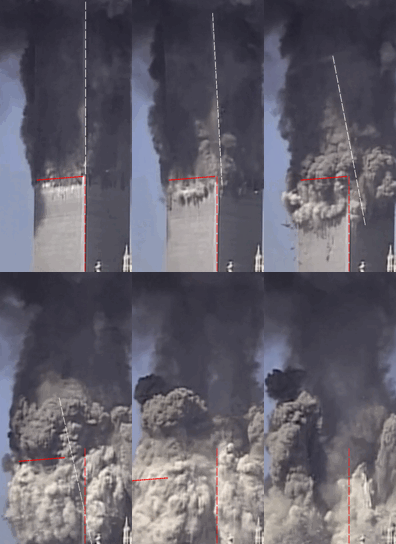
I'll add a quick scope clarification, that in the context of the original post I was restricting the scope to the East face perimeter columns. It is more than probable, that early in the tilting phase, that other columns in the *upper block* will still be attached to those in the *lower block*....
Remember I am approaching this from "thinking" or reasoning about what must happen. The method will only work in situations where the alternates can be identified and at least roughly quantified. Plus help from any video analysis but I have not progressed that path to the sophistication that you have - that comment independent of whether I fully agree with your findings or not.
So my boundary line is when the top block first starts to descend - and by that I mean all of it. That dividing line may not fit with these additional points you raise.
With that disclaimer and recognition that I am entering into what is new territory for me here goes:
There are four perimeter faces tied to one another at the corners, which, until those corners *let go* they do a pretty good job of holding-back lower scale wedging action of the perimeter a little....
I doubt that it is simply four corners not letting go. Given that some sides of the falling block will go inside, some outside the lower tower, in the absence of video evidence available to me I would think two adjoining going inside the other two outside is a likely scenario given the tilt of the top blocks. If it is two out/two in and adjoining then there is no crossing over at those two corners where both are 'out' or both are 'in'. There will be crossing over at the other corners - i.e. those with one out and one in but the likely consequence is buckling or shear at the crossover point given the overwhelming large forces available to concentrate on that one or two points. Allow also that I have only allowed the "out" or "in" options - I discount the "land on" option for reasons analogous to those posted earlier viz it would resolve itself due to overwhelming high local load leading to buckle. (And, lovely irony, we have the work of Messrs Szamboti and Chandler to support that since there was no "big jolt".) Now all that surmise as to possibilities is subject to any clear evidence you may have identified in videos.
The conclusion of all that, relevant to your concern about corners letting go, is that the corners would not need to let go before the "micro wedging" can start.
...b) The effective pivot point of the upper section, which, for WTC2, adds a delay in terms of when the angled upper perimeter comes into contact with the upper edge of the lower perimeter (as the east face of the upper section moves west as a side-effect of the pivot action.
http://www.youtube.com/watch?v=mcZJMdrZ-ps
http://www.youtube.com/watch?v=WFr3QeCzVgY...
Remember my starting point 'top block' moving downwards. Then remember we got to this point because I suggested that your caricature style 'wedge' clip was too crude and the more micro wedgings were probably the key. OK with that bit of context settling let me insert a 'sooner or later' into my explanation - leading to "So it happens a bit later - so what?" I think you are coming from an implicit set of sequenced steps which may need re-framing BUT which, au contraire, may be founded on video evidence.
...c) ROOSD is under way very rapidly and propogating off down to ground independantly and the effective distance between the lowest edge of the crush front and the top of the still upright perimeter is pretty large by the time the tilted upper face applies that larger scale wedging. It's around that time that the NE corner, which up until that point is sitting pretty, fails.
I'm unsure as to how your claim of ROOSD under way very rapidly conflicts with what I say or if it even does conflict. I have no doubt that some outer perimeter bits and particularly corners stood up long after the ROOSD collapse front had passed. Prior to these recent discussions I had not given much thought to the differing progress timings between different OOS zones. Also the related point that, for simplicity, I have never previously concerned myself with the reality that the initiation and continuance of ROOSD was other than "flat floor" falling on "flat floor". (Ouch that is twisted arse about negative logic...

) Let's rephrase "I have always treated ROOSD as if it initiated by release of one floor or more and propagated by flat floor contact on flat floor. So no allowance for either sloping contact OR separate zones falling at differing timings/speeds." And I don't think either of those simplification matter in the scheme of things.