• Security incident: ISF was recently accessed by intruders. Please change your password, and change it anywhere else you used it. Read more

Merged Applicability of Bazant's model to the real world

First, if that was meant light-hearted poking fun, my apologies. Sometimes humor doesn't transmit very well thru this medium.

All in all, tho, it wasn't very funny. it was simply wrong. At least in my case. And whether you (or femr or MT or anyone else) believes it or not.

Regarding my "silly claim"…

Is it really possible that you didn't realize that the entire post was a parody of femr's new self-identified debating style?

Well, not so much a parody as an exact duplicate of the style that he just told us he's chosen to employ.

Funny that you should notice & object to it when "a debunker" uses it. But not when a truther does.


tom
One of the traits of the invariant "MIHOP" and CD crew is an absence of a sense of humor, and tunnel-vision on tactics...
 
Yes. Then could you think about the significance of the 'bald assertion' claim I made. I have posted that claim many times on this and one other forum and never got a bite. Is it so obvious? Or do people simply not see the significance.

I think a few of us have pointed out exactly the same thing, when debating T. Szamboti's 'Missing Jolt' problem.
I think many agree with you about the 'offset' that results from buckling.


I cannot satisfy myself about "collapse initiation" the same way because, despite several contributory mechanisms being identifiable, there is no way to say that there were enough of those mechanisms to add up to a runaway cascading failure... [/QUOTE]

Well, we can't prove a negative, so we can only cite the lack of evidence for CD as the main strike against it.

I personally think that the main collapse initiation points of the NIST report make good sense. For me, the inward bowing of the exterior columns is the strongest case for creep/sagging/heat-induced failure, and it doesn't look anything like an explosive demolition to me.
 
I personally think that the main collapse initiation points of the NIST report make good sense. For me, the inward bowing of the exterior columns is the strongest case for creep/sagging/heat-induced failure, and it doesn't look anything like an explosive demolition to me.

No, bowing is not explosive. How do you redistribute the load of the perimeter to the core? Via the outriggers? Would you expect some convex roof deformation (means antenna looks like growing while the perimeter in the south goes down)? How strong were the outriggers? Strong enough to bow the core?
 
First, if that was meant light-hearted poking fun, my apologies. Sometimes humor doesn't transmit very well thru this medium.

All in all, tho, it wasn't very funny. it was simply wrong. At least in my case. And whether you (or femr or MT or anyone else) believes it or not.

Regarding my "silly claim"…

Is it really possible that you didn't realize that the entire post was a parody of femr's new self-identified debating style?

Well, not so much a parody as an exact duplicate of the style that he just told us he's chosen to employ.

Funny that you should notice & object to it when "a debunker" uses it. But not when a truther does.


tom
I recognised and enjoyed your parody. Humour in general is probably safer if explicitly labelled and I should have realised that. Then irony, sarcasm, analogy, metaphor all seem to have a difficult time across the Interwebs. Not the least reason being cross cultural lssues of idiomatic usage which loses a lot of nuances if not outright mistranslates.

I got a formal warning about my second post on JREF because I inserted the word which means faesces and it got asterisked out so I said something about a nanny filter. At that time I was moderating the Richard Dawkins Forum which had significantly different standards.

So I still tend to describe maths in full colour as it reflects of aluminium sheeting and all those trivial ones. And I still have to think twice to remember that 9/11 was really 11/9 - September not November....
 
I think a few of us have pointed out exactly the same thing, when debating T. Szamboti's 'Missing Jolt' problem.
I think many agree with you about the 'offset' that results from buckling....
I was going to mention the Szamboti and Chandler stuff as examples but decided to just leave the principles without examples. The elementary level flaw with "missing jolt" is that it starts with an assumption and circles to prove the original assumption.

...
I cannot satisfy myself about "collapse initiation" the same way because, despite several contributory mechanisms being identifiable, there is no way to say that there were enough of those mechanisms to add up to a runaway cascading failure...

Well, we can't prove a negative, so we can only cite the lack of evidence for CD as the main strike against it.
Sure - I'm conscious of the logic problem. I was thinking more about the parallel to 'progression' where Bazant et al over-reach what their paper actually 'proves'. That aspect aside you could prove "no demolition assistance required" if there was sufficient data BUT proving 'not required' does not prove 'wasn't used'.
...I personally think that the main collapse initiation points of the NIST report make good sense. For me, the inward bowing of the exterior columns is the strongest case for creep/sagging/heat-induced failure, and it doesn't look anything like an explosive demolition to me.
Same here. To mimic it - the collapse that really happened - by explosive/incendiary devices you would cut floor joist lower chords. In argument ad totally absurdam with pro demolition nuts I have taken that suggested technique to its logical conclusion. The charges placed in the middle of the fire by fire-proof suited and invisible suicide teams..... At that point the rebuff is usually "get serious!" :D
 
No, bowing is not explosive. How do you redistribute the load of the perimeter to the core? Via the outriggers? Would you expect some convex roof deformation (means antenna looks like growing while the perimeter in the south goes down)? How strong were the outriggers? Strong enough to bow the core?

Sorry, I'm not familiar with the 'outriggers' term. What are they?
 
None of those images has the slightest bearing on the discussion that you leaped into regarding the ability to distinguish the crush front from a pressure wave.
Incorrect, on several levels. Outstanding.

The video clips form part of the short course on visual information interpretation I'm providing you with. After you finally get your head around your mistakes...
femr,
...
You're claiming that the upper block, plowing its way thru the lower structure, created a front end that matched perfectly the inside dimensions of the peripheral wall???

:dl:

And magically sheared all the internal floors perfectly from outer columns ??

:dl: :dl:

And left a massively unstable external wall standing in place???

:dl: :dl: :dl:

And it wasn't until the crush front had long since passed by, with the high pressure front IN ADVANCE of it, that the outer walls suddenly threw themselves in all direction??

:dl: :dl: :dl: :dl:
...we can move on to your next lesson. Interestingly, you do seem to have moments of clarity...
It seems to me to be certain (but it's new to me, so I'll only say "highly probable") that the tops of a line of external columns that emerge from the debris could at the end of that gif represent a giant continuous wall of external columns that are STILL ATTACHED to the tower at their lower boundary.
...but then, when you feel you need to go on the defensive and deflect from your repeated mistakes/stupidity, you go straight back to square one again.

Oh, and did you manage to notice who you made that dog-laden post to ?

Here's a pictogram of the difference between your & my view of structures.
No tom, that's simply in your imagination.

You are still clearly struggling with this subject, so I'll spend a little time and throw a few views together in video form, with some nice little arrows so you don't have to think too much and don't get confused.

After that we can move on to identifying the visual cues for internal crush front progression.

Have a nice day.
 
Last edited:
Incorrect, on several levels. Outstanding.

The video clips form part of the short course on visual information interpretation I'm providing you with. After you finally get your head around your mistakes...

...we can move on to your next lesson. Interestingly, you do seem to have moments of clarity...

...but then, when you feel you need to go on the defensive and deflect from your repeated mistakes/stupidity, you go straight back to square one again.

Oh, and did you manage to notice who you made that dog-laden post to ?


No tom, that's simply in your imagination.

You are still clearly struggling with this subject, so I'll spend a little time and throw a few views together in video form, with some nice little arrows so you don't have to think too much and don't get confused.

After that we can move on to identifying the visual cues for internal crush front progression.

Have a nice day.

This is another CLASSIC post from FEMR2...

1. Whenever someone makes an engineering argument using physics principles, or concepts from structural engineering FEMR2 responds by posting a video or photograph.

2. Whenever someone makes a mathematical argument either showing NIST or Bazant to be correct and FEMR2 to be wrong, FEMR2 responds by posting a video or photograph.

3. Whenever someone looks at the video/photograph that FEMR2 is using as evidence and points out that it is not possible to see through the smoke with X-ray vision FEMR2 responds by posting a video or photograph.

4. Whenever some analyzes the videos or photographs and points out that FEMR2 is coming to unwarranted conclusions based off of dubious interpretations of the video or photograph FEMR2 responds by posting a video or photograph.

5. If all else fails, FEMR2 writes a lot of words and claims his opponents are incompetent and he is "schooling" them in video and photographic analysis.

6. And lastly, on occasion, FEMR2 will post a link to a video or photograph instead of the actual video or photograph itself.


I think the new debunking strategy should be to post videos and photographs and just tell people to use their "eyes" instead of silly things like math, engineering, physics, etc.

And to drive the point home we should have only one video and one photograph that answer every question....and have it gyrate back and forth.

I wasn't convinced of the truthers positions until I saw the gyrating photos....not only did they convince me but they got me slightly excited as well.
 
ozeco41 said:
Work through that exercise in thinking and visualising. When you see it is reasonable then consider other impacts.
It's perfectly reasonable...

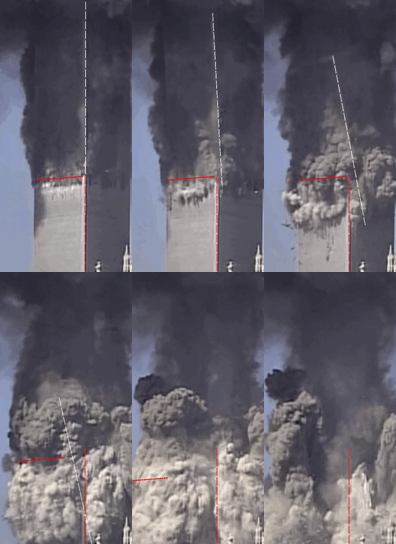
I'll add a quick scope clarification, that in the context of the original post I was restricting the scope to the East face perimeter columns. It is more than probable, that early in the tilting phase, that other columns in the *upper block* will still be attached to those in the *lower block*.

Any opinion on these other points ? ...

a) There are four perimeter faces tied to one another at the corners, which, until those corners *let go* they do a pretty good job of holding-back lower scale wedging action of the perimeter a little.

b) The effective pivot point of the upper section, which, for WTC2, adds a delay in terms of when the angled upper perimeter comes into contact with the upper edge of the lower perimeter (as the east face of the upper section moves west as a side-effect of the pivot action.
http://www.youtube.com/watch?v=mcZJMdrZ-ps
http://www.youtube.com/watch?v=WFr3QeCzVgY

c) ROOSD is under way very rapidly and propogating off down to ground independantly and the effective distance between the lowest edge of the crush front and the top of the still upright perimeter is pretty large by the time the tilted upper face applies that larger scale wedging. It's around that time that the NE corner, which up until that point is sitting pretty, fails.

---

Chewy,

femr2 said:
You seem to disagree with tfk.

Ask him how the perimeter section can effectively hinge at a point way down towards the lower mechanical region, if it's still attached to floors above that point up to the level at which the upper and lower *blocks* separate, will you ?
No answer yet.
 
A quick and rough annotated view...
tilttt.gif
 
I'll add a quick scope clarification, that in the context of the original post I was restricting the scope to the East face perimeter columns. It is more than probable, that early in the tilting phase, that other columns in the *upper block* will still be attached to those in the *lower block*....
Remember I am approaching this from "thinking" or reasoning about what must happen. The method will only work in situations where the alternates can be identified and at least roughly quantified. Plus help from any video analysis but I have not progressed that path to the sophistication that you have - that comment independent of whether I fully agree with your findings or not.

So my boundary line is when the top block first starts to descend - and by that I mean all of it. That dividing line may not fit with these additional points you raise.

With that disclaimer and recognition that I am entering into what is new territory for me here goes:
There are four perimeter faces tied to one another at the corners, which, until those corners *let go* they do a pretty good job of holding-back lower scale wedging action of the perimeter a little....
I doubt that it is simply four corners not letting go. Given that some sides of the falling block will go inside, some outside the lower tower, in the absence of video evidence available to me I would think two adjoining going inside the other two outside is a likely scenario given the tilt of the top blocks. If it is two out/two in and adjoining then there is no crossing over at those two corners where both are 'out' or both are 'in'. There will be crossing over at the other corners - i.e. those with one out and one in but the likely consequence is buckling or shear at the crossover point given the overwhelming large forces available to concentrate on that one or two points. Allow also that I have only allowed the "out" or "in" options - I discount the "land on" option for reasons analogous to those posted earlier viz it would resolve itself due to overwhelming high local load leading to buckle. (And, lovely irony, we have the work of Messrs Szamboti and Chandler to support that since there was no "big jolt".) Now all that surmise as to possibilities is subject to any clear evidence you may have identified in videos.

The conclusion of all that, relevant to your concern about corners letting go, is that the corners would not need to let go before the "micro wedging" can start.
...b) The effective pivot point of the upper section, which, for WTC2, adds a delay in terms of when the angled upper perimeter comes into contact with the upper edge of the lower perimeter (as the east face of the upper section moves west as a side-effect of the pivot action.
http://www.youtube.com/watch?v=mcZJMdrZ-ps
http://www.youtube.com/watch?v=WFr3QeCzVgY...
Remember my starting point 'top block' moving downwards. Then remember we got to this point because I suggested that your caricature style 'wedge' clip was too crude and the more micro wedgings were probably the key. OK with that bit of context settling let me insert a 'sooner or later' into my explanation - leading to "So it happens a bit later - so what?" I think you are coming from an implicit set of sequenced steps which may need re-framing BUT which, au contraire, may be founded on video evidence.
...c) ROOSD is under way very rapidly and propogating off down to ground independantly and the effective distance between the lowest edge of the crush front and the top of the still upright perimeter is pretty large by the time the tilted upper face applies that larger scale wedging. It's around that time that the NE corner, which up until that point is sitting pretty, fails.
I'm unsure as to how your claim of ROOSD under way very rapidly conflicts with what I say or if it even does conflict. I have no doubt that some outer perimeter bits and particularly corners stood up long after the ROOSD collapse front had passed. Prior to these recent discussions I had not given much thought to the differing progress timings between different OOS zones. Also the related point that, for simplicity, I have never previously concerned myself with the reality that the initiation and continuance of ROOSD was other than "flat floor" falling on "flat floor". (Ouch that is twisted arse about negative logic...:o ) Let's rephrase "I have always treated ROOSD as if it initiated by release of one floor or more and propagated by flat floor contact on flat floor. So no allowance for either sloping contact OR separate zones falling at differing timings/speeds." And I don't think either of those simplification matter in the scheme of things.

 
Last edited:
my boundary line is when the top block first starts to descend - and by that I mean all of it.
Okay. Most of what I'm saying is focussed on the WTC2 East facade at the mo, so there will be bits of divergence between our scopes.

I doubt that it is simply four corners not letting go. Given that some sides of the falling block will go inside, some outside the lower tower...
Sure, again I'm focussing upon NE and SE corners for WTC2 East perimeter context.

I would think two adjoining going inside the other two outside is a likely scenario given the tilt of the top blocks.
Sure. Suggest for WTC2... East and South upper -> inside.

The conclusion of all that, relevant to your concern about corners letting go, is that the corners would not need to let go before the "micro wedging" can start.
Sure. My point is to highlight factors which result in the WTC2 lower East perimeter remaining effectively upright until the corners release and upper perimeter pushes it outwards.

we got to this point because I suggested that your caricature style 'wedge' clip was too crude and the more micro wedgings were probably the key
Does my quick draft annotated video segment clarify what I meant ?

I think you are coming from an implicit set of sequenced steps which may need re-framing
Oh, certainly not separate. All sorts of stuff happening at the same time, but I think validly delineated into steps, or perhaps more clearly as generalised phases.

I'm unsure as to how your claim of ROOSD under way very rapidly conflicts with what I say or if it even does conflict.
It doesn't. It's there to highlight the perimeter behaviour above the front.

I have no doubt that some outer perimeter bits and particularly corners stood up long after the ROOSD collapse front had passed.
Noted.

Prior to these recent discussions I had not given much thought to the differing progress timings between different OOS zones.
Noted.

I have always treated ROOSD as if it initiated by release of one floor or more and propagated by flat floor contact on flat floor. So no allowance for either sloping contact OR separate zones falling at differing timings/speeds." And I don't think either of those simplification matter in the scheme of things.
From my perspective it is necessary to drill into such details in order to clarify initiation sequencing and mechanism.
 
This is another CLASSIC post from FEMR2...

1. Whenever someone makes an engineering argument using physics principles, or concepts from structural engineering FEMR2 responds by posting a video or photograph.

2. Whenever someone makes a mathematical argument either showing NIST or Bazant to be correct and FEMR2 to be wrong, FEMR2 responds by posting a video or photograph.

3. Whenever someone looks at the video/photograph that FEMR2 is using as evidence and points out that it is not possible to see through the smoke with X-ray vision FEMR2 responds by posting a video or photograph.

4. Whenever some analyzes the videos or photographs and points out that FEMR2 is coming to unwarranted conclusions based off of dubious interpretations of the video or photograph FEMR2 responds by posting a video or photograph.

5. If all else fails, FEMR2 writes a lot of words and claims his opponents are incompetent and he is "schooling" them in video and photographic analysis.

6. And lastly, on occasion, FEMR2 will post a link to a video or photograph instead of the actual video or photograph itself.


I think the new debunking strategy should be to post videos and photographs and just tell people to use their "eyes" instead of silly things like math, engineering, physics, etc.

And to drive the point home we should have only one video and one photograph that answer every question....and have it gyrate back and forth.

I wasn't convinced of the truthers positions until I saw the gyrating photos....not only did they convince me but they got me slightly excited as well.
NO! You don't really believe that, do you? He wouldn't!

A quick and rough annotated view...
http://femr2.ucoz.com/tilttt.gif
:dl: :dl: :dl:
 
Sure - I'm conscious of the logic problem. I was thinking more about the parallel to 'progression' where Bazant et al over-reach what their paper actually 'proves'. That aspect aside you could prove "no demolition assistance required" if there was sufficient data BUT proving 'not required' does not prove 'wasn't used'.
Hey! You know what? You're right.

Who are MT and femr2 to lecture AE911Truth on whether explosives were used during the collapse, then? The collapse progressed naturally, but that doesn't rule out the presence of explosives on every story.

It also doesn't disprove the presence of explosives in the WFC buildings. These buildings didn't fall, therefore they showed a natural behavior by not falling. No one can rule out that they were stuffed with explosives.

Or the Empire State Building, to mention just another one.

But, alternatively, we can notice that what BLGB really addresses is the theoretical basis for the claims of explosives during the collapse (seismic record, speed of fall, pulverized particle size, pulverization energy, dust reach, booms, dust cloud aka "pyroclastic flow" speed, dust content of the cloud), making them just baseless and therefore proving these "allegations of controlled demolition to be absurd".
 
Hey! You know what? You're right....
Sure - and in 2011 it probably seems an unneeded bit of pedantry to make the distinction.

However I learned it in previous years in closely fought debate with reasoning conspiracy theorists who were pro-demolition and the genuine sceptics who were around in those past times. A different opposition to what we see today with the simplistic polarisation into two camps.

Make a false step in logic in those times and you could be sure it would be spotted.

...But, alternatively, we can notice that what BLGB really addresses is the theoretical basis for the claims of explosives during the collapse (seismic record, speed of fall, pulverized particle size, pulverization energy, dust reach, booms, dust cloud aka "pyroclastic flow" speed, dust content of the cloud), making them just baseless and therefore proving these "allegations of controlled demolition to be absurd".
Given the risk that we could be "called" if we use words like "proving" in an otherwise scientific setting - hence my habit of either explicitly disclaiming or at least "scare quoting" whenever I use "prove" or "impossible" and such terms which would bring certainty into an otherwise presumed to be scientific context.
 
Okay. Most of what I'm saying is focussed on the WTC2 East facade at the mo, so there will be bits of divergence between our scopes.

Sure, again I'm focussing upon NE and SE corners for WTC2 East perimeter context.

Sure. Suggest for WTC2... East and South upper -> inside.

Sure. My point is to highlight factors which result in the WTC2 lower East perimeter remaining effectively upright until the corners release and upper perimeter pushes it outwards.

Does my quick draft annotated video segment clarify what I meant ?
All noted. Yes to last point.
...Oh, certainly not separate. All sorts of stuff happening at the same time, but I think validly delineated into steps, or perhaps more clearly as generalised phases....
Noted
...It doesn't. It's there to highlight the perimeter behaviour above the front...
Understood esp. given recent suggestions that 'trailing' perimeter collapse is not accepted.
...From my perspective it is necessary to drill into such details in order to clarify initiation sequencing and mechanism.
Understood.
 
The large WTC2 east perimeter as it is seen in the rubble. It obviously stretches out from the footprint:

http://www.sharpprintinginc.com/911_misc/wtc2_east.jpg

Here is a photo album of just rubble from the WTC2 east footprint stretching eastward:

http://www.sharpprintinginc.com/911...1&PAGER_limit=9&PAGER_start=0&PAGER_section=1


Here are some images of the WTC2 east perimeter sheet:

1486.jpg


1199852102_911_HighQualityPhotos684.jpg


At the very top of the sheet, The 75, 76 fl mechanical floor perimeter is clearly visible, actually speared into the ground:

911_HighQualityPhotos8162_g_1.jpg


The 2 extra thick spandrels are the 75th fl (lower mechanical room) and the 77th fl (lower escalator floor)

The piece is located at far end of the sheet here:

mech_room_perimeter_2_g_1.jpg


The original location of the piece is shown here (right of blue line):

mech_room_g3.jpg


Which is the very top of the falling perimeter sheet that femr has shown you repeatedly.

Map of location here:

map_g.jpg


All discovered a couple of years ago.

Ozeco, once again you seem to be the only JREF debunker posting that can follow any argument at all. If we had a few people who can be sincere like yourself, we could have a good debate. As it is, most of the thread is just noise.
 
Last edited:
Debate about what? That a model doesn't exactly match reality? NO ****!


:confused:
Hell, even under absolutely controlled conditions (i.e., in a laboratory), "rocket Science" only requires 95% correlation of the math model (FEM) to reality.
Having run several structural tests for NASA projects, 5% error is very good...

ETA: And that's with no non-linearities...
 
Hell, even under absolutely controlled conditions (i.e., in a laboratory), "rocket Science" only requires 95% correlation of the math model (FEM) to reality.
Having run several structural tests for NASA projects, 5% error is very good...

ETA: And that's with no non-linearities...
I agree! The point is lots of good information can be extracted from these models.

I have to add, I do believe they did over step the models when they stated it "proves" no CD. I don't think this is a topic that anyone would honestly debate.
 

ISF - Join now!

Every member here is approved by hand. No bots, no spam, just people who care about evidence and honest debate.

Membership is free!

Create your free account

Back
Top Bottom