• Security incident: ISF was recently accessed by intruders. Please change your password, and change it anywhere else you used it. Read more

How the banks create money

Perhaps you should read it and provide excerpts you think support your position, because fractional reserve banking just doesn't work the way you think it does. Banks cannot and do not loan out "invented" money.


From page 3 of MMM: (red highlights mine)


The actual process of money creation takes place
primarily in banks.
' As noted earlier, checkable liabilities
of banks are money. These liabilities are customers' accounts.
They increase when customers deposit currency
and checks and when the proceeds of loans made by the
banks are credited to borrowers' accounts.
In the absence of legal reserve requirements, banks
can build up deposits by increasing loans and investments
so long as they keep enough currency on hand to redeem
whatever amounts the holders of deposits want to convert
into currency. This unique attribute of the banking business
was discovered many centuries ago.

It started with goldsmiths. As early bankers, they
initially provided safekeeping services, making a profit from
vault storage fees for gold and coins deposited with them.
People would redeem their "deposit receipts" whenever
they needed gold or coins to purchase something, and
physically take the gold or coins to the seller who, in turn,
would deposit them for safekeeping, often with the same
banker. Everyone soon found that it was a lot easier simply
to use the deposit receipts directly as a means of payment.
These receipts, which became known as notes, were acceptable
as money since whoever held them could go to
the banker and exchange them for metallic money.
Then, bankers discovered that they could make loans
merely by giving their promises to pay, or bank notes, to
borrowers. In this way, banks began to create money.
More notes could be issued than the gold and coin on hand
because only a portion of the notes outstanding would be
presented for payment at any one time.
 
Last edited:
We're talking about fractional lending

Ah, fractional reserve banking, as sanctioned by...oh, that's right, the Federal Reserve issues those rules. So it's splitting hairs to suggest we're not talking about the Federal Reserve. I've cited their publication, Modern Money Mechanics. Have you read it yet?

Which I might add, despite a few fairly serious issues in its infancy, has been a resounding success compared to the panics of the 19th Century.

You're right, the Federal Reserve is much better at engineering panics than before the centralization/monopoly.

As already pointed out, I read it years ago...

Then you must surely know what I say about it is correct.

There is nothing that prevents a bank from lending out deposits.

I don't know if that's legal or not, but I know all banks do otherwise. They don't loan out any money, they get a promise to pay back a loan, and in exchange they give the promiser "credits" on their account that they create with ledger entry as a "liability". The banks are able to loan out many times what's been deposited, in actuality. Every bank routinely carries "liabilities" in excess of ten times their reported deposits. They don't dip out of your savings account to make a business loan to your boss.

You can read all about it in MMM under "Deposit Expansion", sections 3-10.

The text you cite accords with the description of banks merely "inventing" money, but as stated before, they don't invent money to cover the extra debt of "interest", they just invent the principal, so there is never money in the supply to pay back the interest. There's no way around that fact, it's how the system is designed.

Still waiting for you to reconcile...

Still waiting for you to apologize for calling me a clown. Consider this response a courtesy, no thanks are necessary.

banking collapses have occurred several times over the last 100 years. I thought they could just invent more money, right? ;)

As I've explained, the game relies on a rapidly expanding (exponential) money supply. Clearly in a physical world this is unsustainable. Every so often they have to rest it all, before the system runs itself into the ground and people carry wheelbarrows of money to buy a loaf of bread.
 
Ah, fractional reserve banking, as sanctioned by...oh, that's right, the Federal Reserve issues those rules. So it's splitting hairs to suggest we're not talking about the Federal Reserve.

Well, psionl0 seems to be asserting that FRB has existed for hundreds of years, so maybe you two can resolve that quandry together.

Then you must surely know what I say about it is correct.

No, you are incorrect in almost everything. It is sophistry of the highest order. It's no better than all the other nonsense posted in this thread before you got here.

I don't know if that's legal or not, but I know all banks do otherwise. They don't loan out any money, they get a promise to pay back a loan, and in exchange they give the promiser "credits" on their account that they create with ledger entry as a "liability". The banks are able to loan out many times what's been deposited, in actuality.

And what limits the lending champ? The amount of deposits or assets of the bank. Go read MMM again, sections 3-10 under expansion like I suggested.

What is a "liability" then, if, according to you, the banks don't care if someone pays them back or not? Not much of a liability huh?

Every bank routinely carries "liabilities" in excess of ten times their reported deposits. They don't dip out of your savings account to make a business loan to your boss.

I already addressed this claim several pages ago. In the US, with a reserve requirement of 10%, it is impossible for a bank to lend out 10x its reserves.

The text you cite accords with the description of banks merely "inventing" money,

They don't invent it, it is created as a liability on their balance sheet against their reserves. If nobody pays that money back, it becomes very real to the bank.

but as stated before, they don't invent money to cover the extra debt of "interest", they just invent the principal, so there is never money in the supply to pay back the interest. There's no way around that fact, it's how the system is designed.

Repeating incorrect claims ad nauseum will not suddenly make them right. You're obsessed with money creation via commercial banks, and ignore all the money created by the government. Repeat after me: not all money created is based on debt!

Still waiting for you to apologize for calling me a clown. Consider this response a courtesy, no thanks are necessary.

I apologise for calling you a clown. It is rather frustrating however when you get everything wrong, and repeatedly.

As I've explained, the game relies on a rapidly expanding (exponential) money supply. Clearly in a physical world this is unsustainable.

So, banks can't just invent money then? I thought you said liabilities don't matter and they're not real money? You appear to be wandering into clown territory again.

Every so often they have to rest it all, before the system runs itself into the ground and people carry wheelbarrows of money to buy a loaf of bread.

Right. When was the last time the US suffered hyperinflation again?
 
What are you arguing about Sceptic-PK? The borrower signs a loan agreement and the bank credits the borrower's account with the agreed amount. Money created. End of story.

You might argue that this is a good system but don't deny the process.
 
I'm still waiting for your history lesson of FRB over the last several hundred years.

What I am arguing about is the assertion that the money is created from nothing, rather than being based upon the reserves of the bank in question, and Mann's curious opinion that banks can create as much money as they want, and liabilities don't really exist.
 
Well, psionl0 seems to be asserting that FRB has existed for hundreds of years, so maybe you two can resolve that quandry together. No, you are incorrect in almost everything. It is sophistry of the highest order. It's no better than all the other nonsense posted in this thread before you got here. And what limits the lending champ? The amount of deposits or assets of the bank. Go read MMM again, sections 3-10 under expansion like I suggested.

The above statements don't constitute facts, in other words they are all false.

What is a "liability" then, if, according to you, the banks don't care if someone pays them back or not? Not much of a liability huh?

Liabilities are traded between financial institutions. The bank invented the liability at the same time it invented the loan. The "liability" is to the banking system, because that invented loan has to come out of "real" money in the system when it's paid back. The banks left holding the bag (the ones with the most outstanding liability) fall off the treadmill at the end of every cycle. So it's like I said, if you're a bank and you're not clawing your way to the top, you're getting pushed out of the bottom. None of this addresses the "interest" part of that "liability" created concurrently with the loan. It's above and beyond the total money supply, and can never be paid back. Failure is built into the system. It's a stupid competitive game that wastes resources and causes misery.

I already addressed this claim several pages ago. In the US, with a reserve requirement of 10%, it is impossible for a bank to lend out 10x its reserves.

As you may or may not understand, the banking industry is essentially a closed system. You can't just open up a bank, you basically need the permission of all the existing banks. They're all colluding. When the government issues money, all that "real" money goes into banks. When the "real" money is deposited, banks loan out money they invent and invent their "liability" to the system. The fractional reserve banking system means banks only have to keep a percentage of the loans they make as "real" money reserves. The percentage varies but let's say it's ten percent. That means for every "real" dollar in a bank, that bank can invent ten dollars to loan out, citing demand for the loan as their authority to invent it. And all this is on top of the fact that every invented dollar they loan out eventually comes back, only this time it looks like "real" money (even if it's just a "liability" invented by another bank), so they can consider that a deposit and invent still more money. Really it's way more than ten times the initial deposit that they can invent and loan out, legally.

They don't invent it, it is created as a liability on their balance sheet against their reserves. If nobody pays that money back, it becomes very real to the bank.

As I explained above, the "liabilities" issue is sleight-of-hand trickery. You can't escape that the "interest" charged is above and beyond all the money in the supply, in other words it can never be repaid, it will eventually have to be forgiven somewhere down the line (as in the government stepping in with a bailout, don't count on the bank forgiving their victims).

Repeating incorrect claims ad nauseum will not suddenly make them right.

I'm glad you finally learned this, Now you can get back to your reading, read page 6 of Modern Money Mechanics as I suggested, but not just that page, start with the first page and read it all, you'll be on much firmer footing then.

You're obsessed with money creation via commercial banks, and ignore all the money created by the government. Repeat after me: not all money created is based on debt!

Money created by the government is also backed only by debt, because it's invented by a bank. The government draws some pictures on a paper and calls it "bonds", the Federal Reserve issues currency for the face value of the bonds, when the bonds mature the government owes face value plus interest. When did the Federal Reserve give them the currency to pay back the interest? Never. It can never be repaid, then. Hence the ever-climbing national debt. When the debt is paid back, the money supply vanishes, the economy grinds to a halt because of some numbers on a piece of paper. It's lunacy, but mass lunacy, so there's no escaping it, if you become sane you're in the minority.

Right. When was the last time the US suffered hyperinflation again?

The US has not suffered a total collapse of its monetary system since regular cycles of boom and bust were implemented by the Federal Reserve.
 
What I am arguing about is the assertion that the money is created from nothing, rather than being based upon the reserves of the bank in question...

Reserves of what, exactly? Reserves of money? So money invented by banks isn't created from nothing because it's based on the reserves of money invented by banks? That's a circular argument, and doesn't cut any ice with me.

Mann's curious opinion that banks can create as much money as they want, and liabilities don't really exist.

I didn't state my opinion, and it's not my opinion that banks can create as much money as they want. I stated the fact that banks invent money by writing it in a ledger. This "liability" they assign themselves is liability to the banking system itself, not to depositors. Depositors' money is never touched. The money loaned out by the banks is invented on the spot. Banks collude with one another, they compile all their outstanding "liabilities" at the end of each cycle, the banks left with the most liabilities are dumped out of the system. They're all shell companies and subsidiaries of each other anyway, it's as incestuous as any royal family of Europe.
 
I'm still waiting for your history lesson of FRB over the last several hundred years.

What I am arguing about is the assertion that the money is created from nothing, rather than being based upon the reserves of the bank in question, and Mann's curious opinion that banks can create as much money as they want, and liabilities don't really exist.
My quote from MMM above should demonstrate that fractional reserve banking is a lot more than 100 years old.

The amount of money that banks can create is limited by the amount of reserves of cash the bank has but created it is.
 
The source material for these claims? Modern Money Mechanics, page 6.

yeah, that doesn't say what you claimed. It says people don't normally make deposits in the form of cash, so the bank takes promissory notes, AKA checks.

you have anything else?
 
From page 3 of MMM: (red highlights mine)

You highlighted the wrong part, here is the key section:

As noted earlier, checkable liabilities of banks are money. These liabilities are customers' accounts. They increase when customers deposit currency

IOW when you deposit money into a checking account it becomes money. You use it just like the money you deposited, while the bank has and uses the money you actual deposited. This means that the act of depositing money in the bank created a form of money.
 
What are you arguing about Sceptic-PK? The borrower signs a loan agreement and the bank credits the borrower's account with the agreed amount. Money created. End of story.


Not so much.

Under double entry book keeping when the bank credits your account they have have record a corresponding debit someplace else.
 
The percentage varies but let's say it's ten percent. That means for every "real" dollar in a bank, that bank can invent ten dollars to loan out, citing demand for the loan as their authority to invent it.

Wrong again. For every dollar a bank possessed, it may lend 90c. You can't get even the simple things right. I will not waste another minute on your nonsense.
 
You highlighted the wrong part, here is the key section:
As noted earlier, checkable liabilities of banks are money. These liabilities are customers' accounts. They increase when customers deposit currency and checks and when the proceeds of loans made by the banks are credited to borrowers' accounts.

There. Completed the quote for you.
 
Last edited:
Under double entry book keeping when the bank credits your account they have have record a corresponding debit someplace else.
Yes, bookkeeping 101. The customer's LOAN account is debited and the customer's DEPOSIT account is credited by the same amount.
 
Wrong again. For every dollar a bank possessed, it may lend 90c. You can't get even the simple things right. I will not waste another minute on your nonsense.
The source material for these claims? Modern Money Mechanics, page 6.
yeah, that doesn't say what you claimed. It says people don't normally make deposits in the form of cash, so the bank takes promissory notes, AKA checks.

you have anything else?
Actually, I couldn't find anything like that on page 6. What I did find was the following:
Of course, they do not really pay out loans from the money
they receive as deposits. If they did this, no additional
money would be created. What they do when they make
loans is to accept promissory notes in exchange for credits
to the borrowers' transaction accounts.

(Sceptic-PK take note).

FYI cheques and promissory notes are two different things. One is an instruction for the bank to debit your account and give the money to somebody else and the other is a promise to make payments in the future.
 
Perhaps you should read it and provide excerpts you think support your position, because fractional reserve banking just doesn't work the way you think it does. Banks cannot and do not loan out "invented" money.

Really! Here are some comments you and other bank lovers need to look at.

Quote from Martin Wolf (Chief Economic Editor- The Financial Times) "The essence of the contempory monetary system is the creation of money, out of nothing, by private banks" often foolish lending 9-11-2010

Quote from Mervyn King (Governor of the Bank of England) "One example (of banking reform) would be to divorce the payment system from risky lending activity- that's to prevent fractional reserve banking" 25-10-2010
 
Wrong again. For every dollar a bank possessed, it may lend 90c.

You clearly don't understand the process. Customer deposits are held as the reserve. The law states banks must keep 10% of their "liabilities" (or around there) in reserve. That means every dollar of deposits equates to ten dollars they can invent and loan out. Banks don't loan out other people's deposits, they invent money by ledger entry and loan that out.

The reason people recoil from this idea is because it's so obviously fraudulent and has the ready potential to hold us all as slaves as long as we continue to abide by the rules of this system. People don't want to come to grips with that, they think money is the solution to all problems, when in fact it's the cause of most of modern society's problems.
 
Again, you are incorrect. The theoretical maximum increase of the money supply is 9x based upon repeated lending and depositing. So, the net effect is to increase the original $10K to $100K ($90K being the maximum increase in supply), but only after repeated lending. This is based upon the fact that banks may only lend 90% of their reserves, ie, of that original $10K, the bank may only lend $9K.

So, your assertion that a bank can have $10K and, by itself, lend $100K based on that 10, is wrong.

The total amount of expansion that can take place is illustrated on page 11. Carried through to theoretical limits, the initial $10,000 of reserves distributed within the banking system gives rise to an expansion of $90,000 in bank credit (loans and investments) and supports a total of $100,000 in new deposits under a 10 percent reserve requirement. The deposit expansion factor for a given amount of new reserves is thus the reciprocal of the required reserve percentage (1/.10 = 10). Loan expansion will be less by the amount of the initial injection. The multiple expansion is possible because the banks as a group are like one large bank in which checks drawn against borrowers' deposits result in credits to accounts of other depositors, with no net change in the total reserves.
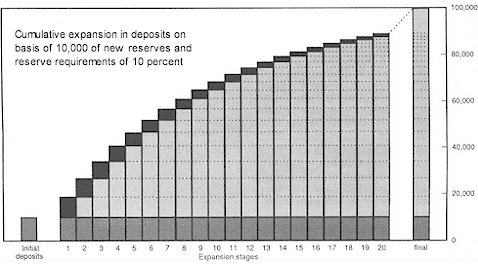
image001.gif
 

ISF - Join now!

Every member here is approved by hand. No bots, no spam, just people who care about evidence and honest debate.

Membership is free!

Create your free account

Back
Top Bottom
