TFK post 389: "Where are femr's & MT's graphs of the tilt angle vs. time?
How about drop distance (in feet, not pixels) vs. time.
How about a statement of the frame in which you think that the drop transitions from rotation to pure descent. "
Tom, how many times have I mentioned frame 224 and the failure of the NW corner?? The last columns to fail are along the NW corner, around Sauret frame 224. I have been posting the same graph and explanation for a few months now.
Do you recall the expression "release point"? How about velocity take off point? Do I need to repeat it all again just because you cannot read?
That 4.4 degree explanation you gave....I'm speechless. I swear, you really don't know how many mistakes you make, do you? I would be totally ashamed to post that picture.
Tom, can you see the north wall in that picture? Have you wondered why not? Where is your mind when you dream that stuff up?
>>>>>>>>>>>>>>>>>>>>>>>>>.
>>>>>>>>>>>>>>>>>>>>>>>>>>
We have established one thing for certain: Nobody posting has a clue about how to find the angle tilt angle over which the columns originally failed. I am not judging you since it is not easy. I do judge the posters that act like they are know-it-alls while they remain ignorant of the basic mistakes they are making.
More importantly, you now realize that there is nowhere in the NIST report you can go for a clear explanation of the WTC1 collapse initiation motion.
It is a bit embarrassing to watch some posters continue to defend the NIST concerning their description of an 8 degree tilt. If the NIST was clear, would you need such tortured explanations?
>>>>>>>>>>>>>>>>>
Tilt angles vs time, Tom? You didn't notice these????
SAURET VIEWPOINT:
Earliest detectable movement leading up to collapse initiation
The earliest detectable movement is traced back to 9.5 seconds before the visible collapse initiation here:
Upper West Wall Pulls Inward 9.5s before Collapse
Antenna Base Shifts Eastward 9.5s before Collapse
VERTICAL DIFFERENCES BETWEEN 4 POINTS: MEASURING ANTENNA TILT, NORTH WALL TILT AND ROOF DEFORMITY
The motion of 4 points (2 on antenna, 1 on NW corner and 1 0n the 98th floor) is recorded and compared to the expected motion of a rigid body rotating about an axis through the north wall, 98th floor. The points a, b r and 98 are located at the elevations shown:
'
a: antenna black to white transition (pink) called ant or a
b: lower antenna ball (blue) called ball or b
r: roof NW corner (yellow) called roof or r
98: 98th fl (red) called 98.
The 4th point along the 98th floor NW corner doesn't move until the NW corner fails. The upper portion rotates around it. It serves as the rotation axis for the rigid model.
The Rigid Model: Fixed relations between southward tilt and perceived downward displacement of points a, b and r.
Here is a computer model of WTC1 undergoing rigid rotation about an axis through the north wall, floor 98 as seen from the SE:
http://img214.imageshack.us/img214/1364/tiltvsvismeasurement.gif
An observer from the north looking up at the building like the Sauret viewpoint should see fixed points on NW corner and the antenna move downward together as the bulding tilts, just at different rates of descent..
Geometric, trigonometric relations of the Sauret viewpoint here:
http://img404.imageshack.us/img404/4391/sauretrelations.gif
If the whole upper portion, antenna and perimeter, rotates together as a rigid body about an axis through the north wall, floor 98 through 360 degrees, the 3 points will follow the fixed trajectories shown here
We are only interested in the region from 0 to 3 degrees, so the domain is stretched to show a small slice of the graph over the first few degrees.
The track of any point fixed to a rigid rotating body will naturally take the form of a sinusoidal wave because any fixed point on the rigid body will be seen to follow a sine wave trajectory as the object is rotated through a complete 360 degree cycle when observed from a viewpoint perpendicular to the axis of rotation. If looked at from a viewpoint parallel to the axis of rotation, a viewer will see any point fixed to the body will take a circular trajectory with a radius equal to the distance the point lies from the rotation axis. But since the Sauret viewpoint is perpendicular to the rigid model axis of rotation, each fixed point travelling along a circular trajectory will appear as taking a sinusoidal trajectory centered around the rotation axis as shown.
During the first 3 degrees of tilt, the fixed linear relation between tilt angle and the perceived drop of points a, b and r are
http://img163.imageshack.us/img163/9084/image00011.png
(Better quality images of relations between points for different angles of rigid rotation for the Sauret viewpoint can be downloaded here:
http://www.megaupload.com/?d=XUIRKRYK)
This gives drop vs southward tilt relations for the antenna and NW corner for a rigid model rotating along a north face, fl 98 hinge as this:
http://img34.imageshack.us/img34/8679/descenttiltratio.png
These near linear relations between observed drop and angular orientation over the first 3 degrees allow us to translate drop data into rotational data between any 2 points as long as the structure interconnecting the 2 points remains rigid.
Also, since each point a, b, and r experiences a linear drop as theta changes from 0 to 3 degrees, we know that the position of each point can be written in the form
where all c values are constants. These expressions can also be written in differential form to show how each measured distance a-b, b-r and r-98 on a rigid rotating body must change relative to the other two distances in each moment of time.
Using these relations, we can see whether the upper portion tilted as a rigid block simply by visually inspecting the actual values of the quantities a-b, b-r and r-98 and the shapes of the resulting graphs.
According to the differential relations between a-b, b-r and r-98, the slopes of each of the 3 graphs should have identical shapes, differing only by a constant of proportionality.
Measuring north perimeter tilt using the quantity r-98: (distance from yellow line to the 98th floor): We know the NW edge of WTC1 between the 98th fl and the NW corner roof line remained rigid until the north perimeter gave along the 98th fl because we can see the whole corner to the roofline. Therefore we can use the change in r-98 to estimate how much the north perimeter had tilted for any given NW roof line drop distance. The NW corner fails along floor 98 around Sauret frame 224, so we can use the measured value of r-98 before frame 224 to calculate the tilt of the north wallt. The r-98 drop data is mapped on the right:
http://img20.imageshack.us/img20/856/calmesnface.png
The fixed relation between r drop and southward tilt of the north perimeter is on the left. We can use the graph on the left to estimate the actual tilt angle of the north perimeter for any frame before the point at which the NW corner fails along the 98th floor The higher resolution data linked below shows us the NW corner gave around frame 224.
http://img101.imageshack.us/img101/4753/image00029.png
We can see that up to frame 224 the north face had only tilted about 0.4 degrees to the south.
Verification of north perimeter tilt angle: Comparison of NW corner movement with a rigid model rotating 1 degree:
The actual movement of the NW corner compared to a rigid model undergoing a tilt of 1 degree here:
http://img246.imageshack.us/img246/9973/1degtilt.gif
We can verify that a north face rotation of 1 degree should produce measurable downward displacement by tracking a model undergoing rigid rotation of 1 degree to frame 224 here:
http://img705.imageshack.us/img705/8757/measure.gif
If the north wall actually rotated 1 degree before failing we would have detected it. The overlay shows the northwst corner faild failed well within a 1 degree tilt confirming the results of the data.
Measuring antenna south tilt using the quantity a-b: (distance from pink to blue line): We know the antenna remains rigid between a and b because we can see it. It is just a big stick moving downward nd tilting away from the camera. The change of the distance a-b is directly proportional to the change of the the south tilt of the antenna over the first 3 degrees. In the graphs below, on the right side we can see the measured a-b as the blue line. We can use the fixed linear relation between a-b and south tilt angle on the left to estimate the actual south tilt in any frame. We can see that in frame 224 the south tilt of the antenna is about 0.6 to 0.7 degrees.
http://img46.imageshack.us/img46/5084/image00000x.png
Measurement of the distance (a-b) compared with measurement of the distance (b-r), multiple points, 2 sets of measurements
http://img541.imageshack.us/img541/7176/calmesant.png
http://img213.imageshack.us/img213/8965/image00001.png
Features:
a) We already know from the antenna drop and velocity graph that the antenna sagged downward from frame 155 to 215, at which time it started to fall at a significant fraction of g. The graphs tell us that the estimated south tilt in frame 215 is about 1 degree.
Measuring roof-line deformation using quantity b-r: (distance from blue to yellow lines): The measured data for b-r shows there must have been significant deformation between the points b and r. Measurements for b-r are mapped as the pink line in the graph on the right
http://img46.imageshack.us/img46/5084/image00000x.png
If we assume the building remained rigid between points b and r and try to estimate rotation in frame 224 using the fixed b-r to angle relations in the graph on the right, we would place the tilt at about 1 degree.
Using a-b tells us the antenna rotated about 0.6 degrees to the south in frame 224. Using r-98 tells us the north face rotated about 0.4 degrees to the south in frame 224.
Using b-r as if the structure is rigid tells us the upper portion rotated about 1 degree by frame 224, which cannot be true considering the actual rotations of the antenna and the north face. Treating points b and r as fixed (rigid) relative to each other gives us a tilt angle which is too large.
Since we know points a and b remained fixed relative to each other through the antenna, and points r and 98 remained fixed relative to each other through the north wall over the frames of interest, this means point b must have sank too much relative to point r to be considered to maintain a rigid relation.
>>>>>>>>>>>>>>>>>>>>>>>>>>>>>>
>>>>>>>>>>>>>>>>>>>>>>>>>>>>>
Large antenna drop for multiple points:
Over 200 frames
http://img52.imageshack.us/img52/1452/dropvstilt00007.png
Same with frames stretched
http://img267.imageshack.us/img267/3524/dropvstilt00006.png
Same over 700 frames
http://img62.imageshack.us/img62/2940/dropvstilt00008.png
East tilt large antenna, measured by tracking the horizontal difference between 2 points on the antenna.
http://img210.imageshack.us/img210/8246/easttilt.png
Features of the graph:
a) The earliest eastward tilt drift is detectable in frame -100 (or frame 70??)
b) The tilt measures about 0.3 degrees in frame 220
c) By frame 320 the tilt has not yet reached one degree
Evolution of east tilting of large antenna visualized (angle exaggerated)
http://img221.imageshack.us/img221/328/easttilt.gif
Features of the east tilting of large antenna :
a) The data of the east tilt shows a gradual drift leaning of the antenna eastward, beginning more than 4 seconds before the first visible movement. Downward movement of the antenna begins in frame 155 and falling begins in frame 215. Notice how drift leaning to the east is detectable as early as frame -200.
b) The whole antenna is drifting eastward while it leans.
The same highlighting initiation frames only
http://img691.imageshack.us/img691/2889/easttiltsiminit.gif
...................................
South tilt large antenna, measured by tracking the vertical difference and convergence of 2 points on the antenna.
http://img517.imageshack.us/img517/2149/nstilt.png
Features of the south tilt graph:
a) A south lean is first detected near frame 175
b) The antenna is leaning about 0.3 degrees to the south in frame 220 (it is later shown that the antenna starts to fall downward at a significant fraction of g in frame 220
c) The tilt reaches one degree in frame 295
d) By frame 320 the tilt has reached 2 degrees
For comparison, movement of stationary object in foreground
http://img440.imageshack.us/img440/2797/easttiltmetal.png
>>>>>>>>>>>>>>>>>>>>>>>>>>>>>
Large antenna drop compared to east antenna drop
http://img704.imageshack.us/img704/7726/twoantennas.png
NW corner drop
Multiple measurements of
NW corner drop
http://img232.imageshack.us/img232/6412/dropvstilt00005.png
Features:
a) The graphs clearly show there is no downward movement until frame 220
Comparison of north (Sauret) with NE (NBC) viewpoints: Large antenna angle
http://img694.imageshack.us/img694/6851/neview.png
Features of the comparison:
a)
Large antenna drop compared to NW corner drop, Sauret viewpoint
http://img101.imageshack.us/img101/4753/image00029.png
The graph shows the drop data of the antenna compared to the NW corner. The measured downward velocities of both points are also shown.
Features:
a) Once again we see no movement of the NW corner until frame 220. Velocity measurements confirm this. The antenna moves downward as early as frame 155. The velocity graph of the antenna also seems to show a slow downward movement from frame 155 to frame 215, after which the antenna starts to fall at a significant fraction of g along with the NW corner.
b) Release points:
NE corner drop
http://img186.imageshack.us/img186/6988/nedropraw.png
http://img683.imageshack.us/img683/7884/necornerdata.png
NE corner, NW corner and large antenna drops compared
http://img522.imageshack.us/img522/3816/nedrop30.png
http://img6.imageshack.us/img6/4128/nedrop3.png
NW corner drop velocity reductions
http://femr2.ucoz.com/photo/6-0-372-3
red is drop in ft
orange is velocity
Features:
a)
NW corner drop vs velocity
http://img194.imageshack.us/img194/9369/image00007.png
http://img14.imageshack.us/img14/5808/image00010.png
..........................................
NBC NW VIEWPOINT:
Large antenna drop compared to SW corner drop,
http://img163.imageshack.us/img163/3738/graphinitialdrop.png
We only care about the lines marked "real fire" and "real antenna".
104 fl fire drop raw
http://img442.imageshack.us/img442/6379/firex.png
http://img15.imageshack.us/img15/1323/fireyr.png
Features:
a) Downward movement of the antenna is measured before the SW corner is observed to move.
Multiple measurements of large antenna, NW corner and SW corner drops taken separately and stretched, NBC NW viewpoint, show the same downward movement of these 3 points relative to each other:
NW corner drop
http://img517.imageshack.us/img517/3391/necornersmall.png
Large antenna drop
http://img718.imageshack.us/img718/2868/antennasmall.png
SW corner drop (104th fl fire)
http://img22.imageshack.us/img22/840/firesmall.png
Static point for comparison
http://img42.imageshack.us/img42/9170/staticsmall.png
Features:
a)
Another
measurement of the large antenna, SW corner fire and NW corner washer drops from the NW NBC viewpoint shows once again that the antenna was moving downward before the SW and NW corners of the building.
http://femr2.ucoz.com/_ph/6/859401119.png
(notes: Black - Antenna
Red - Washer
Purple - SW Fire
59.94 fps - Resolution Doubled. 1 pixel on the graph is 0.5 pixels on the original video.)
............................
NBC NE VIEWPOINT:
NE NBC viewpoint: Measurements of large antenna movement,
Angular movement of large antenna from NE, measured by tracking the horizontal difference between 2 points on the antenna
http://img707.imageshack.us/img707/30/nemaxsouthtilt.png
Evolution of angular movement from NE viewpoint visualized (angle exaggerated)
http://img85.imageshack.us/img85/9061/tilttimeline.gif
Features of the angular movement:
a) Between frame 165 and 217 the antenna tilted faster and reached about 0.75°. After frame 217 the tilting of the antenna stopped for the next 40 frames. During that time the antenna just shifted towards south while the north face (upper floors) apparently tilted more.
In the GIF above the x component of the movement is extremely stretched. Both axis are numbered each 10000 units. A thin blue line shows the position 10 frames ahead and a thin yellow line shows the position 10 frames before. The thin horizontal green lines show the measured antenna section. I extended the vertical lines to see at which elevation the "antenna" rotates (floor 98 is about at y=70000). It's obvious that the antenna started to descent at virtually 0° tilting. At about 0.6°tilting the north face gave way and stopped further tilting for the next 40 frames.)



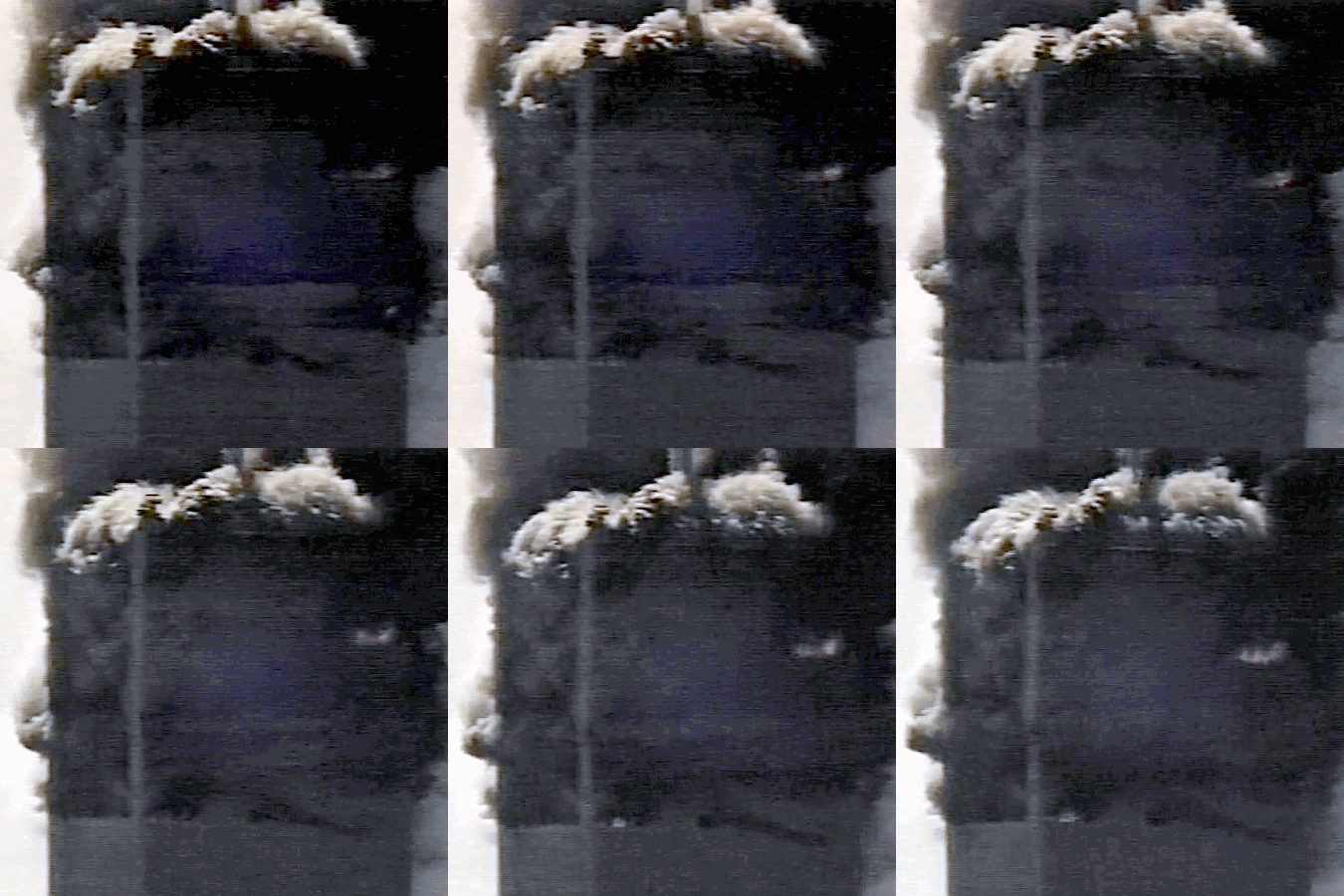


 What, still paranoid that I'd have manipulated it ? Ridiculous.