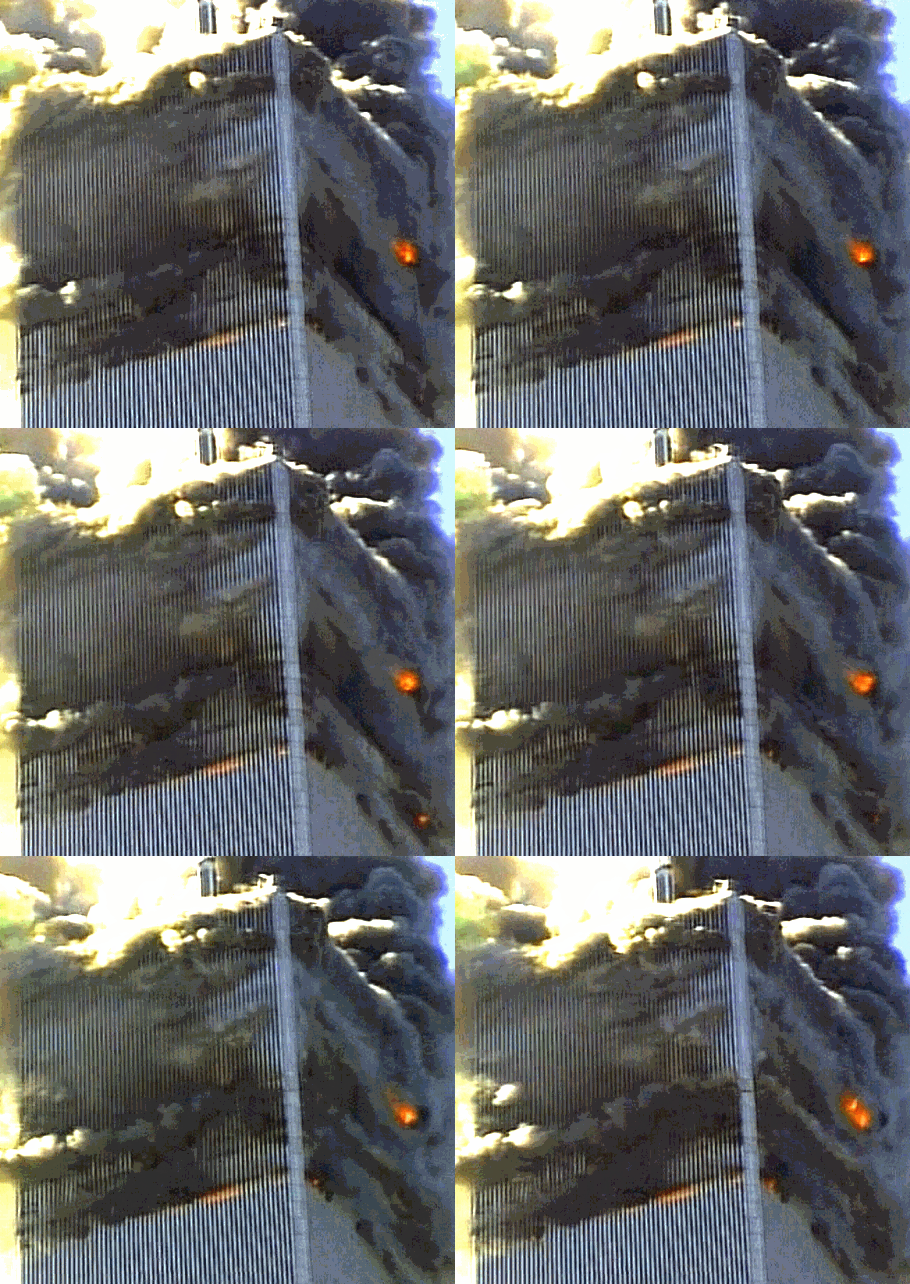
Moderated WTC 1 features list, initiation model / WTC 2 features list, collapse model

Much, much better than using your "eyeball". Obviously.

In fact, if you try to find the velocity take-off event using your eyeballs and compare it with results by using drop curves, not surprisingly you will find that the eyeball method always guesses the release point too late.

By the time you can see it from that blurry west side view it already happened in reality. Why this is so is obvious if you just think about it.

I guarantee that accurate drop curves in 30fps or 60fps video will beat your eyeball every time.
In case you haven't noticed, I have criticized both the protractor-held-against-the-monitor method you recommended and the eyeball method that femr2 recommended here:
I'll probably apply some annotation and measurement (though your eyeballs are quite sufficient in this case),
It really does appear that, for both you and for femr2, your objection to NIST's estimate of 8 degrees is entirely a matter of your insistence upon interpreting NIST's "vertical fall" as coincident with what you referred to above as "the release point".

We can continue to talk past each other so long as you desire, but it becomes boring after a while.
 
It really does appear that your (femr2) objection to NIST's estimate of 8 degrees is entirely a matter of your insistence upon interpreting NIST's "vertical fall" as coincident with what you referred to above as "the release point".
Not specifically. My objection to NIST's *estimate* is that it is at best meaningless, and at worst both wrong and inept.

Take the following oft-repeated NIST statements...
1-6D E-1 said:
Rotation of at least 8 degrees to the south occurred before the building section began to fall vertically under gravity.
...and...
1-6 9-8 said:
The entire section of the building above the impact zone began tilting as a rigid block (all four faces, not only the bowed and buckled south face) to the south (at least about 8º) as column instability progressed rapidly from the south wall along the adjacent east and west walls.
...and...
1-6 6-11 said:
WTC 1 tilt to the south of approximately 8 degrees was measured before smoke and debris obscured view.
...and...
1-6 6-1 said:
Rotation of the building section above the impact and fire zone to at least 8 degrees to the south occurred before the building section began to fall vertically.

So, what are they saying ?

Well, either ~8 degree tilt before vertical fall, or ~8 degree tilt before smoke obscured view.


Are they saying vertical fall began only when smoke obscured view ?

Clearly that would be utterly false. We can all see that significant vertical fall ensues before smoke obscures view.


So, the question arises, what angle did the upper section rotate through before vertical drop ensues.

Stating some way of defining transition from rotation about the lower edge of North face, to continued rotation AND vertical drop of the entire upper section is of course a pre-requisite, and is performed by determinig *release points* as MT has described above.


Now, tell me... how have NIST defined transition from rotation to vertical drop exactly ?


So, whilst I do view the quoted NIST statements above as rather pathetic, my focus is to determine the ACTUAL angle, within clear and reasonable margins.


More what I object to is for folk who have read the NIST report to parrot sections verbatim, without any inkling as to what it actually means, in what context it is valid or why, in this instance, whatever assumption you apply to what you think they might have meant...it's just wrong.

In a discussion which includes presentation of extensive data concluding significantly lower angle than 8 degrees, for someone to conclude their own *analysis* by stating...
The building section tilted about 8 degrees and then fell vertically.
...is nonsense...especially when that person has invented a wondorous process by which the upper section rotates to 8 degrees and then stops rotating as some kind of excuse.

It's simply a case of NISTitis. Rewriting the world around something NIST wrote to try and make sure it fits.

It's nonsense.

 
Please compare this with the CNN west gif posted by femr:

139482298.png


There were no reality checks at all. It's like he never saw the CNN west video.

He parrots the NIST in this image, nothing more. It is as if he reads from the NIST reports as if from a bible. Probably 20 pages of posts by yourselves defending the absurd 8 degree claim.

This is your most updated conception of WTC1 collapse initiation.

It is pure fantasy.
 
Last edited:
WD Clinger post 361: "In case you haven't noticed, I have criticized both the protractor-held-against-the-monitor method you recommended"

My comment about a protractor was to say that even a well-trained monkey could verify that there was no hinged tilt over 8 degrees from the CNN west view.

I never use a protractor in any of the links in the OP. I present the best efforts I have come across at measurements so accurate that small jolts can be detected in the NW corner and antenna over the forst 12 ft of downward displacement.

I present the the only accurate description of WTC1 early movement accessible on the internet. No protractors.


Once again: Nobody has an excuse not to be able to give a rough estimate for tilt over the initial column failure sequence because even Koko the gorilla can be taught how to do it with the CNN west clip and a protractor.

There is no excuse to imagine that the R Mackey illustration is even close to correct. No excuse.
 
WD Clinger post 361: "In case you haven't noticed, I have criticized both the protractor-held-against-the-monitor method you recommended"

My comment about a protractor was to say that even a well-trained monkey could verify that there was no hinged tilt over 8 degrees from the CNN west view.

I never use a protractor in any of the links in the OP. I present the best efforts I have come across at measurements so accurate that small jolts can be detected in the NW corner and antenna over the forst 12 ft of downward displacement.

I present the the only accurate description of WTC1 early movement accessible on the internet. No protractors.


Once again: Nobody has an excuse not to be able to give a rough estimate for tilt over the initial column failure sequence because even Koko the gorilla can be taught how to do it with the CNN west clip and a protractor. There is no excuse to imagine that the R Mackey illustration is even close to correct. No excuse.


So you just accept the gorilla's measurement?
 
Last edited:
I'm reminded of all the exchanges I've seen on the flight 93 threads. They claim the theory that a plane was crashed is a crock because they interpreted witnesses comparing the appearance of the crash scene to a spoon in a cup of coffee as meaning no plane crashed there. Except this time we're quibbling over such details as what the NIST meant when they describe the tilt. Pointless discussion is pointless. The moment the building became misaligned at all was the moment it was doomed :\
 
Last edited:
Another quick clip to think about...

39674418.gif


I'll probably rotoscope a scaled 3D model of the tower over that, and highlight what 8 degrees to the south actually looks like.
 
I asked "how did you determine the location of the cameras?

No answer yet.
You had an answer from me, and have yet to respond to it.

Specific detail depends, of course, upon which piece of footage you mean.

For Sauret, you can start here : 145 Ave of the Americas.

If you are interested, obviously you're going to have to do some legwork yourself, or you'd end up just handwaving about what you personally deem acceptable tolerance.

So, start at that address, do a bit of digging, and you'll end up with a pretty accurate estimation of the actual camera location.
 
A quick render to show 8 degree tilt...
219504271.png

...simply to show that south-side has to descend a couple of floors.
 
No sir, you don't need to repeat yourself. You clearly have an issue with the specific language that the NIST uses. The exact conclusions on which has yet to be revealed in any detailed manner despite the over analyzation of everything else....
 
Last edited:
As there is, and probably will continue to be, doubts about the ability to determine tilt from multi-angle video trace calculations, I'm going to use a different method.

As can be seen in the previous image, tilt of 8º about the North face results in vertical descent of the south-side by over 2 storeys.

More specifically, about 29 ft.


So, we can check the approximate angle by determining how far a feature on/near the SW edge descends before the NW corner releases.

An available feature would seem to be the fire near the SW edge.


  • If that feature descends about 29 ft before the NW corner releases, the 8º figure is correct.
  • If it's significantly less than 29 feet, the 8º figure is not correct.
  • A good tilt angle approximation can be determined directly from the distance the feature descends.


Anyone have any issue with this method ?

Of course, the appropriate math can be applied to account for the actual location of the chosen feature on the West face.
 
Last edited:
Before I *do the math*, here's a quick NW view...

WTC1_NBC_911_1752_northb-new.gif


Now, who thinks that the fire near the SW corner descents about 29 feet before the release of the NW corner ?
 
The gif femr posted shows the first visible failure of the NW corner. You can see the aluminum facade beginning to fold.

This means the collapse initiation sequence is over when you see this failure, because this corner is the last group of columns to fail.

Also, remember that the actual velocity take-off point, or "release point", is before you see the first NW corner damage. There must be a few feet of downward displacement before you see the first folding pattern. Even if we assume 0.7g acceleration during this interval, this still places the actual velocity take-off point about 0.5 seconds before you see the first damage. At 60fps, that means 30 frames displacement between what you see and the failure that already occurred.

You can clearly see there is little if any SW corner fire displacement when you see the first NW corner damage. Now subtract 30 frames from the frame you first see the NW corner damage.

Now, measure the tilt. What do you get?


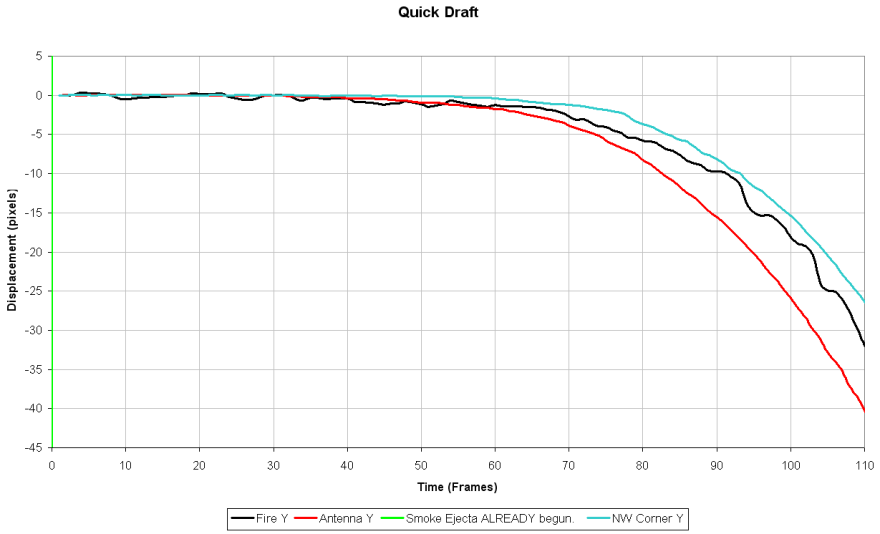
Anyway, there is no need to guess using your eyeballs because the drop curve data for the NW corner, Sauret viewpoint is of excellent quality. It is so good that individual velocity reductions can be detected twice in the first 12 feet of falling. That signifies an amazing sensitivity on a level that most posters have yet to comprehend. This drop data can be used to define the moment at which all columns have initially failed with more precision than your eyeball can ever detect.

(And much better than BasqueArche can, too!)

Wake up, people. Your tilt angles are much smaller than your eyeballs have yet to realize.
 
Last edited:
The gif femr posted shows the first visible failure of the NW corner. You can see the aluminum facade beginning to fold.
Indeed.

This means the collapse initiation sequence is over when you see this failure, because this corner is the last group of columns to fail.
Indeed.

Also, remember that the actual velocity take-off point, or "release point", is before you see the first NW corner damage.
Your eyeballs can do a reasonable job if they are used to looking for this kind of thing (especially with a good scrub function), but, yes.

There must be a few feet of downward displacement before you see the first folding pattern. Even if we assume 0.7g acceleration during this interval, this still places the actual velocity take-off point about 0.5 seconds before you see the first damage.
There's no need to guess of course...

Harking all the way back to Post #118 I posted the following graph...

437537321.png

(if only more folk spent time interpreting data presented eh)

You can clearly see there is little if any SW corner fire displacement when you see the first NW corner damage.
I'd put a reasonable estimate as...the fire is about 2 pixels ahead.

I'll provide detail soon, but for the SW edge 1 pixel ~= 0.8ft, so ~1.6ft...call it 2ft.

< 0.6 degrees.
 
Have a few minutes spare to make a quick response to Post #273...

BasqueArch said:
1) I haven’t seen a frame by frame video of this.
I suggest you source one before making low-level technical observations.

The graph posted above should give you much of the information you require to make valid observation.

2) Your graph also has velocity/drop errors in it. For example at frame 204 the NW corner shows no drop but also a 0.5 ft/sec downward velocity.
No, whilst all trace data has an amount of inherent noise, the problem is your interpretation. There is low-level change in the vertical position. It's just too small for you to see easily in the graph presented. Am sure a zoom of the drop data can be provided if you need to confirm this point.

3) NIST describes the shifting loading, creep and vertical displacement among exterior columns, hat truss and core columns, so some antenna movement would not be unexpected.
No-one has expressed shock at antenna movement. The focus is on specific sequence, extent, timing and behaviour of movement.

4) This was caused by the failure of the center south perimeter columns.
How did you come to this conclusion ? Please include your full analysis process. Copying chunks of the NIST report is not acceptable.

Major_Tom said:
The earliest visible ejections and accelerated smoke activity as visible initiation begins is along fls 92 west face and the SW corner of floor 95, not on floor 98.
6) Wrong. From NCSTAR 1-6D...
NISTitis. See animated GIF above.

The rest of the post descends into even more nonsense.

BasqueArch, as far as I'm concerned there's almost nothing valid in your post. If there is a point you still think is valid, reiterate it and I'll respond.
 
First link: "Ejection from 75th floor during AA11 impact."...It doesn't look like smoke or any other fluid substance to me, hence not likely an ejection from the 75th floor.
I understand where you are coming from, but would also say I think it's smoke ejection. There's also ejection from near-centre of the mechanical floors at the roof during impact.

It left no smudge or mark on the building that is visible in any later images.
That near the roof didn't either.

There is no confirmation of any visible ejected substance from any other angle or any other photo in the same series.
Perhaps by highlighting it, further imagery will surface.

A piece of falling debris? A shadow? I don't know.
Views higher up are available, and I've not found any debris that would get there unless it originated from that region in the first place.

Yes or no?
I agree that requesting yes/no for all observations/features/point/... is perhaps not quite feasible, but I do think it's a good idea for folk to actually read through the details, form an opinion, and respond...as you are. Numerous other posters have made some bizarre responses on the thread, and have clearly not even bothered to open link#1.

Second link: "Damage to basement and lobby."

This is not a link to an observation, it is a link to a forum thread, in which multiple observations are presented and discussed.
I see no reason for each link to not have a wealth of background material, and would consider simply the description to be the *feature*...basement and lobby damage is well known, and of course specific details have been the subject of discussion and argument for years.

More important in my view is to determine time and place as accurately as possible, along with pro's and con's for each theory as to how the damage ocurred.

I don't think any definitive conclusions should be stated.

Third link: "Fire and smoke ejections as WTC2 is struck"
I think that further analysis (not a big job) is required to nail timing between WTC2 impact and WTC1 smoke ejections.

Fourth link: "Strong fire ejections as WTC2 collapses"

Yes, there do appear to be fire ejections from the fire floors of WTC1 near the time of the WTC2 collapse, and the linked videos and stills show this adequately.
I don't think a conclusive causal mechanism has been nailed.

the most likely explanation for the phenomenon, in this case overpressure caused by the crushing of basement areas propagated up from the basement floors inside the building, is omitted.
I can't visualise this at all. Crushing of basement areas in which building, and when ?

Fifth link: "Inward bowing of the south perimeter"...
"But if the core went first at a tilt angle of less than 1 degree, all this seems like bunk" is not an observational claim I can agree with.
Do you agree with the tilt angle presented by me above ?

If you were to present a list that is limited to actual observations along with the supporting evidence for each observation, then yes/no responses (along with some chance that some responses will be yes) will be more likely to be forthcoming.

Respectfully,
Myriad
I agree that further summarising is required, along with removal (or at least separation) of MT's personal viewpoint. Elements under zero dispute should be highlighted.

I doubt MT will have fundamental objection to your comments, even if he doesn't agree, but am sure he'll let you know either way.
 
Still chugging away I see...............when will you have your paper written and who do you imagine will care?
 
I do still wonder where all this is leading, you seem to have an action plan taken from the underpants gnomes,

Step 1 - collect data

Step 2 - ????????

Step 3 - profit
 
I can't visualise this at all. Crushing of basement areas in which building, and when ?


The basement. As in, the common basement floors shared by both towers, all of which formed one single building. When, is when millions of tons of debris slammed downward onto it from the first collapse, reducing its volume significantly and forcing the air previously contained in that volume to rapidly move elsewhere.

The physical principle is demonstrated here.

Do you agree with the tilt angle presented by me above ?


The tilt angle started at zero. Then, at some later time (after which it could no longer be measured), it was about eight degrees. It therefore stands to reason (and is also easily observed) that at various times in between, it must have been half a degree, then one degree, then two degrees and so forth.

I'm not aware of any issue related to the collapse causality that depends on precisely what time a given tilt angle occurred, relative to other events. As I cautioned you long ago, you're applying instantaneous time marks to processes that had durations. Instantaneous time marks are arbitrary and do not necessarily indicate, with any reliability, the exact timing of unobservable causal events occurring fractions of a second apart. Overloaded columns can deform slowly or quickly, in unison or out of unison, and there is no displacement, speed, or acceleration value at which one can definitely say, for instance, that deformation became "release" at that precise moment.

So in sum, I agree with your assertion that there was a time when the tilt angle was about 0.6 degrees. Indeed, it would be very surprising otherwise, such as if it had skipped directly from 0.5 to 0.7. So far I do not agree with any particular significance you might be ascribing to that event.

Respectfully,
Myriad
 
Last edited:
Originally Posted by BasqueArch View Post
The building section rotated about 8 degrees and then fell vertically.

Just to give you something to think about...

[qimg]http://femr2.ucoz.com/CNN_Aircheck_Eric_Letvin_Cli24.gif[/qimg]

Note that the NW corner is visibly descending from half way through the short clip. Trace data can show more accurately the point at which vertical motion begins.

I've used this view as it's relatively near to West-on. Quality is a bit grotty, but the best available from that viewpoint (NIST Cumulus DB).

I'll probably apply some annotation and measurement (though your eyeballs are quite sufficient in this case), but, come on, suggesting that *The building section rotated about 8 degrees and then fell vertically* is simply an acute case of NISTitis.


Two Deceptions-
femr2’s edited video of the west wall nearly perpendicular to the fall south.

Deception 1) At the start of femr2’s edited about half second clip, the top appears to stop rotating at ¼ second and then falling vertically for the other ¼ second.

Take a piece of paper and mark the following:
a) The drop of the NW corner at upper left of west façade (window wash platform) about 5/16” on my 19” monitor.
b) The drop of the floor at the smoke/flame line, lower left corner of west wall, about 3/16”
c) The drop of the flame up at right side of west wall, about 6/16” indicating a tilt in the south direction including deception 2)

The net drop of the NW corner, a) minus b) is actually 2/16” not the 5/16” illusion of the edit, a 40% distortion.

Deception 2)
Place your pointer at the bottom left corner of the NE wall at the start of the video and note the shift of this point to the right at the end of the clip, reducing the apparent tilt of the rotation.

Could these two effects have been in the original video.
No, from femr2’s own other video where this clip is edited from, we don’t see the two deceptions above. Throughout the edited portion, the original video actually shows a tilt to the right of vertical. The deceptions were intentional.

Compare Femr2’s original video (at 1:15)
http://www.youtube.com/watch?v=wjnJ7CPIoFA

Combine the vertical fall distortion and the righting of the tilt angle and you get -

Angry.
 
Last edited:

Back
Top Bottom