Deeper than primes

Status
Not open for further replies.
The Man said:
...well established words and concepts...
are changeable.

Again, "well established words and concepts " are nothing but the current common agreement among people about given "words and concepts", and this common agreement is changeable (something that you don't get).
 
Last edited:
are changeable.

Again, "well established words and concepts " are nothing but the current common agreement among people about given "words and concepts", and this common agreement is changeable (something that you don't get).

Ah, but there's the problem. You, and only you, are changing the use of the words that 99.999999999999% of people use correctly.

Can you provide your "official" definition of locality in a dictionary-type format since it's been over 10,000 posts since you used the term? Let's not use the term "non-local" in the definition please.
 
Last edited:
You indeed denial the qualitative foundation of the mathematical science.
Worng, for example:

A= “It is raining”

B="All we nned is love"

In both cases "A" or "B" have meaning only if "=" ("=" = "iff", in this case) is also used.

Try to use:

A

B

=

and see by yourself that you don't get any meaningful expression.

Doron, this is sloppy. Did you want to say that A and B without an operator in between lacks any meaning, coz no algebraic instruction or logical connective is present? If so, then your statement, "In both cases "A" or "B" have meaning only if "=" ("=" = "iff", in this case) is also used," lacks clear connection to the 'A B' example that tends to accent the initial argument.

Where is the equality symbol (=) applied in "In both cases "A" or "B" have meaning only if "=" ("=" = "iff", in this case) is also used":

A = B

or

A= “It is raining”

B="All we nned is love" ?


Look at how others explain things:
http://en.wikipedia.org/wiki/File:Venn1010.svg
 
Last edited:
Worng, for example:

A= “It is raining”

B="All we nned is love"

In both cases "A" or "B" have meaning only if "=" ("=" = "iff", in this case) is also used.


Excellent! So, even in Doron's world, A can have meaning independent of ~. Doron disproves himself.

(Not that there is any real requirement there be assignment for a variable to have meaning; that is an entirely different realm of Doron confusion.)

Of course, caught in another contradiction of his own making, Doron will attempt to shift the goalposts or deny he made statements he made. Let's just keep the following citation for reference, shall we?

Only if ~ ; A are linked into a one expression.
 
Excellent! So, even in Doron's world, A can have meaning independent of ~. Doron disproves himself.
You have missed it.

A has no meaning, unless "=" refers to it.

= has no meaning, unless A refers to it.

~ has no meaning unless A refers to it.

In all those cases, there is a mutual-independency linkage, where ~ (anything but A) or = (A=A) is the mutual ascent and A is the independent aspect of mutual-independency linkage, which is not totally mutual and not totally independent, but it is the intermediate state between these extremes.
 
Last edited:
You have missed it.


No, you missed it.

As I said, you'd now try to move the goal posts to modify the claim, but your original statement stands. I provided the link for your convenience. It was wrong. You were wrong.

But none of if really matters anyway. It is just another distraction from the fundamentals: Doronetics doesn't accomplish anything. It produces no result; it just complains that everything else is wrong.
 
Where is the equality symbol (=) applied in "In both cases "A" or "B" have meaning only if "=" ("=" = "iff", in this case) is also used":

A = B

or

A= “It is raining”

B="All we nned is love" ?


Look at how others explain things:
http://en.wikipedia.org/wiki/File:Venn1010.svg

A or B have a meanings (they can be different meanings or not (A=B), it does not matter) only if A=A or B=B is used, in the first place.

"A" , "B" , "=" or "~" alone have no meaning.

In other words a meaningful formal framework is AT LEAST Mutual (for example "=" ,"~", etc.. as connectives) aspect/Independent (for example "A" ,"B", etc.. as isolations) aspect Linkage.

Some example:

The lines between the forms are the mutual aspect and the forms are the independent aspect of the following diagram:
750px-Logical_connectives_Hasse_diagram.svg.png


So this diagram is AT LEAST Mutual-Independent framework, which is not totally mutual (lines-only) or not totally independent (forms-only).

Furthermore, this diagram has no superposition of ids, or in other words, is it based on (A,B,C,D,…) state, which is nothing but the particular case of Organic Numbers' 0-Uncertainty x 0-Redundancy.

 
Last edited:
By the way.

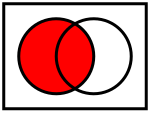
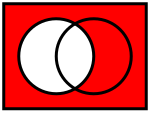
Please look at these Venn diagrams, and how they support my claim that ~A is "Anything but A=A":

A=A
150px-Venn0101.svg.png


~A
150px-Venn1010.svg.png
 
Last edited:
And you do not understand it


No, the misunderstanding continues to be yours. You make very sloppy statements, very incorrect statements, and when called on them for the farces that they are, you blame everyone else for your inability to form a complete thought in a consistent, well-defined way.

You said that without each other, A and ~ had no meaning. You were wrong. You may have meant something else, but I am not a mind reader. I will rely on what you post, and with respect to what you wrote in the post I referenced, you were wrong.
 
Last edited:
By the way.

Please look at these Venn diagrams, and how they support my claim that ~A is "Anything but A=A"


They do not support your claim.

Both your Venn diagrams are incorrect since you failed to identify what each circle represents.

The first Venn diagram is incorrect, since it does not in any way represent the identity A=A. If we assume the left circle be labeled as "A", then the Venn diagram represents the the set A.
 
They do not support your claim.
Yes they do.

Both your Venn diagrams are incorrect since you failed to identify what each circle represents.
I need one and only one circle for my claim.
The first Venn diagram is incorrect, since it does not in any way represent the identity A=A.

Yes it represents A=A, where =A or A is nothig but a short representation of A=A, for example:

A=A (where =A or A is nothig but a short representation of A=A)
150px-Venn0101.svg.png


~A
150px-Venn1010.svg.png


So ~A is "Anything but A".
 
Last edited:
Both your Venn diagrams are incorrect since you failed to identify what each circle represents.
I need one and only one circle for my claim.

Then stopping being the master of irrelevance and use only one circle...and label it.

The first Venn diagram is incorrect, since it does not in any way represent the identity A=A.

Yes it represents A=A, where =A or A is nothig but a short representation of A=A

No, that is just more nonsense you have made up. A alone means whatever A happens to represent. A=A, on the other hand, is a logical proposition involving the equality of the formulas on either side of the equal sign. Since equality happens to be reflexive relation, the logical proposition is a tautology.


...So ~A is "Anything but A".

Yeah, so?
 
I do apologise, but I have let my attention wander for the last couple of pages. Has Doron yet given us an example of OM, using real values, which actually produces a result? Or, failing that, has he managed to define just one of his terms?
 
I do apologise, but I have let my attention wander for the last couple of pages. Has Doron yet given us an example of OM, using real values, which actually produces a result? Or, failing that, has he managed to define just one of his terms?


Rather than doing either of those, he has instead circled back to old absurditiies he's raised and been unable to justify long ago.
 
Status
Not open for further replies.

Back
Top Bottom