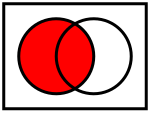
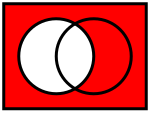
Where is the equality symbol (=) applied in "In both cases "A" or "B" have meaning only if "=" ("=" = "iff", in this case) is also used":
A = B
or
A= “It is raining”
B="All we nned is love" ?
Look at how others explain things:
http://en.wikipedia.org/wiki/File:Venn1010.svg
A or B have a meanings (they can be different meanings or not (A=B), it does not matter) only if A=A or B=B is used, in the first place.
"A" , "B" , "=" or "~" alone have no meaning.
In other words a meaningful formal framework is AT LEAST Mutual (for example "=" ,"~", etc.. as connectives) aspect/Independent (for example "A" ,"B", etc.. as isolations) aspect Linkage.
Some example:
The lines between the forms are the mutual aspect and the forms are the independent aspect of the following diagram:
So this diagram is AT LEAST Mutual-Independent framework, which is not totally mutual (lines-only) or not totally independent (forms-only).
Furthermore, this diagram has no superposition of ids, or in other words, is it based on (A,B,C,D,…) state, which is nothing but the particular case of Organic Numbers' 0-Uncertainty x 0-Redundancy.