Moderated Iron sun with Aether batteries...

Status
Not open for further replies.

sd03.jpg


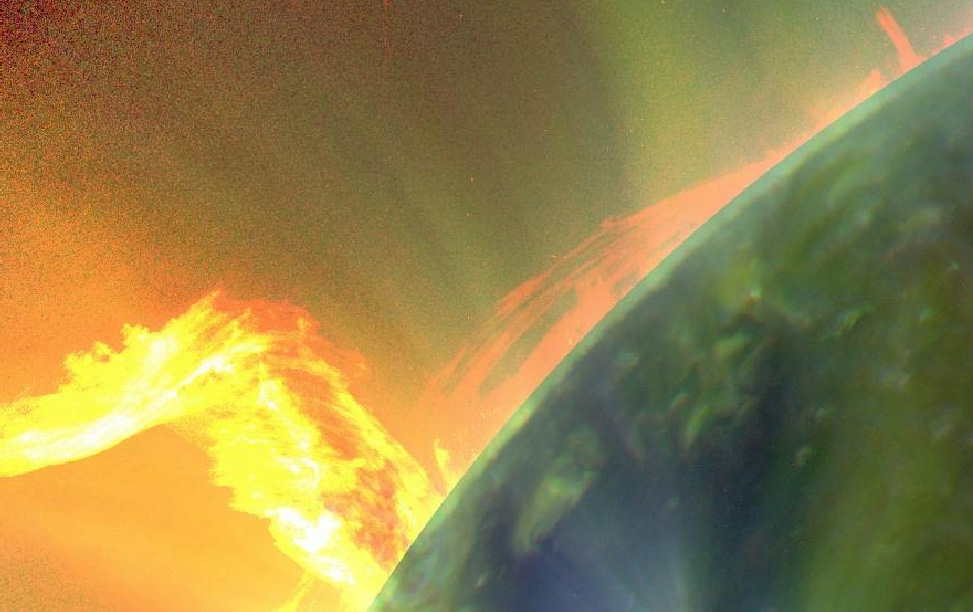
Here's a third side of the same image. All along the underside of the red area, it's supposed to be "opaque" (GM style) to these wavelengths in 3.5 meters, not kilometers, meters. That means that no iron ion light should be seen in below that point. All along the limbs however we see a light green area. Below that it becomes "opaque" (GM definition) at about 4800Km under the chromosphere.

Their "opaque" math bunny claim just went up in green iron smoke. :) I've counted all along every side of the limb and it's exactly the same way everywhere. There are some areas that are too light to get measurements, but I've been all the way around the whole entire limb and it's exactly the same everywhere.

If their theory were correct, that 4800Km of light green would not be there. It would be black all the way to the red line with only light lines here and there. It's not at all like that. In fact their opacity claim fails the observation test entirely. It's not opaque. That math bunny is dead.
 
Last edited:
It has already been determined that the solar disk radius at 171A (transition region - chromosphere) is roughly 10 arcseconds larger than the optical (photospheric) radius. At a distance of 1 AU that angular measure translates into 7253 km, assuming I have done the conversion correctly. So there is in fact nothing to debate. It has all been done already and the Mozina model is the loser, as one would naturally expect.

So naturally I should come out the "looser" in SDO too, right? Higher resolution allows us to check that result, correct? Care to ante up your public change of opinion if it doesn't work out that way in SDO RD images?
 
No, chromosphere. If I said corona, my bad.
You never said anything, that's the first explanation I've been able to squeeze out of you.

It's probably mostly transparent silicon with a thin layer of transparent neon.

Right. Yikes. Why, then, is this ultrapure transparent neon emitting iron wavelengths? That's the only way a super-thick "transparent" layer would look green like that. It's not like it could be letting light through from behind---behind it, in this projection, is empty space (and the far-side chromosphere/corona).

Yes or no: in this projection, if the "green" is a 4800km thick flat layer, then you're looking diagonally through 80,000 km of it to see the black edge---160,000 km for the pixels looking past the black edge.


Too bad it's not emitting the iron emission lines, eh? That's what "black" means in a photo, MM---it doesn't mean "opaque", it means "not emitting light".
 
That means that no iron ion light should be seen in below that point.

That iron light is coming from on the (3D) top of the photosphere, Michael. At the limb you see some of it exactly on-edge. Centerwards of the limb (IN 2D) you see a some of it, nearer to you (but you can't tell, can you?) at a steep angle. Further centerwards you see more, still nearer, at a less-steep angle. This means that in the 2D projection light comes from the edge, and also centerwards of the edge, and also a bit centerwards of that.

Remember 2D projections, Michael? It was a long, long time ago that we discussed them and I suppose they might have slipped your mind.
 
[qimg]http://www.thesurfaceofthesun.com/images/sdo/sd03.jpg[/qimg]

Here's a third side of the same image. All along the underside of the red area, it's supposed to be "opaque" (GM style) to these wavelengths in 3.5 meters, not kilometers, meters. That means that no iron ion light should be seen in below that point. All along the limbs however we see a light green area. Below that it becomes "opaque" (GM definition) at about 4800Km under the chromosphere.

Have you considered the possibility that the green strip is simply due to a misalignment of the source images?
 
I have tried and tried and tried to get a useful measurement out of SOHO and STEREO that was definitive, but the resolution was simply not good enough IMO. In SDO however PS, there's no way to miss the problem.

"Ah yes", says the fox, "those grapes don't look very good anyhow. I think I'll go cherry picking instead."

You don't have a scientific method there, MM. You're just throwing whatever random data you can find at your visual cortex and crowing whenever that cortex gives you a "hit". Perhaps another part of your brain might be given a try some time.
 
The Great Iron Layer

According to this model, the solid surface is located at about 4800 KM under the base of the chromosphere.
What's in between the "base of the chromosphere" and the solid surface, Michael?
Highly ionized silicon and neon plasma.
And what emits visible sunlight? You know, that stuff that makes it light out during the day?
The neon layer and oxygen and other ionized elements inside that neon. If I could figure out what absorbs 94A, I might figure out what "cools off" and then is re excited, and that might allow me go give you a temperature range of something. Without that bit of info however, I'm clueless how to give you surface temperatures at the surface of the photosphere so I'll stick with the standard model for the time being.

94 Angstroms is Fe XVIII (Fe +17). It's one of the lines observed by the AIA instrument on SDO (download the SDO system overview PDF and you will find it there). It probes a temperature of 106.8 (that's 6,310,000) Kelvins, according to the AIA system overview document. The energy of a 94A photon is just Planck's constant * speed of light /wavelength (hc/l) and that's 131.9 eV. if I just express that energy in temperature units (Energy = Boltzmann's constant * temperature or E = kT) I get 1,530,000 Kelvins. So it's clear that if you want that Fe XVIII to "cool off and the re-excite" you need an environment in excess of 1,000,000 Kelvins to pull it off, either in radiation temperature or in electron temperature, take your pick.

The ionization enthalpy for Fe +17 is 122,200 kilo Joules (1.222x10⁸ J) per mole (kJ/mol; Webelements Iron). One mole of iron, in isotopic abundance as found on Earth, weighs in at 55.847 grams. Let's just do a quick estimate and multiply the surface area of the sun (6.087x1022 cm2; Allen's Astrophysical Quantities, 4th edition 2000) by 1 km (105 cm) and assume a layer of Fe XVIII one kilometer thick. I will use the same mass density I gave Sol Invictus, 10-7 gm/cm3. So do the "math" (arithmetic really) and you get 6.087x10²⁰ gm of Fe XVIII, if we follow the usual Mozina recipe and assume that all of the iron is ionized to the highest state. That's 1.09x10¹⁹ moles, which requires 1.33x1027 Joules of energy to ionize to the desired state.

The total luminosity of the sun is 3.845x1026[/sup ]Watts, where 1 Watt = 1 Joule/second. So the total energy required to ionize all of the iron in a layer of pure iron 1 km thick, at the "surface" of the sun, to Fe XVIII is about a factor of 3.4 greater than the total radiant energy coming from the sun in 1 second. But of course, it's not just a matter of "ionize the iron and we're done". Remember ... cool off and then is re-excited ... We don't just have to ionize the iron to Fe XVIII, we then have to keep it there. And that is going to require, every single second, at least 3.4 times the total energy emitted by the sun as radiant energy. That's just the iron, and that's just a 1 km layer. Make that a 100 km layer and you need 100 times the energy. So as you can see, we have quite an energy budget to balance out here. All that energy has to come from somewhere. It does not make any physical sense to me.

 
Betting with Mozina

It has already been determined that the solar disk radius at 171A (transition region - chromosphere) is roughly 10 arcseconds larger than the optical (photospheric) radius. At a distance of 1 AU that angular measure translates into 7253 km, assuming I have done the conversion correctly. So there is in fact nothing to debate. It has all been done already and the Mozina model is the loser, as one would naturally expect.
So naturally I should come out the "looser" in SDO too, right? Higher resolution allows us to check that result, correct? Care to ante up your public change of opinion if it doesn't work out that way in SDO RD images?
Am I going to bet with you? Not a chance. Your "analysis" of the SDO images up to this point has been exceptionally stupid. I predict that it will continue to be equally stupid in the future. Just as you wildly misinterpret the SDO images today, so will you wildly misinterpret the SDO images in the future. You will see some fuzzy color somewhere in some image, wildly misinterpret it, and declare yourself the winner and the standard theory dead (as you have in fact done already several times with an equivalent level of stupidity). Since we know in advance that you will claim to have "won" the bet, quite regardless of what is actually in the images, why would anyone bother to bet with you?

Does the higher resolution of SDO allow us to "check" that result? of course it does, and that will undoubtedly be done, as there is considerable interest in the wavelength dependence of the time variability of the solar diameter. But the result in question has already been proven. What you want to do has in fact already been done, and with more than sufficient accuracy & precision to prove beyond any doubt that the transition region & chromosphere are well above the photosphere. The SDO images will agree with this. You won't, but the images will.
 
94 Angstroms is Fe XVIII (Fe +17).

I missed this the first time around. Geez, Mozina needs the neon/silicon unobtanium to be transparent to 94A? Last time he was just trying to get it transparent to 171A. Neon ions up to Ne VI will absorb 94A light. Michael's handpicked plasma---previously imagined to be strictly confined to Ne IV, V, VI, and VII if I recall correctly---must now be reimagined as being VII, VIII, IX, X, and X only. Toss in a similar shift for the recently-added silicon and the rarely-mentioned calcium (it was in his diagram). What are we on now? Mozplasma 3.1? Mozplasma NT? Who cares---Mozina sure doesn't seem to. One violates just as many laws of physics as the other.
 
I missed this the first time around. Geez, Mozina needs the neon/silicon unobtanium to be transparent to 94A? Last time he was just trying to get it transparent to 171A. Neon ions up to Ne VI will absorb 94A light. Michael's handpicked plasma---previously imagined to be strictly confined to Ne IV, V, VI, and VII if I recall correctly---must now be reimagined as being VII, VIII, IX, X, and X only. Toss in a similar shift for the recently-added silicon and the rarely-mentioned calcium (it was in his diagram). What are we on now? Mozplasma 3.1? Mozplasma NT? Who cares---Mozina sure doesn't seem to. One violates just as many laws of physics as the other.

Given his desire for looking at pretty pictures I'd say Mozplasma Vista works quite well.
 
94 Angstroms is Fe XVIII (Fe +17). It's one of the lines observed by the AIA instrument on SDO (download the SDO system overview PDF and you will find it there). It probes a temperature of 106.8 (that's 6,310,000) Kelvins, according to the AIA system overview document. The energy of a 94A photon is just Planck's constant * speed of light /wavelength (hc/l) and that's 131.9 eV. if I just express that energy in temperature units (Energy = Boltzmann's constant * temperature or E = kT) I get 1,530,000 Kelvins. So it's clear that if you want that Fe XVIII to "cool off and the re-excite" you need an environment in excess of 1,000,000 Kelvins to pull it off, either in radiation temperature or in electron temperature, take your pick.

The ionization enthalpy for Fe +17 is 122,200 kilo Joules (1.222x10⁸ J) per mole (kJ/mol; Webelements Iron). One mole of iron, in isotopic abundance as found on Earth, weighs in at 55.847 grams. Let's just do a quick estimate and multiply the surface area of the sun (6.087x1022 cm2; Allen's Astrophysical Quantities, 4th edition 2000) by 1 km (105 cm) and assume a layer of Fe XVIII one kilometer thick. I will use the same mass density I gave Sol Invictus, 10-7 gm/cm3. So do the "math" (arithmetic really) and you get 6.087x10²⁰ gm of Fe XVIII, if we follow the usual Mozina recipe and assume that all of the iron is ionized to the highest state. That's 1.09x10¹⁹ moles, which requires 1.33x1027 Joules of energy to ionize to the desired state.

The total luminosity of the sun is 3.845x1026[/sup ]Watts, where 1 Watt = 1 Joule/second. So the total energy required to ionize all of the iron in a layer of pure iron 1 km thick, at the "surface" of the sun, to Fe XVIII is about a factor of 3.4 greater than the total radiant energy coming from the sun in 1 second. But of course, it's not just a matter of "ionize the iron and we're done". Remember ... cool off and then is re-excited ... We don't just have to ionize the iron to Fe XVIII, we then have to keep it there. And that is going to require, every single second, at least 3.4 times the total energy emitted by the sun as radiant energy. That's just the iron, and that's just a 1 km layer. Make that a 100 km layer and you need 100 times the energy. So as you can see, we have quite an energy budget to balance out here. All that energy has to come from somewhere. It does not make any physical sense to me.
A whole warren of math bunnies,that is too much for Michael to cope with.He does not concern himself with such mundane things a maths and formulas.
 
Any "running difference" disk that shows up in RD image will tell the whole story.

A running difference "disk" (you put the wrong word between quotes) will *ONLY* show you what has *CHANGED* between the two images. How on Earth (or Sol in this case) can that "tell the whole story?"
 
Why is the solar disk radius at 171A larger than the photospheric radius

First asked 2 April 2010
Micheal Mozina,
What is wrong with the measurement that the solar disk radius at 171A (transition region - chromosphere) is roughly 10 arcseconds larger than the optical (photospheric) radius?

As Tim Thompson posted (my emphais added)
Because Mozina is an idiot? Because the gathered throng wants to humor him? My post on the topic has already fallen to the previous page, but allow to to quote myself in full from last night ...


Note that the EIT instrument on SoHO is used to measure the solar disk radius at Mozina's favorite wavelength, 171A, and the number is 969''.54 ± 0''.02. Now see this ...

On the Constancy of the Solar Diameter II; Kuhn, et al., The Astrophysical Journal 613(2): 1241-1252, October 2004
Abstract: The Michelson Doppler Imager instrument on board SOHO has operated for most of a solar cycle. Here we present a careful analysis of solar astrometric data obtained with it from above the Earth's turbulent atmosphere. These data yield the most accurate direct constraint on possible solar radius variations on timescales from minutes to years and the first accurate determination of the solar radius obtained in the absence of atmospheric seeing.

Download the PDF and look at table I, a list of solar disk radius measurements spanning 1979 - 2004. They are all between 960''.52 and 958''.54. And see the last page of the paper, where the authors determine a SoHO MDI radius 959''.28 (all are normalized to a standard distance of 1 AU).

What Mozina wants to do has already been done, and with far greater accuracy & precision that his RD diddling could ever hope to achieve. It has already been determined that the solar disk radius at 171A (transition region - chromosphere) is roughly 10 arcseconds larger than the optical (photospheric) radius. At a distance of 1 AU that angular measure translates into 7253 km, assuming I have done the conversion correctly. So there is in fact nothing to debate. It has all been done already and the Mozina model is the loser, as one would naturally expect.

The MDI instrument images the photosphere in the 6767.8 Angstrom Ni I (that's neutral, non-ionized Nickel) absorption line. That's slightly redder than the eyeball center wavelength of about 5500 Angstroms, in the rough eyeball range 4000 - 7000 Angstroms (with much variation between individual eyes). So there is no doubt that it is sensitive to the eyeball photosphere "surface", where the effective temperature is around 5800 Kelvins.
 
Last edited:
Here's a third side of the same image. All along the underside of the red area, it's supposed to be "opaque" (GM style) to these wavelengths in 3.5 meters, not kilometers, meters. That means that no iron ion light should be seen in below that point. All along the limbs however we see a light green area. Below that it becomes "opaque" (GM definition) at about 4800Km under the chromosphere.

Ofcourse that kind of "reasoning" does not work, as naturally there are also iron emissions over the face of the Sun and 3D object of which in a picture you only see a 2D projection. Therefore, it is totally possible that there are iron emissions "below the photosphere" as they are generated above the photosphere, only not near the limb. This is such basic geometry it is astounding it even gets brought up as an argument of "being able to see below the photosphere." This whole discussion slides more and more down a anti-science slope by MM's opinions and reasonings.
 
Wait a minute sol. How can the rotating disk end up being smaller in diameter than the photosphere?

Ben has explained that in great detail, and you've ignored him. Would it be any different if I try?

Those "rigid features" rotate and we can watch them rotate as you're welcome to do with the movies on my website. If those "features" are located in the chromosphere, then any limb image should demonstrate similar features at a distance greater than the photosphere. If you disagree, please explain.

I disagree. But I'm not inclined to waste my time, so I need assurance from you that you will follow the discussion through. As a first step, respond to ben's post (the one I've asked you to respond to at least 4 times now).
 
Oh, and you might want to respond to this one too...

You never said anything, that's the first explanation I've been able to squeeze out of you.


Right. Yikes. Why, then, is this ultrapure transparent neon emitting iron wavelengths? That's the only way a super-thick "transparent" layer would look green like that. It's not like it could be letting light through from behind---behind it, in this projection, is empty space (and the far-side chromosphere/corona).

Yes or no: in this projection, if the "green" is a 4800km thick flat layer, then you're looking diagonally through 80,000 km of it to see the black edge---160,000 km for the pixels looking past the black edge.


Too bad it's not emitting the iron emission lines, eh? That's what "black" means in a photo, MM---it doesn't mean "opaque", it means "not emitting light".
 
A running difference "disk" (you put the wrong word between quotes) will *ONLY* show you what has *CHANGED* between the two images. How on Earth (or Sol in this case) can that "tell the whole story?"

So shall I put you down on the RD bet? You're willing to ante up your public opinion on the size of the RD disk seen in 171A at a long cadence?

Tim?
 
Status
Not open for further replies.

Back
Top Bottom