dasmiller
Just the right amount of cowbell
Thanks Hellbound, but I am the baby amongst giants.
FWIW, I'm just an engineer. I can do basic thermodynamics, a little structural analysis, etc, but I have to sit on the sidelines for any serious physics.
Thanks Hellbound, but I am the baby amongst giants.
I have staked out a tiny little 7-8 pixel sliver *inside* the surface of your supposedly "opaque" photosphere.
The photoinization aspects of standard theory alone *INSIST* that not a single photons can come from inside the photosphere at these energy states. This is a complete "no brainer" based on standard solar theory. You can't lose.
AUGH. Do you have a probe "7 pixels inside" the photosphere? No you don't, you have a 2D photo where one line of sight passes 7 pixels centerwards of the photosphere. This line of sight passes through the corona AND the chromosphere AND the photosphere at a very steep angle. The only data you have is the integrated light from this line of sight, starting at the top and going down until it's opaque.
We've been repeating this for 10 pages now and you're deaf, deaf, deaf to it.
Just type "2D" for me, Michael. It's not hard. The "2" is a symbol near the top left of your keyboard, the "d" is left of center. Do you have any grasp of this at all?

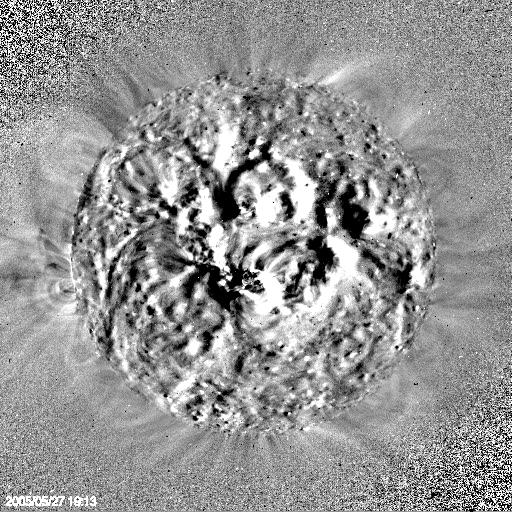
If we take an RD image based on standard theory that disk *MUST* be larger than the bottom of that red/orange chromosphere.
AUGH. Do you have a probe "7 pixels inside" the photosphere? No you don't,
You're wrong, Michael.
To be completely honest, you're making yourself look very bad by repeating this over and over and over while pretending no one has corrected you on it.
It's really kind of childish.
To which Clinger answered:Mozina said:I just want to know what you think the circumference of the RD sphere will be.
To which you responded:Clinger said:A little more than three times its diameter.
And also:Mozina said:Ok, that is *finally* a quantified prediction and we can clearly tell the difference between standard theory and a Birkeland model. I appreciate you efforts Mr. Spock. You're redeemed.![]()
Mozina said:Actually his answer does seem to set minimum and maximum parameters and that seems to be a start.
You keep harping on it being 2D, but along the limbs we can see a 3D set of features. You can't ignore *THE* most important data!
Well, in SDO images, yes. I can clearly see the red boundary of the chromosphere at the limb. At the limbs we have the opportunity to see under that point provided that it is possible to see under that point.
I count 4800Km under that point before the limb becomes "opaque" (GM definition) in the SDO images.
Speaking of falsifiable predictions, is our wager based on W.D. Clinger's prediction still on?
Just to refresh your memory, you asked:
To which Clinger answered:
To which you responded:
And also:
So, if Clinger's prediction is falsified by the RD image, I will publicly eat crow here, as we agreed. What will you do if his prediction is correct?
2D! He said 2D! One point for effort.
How did "talking about the limb data" become "ignoring the limb data"? The limb is exactly where the 3D-to-2D projection is the most complicated; it's where otherwise-thin features become thick, otherwise-dim features become bright, otherwise-transparent features become opaque.
Any "running difference" disk that shows up in RD image will tell the whole story. If the mainstream is right, the then if we put a running difference movie in relationship to that red ring, the disk can necessary be no smaller than the first pixel of the red. If the RD edge doesn't reach the red, Birkeland's model is correct, and their model is forever falsified. There just are no two ways about it. I'm confident that when we put together a RD movie at 171A and place it in relationship to the chromosphere, the disk will consitently rotate inside the chromosphere with 4800 around the disk.
It's not "complicated" and it's not "opaque" at all.
[qimg]http://www.thesurfaceofthesun.com/images/sdo/sd02.jpg[/qimg]
The "opaque" area is 4800Km under the chromosphere and the area you claim is "opaque" isn't.
Certainly.
Will everyone agree to at least the minimum and maximum as it relates to the RD radius? There still seems to be some debate yet.
Any "running difference" disk that shows up in RD image will tell the whole story. If the mainstream is right, the then if we put a running difference movie in relationship to that red ring, the disk can necessary be no smaller than the first pixel of the red. If the RD edge doesn't reach the red, Birkeland's model is correct, and their model is forever falsified.
Even if you weren't completely wrong about the standard model and you could some how falsify it this would not make your model correct. In fact the fact that the standard model had been falsified would provide precisely zero evidence in favour of your model.
Hard to get off square one, isn't it? Michael, please answer yes or no.
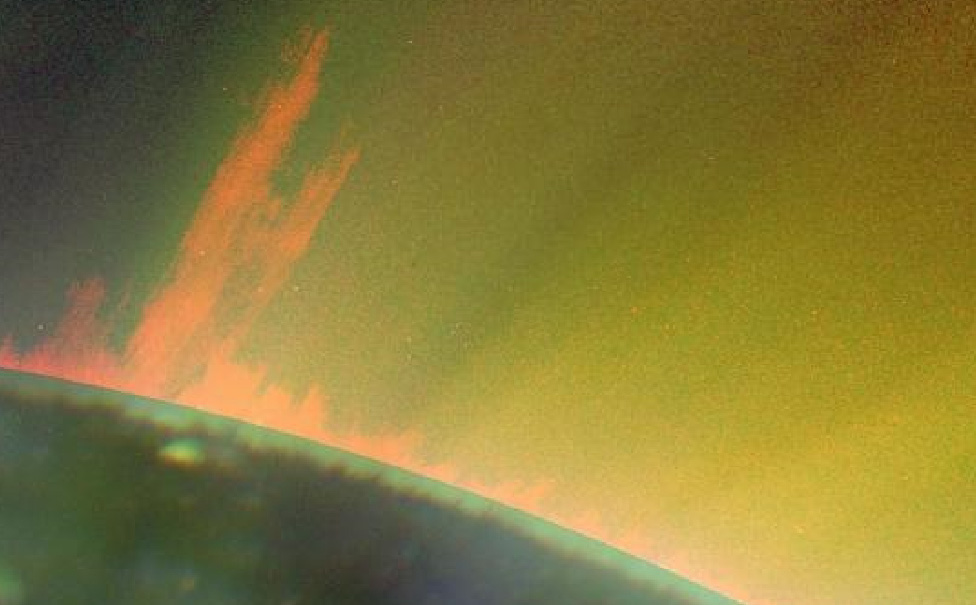
You think that the red stuff is the corona?
You think that the green stuff is "transparent neon"?
You think that the black stuff is iron?
Your model violates the laws of thermodynamics. Of course its wrong.What other solar model predicted these images Tubbythin? That limb darkening happens *exactly* where Kosovichev's data suggested. It's right on, including the best error bars I could come up with for both technologies. It can't be wrong now. It's been confirmed by two different technologies.
Well you're still failing miserably with basic geometry.You guys are now coming into my "hood". I cut my teeth on solar image analysis and SDO is what I've waited my whole life for. There is no way you guys will ever compete now. You're in my territory with SDO images, and I'm not ashamed to count pixels.