Moderated Iron sun with Aether batteries...

Status
Not open for further replies.
I have staked out a tiny little 7-8 pixel sliver *inside* the surface of your supposedly "opaque" photosphere.

AUGH. Do you have a probe "7 pixels inside" the photosphere? No you don't, you have a 2D photo where one line of sight passes 7 pixels centerwards of the photosphere. This line of sight passes through the corona AND the chromosphere AND the photosphere at a very steep angle. The only data you have is the integrated light from this line of sight, starting at the top and going down until it's opaque.

We've been repeating this for 10 pages now and you're deaf, deaf, deaf to it.

Just type "2D" for me, Michael. It's not hard. The "2" is a symbol near the top left of your keyboard, the "d" is left of center. Do you have any grasp of this at all?

The photoinization aspects of standard theory alone *INSIST* that not a single photons can come from inside the photosphere at these energy states. This is a complete "no brainer" based on standard solar theory. You can't lose.

Oh, sure, I'm willing to bet anything you like that there's no light escaping from 4800km 3-dimensionally inside of the real 3D photosphere. Do you have 3D data on the photosphere? No, you have 2D data which you're magically turning into 3D via bad guesswork. What are the terms of the bet, again? "I bet that, when MM incompetently misinterprets a 2D photo, his misinterpretation will say X instead of Y". Yeah, no, that's not a good thing to bet on.

Please type the word "2d" for me, MM. You can do it. "2" is a symbol in the upper left of your keyboard, "d" is left of center. Why is this so hard to understand? (I know why: because if you understood it you wouldn't have anything to browbeat people about. You're quite deliberately determined not to understand it, I believe.)

 
Last edited:
AUGH. Do you have a probe "7 pixels inside" the photosphere? No you don't, you have a 2D photo where one line of sight passes 7 pixels centerwards of the photosphere. This line of sight passes through the corona AND the chromosphere AND the photosphere at a very steep angle. The only data you have is the integrated light from this line of sight, starting at the top and going down until it's opaque.

We've been repeating this for 10 pages now and you're deaf, deaf, deaf to it.

Just type "2D" for me, Michael. It's not hard. The "2" is a symbol near the top left of your keyboard, the "d" is left of center. Do you have any grasp of this at all?

:popcorn6
 
If we take an RD image based on standard theory that disk *MUST* be larger than the bottom of that red/orange chromosphere.

You're wrong, Michael.

To be completely honest, you're making yourself look very bad by repeating this over and over and over while pretending no one has corrected you on it.

It's really kind of childish.
 

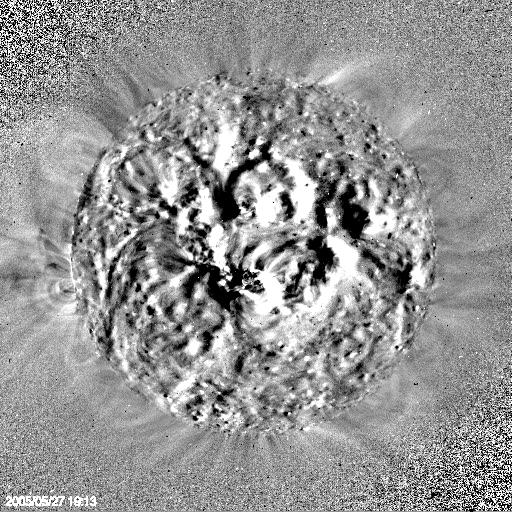
These folks have a serious problem when it comes to RD images PS. They can't play games, they can't list papers, they have to physically demonstrate in the images that the iron lines originate above the base of the chromosphere. The RD images show mostly a "flow pattern" of plasma. At the limbs this should directly relate to the chromosphere red/ring. According to standard theory, the photosphere is a 6000K surface that would absorb these wavelengths in 3.5 meters.

Any "running difference" disk that shows up in RD image will tell the whole story. If the mainstream is right, the then if we put a running difference movie in relationship to that red ring, the disk can necessary be no smaller than the first pixel of the red. If the RD edge doesn't reach the red, Birkeland's model is correct, and their model is forever falsified. There just are no two ways about it. I'm confident that when we put together a RD movie at 171A and place it in relationship to the chromosphere, the disk will consitently rotate inside the chromosphere with 4800 around the disk.

In mainstream theory there is no way for the RD flow patterns of 171A, or the rotating features to be smaller in diameter than the photosphere.
 
Last edited:
AUGH. Do you have a probe "7 pixels inside" the photosphere? No you don't,

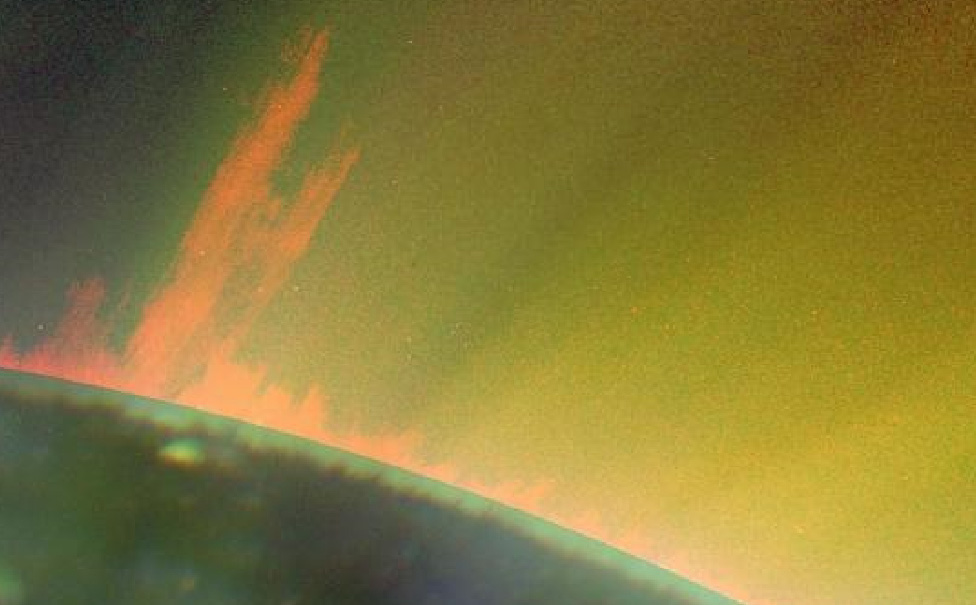
Well, in SDO images, yes. I can clearly see the red boundary of the chromosphere at the limb. At the limbs we have the opportunity to see under that point provided that it is possible to see under that point. I count 4800Km under that point before the limb becomes "opaque" (GM definition) in the SDO images. That is exactly how short you'll come up in RD images. That's also exactly what Kosovichev's data predicted too.

You keep harping on it being 2D, but along the limbs we can see a 3D set of features. You can't ignore *THE* most important data!
 
Last edited:
You're wrong, Michael.

To be completely honest, you're making yourself look very bad by repeating this over and over and over while pretending no one has corrected you on it.

It's really kind of childish.

Wait a minute sol. How can the rotating disk end up being smaller in diameter than the photosphere?

20050527-1913.JPG


Those "rigid features" rotate and we can watch them rotate as you're welcome to do with the movies on my website. If those "features" are located in the chromosphere, then any limb image should demonstrate similar features at a distance greater than the photosphere. If you disagree, please explain.
 
http://www.thesurfaceofthesun.com/images/000606to8_eit195_rd.mpg

http://www.thesurfaceofthesun.com/images/October 5th-15th 2004.wmv

The first image is a SOHO rd image at a relatively high cadence (for SOHO). The second video is a movie of RD images where the time cadence is closer to 6 hours apart. The long duration RD images in particular show very clear contrasts and the limb where the surface ends. That edge must always and completely fall inside the chromosphere boundary. It's a necessary (and falsifiable) prediction of this theory. It should also demonstrate that 4800km problem you have in SDO limb images.
 
Speaking of falsifiable predictions, is our wager based on W.D. Clinger's prediction still on?

Just to refresh your memory, you asked:

Mozina said:
I just want to know what you think the circumference of the RD sphere will be.
To which Clinger answered:
Clinger said:
A little more than three times its diameter.
To which you responded:
Mozina said:
Ok, that is *finally* a quantified prediction and we can clearly tell the difference between standard theory and a Birkeland model. I appreciate you efforts Mr. Spock. You're redeemed. :)
And also:
Mozina said:
Actually his answer does seem to set minimum and maximum parameters and that seems to be a start.

So, if Clinger's prediction is falsified by the RD image, I will publicly eat crow here, as we agreed. What will you do if his prediction is correct?
 
You keep harping on it being 2D, but along the limbs we can see a 3D set of features. You can't ignore *THE* most important data!

2D! He said 2D! One point for effort.

How did "talking about the limb data" become "ignoring the limb data"? The limb is exactly where the 3D-to-2D projection is the most complicated; it's where otherwise-thin features become thick, otherwise-dim features become bright, otherwise-transparent features become opaque.

The features you are seeing on the limb are indeed, out there on the Sun, 3D features. We take 2D data of them, with all of the projection complications folded in (like it or not). Sometimes your visual cortex looks at 2D data and says, "Wow, brain, that looks three-dimensional; the green thing is between me and the red thing". Sometimes your visual cortex is rather badly wrong. It won't tell you so---you have to decide when to listen to it.

Your visual cortex is very good at this when it's looking at a tree or a chair or something you have daily experience with. Your visual cortex is very bad at this when it's looking at optically-complicated and fuzzy-edged clouds, in extreme projection. You, Michael, seem to have an unusually unreliable visual cortex, perhaps because it's been enslaved by the daydreaming-about-being-a-maverick-science-hero lobe.
 
Well, in SDO images, yes. I can clearly see the red boundary of the chromosphere at the limb. At the limbs we have the opportunity to see under that point provided that it is possible to see under that point.

Even if everything is transparent, you don't see "under the point", you see "everything over, under, and also at the point". How can you tell whether the light that lights up the pixel is coming from over or under the surface? You can't, so you guess.

I strongly suspect that you don't know what I'm talking about by "over" and "under" in this context. You know what would clear it up? A DIAGRAM.

I count 4800Km under that point before the limb becomes "opaque" (GM definition) in the SDO images.

No you don't. At best, you count 4800km before a red-to-green transition gives way to a green-to-black transition. (Is that right?) Then you form a mental picture of a black sphere surrounded by a green atmosphere and a red corona, and you guess that that's exactly where the photons are coming from. This is dumb.
 
Last edited:
Speaking of falsifiable predictions, is our wager based on W.D. Clinger's prediction still on?

Just to refresh your memory, you asked:


To which Clinger answered:

To which you responded:

And also:


So, if Clinger's prediction is falsified by the RD image, I will publicly eat crow here, as we agreed. What will you do if his prediction is correct?

Certainly.

Will everyone agree to at least the minimum and maximum as it relates to the RD radius? There still seems to be some debate yet.
 
2D! He said 2D! One point for effort.

How did "talking about the limb data" become "ignoring the limb data"? The limb is exactly where the 3D-to-2D projection is the most complicated; it's where otherwise-thin features become thick, otherwise-dim features become bright, otherwise-transparent features become opaque.

It's not "complicated" and it's not "opaque" at all.
sd02.jpg


The "opaque" area is 4800Km under the chromosphere and the area you claim is "opaque" isn't.
 
Last edited:
Any "running difference" disk that shows up in RD image will tell the whole story. If the mainstream is right, the then if we put a running difference movie in relationship to that red ring, the disk can necessary be no smaller than the first pixel of the red. If the RD edge doesn't reach the red, Birkeland's model is correct, and their model is forever falsified. There just are no two ways about it. I'm confident that when we put together a RD movie at 171A and place it in relationship to the chromosphere, the disk will consitently rotate inside the chromosphere with 4800 around the disk.
:confused:
 
It's not "complicated" and it's not "opaque" at all.
[qimg]http://www.thesurfaceofthesun.com/images/sdo/sd02.jpg[/qimg]

The "opaque" area is 4800Km under the chromosphere and the area you claim is "opaque" isn't.

Hard to get off square one, isn't it? Michael, please answer yes or no.

You think that the red stuff is the corona?
You think that the green stuff is "transparent neon"?
You think that the black stuff is iron?

(ETA. And, still yes or no answers please.

Did you read my post #1969 yet?
Did you do the spherical geometry and somehow prove that a thin corona layer, seen in projection over an opaque sphere, could not possibly produce the green feature in 2D? Yes or no---did you or did you not do the geometric calculation?
)
 
Last edited:
Certainly.

Will everyone agree to at least the minimum and maximum as it relates to the RD radius? There still seems to be some debate yet.

You're starting to make me doubt my own sanity. Is Lewis Carroll writing this thread?

Are you familiar with this formula?

C = π x Diameter
 
Any "running difference" disk that shows up in RD image will tell the whole story. If the mainstream is right, the then if we put a running difference movie in relationship to that red ring, the disk can necessary be no smaller than the first pixel of the red. If the RD edge doesn't reach the red, Birkeland's model is correct, and their model is forever falsified.

Even if you weren't completely wrong about the standard model and you could some how falsify it this would not make your model correct. In fact the fact that the standard model had been falsified would provide precisely zero evidence in favour of your model.
 
Even if you weren't completely wrong about the standard model and you could some how falsify it this would not make your model correct. In fact the fact that the standard model had been falsified would provide precisely zero evidence in favour of your model.

What other solar model predicted these images Tubbythin? That limb darkening happens *exactly* where Kosovichev's data suggested. It's right on, including the best error bars I could come up with for both technologies. It can't be wrong now. It's been confirmed by two different technologies.

You guys are now coming into my "hood". I cut my teeth on solar image analysis and SDO is what I've waited my whole life for. There is no way you guys will ever compete now. You're in my territory with SDO images, and I'm not ashamed to count pixels.
 
Hard to get off square one, isn't it? Michael, please answer yes or no.

You think that the red stuff is the corona?

No, chromosphere. If I said corona, my bad. It's HeII from the chromosphere, and the inside smooth line is where it meets up with an area you claim is "opaque" at 500km and "opaque" to the wavelengths in question in 3.5 meters. Sure looks "ridgy" along those limb lines for 3.5 meters of clearance.

You think that the green stuff is "transparent neon"?

It's probably mostly transparent silicon with a thin layer of transparent neon.

You think that the black stuff is iron?

Yes.
 
What other solar model predicted these images Tubbythin? That limb darkening happens *exactly* where Kosovichev's data suggested. It's right on, including the best error bars I could come up with for both technologies. It can't be wrong now. It's been confirmed by two different technologies.
Your model violates the laws of thermodynamics. Of course its wrong.

You guys are now coming into my "hood". I cut my teeth on solar image analysis and SDO is what I've waited my whole life for. There is no way you guys will ever compete now. You're in my territory with SDO images, and I'm not ashamed to count pixels.
Well you're still failing miserably with basic geometry.
 
Status
Not open for further replies.

Back
Top Bottom