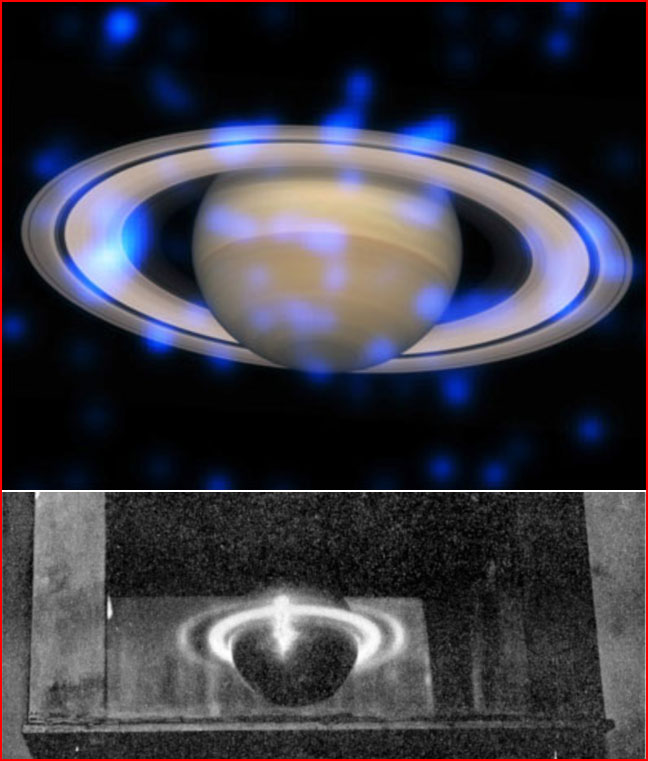
Saturn's Rings
It is news to no one, except perhaps a demented
Sol88, that the rings of Saturn are not plasma. A fascinating plasma it would be, which just happens to reflect sunlight with the same reflectance spectrum of water ice.
Saturn's rings: Spectral reflectivity and compositional implications
Lebofsky, Johnson & McCord
Icarus 13: 226-230, Sep 1970
Abstract: A photometric study of the rings of Saturn was carried out during the 1969 apparition. A reflection spectrum of the A and B rings was obtained for the spectral region 0.3–1.05 μ. The reflectivity for both rings decreases sharply toward blue and ultraviolet wavelengths. A comparison of the ring reflection spectrum with spectra for other solar system objects shows that the ring curve most closely resembles the curve for the Galilean satellite J1. The ring spectrum lacks distinctive absorption features found in lunar, Martian, and Vesta spectra in the 0.3–1.1 μ region. Absorption features characteristic of water frost have been found recently in the 1.25–2.5 μ region, but the decrease in reflectivity of the rings toward shorter wavelengths indicates that material other than pure water frost also must be present. A physical mixture of frost and silicates seems to be unlikely as ring material. Frost-covered silicates and mixtures of frosts with other compounds, perhaps modified by ultraviolet or high-energy particle radiation, remain possible ring constituents.
Not only do the rings reflect sunlight just like water ice, but they reflect radar just like water ice too.
Saturn's rings: Particle composition and size distribution as constrained by microwave observations. I - Radar observations
Cuzzi & Pollack
Icarus 33: 233-262, Feb 1978
Abstract: The radar backscattering characteristics of compositional and structural models of Saturn's rings are calculated and compared with observations of the absolute value, wavelength dependence, and degree of depolarization of the rings' radar cross section (reflectivity). The doubling method is used to calculate reflectivities for systems that are many particles thick using optical depths derived from observations at visible wavelengths. If the rings are many particles thick, irregular centimeter- to meter-sized particles composed primarily of water ice attain sufficiently high albedos and scattering efficiencies to explain the radar observations. In that case, the wavelength independence of radar reflectivity implies the existence of a broad particle size distribution; a narrower size distribution is also a possibility. Particles of primarily silicate composition are ruled out by the radar observations. Purely metallic particles may not be ruled out on the basis of existing radar observations. A monolayer of very large ice 'particles' that exhibit multiple internal scattering may not yet be ruled out.
Not only that, but when viewed in the near infrared, 0.3-0.7 μm, the rings look much redder, just like water ice.
The Composition of Saturn's Rings
Poulet & Cuzzi
Icarus 160(2): 350-358, Dec 2002
Abstract: A composite spectrum between 0.30 and 4.05 μm of Saturn's rings is analyzed using the Shkuratov scattering theory (Shkuratov et al. 1999, Icarus 137, 235-246). Several types of surface and composition are discussed. We demonstrate that both the strong reddening over the interval 0.3-0.7 μm and the water ice absorption features are well reproduced by an intimate ("salt-and-pepper'') mixture of four coarse particles of two different materials: 93% are grains (typical sizes of 10, 200, and 2000 μm) of water ice containing a few percent of refractory organic solid (tholin) impurities within their bulk, and 7% are coarse grains of a dark material (amorphous carbon). The cosmogenic implications of the inferred composition are discussed.
More detailed spectral analysis strengthens the conclusion that the rings are dominated by water ice, but also reveals that not all of the rings are made of the same stuff. Different rings have different mixes of water ice and minerals. And now we are dealing with both reflection & emission spectra, both of which agree with water ice spectra as observed in the laboratory.
Compositions of Saturn's rings A, B, and C from high resolution near-infrared spectroscopic observations
Poulet,
et al.
Astronomy and Astrophysics 412: 305-316, Dec 2003
Abstract: We used the NASA IRTF spectrograph SpeX to obtain near-infrared spectra (0.9-5.4 mu m) of Saturn's rings, achieving spectral resolution lambda / Delta lambda of about 2000. The spatial resolution (about 1 arcsec) is sufficient to distinguish the three main ring components (A, B and C rings) from one another. These new observations of Saturn's rings are the first to combine an extended spectral range with high spectral resolution and good spatial resolution. We combined these data with recent photometric observations acquired by HST in the 0.3-1.0 mu m range. The spectra of the A band B rings are dominated by strong features due to crystalline water ice. The shape and the depth of these absorptions differ for each ring, which indicates different water ice grain sizes and abundances. No spectral evidence for volatile ices other than water ice has been detected. Both the lower albedo and the less blue slope in the near-infrared reflectance of the C ring indicate a concentration of dark material different from that in the A and B rings. The broader triangular Fresnel reflection peak at 3.1 mu m may support the presence of some amount of amorphous ice. The C ring spectrum exhibits bands centered at 1.73 and 3.4 mu m which agree in position quite well with the C-H bands. Although the detection is probable, it requires confirmation. With a radiative transfer model, we constrain the grain sizes and the relative abundances of water ice, a dark colorless component (amorphous carbon) to adjust the albedo and a second contaminant to reproduce the reddening in the UV-visible range represented here by organic tholins. The dark component of the C ring spectrum is included as an intra-mixture only. The cosmogenic implications of the inferred compositions are discussed.
Meanwhile, the Cassini spacecraft has gone right up the the E-ring and actually grabbed bits of it for analysis. Curious that they should find a lot of water ice, isn't it?
The composition of Saturn's E ring
Hillier,
et al.
Monthly Notices of the Royal Astronomical Society 377(4): 1588-1596, June 2007
Abstract: We present the first in situ direct measurement of the composition of particles in Saturn's rings. The Cassini cosmic dust analyser (CDA) measured the mass spectra of nearly 300 impacting dust particles during the 2004 October E ring crossing. An initial interpretation of the data shows that the particles are predominantly water ice, with minor contributions from possible combinations of silicates, carbon dioxide, ammonia, molecular nitrogen, hydrocarbons and perhaps carbon monoxide. This places constraints on both the composition of Enceladus, the main source of the E ring, as well as the grain formation mechanisms.
And finally, a more complete analysis of the rings is presented, in both reflection & transmission of sunlight, over a full set of phase angles. Strange that the "plasma" of the rings seems to mimic mostly water ice in such tremendous detail, is it not?
The Composition of Saturn's Rings
Clark,
et al.
American Geophysical Union, Fall Meeting 2008, abstract #P32A-02, Dec 2008
Abstract: The Cassini spacecraft has obtained a unique collection of data about Saturn's rings, as it has observed the rings from 0 to 180 degrees in phase angle, and on both lit and unlit sides. Identification of trace contaminants, especially organic compounds, requires that spectra of the rings be uncontaminated by light from Saturn. The Cassini Visual and Infrared Mapping Spectrometer (VIMS) has acquired 0.35 to 5.1 micron, high spatial resolution spectroscopic data near the shadow of Saturn on the rings where scattered light is at a minimum. At low phase angles, the ring spectra show classic crystalline-ice spectral features except for a contaminant causing a UV absorption. VIMS spectra at 180-degree phase angle are generally flat, with only a weak positive feature at 2.86 microns in spectra of the F-ring. The general transmission decrease is due to large ring particles completely blocking light. The 2.86-micron feature indicates the presence of fine ice dust, where the ice's index of refraction is near 1.0, and light is not refracted or diffracted. There are no indications of interparticle scattering in the VIMS data at any phase angle. The lack of interparticle scattering indicates that the dense A and B rings must be very thin, approaching a monolayer, but rigorous constraints have yet to be modeled. Previous studies used tholins and amorphous carbon for the contaminant causing the UV absorption, but these models display additional absorptions and spectral structure in the near infrared not seen in VIMS data. Clark et al. (Icarus, v193, p372, 2008) modeled the changing blue peak and UV absorber observed on Phoebe, Iapetus, Hyperion, and Dione with amorphous carbon and nano-sized hematite. Nanohematite has muted spectral features compared to larger grained hematite, due to crystal field effects at the surfaces of small grains. Nanohematite has a strong UV absorber that matches the steep UV slope observed in spectra of Saturn's rings and has no strong IR absorptions. If the UV absorber in Saturn's rings is due to nanophase hematite then less than 1% hematite would be required, if it is uniformly mixed within the ice grains of the ring particle regoliths.
And finally, finally, the thermal emission from the rings depends on the solar elevation & phase angle, just as one would expect for ice particles and dust grains (and not expect for any conceivable plasma). In fact, the thermal emission even shows that it depends on how fast the ring particles spin (the faster spinning particles are more evenly illuminated for even heating, while the slower while the shaded side of slow spinners has time to cool).
Thermal observations of Saturn's main rings by Cassini CIRS: Phase, emission and solar elevation dependence
Altobelli,
et al.
Planetary and Space Science 56(1): 134-146, Jan 2008
Abstract: Two and a half years after Saturn orbit insertion (SOI) the Cassini composite infrared spectrometer (CIRS) has acquired an extensive set of thermal measurements (including physical temperature and filling factor) of Saturn's main rings for a number of different viewing geometries, most of which are not available from Earth. Thermal mapping of both the lit and unlit faces of the rings is being performed within a multidimensional observation space that includes solar phase angle, spacecraft elevation and solar elevation. Comprehensive thermal mapping is a key requirement for detailed modeling of ring thermal properties. To first order, the largest temperature changes on the lit face of the rings are driven by variations in phase angle while differences in temperature with changing spacecraft elevation are a secondary effect. Ring temperatures decrease with increasing phase angle suggesting a population of slowly rotating ring particles [Spilker, L.J., Pilorz, S.H., Wallis, B.D., Pearl, J.C., Cuzzi, J.N., Brooks, S.M., Altobelli, N., Edgington, S.G., Showalter, M., Michael Flasar, F., Ferrari, C., Leyrat, C. 2006. Cassini thermal observations of Saturn's main rings: implications for particle rotation and vertical mixing. Planet. Space Sci. 54, 1167 1176, doi: 10.1016/j.pss.2006.05.033]. Both lit A and B rings show that temperature decreases with decreasing rings solar elevation while temperature changes in the C ring and Cassini Division are more muted. Variations in the geometrical filling factor, β, are primarily driven by changes in spacecraft elevation. For the optically thinnest region of the C ring, β variations are found to be nearly exclusively determined by spacecraft elevation. Both a multilayer and a monolayer model provide an excellent fit to the data in this region. In both cases, a ring infrared emissivity >0.9 is required, together with a random and homogeneous distribution of the particles. The interparticle shadowing function required for the monolayer model is very well constrained by our data and matches experimental measurements performed by Froidevaux [1981a. Saturn's rings: infrared brightness variation with solar elevation. Icarus 46, 4 17].
The rings of Saturn are not plasma.
The rings of Saturn are mostly water ice, with a mix of minerals.
The rings of Saturn do not all have the same composition.
This is a really silly thread.