Hardfire: Physics of 9/11

So you think that both columns of the section wouldn't fail and would support a huge amount of mass.

All columns of section A carry exactly the same - huge? - amount of mass before and after impact. No extra mass pops up when C drops. The compressive stresses in all the A columns are average 0.3 yield before/after impact. During impact stresses were higher due to dynamic effects but as you can, it was the weaker columns in section C that failed first.

It normally happens when you drop a weaker structure C on a stronger structure A (unless C just bounces or drops off).

One-way collapse C crushing A never takes place. Easy to show with a model!
 
All columns of section A carry exactly the same - huge? - amount of mass before and after impact. No extra mass pops up when C drops. The compressive stresses in all the A columns are average 0.3 yield before/after impact. During impact stresses were higher due to dynamic effects but as you can, it was the weaker columns in section C that failed first.

It normally happens when you drop a weaker structure C on a stronger structure A (unless C just bounces or drops off).

One-way collapse C crushing A never takes place. Easy to show with a model!

Unfortunately the floors can't support such a load. And once unbraced, the columns can't support themselves.
 
Unfortunately the floors can't support such a load. And once unbraced, the columns can't support themselves.

But before that even happens the columns have punched through the floors so the floors get entangled into one another. And the floors are always attached to the columns at one end = braces them! Arrest follows soon!
 
But before that even happens the columns have punched through the floors so the floors get entangled into one another. And the floors are always attached to the columns at one end = braces them! Arrest follows soon!

Please show evidence or a model where the floors will get "entangled".

Secondly, the joist must be undamaged to brace the column.

You're full of crap Heiwa, and we both know it.
 
Please show evidence or a model where the floors will get "entangled".

Secondly, the joist must be undamaged to brace the column.

You're full of crap Heiwa, and we both know it.

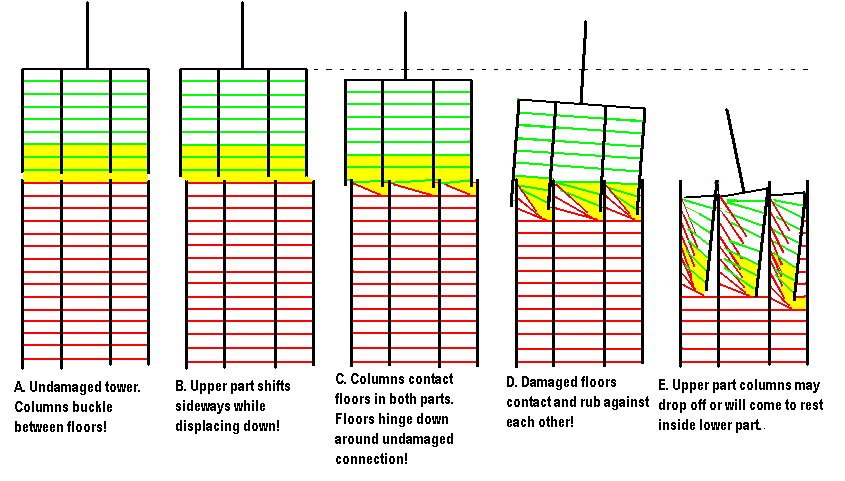
Well, the model is easy in 2D - imagine it in 3D:

WTC1slicea.GIF


And you see - the floor truss joints at the columns are not damaged and brace the columns, while the floors get entangled.

Where did you learn your foul language - at home?
 
Your crappy illustrations don't prove anything. I take that back. They prove that you haven't the slightest clue what you are talking about.
 
Even I get just how ludicrous those drawings are. That's saying a lot.
 
Your crappy illustrations don't prove anything. I take that back. They prove that you haven't the slightest clue what you are talking about.

The illustrations show what happens when two identical structures of strong and weak elements collide slightly offset; the strong elements (columns) damage the weak elements (floors). It is just like a ship collision that happens frequently. I have investigated several.
Why do you suggest I haven't a clue what I am talking about?
 
Heiwa, provide a REAL model that matches your... mlkdfhgklmsdjes about the collapses of the tower.
 
Heiwa, provide a REAL model that matches your... mlkdfhgklmsdjes about the collapses of the tower.
.
How can any model be REAL if we don't know the number and weights of each of the 12 different types of perimeter wall panels?

How can a SCALED MODEL that Mackey talks about in Hardfire #3 possibly be made?

He issued a challenge he knew could not be met but doesn't demand that the information necessary be released or point out that it has not been.

psik
 
Last edited:
Well, the model is easy in 2D - imagine it in 3D:

[qimg]http://heiwaco.tripod.com/WTC1slicea.GIF[/qimg]

And you see - the floor truss joints at the columns are not damaged and brace the columns, while the floors get entangled.

Where did you learn your foul language - at home?

1. The connection from the floor truss to the column cannot undergo the rotation you show. In fact, it probably can only undergo a few degrees of rotation before rupturing.

2. The columns are not braced by a single connection and a weight pulling down on them.

Please stay on topic Heiwa. I asked for a model showing this behavior of your invention. That is consistent with the discussion of this thread. Just saying something "is" and having a pretty picture does not qualify.
 
Heiwa, provide a REAL model that matches your... mlkdfhgklmsdjes about the collapses of the tower.

I have - full scale! Remember the pizza boxes, sponges, lemons, &c. in numerous JREF threads. No piece C of my pizza boxes, sponges, lemons, &c, ever crushed the bigger part A of same pizza boxes, sponges, lemons, &c, when I dropped them. No one-way crush down took place.

Mackey & Hardfire suggest that I must drop piece C of a pizza box, sponge, lemon, &c, from two miles and then C will destroy A of same pizza box, sponge, lemon, &c. It is a matter of scale, I am told.

Same result though. At contact C on A the A force destroyed C long before the C force destroyed A. C was to small. Drop height didn't matter.

Between you and me - Mackey & Hardfire are mlkdfhgklmsdjes. Thanks for reminding me.
 
1.

The connection from the floor truss to the column cannot undergo the rotation you show. In fact, it probably can only undergo a few degrees of rotation before rupturing.

2. The columns are not braced by a single connection and a weight pulling down on them.

Please stay on topic Heiwa. I asked for a model showing this behavior of your invention. That is consistent with the discussion of this thread. Just saying something "is" and having a pretty picture does not qualify.

Sorry, 100% wrong. The floor truss can bend/hinge up to 90° just adjacent to the bolted seat. The bracings of the columns are not affected by this at all!

Stay on topic, Newton Bit.
 
.
How can any model be REAL if we don't know the number and weights of each of the 12 different types of perimeter wall panels?

How can a SCALED MODEL that Mackey talks about in Hardfire #3 possibly be made?

He issued a challenge he knew could not be met but doesn't demand that the information necessary be released or point out that it has not been.

psik

But Mackey did it. Upper Mass part UM = k m contacts Lower Mass part LM = 10 k m BANG and UM is supposed to crush down LM into nothing. After that UM is crushed up into nothing.

Note that UM is 1/10th of LM and that m is same everywhere. Uniform density!

Mackey however forgets the Björkman Axiom, where a small part UM of any structure cannot possibly crush down a big part LM, &c, of same structure.

Asking Mackey & Hardfire to challenge their nonsense I am met by ..... (silence).

I assume they just lost their senses?
 
Thanks for the base diagram Heiwa
heiwamod1.jpg


Despite all the criticism it is a good foundation.

Your "a" is good enough.
"b" is partly true but remember the "Top Block" ended up inside the outer tube for both towers - detailed explanation later if appropriate.
"C" misses the main point of contact - floor on floor - in the outer tube area. AND the whole concept of the core failing similarly to the outer tube is flawed also detailed explanation later if appropriate.
Also the floors did not hinge - both ends sheared and they fell (more or less) "Flat"
"D" so I seriously modified "D" to reflect what actually happened - excuse rough graphics and one point where not clear (column v floors - which contact came first?? AND did it matter - your attribution to column contact leads you of what actually happened)

"E" a rough "how it really happened.

And, for all "detailed explanation later if appropriate."
 
Thanks for the base diagram Heiwa
[qimg]http://conleys.com.au/webstuff/heiwamod1.jpg[/qimg]

Despite all the criticism it is a good foundation.

Your "a" is good enough.
"b" is partly true but remember the "Top Block" ended up inside the outer tube for both towers - detailed explanation later if appropriate.
"C" misses the main point of contact - floor on floor - in the outer tube area. AND the whole concept of the core failing similarly to the outer tube is flawed also detailed explanation later if appropriate.
Also the floors did not hinge - both ends sheared and they fell (more or less) "Flat"
"D" so I seriously modified "D" to reflect what actually happened - excuse rough graphics and one point where not clear (column v floors - which contact came first?? AND did it matter - your attribution to column contact leads you of what actually happened)

"E" a rough "how it really happened.

And, for all "detailed explanation later if appropriate."


This is a very good job.
 
This one may also assist to understand the "Global Collapse" - I made it nearly two years back for another discussion.
003.jpg

And the failure is "symmetrical" - both inner and outer ends of the joists fail allowing the accumulating floors to fall (essentially) "flat" in the pancaking mechanism of the "Global Collapse".
 

Back
Top Bottom