Moderated Steel structures cannot globally collapse due to gravity alone

First they destroy (controlled demolition) floors 4-6 (part B) with explosives - BANG - (note the debris formed, etc) so that the top part C (say 6 floors 7-12) can drop down on lower part A (floors 0-3) due to gravity. At contact part A produces failures on part C and part C produces failures on part A. As top part C is bigger than part A, the whole building is destroyed.


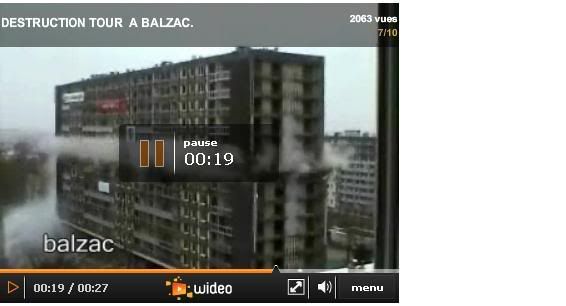
You can't count, Heiwa. Here's a screen shot of the beginning of the CD :

balzacdemolition.jpg


The CD does not begin at floors 4-6, and the top section is a fraction smaller than the lower section.
 
Sorry Architect. You are simply talking nonsense. The dimensions of the core columns and the whole core structure with horizontal and sloping beams as taken from the drawing clearly indicate that its elements could in fact carry 300% of the static (dead and live) loads applied. Reason for this is the redundancy required, e.g. if one primary element, a column, would fail for some reason; bad material or workmanship, misalignment or similar hidden defects or due local fire or some other mishap (elevator exploding, etc). Then the other parts would carry the load and for that FoS=3 is a requirement.

Prove it. Provide some calculations then. But please don't just expect us to take your word for it.
 
A "free-fall" of the upper (smaller) portion of 1.5 seconds is sufficient to destroy this building, yet you claim that one of the Twin Towers wouldn't be destroyed if 30 stories of it were dropped on the lower section from a height of two miles. Please explain why you believe this to be so. Show your math.

Gravy, in your usual style you continue to misquote. Two miles drop? Do I say that? Regardless of drop height impact force F equals reaction force -F in size (but not direction). Applies to anything incl. the Vitry concrete building.
 
Gravy, in your usual style you continue to misquote. Two miles drop? Do I say that?

From an exchange on and around post #744 in this thread :

GlennB said:
One of these possibilities - applicable in pomeroo's extreme scenario* - would be the utter destruction of both parts. Of course.

Heiwa said:
No - not really ... even after a two mile drop and a plenty of energy/forces at impact.

So ... you did say it, both then and long before. Why can't you just admit it?

*The two-mile drop.
 
From an exchange on and around post #744 in this thread :


So ... you did say it, both then and long before. Why can't you just admit it?

*The two-mile drop.

What I said discussing something from a theoretical point of view was:

"No - not really ... even after a two mile drop and a plenty of energy/forces at impact. As the upper part C is smaller (1/10th of A) and can absorb less strain energy than the lower, bigger part A on ground, the upper part C is destroyed completely before part A is totally destroyed. After part C is totally destroyed it does not apply any force on what still remains of part A.

You see, you cannot destroy a structure by dropping a piece of it on the whole.

But if part A had enough strain energy and was elastic enough to absorb all energy involved at the contact and that also part C could absorb that energy (or half of it! and no local failures develop), then part C would bounce - maybe a mile and 3/4 up. Big bounce. "


You see, Glenn B, you have to quote properly!

Actually - according to NIST and Bazant & Co the drop height doesn't matter as they assume that the upper part C is rigid during crush down and does not get affected at all. It remains intact! But after part C has crushed part A, part C is not rigid anymore ... and crushes up = gets destroyed by contact with the ground (or the rubble of part A). Quite unscientific. Part C cannot be rigid at one moment and not rigid another but that is the ONLY way NIST and Bazant & Co can explain the crush down of WTC 1. According basic structural damage analysis (and a small drop 0.5 or even 3.6 m) part C of WTC 1would just get stuck on top of part A! Both parts C and A would be damaged at the interface and the damages would mirror each other.

Had the structure been more like a sponge part C (a small piece of sponge) would just bounce on part A (the bigger piece of sponge) ... and that would be it.

NIST and Bazant & Co cheat: part C is assumed to have a different (rigid) structure than part A (not rigid) and then, OF COURSE, part C can crush down part A. Cheat? It is criminal falsification of a technical report or model to explain something.

It seems I have won the discussion about the subject of this thread. Only you, Architect and Gravy (of course) try in vain still to change the subject. So I will not respond to your nonsense any longer. Real comments are of course still welcome.
 
It seems I have won the discussion about the subject of this thread. Only you, Architect and Gravy (of course) try in vain still to change the subject. So I will not respond to your nonsense any longer. Real comments are of course still welcome.

Here's a real comment: nobody whom I have showed this thread to, and that includes people who I know are experts, thinks you know what you are talking about. Until you can convince a real expert you are right, all we have are your opinions.

Opinions don't "win" debates.
 
It seems I have won the discussion about the subject of this thread. Only you, Architect and Gravy (of course) try in vain still to change the subject. So I will not respond to your nonsense any longer. Real comments are of course still welcome.

Actually, it was you who specifically raised the claim that "FoS>3" first on this thread, all I have done is ask you to provide calculations to prove that and - as a starting point - given you some figures which quite clearly show that the safety factor was nowhere near 300%. You in turn stated:

The dimensions of the core columns and the whole core structure with horizontal and sloping beams as taken from the drawing clearly indicate that its elements could in fact carry 300% of the static (dead and live) loads applied.

I've challenged you to prove this. If your concern is derailing of the current thread, however, then you'll be delighted to know that I've started a thread so you can cover it.
 
What I said discussing something from a theoretical point of view was:

"No - not really ... even after a two mile drop and a plenty of energy/forces at impact. As the upper part C is smaller (1/10th of A) and can absorb less strain energy than the lower, bigger part A on ground, the upper part C is destroyed completely before part A is totally destroyed. After part C is totally destroyed it does not apply any force on what still remains of part A.

So -- you still maintain that a two-mile drop of a smaller upper section will not destroy the lower section ?

This position is exactly what you have denied making, and here you are making it again. In plain view.

Do you ever listen to yourself?
 
So, then no amount of snow applied (slowly) to a all-steel roof can ever make it collapse?

You have misunderstood the subject - drop a piece of structure on a bigger piece of similar structure and see what happens! As far as I am concerned snow is slightly different from steel. Try to keep on topic, pls.

As far as I am concerned it was not snowing on 911 :)
 
Nice try, but no cigar
"The rest of the story" is that the force applied by the falling part of the building to the next lower floor is in excess of that required to remove (obliterate, do away with, etc) the resisting force of that lower, non-moving, intact at the time, floor of the building.
In a static case (nothing is moving), the SUM of all forces = 0. This occurs when the building is standing there, undamaged.
In a dynamic case (i.e., things are moving) the SUM of all forces = M*a. In this case, a=g

The sum of all forces on the upper block is only m*g if it's in freefall, it's impossible for it to be m*g during a collision with the lower block.
 
The sum of all forces on the upper block is only m*g if it's in freefall, it's impossible for it to be m*g during a collision with the lower block.

The force upper, moving part C applies on lower part A at contact is ideally the potential energy applied divided by the distance displaced during contact, i.e. a dynamic phenomenon. Evidently the lower part A applies an opposite reaction force on part C at the same time.

The pressure upper, moving part C applies on lower part A at contact is the potential energy applied divided by the volume compressed during contact, a similar dynamic phenomenon. And again lower part A applies an opposite reaction pressure on part C.

Thus the force/pressure developed at contact depends on the displacement/compression during the event ... so you have to keep an eye on those. As potential energy is transformed into other forms of energy, e.g. heat, elastic (can be stored in the structure) or plastic structural deformation or failures, during the event, you can be sure that it will be arrested after a while, particularly when parts A and C have same structure, and a static equilibrium state develops where the force of upper part C, i.e. its mass times g, on part A is balanced by an opposite reaction force of same magnitude by part A on part C. Part C gets stuck on top op part A.

NIST in its infamous report (read conspiracy theory) about the WTC 1 destruction assumes that part C is rigid - indestructible - and that part A is non-rigid - easily destructible - and that the potential energy applied by part C exceeds the total strain energy that part A can absorb and that therefore part A is destroyed in 1000000's of pieces - global collapse ensues - except that then part C is never destroyed. It is Bush nonsense of course. Part C is not rigid.

Bazant & Co assume the same in their conspiracy theory except that part C becomes non-rigid after crush down and is destroyed in a crush up due to contact with ground. It is a variation of the NIST Bush nonsense but ensures that part C is actually destroyed, which NIST forgot to explain.

For more info about the NIST and the Bazant & Co conspiracy theories, pls visit the Gravy web site
Edited by Gaspode: 
Removed personal remarks

 
Last edited by a moderator:
The sum of all forces on the upper block is only m*g if it's in freefall, it's impossible for it to be m*g during a collision with the lower block.
Duh.
Correct. F=m*g-Fult
It can be damn close, though--and was, especially once the first 10 or 20 floors below the damage went...
 
You have misunderstood the subject - drop a piece of structure on a bigger piece of similar structure and see what happens!
Third time: you claim that 30 stories of a Twin Tower, if dropped from a height of two miles, would not destroy the lower 80 stories.

Prove it. Show your math, or retract your claim.

While you're at it, please respond to the demolition video posted above, which shows a smaller (or at best, equal-sized) section destroying a lower section that likely is of equal or stronger construction.
 
Third time: you claim that 30 stories of a Twin Tower, if dropped from a height of two miles, would not destroy the lower 80 stories.

Prove it. Show your math, or retract your claim.

While you're at it, please respond to the demolition video posted above, which shows a smaller (or at best, equal-sized) section destroying a lower section that likely is of equal or stronger construction.
Even there, he blows it, and does not comprehend his error:
"You have misunderstood the subject - drop a piece of structure on a bigger piece of similar structure and see what happens! "
Except what he keeps ignoring (intentionally, it would seem) is that each floor below the initial damage area must be treated as a seperate entity.
thus, you are not dropping "a piece of structure on a bigger piece of similar structure and see what happens!"--you are dropping a large piece of the structure (the upper part above the initial damage) onto a smaller part--ONE FLOOR!
 
Even there, he blows it, and does not comprehend his error:
"You have misunderstood the subject - drop a piece of structure on a bigger piece of similar structure and see what happens! "
Except what he keeps ignoring (intentionally, it would seem) is that each floor below the initial damage area must be treated as a seperate entity.
thus, you are not dropping "a piece of structure on a bigger piece of similar structure and see what happens!"--you are dropping a large piece of the structure (the upper part above the initial damage) onto a smaller part--ONE FLOOR!

Actually, that's not entirely correct. You are dropping a piece of structure on a lower structure which depended on the upper for overall stability in the first place. By ignoring the important structural contribution posed by the building as a whole he makes a fundamental error.
 
Even there, he blows it, and does not comprehend his error:
"You have misunderstood the subject - drop a piece of structure on a bigger piece of similar structure and see what happens! "
Except what he keeps ignoring (intentionally, it would seem) is that each floor below the initial damage area must be treated as a seperate entity.
thus, you are not dropping "a piece of structure on a bigger piece of similar structure and see what happens!"--you are dropping a large piece of the structure (the upper part above the initial damage) onto a smaller part--ONE FLOOR!
I've been giving him the benefit of the doubt and assuming that he's arguing along the lines of the first Bazant paper: that here's what would happen if the load was evenly distributed across the structure. Of course that doesn't reflect reality, but I'm asking that Heiwa support his claim using the most basic model and math. Perhaps he's too busy jumping on his bathroom scale, scratching his head, and wondering what's wrong with the scale.
 

Back
Top Bottom