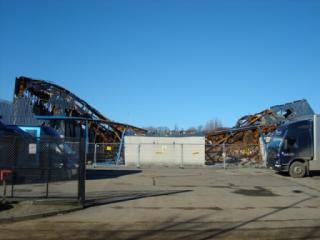
Moderated Steel structures cannot globally collapse due to gravity alone

That is his opinion.

Perhaps you missed this part again:
"to answer this question fully, a three-dimensional analysis would be required."

I think you should explain the differential equation used by Bazant and how it fails to model correctly based on Bazant’s assumptions.

Did you know a simple momentum model matches the timing too? Can you do a simple momentum model? Do you have any idea what momentum is?
 
Dave,

Well, whatcha know.

I just did a quick calculation, based on a single beam, 444" long, 13" thick x 14" wide on the outside, 12.5" thick x 13.5" wide cut-out interior, yield strength 70 Ksi, cantilever.

The force you can put on it and keep the outer fiber stresses below Sy is about 1,850 lbs with a deflection of 5.3". This gives about 4,900 in-lb potential energy.

Converting this entirely into linear velocity gives about 83 ft/sec = 56 mph.

A quick check of the rotational energy (0.5 Ixx omega^2) shows the rotational energy for one of these (almost hollow) box beams to be a trivial percent of the linear energy. So, figure it drops the linear velocity to about 54 mph.

Note that I figured this for a cantilevered beam, which stores only half as much energy as a beam that is bent into a uniform arc throughout its length. Twice as much energy gives you 41% more velocity, or 76 mph. Not bad.

Bill, what this calc does show is that, contrary to what you were "certain of", the box beams can take quite a bit of deflection (over 5") before they start to take a set, and substantially more than this before they are in danger of kinking. And they can store an enormous amount of energy in them in the process.

As expected, until one runs the numbers, you don't know what you're gonna get. And you, bill, have precisely ZERO "feel" for any of this.

You have simply your wishful thinking, based on your foregone conclusions.

tk

Well done Teddy. Just a few remarks though. 5.3'' of beflection in a 37 foot long beam does not seem like a whole hell of a lot to me. How much of that 4.900 in/lbs PE would actually be converted into linear motion that would carry the entire beam away at 54 mph and how far would it travel horizontally ?. Do you mean one end fixed at the bottom ?
 
Dave,

Well, whatcha know.

I just did a quick calculation, based on a single beam, 444" long, 13" thick x 14" wide on the outside, 12.5" thick x 13.5" wide cut-out interior, yield strength 70 Ksi, cantilever.

The force you can put on it and keep the outer fiber stresses below Sy is about 1,850 lbs with a deflection of 5.3". This gives about 4,900 in-lb potential energy.

Converting this entirely into linear velocity gives about 83 ft/sec = 56 mph.

A quick check of the rotational energy (0.5 Ixx omega^2) shows the rotational energy for one of these (almost hollow) box beams to be a trivial percent of the linear energy. So, figure it drops the linear velocity to about 54 mph.

Note that I figured this for a cantilevered beam, which stores only half as much energy as a beam that is bent into a uniform arc throughout its length. Twice as much energy gives you 41% more velocity, or 76 mph. Not bad.

Bill, what this calc does show is that, contrary to what you were "certain of", the box beams can take quite a bit of deflection (over 5") before they start to take a set, and substantially more than this before they are in danger of kinking. And they can store an enormous amount of energy in them in the process.

As expected, until one runs the numbers, you don't know what you're gonna get. And you, bill, have precisely ZERO "feel" for any of this.

You have simply your wishful thinking, based on your foregone conclusions.

tk

56 to 76 MPH?? Seriously? That much speed imparted? Huh... I never would've guessed.

Thanks for the calculation! :thanks

If I may bother you further, here's a question: Consider a column that came from the North tower. Presume that it originated from somewhere around the impact zone (floors 94-98; this is of course arbitrary, but I'm trying to establish a hypothetical scenario, so it'll do for now). At 56 MPH, how far out horizontally would it go before reaching around 200 feet above ground level? And how far out would it travel at 76 MPH? Since it's just a query for a rough number, any simplifications necessary to avoid serious headaches are no problem.

Obviously, I'm trying to gain a feel for what happened to the column that embedded itself in roughly the 20th floor of World Financial Center 3 (the column that Christopher7 keeps on going on about). The speeds you note make decent boundary conditions, so it will be interesting to see how that works out when considering a real scenario from the collapse.

If you choose to do this - and it's of course strictly voluntary, so don't feel obligated - thank you! Even if you don't: Thanks for the calc so far!
 
Professional opinions are still just opinions. They are not proof of anything.

Good. You are getting somewhere. Now, reread you own posts. What do they contain? Right. Opinions. quote They are not proof of anything unquote. Moreover, your opinions are unprofessional, non-expert, top-of-the-head opinions. Your opinions do not match the behaviour of physical objects, as the people who actually do understand how physical objects behave have tried to explain to you. In addition, your opinions run contrary to the available photographic evidence. Your opinions thus not only quote are not proof of anything unquote, they are worthless.
 
Well done Teddy. Just a few remarks though. 5.3'' of beflection in a 37 foot long beam does not seem like a whole hell of a lot to me. How much of that 4.900 in/lbs PE would actually be converted into linear motion that would carry the entire beam away at 54 mph and how far would it travel horizontally ?. Do you mean one end fixed at the bottom ?

What are your qualifications that give your opinion on this matter any weight? So far, pretty much all we know about you is that you are defending Heiwa. Not off to a good start.

You do realize that the stored energy in one of these compressed/bent beams is not the only collapse energy available to provide horizontal motion don't you?
 
I think you should explain the differential equation used by Bazant and how it fails to model correctly based on Bazant’s assumptions.
Why?

Bazant has admitted that his 1 dimensional model does not accurately represent the actual collapse and a 3 dimensional model is required.
 
was it really half-inch steel in those box columns where the planes enered the buildings ?

Although I have you on ignore I will respond to this one post.


READ THE REPORT THAT YOU CLAIM TO KNOW SO MUCH (and doubt) ABOUT! IT'S IN THERE. HOW CAN YOU KNOW SO LITTLE AND COMPLAIN SO MUCH? Back to ignore you go.
 
Why?

Bazant has admitted that his 1 dimensional model does not accurately represent the actual collapse and a 3 dimensional model is required.

What does one dimension mean? What does the paper mean? Explain it

Does this mean you failed to explain the differential equation used by Bazant?

Did you take a course on differential equations?

Failure to explain these two simple things from Bazant’s model, make your conclusions worthless.
 
Although I have you on ignore I will respond to this one post.


READ THE REPORT THAT YOU CLAIM TO KNOW SO MUCH (and doubt) ABOUT! IT'S IN THERE. HOW CAN YOU KNOW SO LITTLE AND COMPLAIN SO MUCH? Back to ignore you go.

Nah....thanks anyway but ignore is fine by me.
 
What does one dimension mean? What does the paper mean? Explain it

Does this mean you failed to explain the differential equation used by Bazant?

Did you take a course on differential equations?

Failure to explain these two simple things from Bazant’s model, make your conclusions worthless.

I must admit, I'm as uninformed as Christopher in this area. I would like to know what this reference to dimensional differences means. I'm guessing by the way your asking that the answer is not obvious.
 
NIST did NOT explain how the towers collapsed.

Way to go funk.

When faced with an intolerable truth, just call the messenger a liar.

Sit thee down funk, rest ye. Then read 'em and weep.

NIST reply to stj911truth
http://www.911proof.com/NIST.pdf

pg 3 NIST has stated that it did not analyze the collapse of the towers.

PG 4
We are unable to provide a full explanation of the total collapse.
NIST’s analysis was carried to the point of collapse initiation.

Read this and weep liar.

From the December FAQs posted after the claims you have made

NIST said:
1. Was there enough gravitational energy present in the World Trade Center Towers to cause the collapse of the intact floors below the impact floors? Why was the collapse of WTC 1 and 2 not arrested by the intact structure below the floors where columns first began to buckle?

Yes, there was more than enough gravitational load to cause the collapse of the floors below the level of collapse initiation in both WTC Towers. The vertical capacity of the connections supporting an intact floor below the level of collapse was adequate to carry the load of 11 additional floors if the load was applied gradually and 6 additional floors if the load was applied suddenly (as was the case). Since the number of floors above the approximate floor of collapse initiation exceeded six in each WTC Tower (12 and 29 floors, respectively), the floors below the level of collapse initiation were unable to resist the suddenly applied gravitational load from the upper floors of the buildings. Details of this finding are provided below:

Consider a typical floor immediately below the level of collapse initiation and conservatively assume that the floor is still supported on all columns (i.e., the columns below the intact floor did not buckle or peel-off due to the failure of the columns above). Consider further the truss seat connections between the primary floor trusses and the exterior wall columns or core columns. The individual connection capacities ranged from 94,000 lb to 395,000 lb, with a total vertical load capacity for the connections on a typical floor of 29,000,000 lb (See Section 5.2.4 of NIST NCSTAR 1-6C). The total floor area outside the core was approximately 31,000 ft2, and the average load on a floor under service conditions on September 11, 2001 was 80 lb/ft2. Thus, the total vertical load on a floor outside the core can be estimated by multiplying the floor area (31,000 ft2) by the gravitational load (80 lb/ft2), which yields 2,500,000 lb (this is a conservative load estimate since it ignores the weight contribution of the heavier mechanical floors at the top of each WTC Tower). By dividing the total vertical connection capacity (29,000,000 lb) of a floor by the total vertical load applied to the connections (2,500,000 lb), the number of floors that can be supported by an intact floor is calculated to be a total of 12 floors or 11 additional floors.

This simplified and conservative analysis indicates that the floor connections could have carried only a maximum of about 11 additional floors if the load from these floors were applied statically. Even this number is (conservatively) high, since the load from above the collapsing floor is being applied suddenly. Since the dynamic amplification factor for a suddenly applied load is 2, an intact floor below the level of collapse initiation could not have supported more than six floors. Since the number of floors above the level where the collapse initiated, exceeded 6 for both towers (12 for WTC 1 and 29 for WTC 2), neither tower could have arrested the progression of collapse once collapse initiated. In reality, the highest intact floor was about three (WTC 2) to six (WTC 1) floors below the level of collapse initiation. Thus, more than the 12 to 29 floors reported above actually loaded the intact floor suddenly.

I bet you are not man enough to admit you are wrong. Or you will move goalpost again. It's truly pathetic

And here we are just to make sure the shifting is noticed

C7 said:
NIST did NOT explain how the towers collapsed.
 
Last edited:
Well, I see that I straightened out a number of mindless shills in short order, destroyed the very fabric of their thought process. I didn't even need to warm up either, I come out of the bullpen on short notice and start throwing 105 mph fastballs that the shills just can't even swing the bat at

Hard to swing when every pitch is over the backstop or hits a batter.
 

Back
Top Bottom