
-
Security incident: ISF was recently accessed by intruders. Please change your password, and change it anywhere else you used it. Read more
You are using an out of date browser. It may not display this or other websites correctly.
You should upgrade or use an alternative browser.
You should upgrade or use an alternative browser.
The Sensitive Issue of Circumcision
- Thread starter Upchurch
- Start date
logical muse
LogMu

- Joined
- Oct 24, 2005
- Messages
- 2,050
You have to warn people to keep their hands off his penis???My son is intact. The only problem that being uncircumcised poses is that some people are still very misinformed. I have to be very careful to tell everyone to keep their damn hands off my sons foreskin. When he was almost 3, I'd gotten lax about warning people to keep their hands off my son's pee-pee because no one was doing it. Then, during a hospital stay, a damn doctor pushed his foreskin back because she said it needed to be "scretched"...which was not at all recommended by his primary care physician.

Just when I thought this thread couldn't get any more weird....
Ivor the Engineer
Penultimate Amazing

- Joined
- Feb 18, 2006
- Messages
- 11,103
To be fair, there are still plenty of modern American anatomy books which don't even show the male prepuce, so I'd imagine there are plenty of American physicians who are woefully misinformed about what is and what is not the normal state of a boys foreskin at a particular age, and what treatment (if any) is appropriate.
logical muse
LogMu
- Joined
- Oct 24, 2005
- Messages
- 2,050
To be fair, there are still plenty of modern American anatomy books which don't even show the male prepuce, so I'd imagine there are plenty of American physicians who are woefully misinformed about what is and what is not the normal state of a boys foreskin at a particular age, and what treatment (if any) is appropriate.
Really?
That's inadequate.
Ivor the Engineer
Penultimate Amazing
- Joined
- Feb 18, 2006
- Messages
- 11,103
Really?
That's inadequate.
Yep. I have Gray's Anatomy for Students (pub. 2004), which has some really good computer generated images and full-colour photographs of the human body. There is absolutely no mention of the male prepuce and all the photographs are of a circumcised male model.
I also have McMurtrie's Human Anatomy Coloring Book which shows the prepuce, but only mentions that it is the part removed during circumcision; no function is assigned to it.
3point14
Pi

- Joined
- Nov 4, 2005
- Messages
- 23,209
I indulged in one of these threads some time ago. Since then, the following has occured to me - apologies if the point has been made before, but I must admit to not having read the whole thread.
The medical practitioners who are performing these procedures that are, at best - of dubious benefit and at worse could be considered mutilation (and I'm afraid I veer in that direction) - couldn't they be doing something more useful with their time? Like improving someone's quality of life with a procedure that can be reasonably demonstrated to have a positive effect?
What I think I'm trying to say is - isn't the whole procedure just a big fat waste of highly trained physicians time?
Pi.
The medical practitioners who are performing these procedures that are, at best - of dubious benefit and at worse could be considered mutilation (and I'm afraid I veer in that direction) - couldn't they be doing something more useful with their time? Like improving someone's quality of life with a procedure that can be reasonably demonstrated to have a positive effect?
What I think I'm trying to say is - isn't the whole procedure just a big fat waste of highly trained physicians time?
Pi.
Ivor the Engineer
Penultimate Amazing
- Joined
- Feb 18, 2006
- Messages
- 11,103
I indulged in one of these threads some time ago. Since then, the following has occured to me - apologies if the point has been made before, but I must admit to not having read the whole thread.
The medical practitioners who are performing these procedures that are, at best - of dubious benefit and at worse could be considered mutilation (and I'm afraid I veer in that direction) - couldn't they be doing something more useful with their time? Like improving someone's quality of life with a procedure that can be reasonably demonstrated to have a positive effect?
What I think I'm trying to say is - isn't the whole procedure just a big fat waste of highly trained physicians time?
Pi.
Possibly, but it's a fairly straightforward and quick procedure, makes money for the physician / hospital, and foreskins can be sold for use in medical research. I have no idea how often the latter occurs, BTW.
I indulged in one of these threads some time ago. Since then, the following has occured to me - apologies if the point has been made before, but I must admit to not having read the whole thread.
The medical practitioners who are performing these procedures that are, at best - of dubious benefit and at worse could be considered mutilation (and I'm afraid I veer in that direction) - couldn't they be doing something more useful with their time? Like improving someone's quality of life with a procedure that can be reasonably demonstrated to have a positive effect?
What I think I'm trying to say is - isn't the whole procedure just a big fat waste of highly trained physicians time?
Pi.
But it's not physician-driven, just like requests for oral contraceptives aren't physician-driven. Your criticism is valid, but it isn't relevant to the issue of getting people to stop circumcising their sons.
I've vacillated back and forth on the extent to which physicians could do something about this practice. They've officially been against it for almost two generations now, yet it persists as a requested procedure. I still think that systematic changes in the US would reduce the requests (for example, make parents jump through a bunch of hoops in order to request the procedure - take a class, pay for it themselves, make the process more bureaucratic), instead of simply acquiescing. Plus, I don't really know how the individual physicians who are performing the procedure are presenting it to the parents - 'neutral' can cover a wide range of behaviours.
I still think that making sure parents actually have to put some thought into it and that they recognize that it's 'normal' for boys to not be circumcised (instead of assuming that everyone else is doing it), with a smidgen of 'circumcisions gone wrong' stories, is most persuasive (don't ask me for evidence
 ). I think that the demonization of any parents who would consider the procedure, and putting a 'rabid-radical' face on the anti-circumcision crowd, just leads the average person to dismiss the information coming from those groups as crazy.
 Linda
LadyMitris
Scholar

- Joined
- Apr 11, 2008
- Messages
- 60
You have to warn people to keep their hands off his penis???
Just when I thought this thread couldn't get any more weird....
Yeah...it's ridiculous.
I assume parents of circumcized boys don't have this issue.
Many people still think a boys foreskin has to be forcibly retracted while being cleaned. My mother was one of those people. Fortunately, I was aware of my mom's misinformation before my son was born. So, I gave my whole family a lesson in keeping their damn hands off my son's pee-pee. I don't think they agreed with me, but they at least do as I ask.
Yeah...it's ridiculous.
I assume parents of circumcized boys don't have this issue.
Many people still think a boys foreskin has to be forcibly retracted while being cleaned. My mother was one of those people. Fortunately, I was aware of my mom's misinformation before my son was born. So, I gave my whole family a lesson in keeping their damn hands off my son's pee-pee. I don't think they agreed with me, but they at least do as I ask.
It's unfortunate but this seems to be a significant problem with US peds, and other Drs too despite the fact that the AAP's own information instructs care takers not to retract boys.
aap.org/publiced/br_uncircumcised.htm
Hopefully as the incidence of circumcision decreases Drs will update their practices, until then US parents have to keep a close eye on their peds.
cirp.org/library/normal/aap/ though it seems the AAP has had this information published since at least the mid 80s so who knows when US practicing physicians will pick this up.
Last edited:
But it's not physician-driven, just like requests for oral contraceptives aren't physician-driven. Your criticism is valid, but it isn't relevant to the issue of getting people to stop circumcising their sons.
I've vacillated back and forth on the extent to which physicians could do something about this practice. They've officially been against it for almost two generations now, yet it persists as a requested procedure.
In some sense I think it's a 50/50 split. While it's true parents proabably ask about it, I don't think most physicians necessarily inform their patients that there is really no medical reason to circumcised and that they've been officially against it for as long as they have. Rather, I get the impression that the physicians 'feel out' the parents and if the parents want to circumcise their son, tacitly approve and perform it.
As far as stopping the practice, I think that physicians could have a strong influence; if they won't perform it, it can't get done. Sure not all would refuse to perform a circumcision but the fewer that perform it, the more parents would have to work to fine someone to do it, and the more critically they would think about the procedure. And of course if a parent asks and the physician replies, "They aren't recommended and I don't do them." That will carry a lot of weight.
I still think that systematic changes in the US would reduce the requests (for example, make parents jump through a bunch of hoops in order to request the procedure - take a class, pay for it themselves, make the process more bureaucratic), instead of simply acquiescing. Plus, I don't really know how the individual physicians who are performing the procedure are presenting it to the parents - 'neutral' can cover a wide range of behaviours.
All good points that I think would help some of which is happening more and more. How it's presented probably varies enormously between practices.
I still think that making sure parents actually have to put some thought into it and that they recognize that it's 'normal' for boys to not be circumcised (instead of assuming that everyone else is doing it), with a smidgen of 'circumcisions gone wrong' stories, is most persuasive (don't ask me for evidence
Linda
I think that the thought that 'everyone else is doing it' is the largest part of what drives circumcision in the US. Also there seems to be many pernicious myths particularly surrounding 'hygiene'. It's hard to understand why those myths persist.
Jeff Corey
New York Skeptic

- Joined
- Aug 2, 2001
- Messages
- 13,714
Recently, Marc Gellman from Newsday's "God Squad" said this about multilation of the body. http://www.buffalonews.com/lifearts/religion/story/395133.html
In some sense I think it's a 50/50 split. While it's true parents proabably ask about it, I don't think most physicians necessarily inform their patients that there is really no medical reason to circumcised and that they've been officially against it for as long as they have. Rather, I get the impression that the physicians 'feel out' the parents and if the parents want to circumcise their son, tacitly approve and perform it.
As far as stopping the practice, I think that physicians could have a strong influence; if they won't perform it, it can't get done. Sure not all would refuse to perform a circumcision but the fewer that perform it, the more parents would have to work to fine someone to do it, and the more critically they would think about the procedure. And of course if a parent asks and the physician replies, "They aren't recommended and I don't do them." That will carry a lot of weight.
The change in Canada seemed to be driven by removing it from provincial insurance plans. Maybe someone in the UK or Europe could speak as to whether the reductions there were from a similar cause or physician-driven. I want to think that physicians can influence social trends, but I'm not sure the evidence supports that conclusion.
I agree with what you've said. I do think that more explicit physician disapproval would reduce the rate to some degree, but only to the extent that the change is supported by cultural changes. And it is difficult to refuse to perform a procedure altogether when benefit can be demonstrated.
Linda
Hmmm -- a comparison, if I may?
I am disturbed by the trend--which based upon my personal experience (YMMV) seems to be increasing--of piercing little girls' ears in infancy? To me, it seems to be inflicting pain and a small risk of infection onto the child, and for what reason other than to fulfil some emotional need/want of the parents having to do with what they think is proper for a girl. I can draw some parallel with immediate circumcision and what the parents think is proper for a boy.
When I first got pregnant, I was mildly in favor of circumcision, and my husband was mildly opposed. I said, "Well, we should look at the medical evidence if we need to decide," and since we were having a girl, no further work was done. (Given my rather advanced age for a first-time mother, it was prudent to check for genetic problems and we learned the sex from that testing process.) My understanding was--and is--that there is an absence of serious benefits or problems, so it is much more in realm of, Why inflict needless pain? vs. How hard is it for Mom to get that sucker clean if it's hooded? Having had my child in the hospital for a UTI that became a kidney infection (because the microbe turned out to be resistant to the intial antibiotic), I am a little leery of hygiene issues. But...I'm also squeamish about hurting a baby, even if they don't remember it.
Forgive me if the comparison was already raised, I freely admit I haven't read the whole thread.
I am disturbed by the trend--which based upon my personal experience (YMMV) seems to be increasing--of piercing little girls' ears in infancy? To me, it seems to be inflicting pain and a small risk of infection onto the child, and for what reason other than to fulfil some emotional need/want of the parents having to do with what they think is proper for a girl. I can draw some parallel with immediate circumcision and what the parents think is proper for a boy.
When I first got pregnant, I was mildly in favor of circumcision, and my husband was mildly opposed. I said, "Well, we should look at the medical evidence if we need to decide," and since we were having a girl, no further work was done. (Given my rather advanced age for a first-time mother, it was prudent to check for genetic problems and we learned the sex from that testing process.) My understanding was--and is--that there is an absence of serious benefits or problems, so it is much more in realm of, Why inflict needless pain? vs. How hard is it for Mom to get that sucker clean if it's hooded? Having had my child in the hospital for a UTI that became a kidney infection (because the microbe turned out to be resistant to the intial antibiotic), I am a little leery of hygiene issues. But...I'm also squeamish about hurting a baby, even if they don't remember it.
Forgive me if the comparison was already raised, I freely admit I haven't read the whole thread.
I want to think that physicians can influence social trends, but I'm not sure the evidence supports that conclusion.
Linda
That should be strongly influence.
Linda
And, if I recall correctly, someone cursed not only me but my ancestors in that thread.
ETA: Lest we forget.
Loss Leader and others seem to be oblivious to the insanity of his position.
I wished it, meanwhile I am a bad guy for wishing the same thing that happened to me on his son, and Loss is a hero for ACTUALLY DOING IT.
Only in some place outside of reality.
six7s
veretic

- Joined
- Jun 17, 2007
- Messages
- 8,716
There is, I think, some evidence:That should be strongly influence.I want to think that physicians can influence social trends, but I'm not sure the evidence supports that conclusion.
Linda
Linda
http://www.circumstitions.com/NZ.html
The Rise and Fall of Circumcision in New Zealand
"I always hated doing them, and I was glad to give it up."
New Zealand is unique in the world for adopting infant circumcision almost universally, and then abandoning it.
(A presentation to the Sixth International Symposium on Genital Integrity, Sydney, December 8, 2000, by H. Y. and Ken McGrath.)
<snip/>
In 1949, Douglas Gairdner had his landmark paper, The Fate of the Foreskin, published in the BMJ, which all New Zealand doctors would receive. Lacking any other reason, we conclude, this triggered the decline. They would not have known that Britain's National Health Service had stopped paying for it two years earlier.
<snip/>
So it seems the tide went out some time after the war, driven out as it had been driven in, by doctors, but delayed by considerable parental pressure. And grandparental: Some time around 1980, a colleague of the author took her daughter to six different doctors before they could find one to circumcise her grandson. Shannon et al had found grandmother's opinion to be the next greatest risk factor after father's circumcision. In 1972 some mothers still thought it was done as a matter of course.
One possible turning point is that when National Women's Hospital opened in Auckland in 1962 (graph [above]), the order came down from the Professorial Board, personified by Professor Denis Bonham, that circumcision was not to be done there at public expense. Private doctors would be given a tray and a small operating theatre and left to it if they wished. By 1976 it was nearly universal not to raise the subject - a "sleeping dogs" policy. In 1986, no circumcision instruments could be found at National Women's.
<snip/>
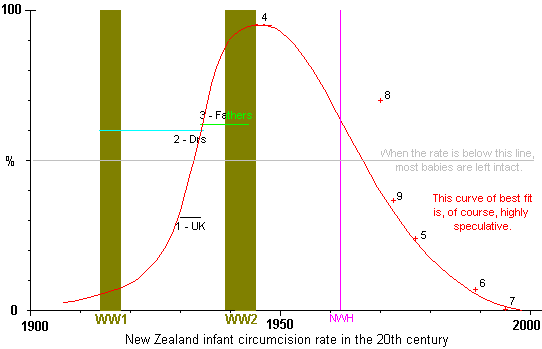
There is, I think, some evidence:
http://www.circumstitions.com/NZ.html
The Rise and Fall of Circumcision in New Zealand
Summary:
"We collected a bit of information in order to show that the doctors were responsible. The information we collected showed that it wasn't the doctors, but we wanted it to be the doctors, so we went ahead and said they were responsible anyway."
Linda
"The Fate of the Foreskin" would be a great name for a band.There is, I think, some evidence ...
six7s
veretic
- Joined
- Jun 17, 2007
- Messages
- 8,716
I'm confused... which is hardly surprising as I am decidedly unskilled at deciphering medical stuffSummary:
"We collected a bit of information in order to show that the doctors were responsible. The information we collected showed that it wasn't the doctors, but we wanted it to be the doctors, so we went ahead and said they were responsible anyway."
Linda
I'd appreciate a brief explanation of what you think (know?) the information they collected did show
Thanks