The search engine right now does not seems to be able to recover the old posts. But this is no problem, I can reproduce it all quite easilly and also use the opportunity to show why his answer does not touches any of the issues I raised. As always, I'll try to make it as simple as possible. However, the credits of the pictures are at the original posts and unfortunately I no longer have them.
First, lets start with some comparsions:
Here we have, at the upper part pics from real flexible feet. At the lowermost part, some well-known casts of alleged bigfeet footprints.
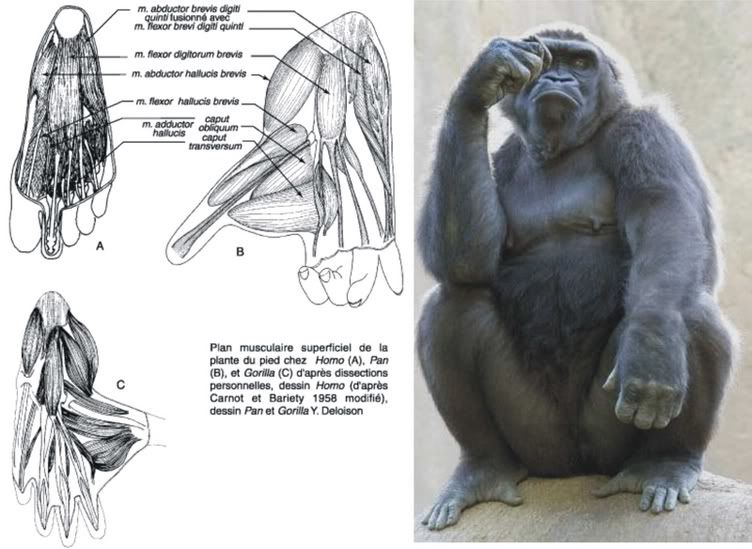
Here's a comparsion between feet of humans and great apes.
Note the completely different toe architecture and feet shapes. Flexible feet are associated with long, prehnsile and opposing toes. None of these features are seen at the alleged bigfoot footprints, that look like enlarged human feet.
Now lets make another comparsion. Here we have a comparsion between footprints of Homo, chimps and australopithecines. Note the footprints from chimps and australopithecines share similar features when it comes to toe shape and disposition, and that both are quite diferent from the ehxibited by humans and the alleged bigfoot footprints. Australopithecines were bipedals, but they did not ventured too far from trees, and still spent a lot of times at them, sleeping, foraging, resting, escaping from predators, etc. Thus, from an evolutionary point of view, it makes sense to have prehnsile feet. Not only helps climbing but its also an usefull to have an extra pair of hands in such an environment.
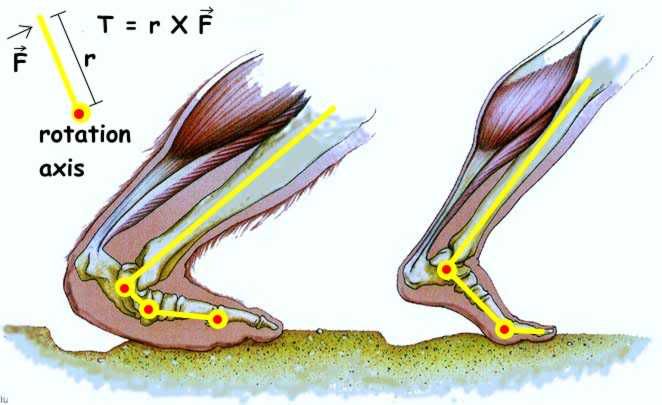
Homo, the only known fully bipedal (and large) primate that are not partially arboricolal do not have these flexible and prehnsile feet. Why? Because from an evolutionary perspective, it makes no sense to have such features. Such feet do not allow an efficient transmittion to the ground of the energy produced by the muscles. Its a conclusion driven by the lever and/or torque principles.
The extra joint of bigfoot's feet would render this "foot model" much more inneficient when it comes to energy transmittion to the ground. Imagine two simplified model, using the yellow lines from the diagram above as rods and the yellow circles with a red dot inside as hinges. Now put the human foot model over a table and move it. Repeat with the bigfoot's. The bigfoot's foot model has an extra hinge, its work is more complicated, less efficient, requires more energy to work and has an extra wear point.
Bottomline: for a large bipedal primate that no longer spends long periods over the trees, the "rigid" foot is more efficient. No wonder it was the solution "adopted" by Homo.
Now lets's check meldrum's answer.
Neto clearly has no concept of the calculation of the mechanical advantage of the triceps surae (calf musculature) as evidenced by his comments and attempt to diagram his point.Humans have departed from this pattern by adopting a fixed arch.
And this mechanical advantage would be?
Hard to see any advantage, since part of the energy produced by the calf musclue would not be efficiently transmitted to the ground due to the presence of an extra joint.
Humans departed from this pattern because humans evolved towards a bipedal locomotion and a lifestyle that no longer required spending long times at tree tops. Flexible feet no longer were needed and became a disavantage, thus the fixed arches at our feet.
The model of the sasquatch foot is a very natural extension of trends displayed in a size-graded sample of ape feet from gibbons to chimps to lowland gorillas to mountain gorillas, not only in relative elongation of the heel but in lessened divergence of the great toe.
All the mentioned known animals are adapted to lifestyles that spend long times over trees. And their feet are very different from what bigfoot's feet are supposed to be. The same is valid for their lifestyles.
The MT break has little to do with the loss of divegence of the big toe, until the fixation of the arch, at which point the aligned big toe becomes the distal support of the arch. There are a number of interacting modifications at play during the evolution of the modern human foot.
Mid-foot flexibility has to do with prehnsile feet, an adaptation for tree climbing. It makes no sense to have human-like toes and a articulated arch. Both are nice to have if you still make a lot of tree-climbing. But the flexible foot makes no sense when you no longer are a tree-hugger. Evolutionary pressures from a bipedal locomotion style shaped our feet - and should also have shaped those from bigfeet (assuming they are real). And since similar problems result in similar solutions...
And, at last but no least, non-flexible feet do generate impressions similar to those shown as evidence for mid tarsal feet. And since there are no evidence bigfeet are real...
It all boils down to mid tarsal breaks reasonings failing to provide backing to the claim bigfeet are real.