• Quick note - the problem with Youtube videos not embedding on the forum appears to have been fixed, thanks to ZiprHead. If you do still see problems let me know.

Cont: Electric Vehicles II

Seems like a lot of hassle when it's something that's much easier to do at home. Many people probably do it without realising they're doing anything more than just charging their car. It takes eight hours to do that charge on my car which only has a 51 kwh battery. It's an overnight job.

It's not that hard to run your car down below 10% at your convenience. I either wait till I come back low from a long trip (not paying for any more juice at my last public charge than I have to) or just don't charge the car in normal use until it's got there. (I remember once simply giving it a short charge one night so that it had just enough for the next day's drive, calculating that I'd be under 10% when I got home.) Then charge overnight in a single run. (This can take some fiddling if you're on Octopus Intelligent Go, but if you're restrictive enough about your "ready by" time you can make it happen.)

It's not that important. It doesn't do permanent damage to the battery if it's not done. It's just, if you don't do it, on your head be it if you suddenly find you don't have as many miles left as you thought you did.
 
Maybe then a better idea would be for the service to include asking the car when its battery last had a suitable calibration cycle, and recommend the owner do this if it's been a while.
 
Where is this recommendation from?


It's in my car's manual, and it's something that most manufacturers seem to recommend.

Basic battery maintenance.

NMC, operate on a day to day basis between 20% and 80%. The car will balance to some extent if it's set to stop charging at 80% on AC. Charge to 100% any time you need the range, but don't leave the car sitting at 100% for days or weeks on end. Once a month, charge to 100% (preferably just before you're in a position to drive it down below 80% fairly soon) and let it balance at 100% for as long as it wants.

LFP, do what the hell you like, it won't care. Charge up to 100% routinely, and let the car balance at 100% - the recommendation is to do this weekly, but it's going to depend a bit on usage.

Even if you don't follow these guidelines you probably won't do significant damage in the short to medium term. These batteries are proving a lot more resilient than even their designers believed, and modern EV batteries are expected to outlast the cars they're in. But the above is recommended day to day operation to minimise degradation.

Then for both chemistries, do the <10% to 100% and balance long charge at least every six months.

I read about people who recommend only running batteries in the middle of their range, even LFP, and never charging or discharging fully. Also never DC charging. Frankly life is way too short, and the actual magnitude of any benefit you'll get from that is highly questionable.

I rather like the "do what you like" part of running an LFP battery, but I don't think running an NMC between 20% and 80% on a day to day basis is particularly onerous. Beyond that, it's paranoia in my book. It's a car, drive it.
 
Maybe then a better idea would be for the service to include asking the car when its battery last had a suitable calibration cycle, and recommend the owner do this if it's been a while.


Like putting it in the manual isn't enough?

It's not the end of the world if it's not done. All that's going to happen is you get some strange range predictions, and one day, if you run the car a bit low, you might get an unpleasant surprise.

I think EV owners need to take some responsibility for educating themselves about EV care and maintenance. We all learn about the care and feeding of the ICE when we learn to drive, and pick it up as we go along. Car maintenance is quite a hobby with some people. EVs need much less maintenance, in fact they don't need servicing as such at all, but dealers insist that they get to do something (that you have to pay for) to keep the warranty valid, because that's been their business model for the past 100 years or so.

But it's different. There are things people should know about batteries and how they work and how they like to be treated. It's not rocket science, but you can't expect just to drive off in an EV and magically acquire a degree of knowlegde similar to what you acquired over decades driving an ICE, without making any effort at all. I meet people who don't even know whether their battery is NMC or LFP, which is only a couple of steps short of not knowing whether your ICE is petrol or diesel.
 
Last edited:
I don't know how it is with other manufacturers, but the MG dealers have a bit of a name for being unco-operative. I hate mine with a fiery passion, because they routinely pooh-pooh my concerns about sotfware bugs and the legendary undertray warp. Quite rude, "why do you want your undertray to be flat anyway?" even after I'd given them three reasons, and shown a photo of the fix MG had released in Australia. "They're all like that, it's flimsy plastic, it's pot luck whether your car has the warp, MG won't do anything, maybe if you write to them and offer to pay for the fix." Then the fix was released in this country and they had to do it, without so much as a "sorry".

The default is, "it's meant to be like that", even when it's an obvious bug. I handed them a list of nearly ten buggerations in the software a few months after getting my car and got the same thing. Why do you need a USB player that works? Some people don't mind if the external temperature display doesn't work, and so on. Then a software update was released which fixed all but one of the issues I had raised (and made a number of other improvements). I begged them almost with tears in my eyes to install this at the car's first service. When I went to collect the car it hadn't been done and I don't think anyone had even tried to do it. This was in April, and the update had been out since the previous October. What with one thing and another I didn't get the update until this month, nearly a year after it had been issued. All I got was patronising, supercilious excuses.

The car is massively better than before, it's the car it ought to have been. But I shouldn't have had to wait that long for the update to be installed. There are now only two bugs remaining that I know about, and maybe a bit of pressure on MG will fix these too.

But the point is that a lot of dealers (not all of them) know a lot less about the cars than the owners who have educated themselves do. Their business has been, and still is to a large extent, ICE cars, and education is patchy and ad-hoc. This will change as EVs become a larger slice of the market and people catch on. But at the moment, expecting a dealer to be pro-active in addressing EV-specific issues may be expecting a bit much.

I'm going to change dealers as soon as a small warranty repair to my charging port lights has been done in a few weeks. Fingers crossed the Galashiels outfit will have a better idea of what constitutes customer service than the Edinburgh lot.
 
My dad had an ambulance converted in to a camper that had an LPG conversion back in the 80s.
You started it on petrol then when the engine was warm flipped a switch that changed it over to LPG. You had to start on petrol to get everything warmed up or it would freeze the lpg valve on the carburettor.
There was only one LPG supply at a place in Redcar a 15 minute drive but it was worth the trip as it was so much cheaper than petrol.
There was some power loss so running on petrol was best for steep hills and it could be more problematic to get it to switch over in really cold freezing weather.
 
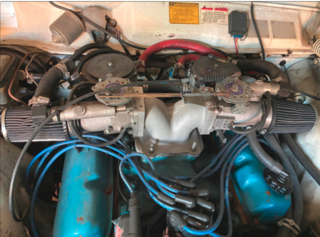
My sister still has a LPG powered 1978 XC Ford Falcon- but then its her 'weekend warrior' a modified 351 Cleveland v8 XC - with petrol running at over $2 a litre- it would keep even her broke if it wasn't a 'LPG only' setup...
It demands so much LPG, that even the biggest 'LPG carby' wasn't big enough- so its got TWO!!!!
:jaw-dropp
Screenshot-from-2024-09-07-21-36-32.png

Its plumbing is a nightmare- theres two of everything (fuel lines from the LPG tank, two of the 'LPG heater' thingos- each with its own water lines, two sets of cutoff safety solenoids...)

Had an old HZ Kingswood myself years ago that was a 'dual fueller' with the switch on the dash- it had no power on either lol- but then it was a VERY tired ex taxi that was showing its age by the time I got it- everything rattled and squeaked and was sloppy as... it was over 12 years old by the time I got it... and yeah, the 'hit the base of a steep hill and reach down and flick it to petrol' thing was very familiar to me as well lol
 
Last edited:
An LPG conversion would be a much more likely conversion for a petrol Land Rover than a night heater.

The former let you use a much lower taxed fuel and made economic sense in a large thirsty vehicle. The conversion would have to be disclosed for insurance of course but even if it wasn't the propane tank and extra fuel injection parts would be very obvious to investigators.

The latter generally use diesel fuel (so not suited to a petrol car) and tend to be fitted to long distance truck cabs. (Who sleeps in their Land Rover overnight?)


That's another thing I really like about electric cars. You can sleep in them overnight with the heater/aircon on without needing any modification to the car. Very comfortable.
 
That's another thing I really like about electric cars. You can sleep in them overnight with the heater/aircon on without needing any modification to the car. Very comfortable.

To be fair I had to sleep in a ICE overnight with the heater on once (it was a soft top convertible and we got caught in snow). Fortunately I'd filled up just before the traffic stopped otherwise we'd have been in real trouble. Made for a memorable wedding anniversary though.
 
Please don't stalk me, but I drive a '15 Honda Fit EX with a 6-speed manual transmission. However, in my heart of hearts, I'm driving a '70 Lola T-70 Mk III.
 
To be fair I had to sleep in a ICE overnight with the heater on once (it was a soft top convertible and we got caught in snow). Fortunately I'd filled up just before the traffic stopped otherwise we'd have been in real trouble. Made for a memorable wedding anniversary though.


Wow, that sounds like no fun. I suppose it's rare, but I have heard of people dying from carbon monoxide poisoning in that situation. (I once had to sleep in a four-seater ICE car with three other people, in summer with no heater on. It was unforgettably miserable, cold, and the windows were running with condensation by the morning.)

I'm not sure how long an ICE will idle for without running out of petrol. Round here it's illegal to do that, although pleading that you'd probably die of hypothermia if you didn't would probably get you off. EVs that aren't low in battery are probably good for three days. Certainly mine was taking about 15% of the battery in a 14-hour camping stop in reasonably mild weather, including using the electrical pump to inflate and deflate the airbag, and boiling a kettle a couple of times. Next time I'm going to take a small microwave as well. I actually stayed out two nights before going back to the charger, and was still on 20% when I got there. I think the car was only turned off for about six hours out of 42 hours and was driven about 75 miles in addition to powering the camp.

So next time you hear the tale about multiple EVs being stranded with empty batteries after a long wait in a traffic jam, you'll KNOW youre being lied to. (If you were already imprudently low on charge you could avoid using any more simply by switching the car off. However, most drivers would have plenty charge to wait in comfort for many hours.)
 
Wow, that sounds like no fun. I suppose it's rare, but I have heard of people dying from carbon monoxide poisoning in that situation. (I once had to sleep in a four-seater ICE car with three other people, in summer with no heater on. It was unforgettably miserable, cold, and the windows were running with condensation by the morning.)

I'm not sure how long an ICE will idle for without running out of petrol. Round here it's illegal to do that, although pleading that you'd probably die of hypothermia if you didn't would probably get you off. EVs that aren't low in battery are probably good for three days. Certainly mine was taking about 15% of the battery in a 14-hour camping stop in reasonably mild weather, including using the electrical pump to inflate and deflate the airbag, and boiling a kettle a couple of times. Next time I'm going to take a small microwave as well. I actually stayed out two nights before going back to the charger, and was still on 20% when I got there. I think the car was only turned off for about six hours out of 42 hours and was driven about 75 miles in addition to powering the camp.

So next time you hear the tale about multiple EVs being stranded with empty batteries after a long wait in a traffic jam, you'll KNOW youre being lied to. (If you were already imprudently low on charge you could avoid using any more simply by switching the car off. However, most drivers would have plenty charge to wait in comfort for many hours.)


If the exhaust has any leaks it could be problematic, otherwise CO2 shouldn't be a problem near the cabin air intake. Of course the very reason we needed so much heating was also the reason we were safe on that front! TBH it was enough years ago we didn't need to worry about getting a ticket! How long an ICE will idle is going to vary by model and (as with an EV) depend on when it was last topped up, but most cars will last a pretty good time at tick over, although obviously if not really needed sitting at idle is beyond irresponsible, but it really was literally potential life or death that night.
 
If the exhaust has any leaks it could be problematic, otherwise CO2 shouldn't be a problem near the cabin air intake. Of course the very reason we needed so much heating was also the reason we were safe on that front! TBH it was enough years ago we didn't need to worry about getting a ticket! How long an ICE will idle is going to vary by model and (as with an EV) depend on when it was last topped up, but most cars will last a pretty good time at tick over, although obviously if not really needed sitting at idle is beyond irresponsible, but it really was literally potential life or death that night.


I think the scenario I heard about involved snow blocking the exhaust. But don't quote me on that. Sorry, shouldn't derail. (I remember running the engine of a hire car for most of an afternoon in 1979, somewhere on the Brecon Beacons, waiting for a bunch of riders to get back, and I was more cross about having to use the petrol than worried about running out, but I'm not sure how much an overnight would have taken.)
 
I think the scenario I heard about involved snow blocking the exhaust. But don't quote me on that.

to be honest it sounds apocryphal/misremembered/misreported in my opinion, a blocked exhaust will stop an engine but won make exhaust gasses go backwards through the system, plus exhausts are pretty warm I don't see enough snow building up around them to make a seal (although I admit I could be wrong about that in some colder countries). I'd say leaks around the exhaust manifold allowing exhaust gasses to be drawn through the cabin air intake are a far more likely culprit.
 
to be honest it sounds apocryphal/misremembered/misreported in my opinion, a blocked exhaust will stop an engine but won make exhaust gasses go backwards through the system, plus exhausts are pretty warm I don't see enough snow building up around them to make a seal (although I admit I could be wrong about that in some colder countries). I'd say leaks around the exhaust manifold allowing exhaust gasses to be drawn through the cabin air intake are a far more likely culprit.


Could well have been apocryphal, it was just one of these "gee I heard this happened" conversations.
 
Last edited:
...

So next time you hear the tale about multiple EVs being stranded with empty batteries after a long wait in a traffic jam, you'll KNOW youre being lied to. (If you were already imprudently low on charge you could avoid using any more simply by switching the car off. However, most drivers would have plenty charge to wait in comfort for many hours.)

I was caught in a traffic jam for three hours (famous South Australian blackout, when tornadoes took out a major powerline causing the grid to shut down).

My car consumed zero power (or petrol) while we were sitting in traffic.

Unlike the many, many, ICE cars that ended up being pushed to the side of the road and abandoned until the following day.

It turns out, that at any given time, there are a percentage of drivers who are running very low on fuel. It's not a big deal, because they can just pull into the next petrol station and put some more in.

Unless there's a blackout, and none of the petrol stations can pump fuel and they've been moving a few feet at a time in stalled traffic for three hours...

(The blackout lasted 8 hours in a big chunk of the metropolitan area, and many days in the worst rural areas.)
 
Last edited by a moderator:
I was caught in a traffic jam for three hours (famous South Australian blackout, when tornadoes took out a major powerline causing the grid to shut down).

My car consumed zero power (or petrol) while we were sitting in traffic.

Unlike the many, many, ICE cars that ended up being pushed to the side of the road and abandoned until the following day.

It turns out, that at any given time, there are a percentage of drivers who are running very low on fuel. It's not a big deal, because they can just pull into the next petrol station and put some more in.

Unless there's a blackout, and none of the petrol stations can pump fuel and they've been moving a few feet at a time in stalled traffic for three hours...

(The blackout lasted 8 hours in a big chunk of the metropolitan area, and many days in the worst rural areas.)


Of course, to be fair, ICE cars don't use any fuel if you turn the engine off either, it's just that a lot of drivers don't think to switch them off (when hypothermia isn't in play obviously) when sitting in stalled traffic. I think the real message is don't play the 'I bet I can just make it to the next fueling/charging point' game..
 

Back
Top Bottom