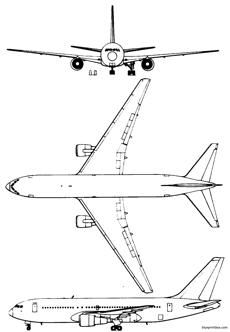
Your line drawing of a B767 is incorrect! Your line drawing shows a pronounced dihedral wing structure
that the Boeing 767-200 series does not have.
Your line drawing only fits in the WTC1 scar because of the dihedral.
The Boeing 767-200 is a "low wing" design-NOT dihedral
YOUR plane does not Fit the WTC1 scar.
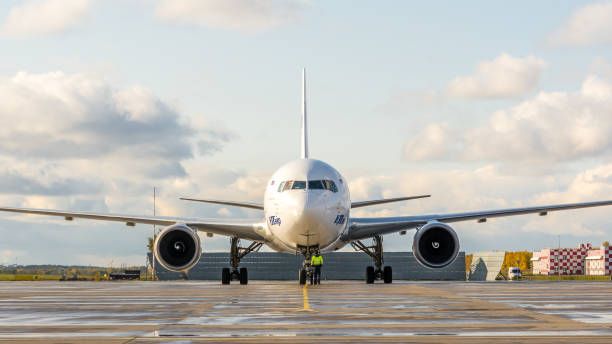
Dear, oh dear, oh dear! What a sad little misinformed twoofer you are. You really do lack observational skills of any kind (a typical trait for a twoofer). Your research skills are similarly lacking (another twoofer trait). Furthermore, your knowledge of Aeronautical Engineering is almost non existent, as indicated by the fact that you fail to understand the terms "low-wing" and "dihedral" are not mutually exclusive. In fact, almost ALL modern jet airliners (Boeing 7xx series, Airbus Axxx series), are both low-wing and have a dihedral wing design (and FYI most high-wing aircraft such as the Antonov An-124, 224, Boeing C-17, Lockheed C-5, C-141, Airbus A400M) have an anhedral wing design.
https://modernairliners.com/boeing-767/
A little knowledge is a dangerous thing... and you have very little knowledge. But just to add to
Beachnut's post, I am now going to tear your ignorant BS to shreds.
Your problem here is that you understand nothing about aerodynamics or flight dynamics. If you did, you would have realized that the specified dihedral angle is the upwards angle of the wing AT THE WING ROOT at the center of the wing spar... when the aircraft is STATIONARY ON THE GROUND. But as I am sure you will have failed to notice, the wings of an airliner droop downwards when its parked (and you can even see that in the head-on on photo you posted). However, because the wings of an airliner are flexible, the whole wing flexes upwards in flight because of the force imparted on it by lift. On a 767-200, the whole wing outboard of the engine visibly bends upwards as its speed increases, and the faster it flies, the more the upwards it bends. At 430 knots, which is the speed Flight 175 hit the south tower, the bending upwards of the wings causes the wingtip to be as much as nine feet "higher" than they are when on the ground and stationary - that is over 11% of the (single) wing length!!!. Additionally, Flight 175 was in a left bank at impact, and which causes the wings to bend even more due to the differential between G-forces on the fuselage and the wind resistance on the wingtips. I calculated as accurately as possible the effect of the speed and turn when I was drawing the diagram.
You can now consider yourself thoroughly debunked. If you want to continue to argue about aircraft with someone who has had a career in Aviation (and a degree in Aeronautical Engineering to go with it) then bring it on... I love dishing out botty-smackings to ignorant twoofers! You will, of course, be at somewhat of a disadvantage because your only source of information is
"Googleversity", whereas I still have all the manuals and text books I had during my training and career, and they contain information that will extremely difficult, if not impossible to find online.
As Jay Utah once said,
"You can Google for information, but you can't Google for experience"