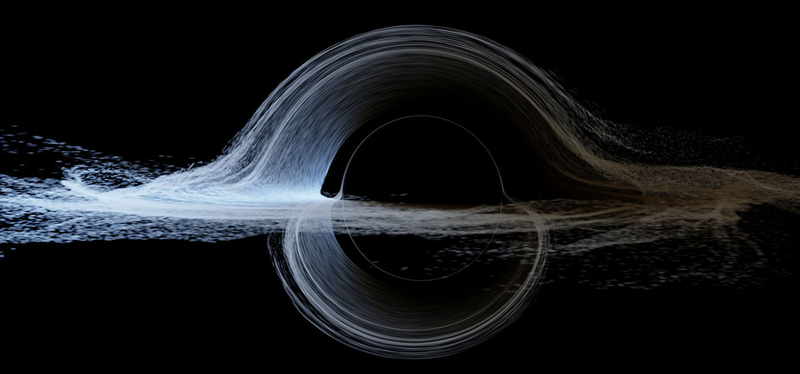
The question I was asking was merely: in the frame of an external observer at a safe distance, does a black hole ever finish forming, or does it get stuck at having most of its mass OUTSIDE the apparent event horizon? You already said it's the latter. And I thank you for that.
I'm not sure how to get this through, but when something is happening at a distance, it's actually a non-trivial problem to figure out when it's happening in your frame. Even in special relativity, which is massively simpler, there's a critical difference between what you see and what you observe. You can get a unique answer in special relativity, if you're in an inertial frame. But abandon that (which you have to for GR), and the answers are no longer unique.
First, here's a simple example to illustrate the difference between seeing and observing. I'm sure you've seen a jet plane fly overhead, and if it's low enough you can hear it. But it sounds like the noise is coming from behind the plane. The finite speed of sound means that by the time the noise reaches you, the plane is no longer where the sound was emitted from. So you
hear the noise coming from behind the plane. But if you know the speed of sound, the speed of the plane, and its distance away, you can figure out that the noise came from where the plane was. So you
observe the noise coming from the plane. That observation isn't simply what you hear, it's an idealized reconstruction of reality based on what you hear.
The same goes in special relativity. What you see is not what you observe. For example, length contraction: you observe that objects are contracted along the path of motion. But that's not actually what you see. You actually
see moving objects as
rotated. This is an optical effect, though, and an idealized measurement can account for that.
Now, when it comes to black holes, what you
see is the matter never falling in. But that
isn't what you observe. The hard part is that in order to change what you see into what you observe, you need to pick a coordinate system. And unlike special relativity, you cannot pick a coordinate system which is inertial everywhere. Strange, strange things happen in non-inertial coordinate systems(including the creation of event horizons, see below), many of which are artifacts of the coordinate system. So there's no one obvious choice, and depending on what you choose, you'll get a different answer. The Schwarzchild coordinate system make intuitive sense far from the black hole, so there's a big temptation to use it. And in that coordinate system, the object will never pass the event horizon. But in other coordinate systems, that's not the case. Since other coordinate systems handle the event horizon better (ie, they don't have coordinate singularities there), and since objects DO pass the event horizon in those coordinate systems, I would say it makes sense to use THOSE coordinate systems to observe (not see) that yes, the object really does pass the event horizon in finite time.
Basically all I was asking, in your door analogy, is: am I correct in my understanding that in MY frame the guy is never actually passing through the door? So all the information that guy contains, from MY point of view is still outside the door?
Your frame doesn't apply to him. That's a hard thing to wrap your head around, but you need to.
It might be helpful to consider what happens in the case of an
event horizon created by acceleration. If you accelerate continuously (doesn't matter the magnitude of the acceleration, so long as it's constant), then that creates an event horizon. There's some distance from your starting point beyond which light can never reach you. That event horizon will actually advance toward you at the speed of light, so plenty of stuff will cross that event horizon. But you will never see any of it cross the event horizon. You will see it red shift and fade out before reaching that point. If you ever stop accelerating, then you will be able to see all that stuff which passed through the event horizon, as you yourself pass through it. Similarly, if you drop through the event horizon of a black hole, you will see all that stuff that passed through before you. But staying outside is just like accelerating forever: there is much you cannot
see as a direct result. Don't confuse what you see with what actually happens.