• Quick note - the problem with Youtube videos not embedding on the forum appears to have been fixed, thanks to ZiprHead. If you do still see problems let me know.

So how DOES a black hole form?

But here's another stupid question: from the reference frame of an observer far away, does the event horizon even form, much less expand? It seems to me like adding more mass would just have it slow down too and never cross the event horizon of the mass already there. Again, from the POV of an external observer. As far as the rest of the universe "sees" it, the event horizon will only advance at +infinity time.
 
Last edited:
But here's another stupid question: from the reference frame of an observer far away, does the event horizon even form, much less expand?

It's not something you can directly see, you always have to infer its existence. But yes, the horizon that you infer will noticeably expand if you throw enough stuff in.

It seems to me like adding more mass would just have it slow down too and never cross the event horizon of the mass already there.

Sure, but 1) everything will look like it's getting infinitely compressed against this horizon, and 2) the horizon will still expand outward.

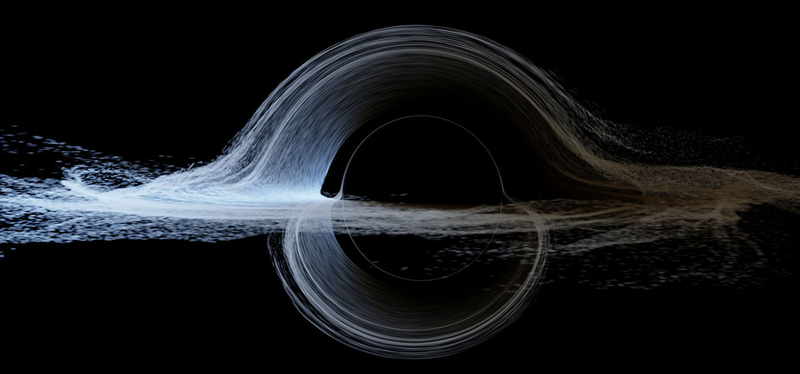
One of the problems with getting an intuitive grasp of this whole thing (even aside from the infinite redshift and fading) is that even the basic geometric optics of the situation are really, really messy. Normally when you think about how you determine the distance to something, you think about using stereoscopic vision and parallax. And parallax works great, in Euclidean space. But a black hole is decidedly non-euclidean. I mean, look at this:
jpgflniakhv6zwx6p6ik.png


That's a completely flat disk, that wrap-around effect is purely an optical effect. And that's just the accretion disk, which is farther out than the event horizon. If you get really close to the event horizon, the optical distortion gets even more extreme.
 
The horizon we INFER, the apparent horizon if you will, will expand indeed. But it seems to me like what you have is essentially a layer cake of matter hanging just OUTSIDE the apparent horizon of the matter before it. And adding more matter, will just add more layers to this cake, but at any distance from the centre you wish to go as a horizon, there is not enough matter INSIDE it for it to actually be the event horizon of a black hole.

Again, from the point of view of an external observer.

And yes, I know that:

A) that's just a gravity lensing effect. I've seen such images before.

and more importantly,

B) yeah, that you couldn't really tell from enough of a distance. It has the same gravity and lensing effect from far away, and once that matter is stuck in time and emitting like one photon every million years, yeah, you're not gonna be able to tell it's there.

What is important to me is just whether that matter is really inside or outside that horizon at this point in MY frame of reference, not whether there's some practical difference or application. I'm not proposing to actually do anything with that matter outside the apparent horizon, be it using it or detecting it or whatnot.

I'm really just trying to understand the theoretical physics part, not trying to spring some "ah-ha, then the universe is electric" nonsense. I fully realize that in practical terms, as far as the rest of the universe is concerned, that empty shell of matter outside the event horizon behaves exactly the same as a proper black hole would. It has the same gravity, same photon emissions, same everything.
 
But here's another stupid question: from the reference frame of an observer far away, does the event horizon even form, much less expand? It seems to me like adding more mass would just have it slow down too and never cross the event horizon of the mass already there. Again, from the POV of an external observer. As far as the rest of the universe "sees" it, the event horizon will only advance at +infinity time.

Only one way to find out, go and check :p

But seriously, If at any time, now or in the future, you can travel at c to some point in space and something exists, does that make it sufficiently real?
 
What is important to me is just whether that matter is really inside or outside that horizon at this point in MY frame of reference

There is no such thing as a global reference frame in general relativity. Your reference frame is only local. Coordinate systems can be global, but they are not unique.
 
From your reference frame you obviously can't see matter that's passed through the event horizon - you can't see anything beyond the event horizon.

All that's happened is that the photons leaving the falling matter take longer and longer to reach your eye the closer the matter approaches the horizon. The photons also get increasingly red shifted and further apart.

It's ridiculous really to say that falling matter appears frozen at the event horizon - it's more correct to say that it just disappears. It disappears in three ways: first the photon wavelengths are stretched out to hundreds of kilometres and you won't be able to build a radio telescope capable of receiving them; secondly, even if you could build such a telescope, you won't be able to resolve where the photons are coming from accurately enough to know that they are from the event horizon you're trying to observe; thirdly, the photons arrive less and less frequently. When you're only receiving a single, mile-long-wavelength, photon per month can you really claim you are still observing the matter?
 
From your reference frame you obviously can't see matter that's passed through the event horizon - you can't see anything beyond the event horizon.

All that's happened is that the photons leaving the falling matter take longer and longer to reach your eye the closer the matter approaches the horizon. The photons also get increasingly red shifted and further apart.

It's ridiculous really to say that falling matter appears frozen at the event horizon - it's more correct to say that it just disappears. It disappears in three ways: first the photon wavelengths are stretched out to hundreds of kilometres and you won't be able to build a radio telescope capable of receiving them; secondly, even if you could build such a telescope, you won't be able to resolve where the photons are coming from accurately enough to know that they are from the event horizon you're trying to observe; thirdly, the photons arrive less and less frequently. When you're only receiving a single, mile-long-wavelength, photon per month can you really claim you are still observing the matter?

He's not asking about observing or seeing. He's asking if any of the straight lines of constant time (now) in his penrose diagram (solid red lines) connect to matter beyond the event horizon, which afaik, they don't.

carter_penrose.png
 
He's not asking about observing or seeing. He's asking if any of the straight lines of constant time (now) in his penrose diagram (solid red lines) connect to matter beyond the event horizon, which afaik, they don't.

What do you mean, "constant time"? All that really means, in this case, is constant Schwarzchild metric time coordinate. That's close to our intuitive understanding at distances far from the black hole. But the Schwarzchild metric is a bad choice for crossing the event horizon. So the fact that lines derived from the Schwarzchild metric don't cross the event horizon doesn't actually tell us anything useful.
 
There is no such thing as a global reference frame in general relativity. Your reference frame is only local. Coordinate systems can be global, but they are not unique.

That I know too. Which is why I started qualifying it as the frame of reference of myself, rather than say, something silly like the frame of reference of the universe or such.

But infinity is kinda the same for everyone, I would assume? Time may pass twice as fast in one place than another, or a thousand times faster if you're on that planet in Interstellar, but in none of those reference frames is the matter going to finish falling into a black hole, innit? A hare (or for that matter a racing car) isn't going to reach infinity any faster than a tortoise.
 
Last edited:
That I know too. Which is why I started qualifying it as the frame of reference of myself, rather than say, something silly like the frame of reference of the universe or such.

But since your reference frame is only local, what do you even mean by asking when something happens somewhere else? That somewhere else isn't in your reference frame. It's got its own reference frame. And there's no universal way to tie those two different reference frames together.

But infinity is kinda the same for everyone, I would assume?

Nope. The infinite time to reach the event horizon is a coordinate singularity, not a real singularity.

Time may pass twice as fast in one place than another, or a thousand times faster if you're on that planet in Interstellar, but in none of those reference frames is the matter going to finish falling into a black hole, innit?

Well, no. First off, the standard treatment of time moving slower in a higher gravitational field applies when you're stationary in a gravitational field, and you compare two such frames to each other by bouncing light back and forth to establish the time comparison.

But you can't do that with an object falling into a black hole. It's not stationary. You can't bounce light back and forth to establish a comparison, because there isn't a symmetry between light going in and light coming back out. So it doesn't actually make sense to say that time slows down infinitely for the infalling body. Because to that body, time DOESN'T slow down infinitely. And looking back at you as it falls in, you are not infinitely blue-shifted. From that body's perspective, it will fall in in finite time, whether it measures that time by its own clock or by watching light from your outside clock.
 
I ALREADY said in message #1, and this is a copy and paste quote, "So let's say some chunk of matter swirls down the drain... err, accretion disk, and falls down into the black hole. From its point of view, of course, that happens in a finite time."

So, err, not only I know that already, but I SAID that already? I'm not sure why people think I'm trying to tie the two frames together or whatever. I KNOW that the time dilation is not applying to both the observer and the observed piece of matter. I mean, nobody would see any dilation if the time of the two frames were the same, amirite?

To repeat mmyself, my curiosity was just whether "the rest of the universe" has actually "seen" a black hole form, since people talk about them and their effects as if they're already there, from the POV of the object they influence. And before that becomes another confusion point, by "the rest of the universe" I don't mean a single frame of reference for all of it, but basically the set of local (and yes, different) frames of reference of the stars and planets and whatnot that would notice its gravity, but that are at a reasonably safe distance and would not join that accretion disk any time soon.

And is not the reference frame a photon, I guess, since going at c does funny things even to infinity :p

If you want me to be going anywhere with it -- though I dunno where that expectation came from either -- well, black holes essentially delete information. But it seems to me that from the point of view of that "rest of the universe" (again, NOT implying a single reference frame), the information didn't really go anywhere... yet. It will at +infinity time. It may not really be easily accessible any more, on account of red shift and time dilation, but it's still outside an event horizon.

That's essentially one of the things I'm trying to wrap my head around.
 
Last edited:
Didn't we on earth recently observe, by gravitational waves, the coalescing of two black holes into one? Presumably we could observe by the same method the coalescing of two neutron stars to form a new black hole? I suppose if they were near enough to observe visually, we'd see the two neutron stars disappear (I assume with some fireworks) at the same moment our gravity wave detector 'sees' the event.
 
So, err, not only I know that already, but I SAID that already? I'm not sure why people think I'm trying to tie the two frames together or whatever.

You have to tie two frames together in order to ask your question. That's the point. If you don't, then it's not possible to answer.

I KNOW that the time dilation is not applying to both the observer and the observed piece of matter. I mean, nobody would see any dilation if the time of the two frames were the same, amirite?

And I'm trying to tell you, gravitational time dilation doesn't even work in this scenario. It requires being able to do a comparison back and forth between the two frames that isn't possible.

To repeat mmyself, my curiosity was just whether "the rest of the universe" has actually "seen" a black hole form

No. But they can observe one form. There's a difference.

If you want me to be going anywhere with it -- though I dunno where that expectation came from either -- well, black holes essentially delete information. But it seems to me that from the point of view of that "rest of the universe" (again, NOT implying a single reference frame), the information didn't really go anywhere... yet.

That answer doesn't suffice.

Consider an object passing through a door that closes behind it. The object emits light that an external observer can see, until the door closes. Is all the information contained within the object transmitted to the external observer? No, of course not. The object contains far more information than it radiates.

An object that falls into a black hole isn't any different. It will not radiate away all its information on its way through the event horizon. The fact that the bit of information it DOES radiate will be stretched out over infinite time doesn't change the fact that it's still only a fraction of its information.
 
I never said that the radiated photons are all the information, or even the information. I think you assume me to be smarter or more educated than I am, or asking a grander question. I'm just asking something a lot more simple -- well, I assume simple for you, not so simple for me obviously -- purely for my education, and which you have already answered.

The question I was asking was merely: in the frame of an external observer at a safe distance, does a black hole ever finish forming, or does it get stuck at having most of its mass OUTSIDE the apparent event horizon? You already said it's the latter. And I thank you for that.

Basically all I was asking, in your door analogy, is: am I correct in my understanding that in MY frame the guy is never actually passing through the door? So all the information that guy contains, from MY point of view is still outside the door?

It may be old knowledge and not very interesting or informative to you, so you may or may not assume that I'm going somewhere more interesting with it. But it is new and interesting to me. I'm not asking anything grander than that, really. I'm just trying to learn the basics, and asking here is cheaper than going back to college :p
 
Regarding the neutron star, if I understand correctly, even the part of the neutron star that is initially at a distance less than 2MG from the center of the star at the time the collapse begins will also be spread out over the surface of the event horizon from the perspective of a distant observer.

On the other hand, take someone who falls into the black hole. While someone on the outside will see them smeared out over the horizon, the person who falls in could see someone else on the outside after they have already fallen in; that person could then jump in and meet them. Which suggests that it can't have taken an infinite amount of (external) time for the person on the inside to pass through the horizon. Because when they meet he can say "I saw you start to jump in after I had already passed through the horizon, and I can't see into the future, so I must have fallen through before you started to jump in."

Which basically just comes down to GR is weird. Depending on your perspective you can say that the black hole has not yet formed. You can also say it has. The issue is how we define the present. IE Ziggurat's point about a coordinate singularity. On the other hand from a particular perspective Hans is correct, it's just that this perspective is more limited than "my frame" seems to imply.

By the ways, Hans, this lecture by Leonard Susskind goes into pretty much exactly the issues that you're asking about, you'll probably find it very interesting:
https://www.youtube.com/watch?v=EJrgKI8aXgQ
 
It's a bit like Zeno's paradoxes except that relativity does the job of looking at smaller and smaller time intervals so that the external observer doesn't have to.

So the external observer can say that the falling matter never reaches the event horizon in just the same way that Zeno said that it was impossible for Achilles to ever overtake the tortoise.
 
The question I was asking was merely: in the frame of an external observer at a safe distance, does a black hole ever finish forming, or does it get stuck at having most of its mass OUTSIDE the apparent event horizon? You already said it's the latter. And I thank you for that.

I'm not sure how to get this through, but when something is happening at a distance, it's actually a non-trivial problem to figure out when it's happening in your frame. Even in special relativity, which is massively simpler, there's a critical difference between what you see and what you observe. You can get a unique answer in special relativity, if you're in an inertial frame. But abandon that (which you have to for GR), and the answers are no longer unique.

First, here's a simple example to illustrate the difference between seeing and observing. I'm sure you've seen a jet plane fly overhead, and if it's low enough you can hear it. But it sounds like the noise is coming from behind the plane. The finite speed of sound means that by the time the noise reaches you, the plane is no longer where the sound was emitted from. So you hear the noise coming from behind the plane. But if you know the speed of sound, the speed of the plane, and its distance away, you can figure out that the noise came from where the plane was. So you observe the noise coming from the plane. That observation isn't simply what you hear, it's an idealized reconstruction of reality based on what you hear.

The same goes in special relativity. What you see is not what you observe. For example, length contraction: you observe that objects are contracted along the path of motion. But that's not actually what you see. You actually see moving objects as rotated. This is an optical effect, though, and an idealized measurement can account for that.

Now, when it comes to black holes, what you see is the matter never falling in. But that isn't what you observe. The hard part is that in order to change what you see into what you observe, you need to pick a coordinate system. And unlike special relativity, you cannot pick a coordinate system which is inertial everywhere. Strange, strange things happen in non-inertial coordinate systems(including the creation of event horizons, see below), many of which are artifacts of the coordinate system. So there's no one obvious choice, and depending on what you choose, you'll get a different answer. The Schwarzchild coordinate system make intuitive sense far from the black hole, so there's a big temptation to use it. And in that coordinate system, the object will never pass the event horizon. But in other coordinate systems, that's not the case. Since other coordinate systems handle the event horizon better (ie, they don't have coordinate singularities there), and since objects DO pass the event horizon in those coordinate systems, I would say it makes sense to use THOSE coordinate systems to observe (not see) that yes, the object really does pass the event horizon in finite time.

Basically all I was asking, in your door analogy, is: am I correct in my understanding that in MY frame the guy is never actually passing through the door? So all the information that guy contains, from MY point of view is still outside the door?

Your frame doesn't apply to him. That's a hard thing to wrap your head around, but you need to.

It might be helpful to consider what happens in the case of an event horizon created by acceleration. If you accelerate continuously (doesn't matter the magnitude of the acceleration, so long as it's constant), then that creates an event horizon. There's some distance from your starting point beyond which light can never reach you. That event horizon will actually advance toward you at the speed of light, so plenty of stuff will cross that event horizon. But you will never see any of it cross the event horizon. You will see it red shift and fade out before reaching that point. If you ever stop accelerating, then you will be able to see all that stuff which passed through the event horizon, as you yourself pass through it. Similarly, if you drop through the event horizon of a black hole, you will see all that stuff that passed through before you. But staying outside is just like accelerating forever: there is much you cannot see as a direct result. Don't confuse what you see with what actually happens.

 
Well, "see" is probably the wrong word on my part. Call it "observe" if that has a better meaning. I just really mean what happens in my own frame of reference.

I actually like your length contraction example, because, yeah, that's what I'm interested in.

Not entirely sure what you mean by "Your frame doesn't apply to him." Please explain.

I mean, I can dig that x, y, z and t are different in his frame. But I would ASSUME that in my own x, y, z and t, I can put a dot on the graph for where the guy is from my perspective. At least as long as in THAT perspective the guy isn't already past the door.

Also not sure what you mean about those other coordinates, since well, I never went to a physics college, so I'm clueless there. You may need to explain those too. But, unless I got the whole idea of physics wrong, there must be SOME coordinate transform back to x, y, z and time. So it may be easier to calculate stuff using different coordinates, but eventually you must make a prediction like "it's gonna happen over there at that time".

Like, dunno, when they showed gravity lensing correct in 1919. You have to go back to x, y, z and t, and say something like "that star should have been over there, but it was over here."

So when I do that transform back to the x, y, z and t of where I stand (say, I'm standing at Greewich, z is upwards, x and y are the tangets along latitude and longitude, and time is GMT), will matter have crossed the event horizon in a finite time in that frame?
 
Last edited:
Not entirely sure what you mean by "Your frame doesn't apply to him." Please explain.

I mean that the idea of simultaneity doesn't really work here. You can create coordinate systems which apply a time coordinate to everything, and you could ask when two events have the same time coordinate. But you can't simply call events simultaneous if they have the same time coordinate, because when you aren't inertial (and you can't be here) there is no unique answer.

In some cases, you can establish simultaneity by bouncing light back and forth to coordinate clocks. That works for comparing two clocks that are stationary in a gravitational field. They can watch each other's clocks and agree that the higher potential clock is running faster than the lower potential clock, and by how much. But it doesn't work for this problem. The light can't bounce back and forth for the period we're most interested in. And even for the period where they can both see each other, they will not both agree on what's happening to each other's clocks.

tl;dr: there is no unique way to define what counts as simultaneous in this scenario, and so no unique answer as to what is happening in the black hole simultaneous to your present outside the black hole.

I mean, I can dig that x, y, z and t are different in his frame. But I would ASSUME that in my own x, y, z and t, I can put a dot on the graph for where the guy is from my perspective. At least as long as in THAT perspective the guy isn't already past the door.

Sure. But your x, y, z and t don't extend beyond your local environment in a unique way. So the answer depends on your choice of how to extend those coordinates.

Also not sure what you mean about those other coordinates, since well, I never went to a physics college, so I'm clueless there. You may need to explain those too. But, unless I got the whole idea of physics wrong, there must be SOME coordinate transform back to x, y, z and time. So it may be easier to calculate stuff using different coordinates, but eventually you must make a prediction like "it's gonna happen over there at that time".

OK, this is going to take some more explaining. I'll have to put it off till later, but things are going to get weird. Really, really weird.
 

Back
Top Bottom